
• KGS/USD = 0.01144 0%
  • KZT/USD = 0.00205 0%
  • TJS/USD = 0.10722 0%
  • UZS/USD = 0.00008 0%
  • TMT/USD = 0.28490 0%
  • KGS/USD = 0.01144 0%
  • KZT/USD = 0.00205 0%
  • TJS/USD = 0.10722 0%
  • UZS/USD = 0.00008 0%
  • TMT/USD = 0.28490 0%
  • KGS/USD = 0.01144 0%
  • KZT/USD = 0.00205 0%
  • TJS/USD = 0.10722 0%
  • UZS/USD = 0.00008 0%
  • TMT/USD = 0.28490 0%
  • KGS/USD = 0.01144 0%
  • KZT/USD = 0.00205 0%
  • TJS/USD = 0.10722 0%
  • UZS/USD = 0.00008 0%
  • TMT/USD = 0.28490 0%
  • KGS/USD = 0.01144 0%
  • KZT/USD = 0.00205 0%
  • TJS/USD = 0.10722 0%
  • UZS/USD = 0.00008 0%
  • TMT/USD = 0.28490 0%
  • KGS/USD = 0.01144 0%
  • KZT/USD = 0.00205 0%
  • TJS/USD = 0.10722 0%
  • UZS/USD = 0.00008 0%
  • TMT/USD = 0.28490 0%
  • KGS/USD = 0.01144 0%
  • KZT/USD = 0.00205 0%
  • TJS/USD = 0.10722 0%
  • UZS/USD = 0.00008 0%
  • TMT/USD = 0.28490 0%
  • KGS/USD = 0.01144 0%
  • KZT/USD = 0.00205 0%
  • TJS/USD = 0.10722 0%
  • UZS/USD = 0.00008 0%
  • TMT/USD = 0.28490 0%

Viewing results 1 - 6 of 74

Kyrgyz Startup Yessa Helping Women to Reclaim Pleasure

When Begaiym Zamirbek left her job at the Institute for War & Peace Reporting (IWPR), where everything was stable and predictable, she dove into the significantly riskier world of startups with her new venture, Yessa. That’s how her path of entrepreneurship began, which led her to Vietnam. Yessa supplies audio erotic entertainment for women, like companies including Quinn and Femtasy. Both boast a vast audience and have raised over $3 Million in investments. Quinn is based in the U.S., and its European counterpart, Femtasy, operates out of Berlin. Neither are available in languages other than English, French, and Deutsch, however. But Yessa is trying to fix that by making audio erotica for women available in other languages. My previous partner “did things in bed that I agreed to unconditionally. I didn't even know I had a choice,” Zamirbek told TCA. “I came out of that relationship traumatized and didn't realize, but after the breakup, any thought of sex made me feel disgusted. I accidentally came across an audio where the men were caring, tender and asked for my consent for literally everything. I thought that if such audios exist, then there must be such partners in reality. And I was not mistaken. I regretted that all such content was in English, and then I thought that Russian-speaking women also need such things.”Apart from her full-time job at IWPR, Zamirbek is a seasoned podcast host. Her podcast, Second Shift, which she has been co-hosting for five years, was the first feminist podcast in Kyrgyzstan and quickly became one of the most popular ones. That experience set her on the path toward the launch of her audio company. During the COVID-19 pandemic, Zamirbek spent a lot of time at home listening to erotica in English, which piqued her interest in exploring her desires and going on dates. In 2024, inspired by TikTok, where more and more women were openly discussing the intimate details of their relationships, she began implementing her startup idea. After seeking advice from a venture capital professional and completing the Y Combinator’s Startup School, Zamirbek started looking for a tech co-founder. “We met at the March 8 march for women's rights in Bishkek. Anna Karamurzina came up to say ‘hello’ because she knew of me. She had worked in IT for over twelve years, and I came to her with an offer to build a startup just when she needed a job. Since August 2024, we’ve been the co-founders of the Yessa app.” The ex-IWPR Program Manager for Central Asia began her journey in the startup ecosystem by participating in the Startup Nation hackathon as the Co-Founder of Yessa in September 2024, where she was awarded a special prize as the strongest startups chosen from over 40 teams. Zamirbek soon realized that she needed resources and expertise to scale Yessa and followed the path of one of the Kyrgyz founders of Antler, one of the leading global accelerators backing early-stage companies with offices worldwide. With the help of several...

Turkmenistan Develops Innovative Grapevine-Based Products

The International Science and Technology Park of the Academy of Sciences of Turkmenistan is conducting groundbreaking research on the use of local grape varieties in biotechnology, focusing on waste-free production. The biotechnology laboratory is studying grape varieties such as "Garauzyum," "Gelinbarmak," "Terbash," "Khalili," and "Dagtokga," analyzing the properties of grapes, including their leaves, seeds, and vines, to develop innovative technologies. Altyn Rakhmanova, head of the laboratory, highlighted the versatility of grapes, noting their significance beyond traditional wine-making. She emphasized their potential to produce biologically active substances, compound feed, and environmentally friendly fuel. “Our research is aimed at identifying the potential of this crop for use in various industries,” Rakhmanova explained. The laboratory has already developed several grapevine-based products, including the antioxidant resveratrol, animal feed, and fuel briquettes. These briquettes, made from grapevine combined with other wood-based materials, are particularly noteworthy for their environmental benefits. When burned, they emit no toxic resins, making them suitable for both domestic and industrial use. This innovative approach not only reduces waste but also diversifies the product range. The project’s uniqueness lies in its combination of environmental sustainability and broad applications. In addition to product development, the biotechnology laboratory is exploring opportunities for international collaboration. Scientists believe that partnerships with foreign companies and research organizations will facilitate the exchange of knowledge and foster the creation of advanced environmentally friendly technologies.

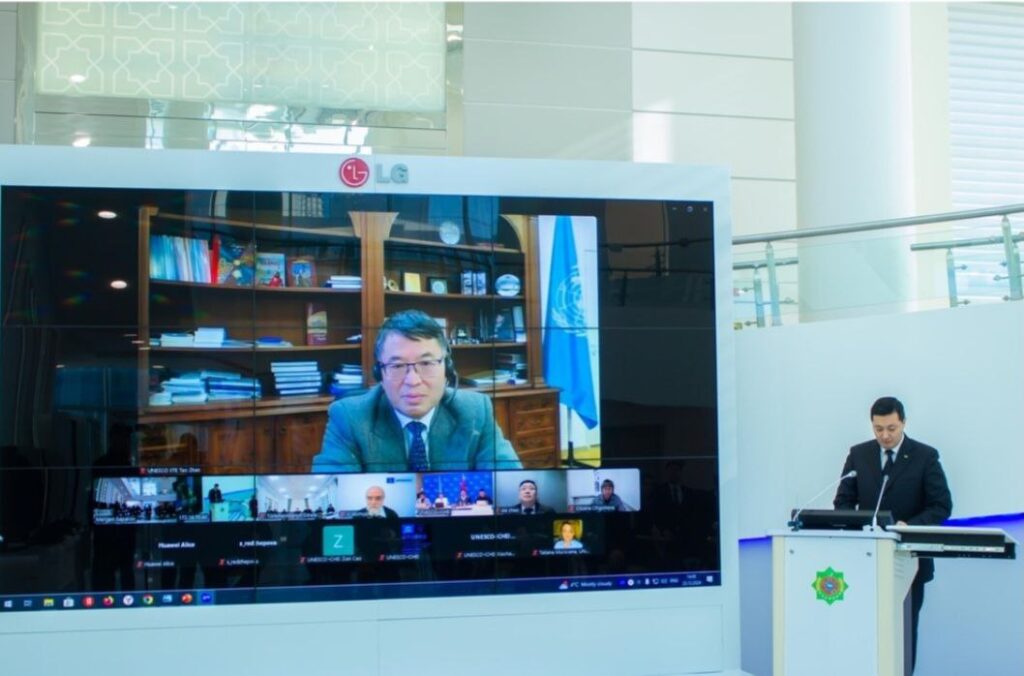
Turkmenistan Explores Integration of Artificial Intelligence in Education

Turkmenistan has taken a significant step toward integrating artificial intelligence (AI) into its education system by hosting a scientific and practical conference. Organized by the Ministry of Education in collaboration with the UNESCO Institute for Information Technologies in Education, the event marked progress in implementing the goals outlined in the “Roadmap of Cooperation for 2024-2025.” Key Discussions The conference explored critical aspects of applying AI in education. Topics included the development of education management information systems, improving teachers’ digital literacy, and adapting cutting-edge technologies to Turkmenistan’s specific conditions. Participants also presented a draft strategy for the development of AI in education and highlighted international platforms already in use in this field. Special emphasis was placed on the competencies required for both teachers and students to effectively work with AI. Experts noted that fostering such skills is essential in an increasingly digitalized society and workplace. They stressed that equipping young people with AI-related knowledge could significantly enhance their future professional prospects. Practical Implementation and Examples Turkmenistan is already incorporating AI into educational initiatives. A notable example was presented on October 4 in Ashgabat, where Selin Ataeva, a 12th-grade student at the Swiss School of Dubai and leader of a startup development team, showcased an AI-driven math learning platform. This innovative software adopts a personalized approach to education, catering particularly to students in rural and remote regions. By optimizing the learning process and improving access to quality education, the platform exemplifies the transformative potential of AI in bridging educational gaps. As Turkmenistan advances toward integrating AI into its education system, the conference highlighted the importance of aligning technology with local needs and preparing students and teachers for a digitally driven future. With initiatives like Ataeva’s math learning platform, the country demonstrates a commitment to using AI to enhance education accessibility and efficiency.

Kazakhstan’s Greenhouse Bananas: A Southern Success Story

A pioneering greenhouse in Kazakhstan's Turkestan region has begun producing 1,000 tons of bananas annually, marking a significant milestone in the country's agricultural diversification efforts. The project, led by GenGroupKazakhstan, combines innovative technology and tropical crop expertise to make banana cultivation viable in the region. GenGroupKazakhstan, known for its modern greenhouse construction, launched its first banana greenhouse on a five-hectare plot in June 2023. Drawing on techniques used in Turkey, the company harvested its first crop in May 2024. Building on this success, the company plans to expand its operations significantly. A new greenhouse complex spanning six hectares will focus on producing 3,000 tons of tomatoes and 130 tons of strawberries annually. Construction of the facility is expected to be completed by the end of 2025. In addition, GenGroupKazakhstan aims to cultivate mangoes, avocados, and blueberries across 10 hectares of open ground, further diversifying its portfolio of high-value crops. Vice Minister of Agriculture Azat Sultanov noted that growing bananas in Kazakhstan, while potentially profitable, presents unique challenges. Unlike tropical countries like Ecuador or Brazil, where bananas grow naturally with minimal input costs, Kazakhstan’s climate necessitates substantial investments in greenhouses, electricity, heating, fertilizers, and plant protection products. These requirements make banana production here a more resource-intensive endeavor.

Robots May Replace Bailiffs in Kazakhstan

Kazakhstan is implementing a pilot project, “Robot”, which will conduct enforcement proceedings without human involvement. The creators of the project have commented: "In January, the city of Taraz launched a pilot project, ‘Robot’, which automatically starts enforcement proceedings without the participation of a bailiff. This will free citizens from paying commissions and save about 2 billion tenge ($4.2 million). In August the project is planned to be scaled nationwide.” The registration of non-profit organizations is now fully automated and available on the “Electronic Government” portal. This initiative will save the time and costs that legal entities spend on visits to the Central Office of Public Organizations. The procedure for changing the head of a legal entity has been simplified, and is now possible through the portal “eGov”. The Kazakh Ministry of Justice has also launched a project for issuing online powers of attorney through the "eGovMobile Business" portal. This service will significantly speed up and simplify the way that managers issue powers of attorney. Previously, powers of attorney were only issued on paper, which made it difficult to verify their legitimacy.

Uzbekistan to Establish International Financial and Technology Center

On June 13, Tashkent hosted the inaugural meeting of the Working Groups on the development of Uzbekistan’s capital market and creation of the International Financial and Technology Center. The event which also addressed the development of the Law on Alternative Investments, was organized within the framework of the Foreign Investors Council under the President of Uzbekistan. Representatives of international financial organizations and Uzbekistan’s business community joined heads of Uzbek ministries and foreign investors in discussions on the establishment of an International Financial and Technology Center, with an emphasis on attracting financial technology companies to Uzbekistan. The Uzbek Ministry of Investment, Industry and Trade reported that the agenda also included the development of a law governing the Center's operations as well as the creation of a strategy to promote opportunities offered by the center to entice foreign investment in Uzbekistan. According to experts, the launch of the Center will ensure long-term sustainable investment growth, increase the country’s GDP by 1% annually, and attract portfolio investments amounting to $7-$8 billion by 2028. It is also expected to create 15-20 thousand new highly skilled jobs over the next ten years. The meeting also reviewed draft amendments to the Law of the Republic of Uzbekistan "On Joint Stock Companies and Protection of Investors' Rights" and the concept of the law "On the International Financial and Technology Center".