
• KGS/USD = 0.01144 0%
  • KZT/USD = 0.00206 0%
  • TJS/USD = 0.10415 -0.19%
  • UZS/USD = 0.00008 0%
  • TMT/USD = 0.28571 0%
  • KGS/USD = 0.01144 0%
  • KZT/USD = 0.00206 0%
  • TJS/USD = 0.10415 -0.19%
  • UZS/USD = 0.00008 0%
  • TMT/USD = 0.28571 0%
  • KGS/USD = 0.01144 0%
  • KZT/USD = 0.00206 0%
  • TJS/USD = 0.10415 -0.19%
  • UZS/USD = 0.00008 0%
  • TMT/USD = 0.28571 0%
  • KGS/USD = 0.01144 0%
  • KZT/USD = 0.00206 0%
  • TJS/USD = 0.10415 -0.19%
  • UZS/USD = 0.00008 0%
  • TMT/USD = 0.28571 0%
  • KGS/USD = 0.01144 0%
  • KZT/USD = 0.00206 0%
  • TJS/USD = 0.10415 -0.19%
  • UZS/USD = 0.00008 0%
  • TMT/USD = 0.28571 0%
  • KGS/USD = 0.01144 0%
  • KZT/USD = 0.00206 0%
  • TJS/USD = 0.10415 -0.19%
  • UZS/USD = 0.00008 0%
  • TMT/USD = 0.28571 0%
  • KGS/USD = 0.01144 0%
  • KZT/USD = 0.00206 0%
  • TJS/USD = 0.10415 -0.19%
  • UZS/USD = 0.00008 0%
  • TMT/USD = 0.28571 0%
  • KGS/USD = 0.01144 0%
  • KZT/USD = 0.00206 0%
  • TJS/USD = 0.10415 -0.19%
  • UZS/USD = 0.00008 0%
  • TMT/USD = 0.28571 0%

Viewing results 1 - 6 of 649

Kyrgyzstan Expands Trade Access to Afghan Market

Kyrgyzstan and Afghanistan have taken a significant step toward deepening economic ties with the opening of the Trade House of the Kyrgyz Republic in Kabul on December 16. The launch ceremony was attended by Kyrgyz Minister of Economy and Commerce Bakyt Sydykov and Afghan Minister of Industry and Commerce Nooruddin Azizi. According to the Kyrgyz Ministry of Economy and Commerce, the new Trade House is intended to serve as a platform for promoting Kyrgyz exports, facilitating direct business connections between entrepreneurs from both countries, and expanding bilateral trade. The Kyrgyz delegation also participated in a Kyrgyz-Afghan business conference on December 17 in Kabul, organized by the Afghanistan Chamber of Commerce and Investment. Speaking at the event, Azizi announced Afghanistan’s intention to open its own Trade House in Bishkek, describing Afghanistan and Kyrgyzstan as “interconnected countries” with complementary positions in regional trade. He characterized Kyrgyzstan as a gateway to Central Asia and the Eurasian Economic Union, and Afghanistan as a strategic hub linking South and West Asia. The conference concluded with the signing of commercial contracts worth $157 million between Kyrgyz and Afghan companies. Bilateral trade has gained momentum since Kyrgyzstan removed the Taliban from its list of prohibited organizations in September 2024. At the time, the Kyrgyz Ministry of Foreign Affairs stated that the decision was intended to support regional stability and constructive dialogue. According to Afghanistan’s Ministry of Industry and Commerce, bilateral trade reached $66 million in the most recent solar year (March 2024-March 2025), with Afghan exports totaling $7 million. Key Afghan exports to Kyrgyzstan include aluminum and copper utensils, pressure cookers, carpets, fruits, and vegetables. Kyrgyzstan is a significant supplier of petroleum products to the Afghan market. In a further move to strengthen its regional trade presence, Kyrgyzstan secured a pavilion at the Termez International Trade Center in November 2024. Located in Termez, Uzbekistan, near the Afghan border, the Center serves as a key node in regional trade routes, particularly between Uzbekistan and Afghanistan. The Kyrgyz pavilion offers a strategic foothold to further expand access to the Afghan market.

Uzbekistan and Taliban Sign Trade Deals as Coal Shipments Pivot from Pakistan

Afghanistan International has reported that the Taliban administration in Afghanistan’s Balkh province has signed new trade agreements with Uzbekistan, signaling a shift in Kabul’s commercial strategy amid growing tensions with Pakistan. According to Haji Zaid, spokesperson for the Taliban-appointed governor in Balkh, Afghan coal will now be exported to Uzbekistan under the newly signed agreements, replacing previous shipments to Pakistan. In exchange, Uzbekistan will export cement and pharmaceuticals to Afghanistan. Zaid stated that the Taliban, in response to border closures and disrupted trade with Pakistan, is seeking to strengthen economic ties with neighboring countries, particularly Uzbekistan and Iran. Persian-language media also reported that Taliban officials are increasingly urging Afghan traders to seek alternative commercial and transit routes. The Taliban’s Ministry of Finance has claimed that the deterioration of trade with Pakistan has had “no negative impact” on Afghanistan’s overall trade volume, asserting that customs revenues have remained stable. The ministry added that it would fully support traders using new trade corridors. However, Afghan economic experts have challenged the Taliban’s claims. Economist Reza Farzam told local media that assertions about Pakistan’s trade freeze having no impact are misleading, arguing that Afghanistan currently lacks sufficient substitutes for its traditional transit infrastructure through Pakistan. Earlier, Pakistan’s Dawn newspaper reported that the month-long closure of the Torkham border crossing caused more than $4.5 billion in economic losses on both sides of the border. The latest agreements build on earlier announcements that Uzbekistan plans to import Afghan coal as part of broader efforts to balance bilateral trade. During a recent visit to Kabul, an Uzbek delegation expressed interest in purchasing coal, resulting in private-sector deals worth $4.5 million. Discussions also covered trade incentives, joint exhibitions, and a proposal from Uzbekistan to construct a cement plant in Afghanistan’s Samangan region. The Taliban administration has further stated that Afghan agricultural products will be exported to Central Asia, South Asia, and Europe via air corridors through Uzbekistan, as part of a wider strategy to diversify the country’s trade routes.

New York Mayor Eric Adams Discusses Expanding Economic Ties During Visit to Uzbekistan

A delegation led by New York City Mayor Eric Adams met with the Chamber of Commerce and Industry of Uzbekistan on 19 November to explore new avenues for economic and business cooperation. The session brought together Adviser to the Chairman Umid Safarov, prominent Uzbek entrepreneurs and businessassociation representatives. Discussions focused on strengthening trade and investment links between Uzbekistan and New York. Safarov proposed collaboration with the New York Stock Exchange to help prepare Uzbek companies for U.S. capitalmarket access, creating business schools and accelerator programmes in partnership with leading American universities, and opening a joint vocationaltraining college in Tashkent. Kamolat Mirzaaliyeva, head of Uzbekistan’s Small Business Association, sought support in building ties between Uzbek and New York smallbusiness networks and expanding exports of Uzbek products to the U.S. market. Other entrepreneurs at the meeting raised proposals to increase agricultural exports, develop biochemical production and support innovative projects. Officials described the talks as constructive and expect them to lift bilateral business cooperation to a new level. Mayor Adams also met with Tashkent Mayor Shavkat Umurzoqov. The two agreed to begin drafting a partnership agreement between New York and Tashkent to cover longterm cooperation in urban development, culture, innovation and economic projects. The visit comes amid renewed interest in the U.S.-Uzbekistan economic corridor and at a time when Adams’ international engagements are under scrutiny.

Mirziyoyev and Berdymuhamedov Agree on New Projects as Trade Tops $1 Billion

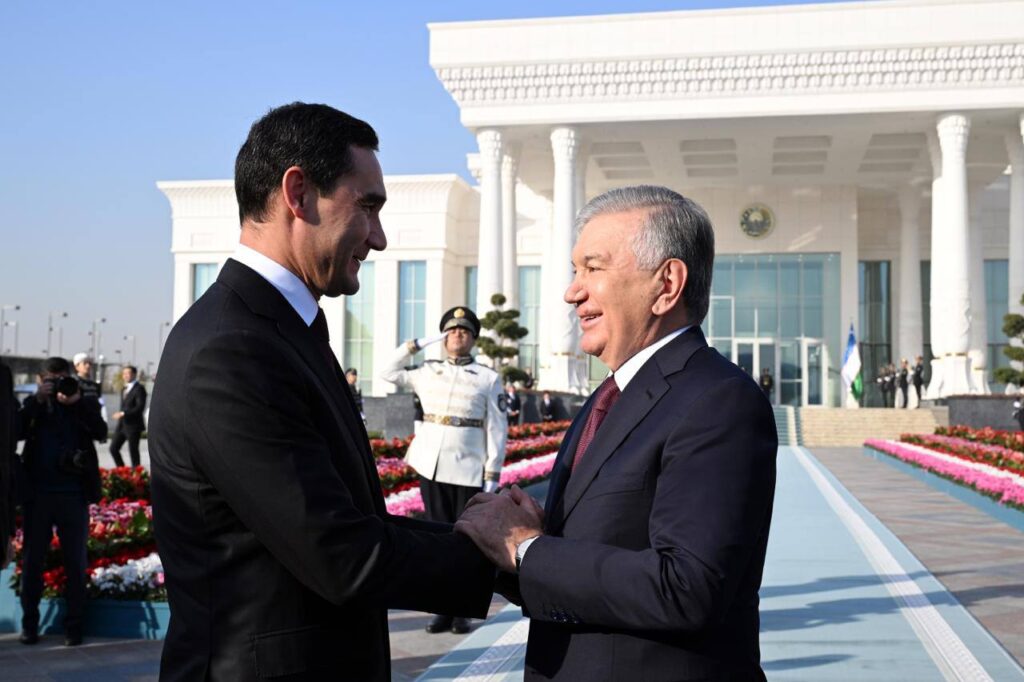
Uzbekistan and Turkmenistan have agreed to deepen political, economic, and humanitarian cooperation following President Serdar Berdymuhamedov’s state visit to Tashkent, where he held talks with President Shavkat Mirziyoyev on November 17. The summit began in a narrow format at the Kuksaroy Residence, where both leaders emphasized the significance of the visit in strengthening the growing strategic partnership. They noted the increasing dialogue across various sectors and highlighted recent cultural initiatives, including the Days of Turkmen Culture and Cinema held in Urgench and Tashkent. Bilateral trade continues to grow, having surpassed $1 billion last year, supported by rising freight flows through the Turkmenbashi port. The presidents explored new opportunities to boost mutual trade and deepen cooperation in industry, energy, transport, mechanical engineering, agriculture, and water management. They also agreed to expand interregional collaboration and to convene the next Forum of Regions in Khiva. Talks then continued in an expanded format with the participation of both delegations. Mirziyoyev stated that the visit reflects the “centuries-old ties of friendship and good neighborliness,” and he praised Turkmenistan’s progress under the leadership of Gurbanguly Berdymuhamedov, Chairman of the Halk Maslahaty. The two sides agreed to work toward increasing trade to $2 billion by expanding the range of goods and more effectively utilizing the free trade regime. They noted that the newly launched Shavat-Dashoguz cross-border trade zone would play a key role in achieving this target and agreed to replicate the model in other regions, starting with the Alat-Farab corridor. Industrial cooperation is set to expand, with both sides encouraging businesses to launch joint projects in sectors such as building materials, pharmaceuticals, and food production. In the energy sector, the two countries plan to embark on larger-scale cooperative projects, including the development of promising natural resource deposits. Transport cooperation will also deepen through joint development of the Turkmenbashi port and the resumption of direct flights between Tashkent and Ashgabat. The presidents instructed their governments to ensure timely implementation of all agreements by holding regular meetings of the Intergovernmental Commission and the Business Council. They also committed to intensifying collaboration in culture, education, youth exchanges, filmmaking, healthcare, and medical science. Following the talks, the leaders jointly inaugurated the Shavat-Dashoguz trade zone, which includes customs, quarantine, and veterinary services, as well as warehouse facilities, a trade pavilion, and public services operating under a single-window system. The zone is expected to significantly boost economic ties between Uzbekistan’s Khorezm region and Turkmenistan’s Dashoguz region, which together are home to more than 3.5 million people. At a ceremony held at Kuksaroy, Berdymuhamedov was awarded the “Oliy Darajali Dustlik” Order, Uzbekistan’s highest state honor. Mirziyoyev said the award reflects Turkmenistan’s contributions to strengthening friendship, trust, and strategic partnership. Berdymuhamedov expressed his gratitude and reaffirmed his commitment to enhancing bilateral relations. The two sides signed a Joint Statement and oversaw the exchange of intergovernmental and interagency agreements covering trade, healthcare, agriculture, transport, biological safety, justice, forestry, and regional cooperation. The Uzbekistan-Turkmenistan summit concluded the same day. As part of his visit, Berdymuhamedov also...

Trade in Central Asia: China Deepens Influence, Europe Expands Presence, Region Seeks New Markets

Central Asia remains a theater of active economic competition, with countries in the region striving to diversify external partnerships and reduce dependence on traditional power centers, Russia and China. While both continue to dominate foreign trade, Kazakhstan, Uzbekistan, Kyrgyzstan, and Tajikistan are increasingly exploring new directions. The region’s evolving trade dynamics reflect each country's economic characteristics. Kazakhstan is driven by energy and metals exports, Uzbekistan by manufacturing and resource processing, while Kyrgyzstan and Tajikistan rely heavily on remittances and raw material exports. Amid global shifts and intensified competition for markets, Central Asian states are gradually shaping more multipolar trade strategies, opening up new routes and partnerships. Turkmenistan is excluded from this analysis due to the opacity of its national statistics. Kazakhstan As Central Asia’s largest economy, Kazakhstan relies heavily on natural resource extraction. Its main exports include oil, gas, metals, coal, grain, and agricultural products. Imports consist primarily of machinery, chemicals, vehicles, and consumer goods. Key export partners include Italy (21.6%), China (18.6%), Russia (10.2%), the Netherlands (7.4%), Turkey (4.7%), and Uzbekistan (4.3%). On the import side, China (29%) and Russia (28.8%) dominate, followed by Germany (4.8%), South Korea (3.7%), the United States (3.6%), and Turkey (2.5%). Kazakhstan has maintained a positive trade balance, buoyed by consistent demand for raw materials. In January-July 2025, the country’s foreign trade turnover totaled $78.18 billion, down 2.6% from the same period in 2024. Exports declined by 6.4% to $43.58 billion, while imports rose by 2.6% to $34.6 billion. Uzbekistan Uzbekistan's economy is focused on agriculture, textiles, natural resources, and manufacturing. Major exports include textiles, gold, gas, automobiles, cotton, and fruit. Imports are led by machinery, equipment, chemicals, and petroleum products. In the first half of 2025, foreign trade turnover reached $44.4 billion, up 19.9% year-on-year. Exports rose 34.9% to $20.1 billion, while imports increased 9.9% to $24.29 billion, leaving a trade deficit of $4.18 billion. Uzbekistan trades with 197 countries. Its largest trade partners are China (18.2%), Russia (16.1%), Kazakhstan (5.9%), Turkey (3.6%), and South Korea (2.2%). Export destinations include Russia (12.3%), China (5.5%), Kazakhstan (4.0%), Afghanistan (3.7%), Turkey (3.0%), France (2.6%), the UAE (1.8%), Kyrgyzstan (1.6%), Tajikistan (1.4%), and Pakistan (1.2%). Imports mainly come from China (28.7%), Russia (19.3%), Kazakhstan (7.6%), Turkey (4.1%), South Korea (3.9%), Germany (2.8%), and India (2.6%). Kyrgyzstan Kyrgyzstan, with limited natural resources, is heavily dependent on foreign trade. Its economy is rooted in agriculture, mining, and textiles. Key exports include gold and agricultural products, while imports are dominated by machinery, vehicles, petroleum products, and chemicals. From January to June 2025, foreign trade turnover fell 12.4% year-on-year to $6.99 billion. Exports made up only 15% of total trade, underscoring a continued trade deficit. Main partners remain Kazakhstan, Russia, and China. Tajikistan Tajikistan’s economy is centered on agriculture, hydropower, textiles, and mining. In January-August 2025, foreign trade turnover rose 16.8% year-on-year to $6.73 billion. Exports totaled $1.63 billion, while imports reached $5.1 billion, more than triple the export volume. Main exports are aluminum, textiles, agricultural goods, and minerals; imports...

Experts Warn of Risks as Kazakhstan Considers Alcohol Sales Restrictions

On October 13, Kazakhstan’s Ministry of Internal Affairs shocked citizens by proposing a ban on the sale of alcohol in regular grocery stores, retail chains, and online platforms. The announcement overshadowed global headlines and quickly sparked widespread debate. While the number of alcohol-free settlements in Kazakhstan is rising, overall consumption remains high, prompting concerns among experts about the potential consequences of such a sweeping ban. A Push for Specialized Alcohol Stores The ministry justified the proposed restrictions as a public safety measure. According to Minister of Internal Affairs Yerzhan Sadenov, alcohol is a major contributor to crime, with up to 10,000 crimes committed annually under the influence. Violations of age and time restrictions on alcohol sales are reportedly common. “They sell around the clock under the guise of cafes and bars. Online delivery is widely used. The measure of revoking a license is ineffective, it can be obtained the next day by other persons,” said Sadenov. The ministry is advocating for alcohol to be sold only in specialized stores, so-called alcohol markets. It also proposes tightening the licensing process and limiting the number of licenses issued. Additionally, it recommends restricting alcohol sales in entertainment venues, where more than 1,400 alcohol-related crimes, including three murders, have occurred. A New Front in the Fight Against Alcohol Abuse Many Kazakhstani citizens observe that alcohol consumption has declined since Soviet times, a trend attributed to increasing religiosity in the predominantly Muslim country and the popularity of healthy lifestyles. Still, the issue remains pressing. Over the years, Kazakhstan has introduced stricter regulations. In 2014, restrictions were imposed on sales hours. High-alcohol-content beverages were banned in stores from 9 p.m. to 12 p.m., and low-alcohol beverages from 11 p.m. to 8 a.m. In 2020, the minimum legal age for purchasing alcohol and tobacco was raised from 18 to 21. As of 2025, 429 villages have officially renounced alcohol. In the Aktobe region, 33 villages adopted alcohol-free policies, while 18 in the Kyzylorda region and 53 in the Atyrau region followed suit. According to officials, no offenses have been recorded in some of these areas over the past two years. Kazakhstan Still Drinks Despite these measures, alcohol consumption remains substantial. According to the World Health Organization (WHO), the average per capita alcohol consumption in Kazakhstan among those aged 15 and older stood at 5.4 liters of pure ethanol in 2022. The global average that year was 6.2 liters, with consumption in Europe ranging from 9 to 11 liters. In predominantly Muslim countries, the average is below 3 liters. WHO considers levels above 5 liters a significant health risk. A June 2025 survey found the highest consumption in northern regions, Pavlodar, Kostanay, and North Kazakhstan, as well as in Astana and Almaty. In contrast, Shymkent, Atyrau, and Turkestan reported the lowest levels. Interestingly, young adults aged 18 to 24 were found to drink less frequently, a trend attributed to stronger family oversight and cultural values. Economic and Social Risks of a Ban Experts urge caution in pursuing aggressive...