• KZT/USD = 0.00220
  • TJS/USD = 0.10860
  • UZS/USD = 0.00008
  • TMT/USD = 0.29850
  • KZT/USD = 0.00220
  • TJS/USD = 0.10860
  • UZS/USD = 0.00008
  • TMT/USD = 0.29850
  • KZT/USD = 0.00220
  • TJS/USD = 0.10860
  • UZS/USD = 0.00008
  • TMT/USD = 0.29850
  • KZT/USD = 0.00220
  • TJS/USD = 0.10860
  • UZS/USD = 0.00008
  • TMT/USD = 0.29850
  • KZT/USD = 0.00220
  • TJS/USD = 0.10860
  • UZS/USD = 0.00008
  • TMT/USD = 0.29850
  • KZT/USD = 0.00220
  • TJS/USD = 0.10860
  • UZS/USD = 0.00008
  • TMT/USD = 0.29850
  • KZT/USD = 0.00220
  • TJS/USD = 0.10860
  • UZS/USD = 0.00008
  • TMT/USD = 0.29850
  • KZT/USD = 0.00220
  • TJS/USD = 0.10860
  • UZS/USD = 0.00008
  • TMT/USD = 0.29850
03 November 2026

Viewing results 1 - 6 of 2

Almaty Builds New Tram Line as Residents Question Costs and Delays

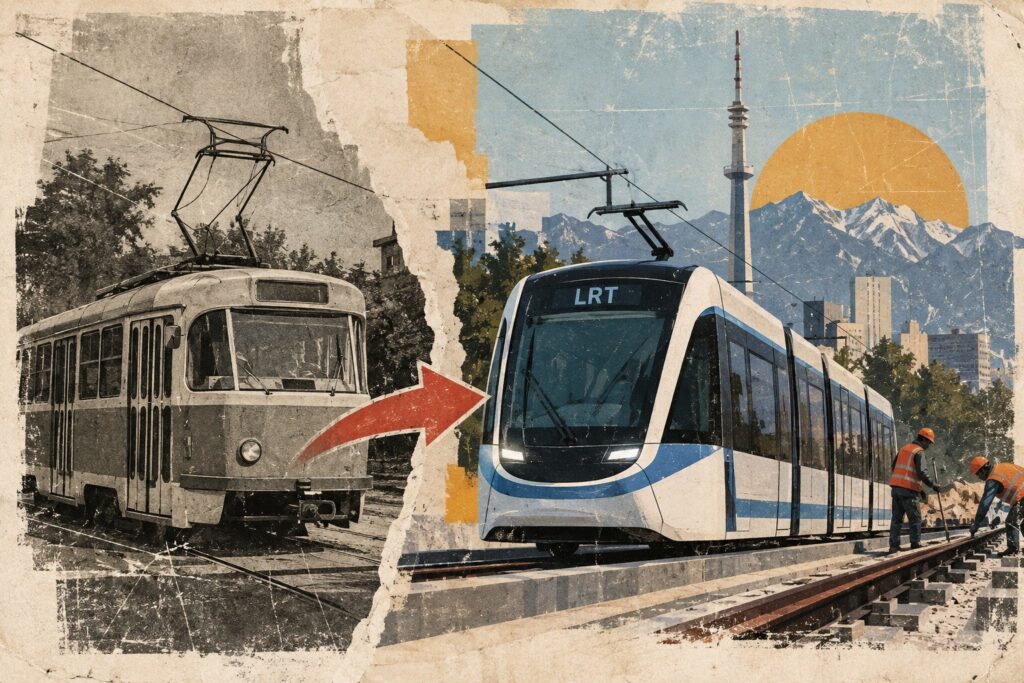
Almaty, Kazakhstan's largest city with a population of more than two million, is laying tram tracks again, more than a decade after shutting down its old network. The authorities aim to open the first 18.3-kilometer light rail transit (LRT) line in December 2027. The city has allocated 61.4 billion tenge (approximately $136 million) for construction in 2026, but the authorities have yet to disclose the project's total cost. As construction closes streets and disrupts traffic, some residents are questioning why the city dismantled its old tram system only to build a new one. The Project The new line will run from an industrial area in western Almaty through central districts to the Almaty-2 railway station and the Raiymbek Batyr transport hub. Unlike the elevated LRT system in Kazakhstan's capital, Astana, Almaty's tracks will be laid at street level, separated from road traffic by curbs. City authorities say a ground-level line is less expensive than the elevated system in Astana. The project is being built by Kazakhstan's Integra Construction KZ. China's CRRC is being considered as a supplier of rolling stock, with the parties signing a memorandum of intent in June. The proposed five-section trams would carry up to 283 passengers each. City officials estimate that the line could carry more than 100,000 passengers a day, slightly below the roughly 122,000 passengers Almaty's metro handles on a typical weekday. [caption id="attachment_58784" align="aligncenter" width="2560"] The groundwork for the new tram line along Tole Bi Street, Almaty. Image: TCA[/caption] Public Opinion Speaking to The Times of Central Asia (TCA), 25-year-old entrepreneur Sanzhar Uvashev questioned the need for the new project after the dismantling of the previous tram network. “There used to be trams running through the city. Then they removed them, and now they want to build an LRT. Why remove one system only to build practically the same thing again?” he said. Tram services in Almaty ended on October 31, 2015. An inspection found the tracks to be unsafe after 43 derailments had occurred over just nine and a half months. The city decided to discontinue operations on the old network. By May 2026, workers were removing the remaining rails on Tole Bi Street to make way for new construction. Abai Kazbayev, a 40-year-old actor who also spoke to TCA, does not oppose bringing trams back but fears another prolonged construction project. “Perhaps it really will help ease traffic congestion in the future. The main thing is that construction doesn't drag on for years again,” he said. [caption id="attachment_58786" align="aligncenter" width="1280"] Sections of the street are closed periodically, while hoardings advertise the coming trams. Image: TCA[/caption] Why Not Expand the Metro? Raushan Otan, a 46-year-old art historian interviewed by TCA, believes the city should focus on expanding its existing subway system. “It would make much more sense to continue building the metro and developing the transport system we already have,” she said. Construction of Almaty's metro began in 1988, during the Soviet era. It welcomed its first passengers in 2011, 20 years...


Bishkek Metro Plans Resurface Despite High Costs and Low Demand

Bishkek is once again talking about building a metro, despite an assessment by the Kyrgyz capital's own planners that it would attract too few passengers and cost roughly ten times as much as a tram network. Officials have now raised it with French and European development partners. Plans for the new transport systems were discussed on October 9 by Bishkek First Deputy Mayor Kubanychbek Imanaliev, French Ambassador Nicolas Faye, and representatives of the European Bank for Reconstruction and Development. The French side expressed its willingness to help finance a feasibility study. Alexander Baranov, one of the developers of the city's master plan through 2050, said in December 2025 that a tram network would be much quicker to build and better suited to the city's passenger volumes. Mayor Aibek Dzhunushaliev said on October 2 that the city would consider building a metro if a viable project and investors emerged. Meanwhile, Bishkek is still struggling to provide enough buses. The mayor said on October 12 that the 1,600 buses purchased earlier were insufficient and that the fleet needs to expand to approximately 2,500. Bishkek's master plan through 2050, approved earlier this year, includes tram lines and a bus rapid transit (BRT) system, using dedicated bus lanes and specially equipped stops. This approach can carry more passengers and reduce travel times without requiring underground tunnels. The proposed tram network would connect several districts of the capital. A BRT line could link parts of the city with Manas International Airport. No construction timetable has been established. According to official estimates, the city's road network was originally designed for approximately 50,000 vehicles. Today, around 468,000 vehicles are registered in the capital, while as many as 700,000 use its streets daily when traffic from the suburbs and neighboring regions is included. Nearly 80% of Bishkek's registered cars were more than 15 years old, according to figures published by Kyrgyzstan's Ministry of Natural Resources, Ecology, and Technical Supervision in 2025. A World Bank study identified transport as one of the city's main pollution sources, accounting for approximately 27% of annual fine particulate matter (PM2.5) concentrations. Bishkek regularly experiences severe smog, particularly in winter, when vehicle emissions are compounded by pollution from residential heating and other sources. Authorities previously proposed prioritizing public transportation and gradually reducing the use of private cars.