• KGS/USD = 0.01144 0%
  • KZT/USD = 0.00207 0%
  • TJS/USD = 0.10839 0.09%
  • UZS/USD = 0.00008 0%
  • TMT/USD = 0.28571 0.28%
  • KGS/USD = 0.01144 0%
  • KZT/USD = 0.00207 0%
  • TJS/USD = 0.10839 0.09%
  • UZS/USD = 0.00008 0%
  • TMT/USD = 0.28571 0.28%
  • KGS/USD = 0.01144 0%
  • KZT/USD = 0.00207 0%
  • TJS/USD = 0.10839 0.09%
  • UZS/USD = 0.00008 0%
  • TMT/USD = 0.28571 0.28%
  • KGS/USD = 0.01144 0%
  • KZT/USD = 0.00207 0%
  • TJS/USD = 0.10839 0.09%
  • UZS/USD = 0.00008 0%
  • TMT/USD = 0.28571 0.28%
  • KGS/USD = 0.01144 0%
  • KZT/USD = 0.00207 0%
  • TJS/USD = 0.10839 0.09%
  • UZS/USD = 0.00008 0%
  • TMT/USD = 0.28571 0.28%
  • KGS/USD = 0.01144 0%
  • KZT/USD = 0.00207 0%
  • TJS/USD = 0.10839 0.09%
  • UZS/USD = 0.00008 0%
  • TMT/USD = 0.28571 0.28%
  • KGS/USD = 0.01144 0%
  • KZT/USD = 0.00207 0%
  • TJS/USD = 0.10839 0.09%
  • UZS/USD = 0.00008 0%
  • TMT/USD = 0.28571 0.28%
  • KGS/USD = 0.01144 0%
  • KZT/USD = 0.00207 0%
  • TJS/USD = 0.10839 0.09%
  • UZS/USD = 0.00008 0%
  • TMT/USD = 0.28571 0.28%

Viewing results 1 - 6 of 11

Washington Meets Ashgabat as Turkmen-American Business Cooperation Association Debuts

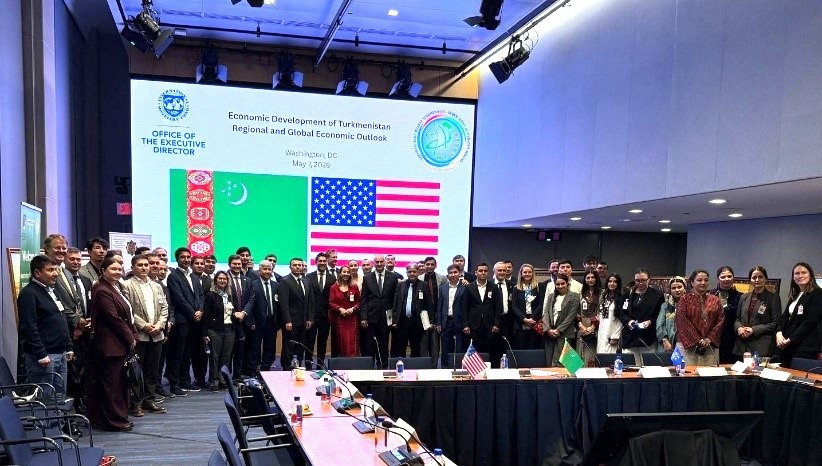
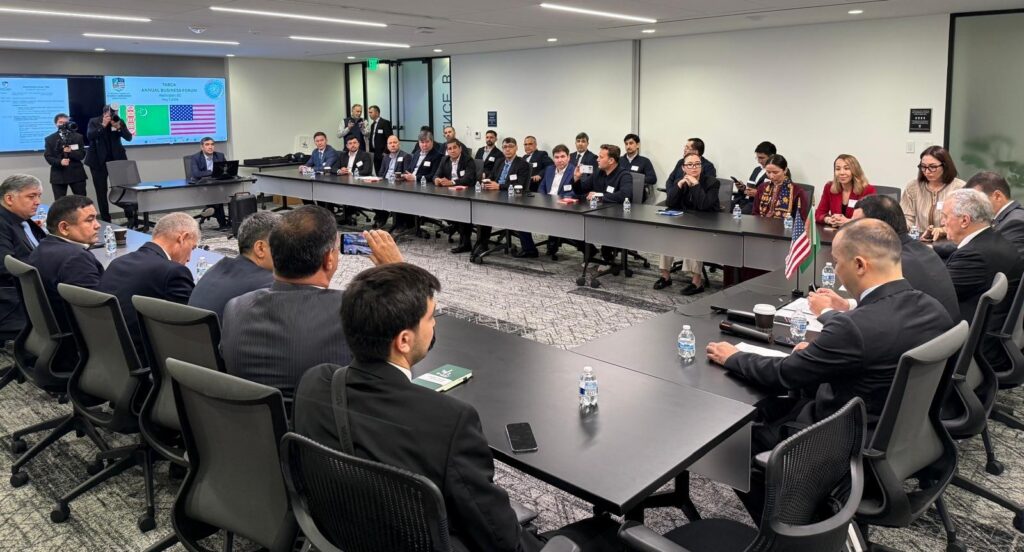
On May 7, the Turkmen-American Business Cooperation Association (TABCA) and the Embassy of Turkmenistan in Washington marked the organization’s official launch through a series of daylong events attended by members of the business community, diplomats, and dignitaries, including senior representatives from the U.S. Department of Commerce. Serving as a definitive bridge between the business communities of the United States and Turkmenistan, TABCA aims to promote bilateral trade, support market access initiatives, and encourage strategic partnerships and innovation across key sectors. More than 50 Turkmen and American companies joined the meetings, underscoring Ashgabat’s continued push toward a more open and globally engaged economy—one that inevitably brings both opportunity and risk. According to Esen Aydogdyyev, Turkmenistan’s Ambassador to the United States, “We are committed to cultivating broad international partnerships where agreements contribute to national development, economic resilience, and long-term independence for its citizens. Ashgabat is seeking broader investor and commercial engagement, which is compatible with our strategic autonomy and non-aligned status.” [caption id="attachment_48630" align="aligncenter" width="901"] (L/R) Viktoriya Frolova, Commerical Specialist, U.S. Embassy Turkmenistan, former Ambassador of Turkmenistan to the U.S., Meret Orozov, Chairman of the Board, Turkmen American Business Cooperation Association Nurgeldi Meredov, and Mr.Maksat Annamyradov, Board Member, Turkmen American Business Cooperation Association. Image: Kakajan Ovezov, Begench Arazalyyev[/caption] The initiative reflects Turkmenistan’s effort to strengthen ties with Western investors while maintaining its neutrality and independent foreign policy. Economic growth is strongest, the participants echoed, when enterprise creates broad opportunity and shared prosperity. Ambassador Aydogdyyev said that “priority areas for cooperation include trade and commerce, energy, transportation and communications, agriculture, renewable energy, the chemical and food sectors, as well as environmental protection. We especially value entrepreneurship and small business partnerships between Turkmenistan and the United States. In addition, we want Turkmen entrepreneurs to play a role in supporting economic growth and employment opportunities in the United States, which they are already contributing to today.” Win-Win is the Guiding Principle TABCA’s official launch in Washington is more than symbolic—it reflects a meaningful new chapter in U.S.-Turkmenistan relations, grounded in practical business cooperation and a shared commitment to cross-border investment. While some observers in Turkmenistan remain cautious about the risk of outside geopolitical agendas or economic models that favor a narrow set of interests under the banner of long-term prosperity and commercial diplomacy, the focus today is on building fair opportunity, productive partnership, and tangible commercial results. “U.S. and Turkmen businesses are already helping drive jobs and economic growth in both countries—a reminder of why stronger commercial ties matter,” said Nurgeldi Meredov, TABCA’s Chairman. “Our goal is to expand trade, boost investment, and create long-term partnerships that open new opportunities for companies on both sides.” [caption id="attachment_48631" align="aligncenter" width="712"] Jamila Kerimova, founder of “Ish nokady” (standing); image: Kakajan Ovezov, Begench Arazalyyev[/caption] At TABCA’s morning session, Turkmen businesses highlighted B2B engagement and SME growth opportunities, showcasing companies in logistics, e-commerce, manufacturing, consulting, and real estate. The presentations were followed by networking aimed at fostering direct commercial partnerships. Nurgeldi Meredov, alongside Meret Orazov, former Ambassador of Turkmenistan...

Business Leaders from Turkmenistan Talk Trade on U.S. Tour

Dozens of business executives from Turkmenistan and the United States have met in Washington amid efforts by the two countries to strengthen trade. The conference of the Turkmen American Business Cooperation Association, also known by its acronym TABCA, was held on Thursday, according to Turkmenistan’s embassy in the U.S. It said the association is a “new practical platform” for expanding economic ties, with a focus on small and medium-sized enterprises. Earlier this month, business leaders from Turkmenistan attended the SelectUSA Investment Summit, an event hosted by the U.S. Department of Commerce that was designed to connect investors, companies and experts from around the world. The investment forum was held in National Harbor, Maryland. Ambassador Esen Aydogdyyev of Turkmenistan, meanwhile, has been making contacts since he was appointed to his new post in Washington in March. On May 1, Aydogdyyev met S. Paul Kapur, U.S. Assistant Secretary of State for South and Central Asian affairs. On April 22, the Turkmen ambassador held talks with Patryk Łoszewski, an executive director of the International Monetary Fund. U.S. goods trade with Turkmenistan was $152.7 million in 2025, according to U.S. government data. U.S. goods exports to Turkmenistan last year were $113.3 million, up 43.6% from the previous year, and U.S. goods imports from Turkmenistan were $39.4 million, up 169% from 2024. While those numbers are relatively low compared to the volume of trade between the United States and its bigger trading partners, the annual percentage increase is notable. One of Turkmenistan’s biggest exports to the U.S. is fertilizer. Turkmenistan has major reserves of natural gas and oil, and the Central Asian country is working to diversify its trading partners. U.S. and other foreign companies are hoping for reforms in the highly controlled country that would make it a more attractive place to invest.

Behind Turkmenistan’s Neutrality, Quiet U.S. Military Ties Endure

In late January, U.S. Special Envoy for South and Central Asia, Sergio Gor visited Turkmenistan. Accompanying Gor was U.S. Secretary of the Army Daniel Driscoll. Driscoll’s presence in Turkmenistan, a country with a roughly 1,150-kilometer border with Iran, sparked some speculation that his visit was related to escalating tensions between Washington and Tehran. But while it is unusual for any top foreign military officials to visit Turkmenistan, U.S. military officials have stopped by Turkmenistan relatively often over the course of the last 30 years. Neutral Turkmenistan A good trivia question about Central Asia is, which country was the first to join NATO’s Partnership for Peace (PfP) program? The answer is Turkmenistan, in May 1994, and NATO had just created the PfP program in January of that year. However, in December 1995, the UN approved giving Turkmenistan official status as a neutral country. Turkmenistan’s president at the time, Saparmurat Niyazov, said as part of that neutral status, Turkmenistan would not join any military blocs or join in aggression against another country. Then came the September 11, 2001, terrorist attacks on the United States and U.S. President George Bush Jr’s remark that “you’re either with us or against us.” Central Asia, with its nearly 2,400-kilometer border with Afghanistan, suddenly became a frontline in Washington’s campaign against terrorist groups inside Afghanistan. The other Central Asian countries, which had watched with dread as the Taliban advanced toward Central Asian borders, quickly expressed their support. Kyrgyzstan, Tajikistan, and Uzbekistan offered the use of military bases to the U.S. and NATO forces that were rapidly being assembled. Turkmenistan took a different position on events in Afghanistan. Remaining true to its UN-recognized neutrality status, Turkmenistan engaged with the Taliban and with the government of Burhanuddin Rabbani, whom the Taliban had ousted from power. A round of peace talks between the two Afghan parties was held in the Turkmen capital, Ashgabat, in March 1999. After 9/11, Turkmenistan agreed to allow U.S. planes carrying non-lethal cargo to transit through Turkmen airspace and to refuel at Ashgabat airport. But officially, that was as far as the Turkmen government was willing to become involved. The U.S. had already established a military connection with Turkmenistan. The head of the U.S. Central Command, General Tommy Franks, visited Turkmenistan in September 2000 and again in May 2001. U.S. Secretary of State Donald Rumsfeld visited Turkmenistan in April 2002. General Franks followed in August that year, promising to help Turkmenistan fight the illegal narcotics trade. The United States gave Turkmenistan two small naval patrol boats for use in the Caspian Sea in 2002, and in 2003, gave 40 Russian-made off-road vehicles to Turkmenistan’s border guards. Reports started to appear stating that Turkmenistan’s military cooperation with the United States was quietly deepening. The Turkmen government had said when agreeing to allow overflights and refueling that no foreign troops would be stationed in Turkmenistan. But it turned out that a small U.S. Air Force team, only about seven servicemen, was stationed in Ashgabat to help refuel U.S....

Opinion: Gas, Geopolitics, and Realism: U.S.–Turkmenistan Talks Signal Shift

U.S. Secretary of State Marco Rubio and his Turkmen counterpart Rashid Meredov wrapped up bilateral consultations last week in Washington, DC. The encounter suggested a new awareness on Washington’s part of Turkmenistan’s pivotal geostrategic location in the heart of Central Asia and its status as a major hub of natural resources. Since becoming head of state in March 2022, Turkmenistan’s President Serdar Berdimuhamedov has shifted his country’s foreign policy from one of strategic isolation to what might be called practical realism, whereby priority is given to fair trade and investments that are in line with national interests and long-term development. Like the other Central Asian heads of state, Berdimuhamedov also champions a pragmatic, interest-based foreign policy. Consequently, they find the current, pragmatic U.S. administration with its concern to work out deals (presumably mutually beneficial ones) more congenial than its predecessor, with its penchant for geostrategic maneuvering and ideology. Secretary Rubio recently observed: “A mature foreign policy requires a balancing of interests - that’s a fact.” This way of thinking goes over well in smaller independent states such as Turkmenistan and other Central Asian countries, whose key national priorities include establishing their statehood on a firm basis and safeguarding their sovereignty amid the turbulent great power politics being played out in their vicinity. Oil and Gas Over the years, Berdimuhamedov has insisted that foreign entities seeking access to the country’s vast natural gas reserves must play by Ashgabat’s rules. Home to the world’s fourth-largest gas reserves, Turkmenistan invites foreign participation in its energy sector, provided that agreements are structured as win-win arrangements and don’t give suitors the geostrategic upper hand. In this context, it would make sense for Washington to get the word out about two upcoming conferences in Ashgabat: The Turkmenistan Investment Forum, September 18– 19, 2025, which will serve to attract long-term investment into the country's economy, and the 30th Oil & Gas of Turkmenistan – 2025 International Conference & EXPO (OGT 2025) on 22–24 October. Turkmenistan had a strong 2024 in terms of energy, producing 77.6 billion cubic meters of natural gas and 8.3 million tons of oil. The OGT 2025  will showcase the country’s resource potential and new investment opportunities, focusing on upstream projects such as the Galkynysh gas field and the Caspian blocks, as well as on initiatives in the areas of renewable energy, methane mitigation, and infrastructure modernization. Moreover, Ashgabat wants to expand its Trans-Caspian and north-south economic corridors and complete the Turkmenistan-Afghanistan-Pakistan-India (TAPI) gas pipeline, among other initiatives in transport and logistics. U.S. companies may want to explore these new opportunities. Travel Limitations to the U.S. Ashgabat is working with the U.S. Department of State to lift recently imposed restrictions on Turkmen citizens wishing to travel to the U.S. Both sides are aiming to ensure that applicants are properly screened before a visa is granted and that recipients comply with its terms. To further deepen ties, Washington should view Turkmenistan’s neutrality towards others on the global stage in security and foreign-policy matters not as an obstacle, but as an advantage that facilitates dialogue. While maintaining its advocacy for democratic principles,...

U.S.–Turkmenistan Rapprochement: Energy, Neutrality, and Digital Geopolitics

For more than three decades, Turkmenistan has stood apart from its neighbors. Since declaring independence in 1991, it has built its foreign policy around “permanent neutrality,” a status formally recognized by the United Nations in 1995. Neutrality has meant avoiding military alliances, steering clear of regional blocs, and limiting international engagement to carefully managed bilateral relationships. Ashgabat has been especially cautious in its dealings with Washington, keeping contacts minimal while relying overwhelmingly on China to buy its natural gas. That posture is beginning to shift. In 2025, the outlines of a quiet rapprochement between Turkmenistan and the United States are visible. The latest round of Annual Bilateral Consultations (ABCs) in Washington, coupled with Ashgabat’s more active role in the C5+1 regional dialogue, suggests a gradual warming. On September 19, 2023, Turkmen President Serdar Berdimuhamedov participated in the first C5+1 multilateral summit alongside the U.S. and regional counterparts, highlighting Ashgabat’s more active role in the platform. At the heart of this cautious opening are three themes: energy dependence, security on Turkmenistan’s southern border, and the geopolitics of digital connectivity. Annual Bilateral Consultations: A Structured Dialogue The ABCs were launched in 2010 as part of a U.S. initiative to formalize engagement with all five Central Asian states. They are yearly, structured meetings between senior officials that review the state of bilateral relations across political, economic, and security issues. In August 2025, Foreign Minister Rashid Meredov met Secretary of State Marco Rubio in Washington for the 11th ABC. According to the U.S. State Department release, the two sides “underscored their commitment to advancing U.S.-Turkmenistan relations, including through security cooperation, increased economic and investment opportunities, the advancement of religious freedom, and deepening engagement through the C5+1 diplomatic platform.” The statement was deliberately brief and omitted sensitive matters such as the partial visa restrictions Washington imposed on Turkmen citizens earlier that year. But the very fact of the meeting, following years of minimal contact, marked a notable warming. From Episodic Contacts to Broader Cooperation The rapprochement has begun to take shape in concrete ways. Trade between the two countries, though still small, nearly doubled in 2024 to reach $218.5 million. Turkmenistan exported textiles, chemicals, and gas-related equipment, while U.S. exports included aviation technology, electronics, and agricultural machinery. Overall, the trade volume remained the second-lowest among Central Asian states, but the sharp increase pointed to a deliberate effort to expand ties. Reflecting this momentum, on June 8, 2025, Turkmenistan’s Foreign Minister Rashid Meredov met with the Executive Director of the Turkmenistan–U.S. Business Council, Eric Stewart, to discuss cooperation across sectors, including energy, cybersecurity, green technology, and education. Security cooperation has grown more visible. Turkmenistan’s long border with Afghanistan has long been a vulnerability, and while Ashgabat avoided involvement in the U.S.-led war, it quietly welcomed assistance to reinforce border defenses and counter trafficking. The U.S. has provided equipment, training, and support for Turkmen border services, a low-profile effort documented in a Congressional Research Service report. Turkmenistan has invested over a billion dollars in Afghan infrastructure projects...