• KGS/USD = 0.01144 0%
  • KZT/USD = 0.00207 0%
  • TJS/USD = 0.10437 0.19%
  • UZS/USD = 0.00008 0%
  • TMT/USD = 0.28490 0%
  • KGS/USD = 0.01144 0%
  • KZT/USD = 0.00207 0%
  • TJS/USD = 0.10437 0.19%
  • UZS/USD = 0.00008 0%
  • TMT/USD = 0.28490 0%
  • KGS/USD = 0.01144 0%
  • KZT/USD = 0.00207 0%
  • TJS/USD = 0.10437 0.19%
  • UZS/USD = 0.00008 0%
  • TMT/USD = 0.28490 0%
  • KGS/USD = 0.01144 0%
  • KZT/USD = 0.00207 0%
  • TJS/USD = 0.10437 0.19%
  • UZS/USD = 0.00008 0%
  • TMT/USD = 0.28490 0%
  • KGS/USD = 0.01144 0%
  • KZT/USD = 0.00207 0%
  • TJS/USD = 0.10437 0.19%
  • UZS/USD = 0.00008 0%
  • TMT/USD = 0.28490 0%
  • KGS/USD = 0.01144 0%
  • KZT/USD = 0.00207 0%
  • TJS/USD = 0.10437 0.19%
  • UZS/USD = 0.00008 0%
  • TMT/USD = 0.28490 0%
  • KGS/USD = 0.01144 0%
  • KZT/USD = 0.00207 0%
  • TJS/USD = 0.10437 0.19%
  • UZS/USD = 0.00008 0%
  • TMT/USD = 0.28490 0%
  • KGS/USD = 0.01144 0%
  • KZT/USD = 0.00207 0%
  • TJS/USD = 0.10437 0.19%
  • UZS/USD = 0.00008 0%
  • TMT/USD = 0.28490 0%

Viewing results 1 - 6 of 16

Uzbekistan Launches First Concrete Works at Planned Nuclear Power Plant

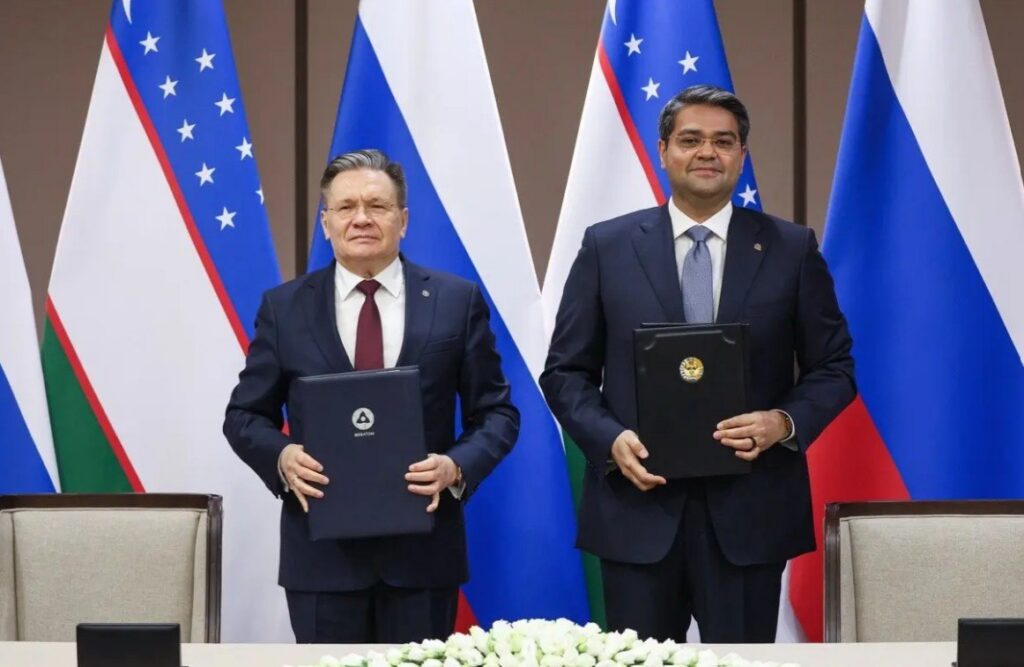
Construction of Uzbekistan’s first nuclear power plant has entered a new phase, with initial concrete works officially launched at the project site in the Farish district of the Jizzakh Region, according to the country’s Atomic Energy Agency, Uzatom. The milestone was marked on March 24 during simultaneous ceremonies held in Tashkent and at the construction site. During the events, Uzatom and Russia’s state nuclear corporation Rosatom signed a number of strategic documents, formally advancing the project to the stage of practical implementation. Among the agreements were a cooperation roadmap covering nuclear and related sectors, as well as an addendum to the contract for the construction of an integrated nuclear power facility in Uzbekistan. The documents were signed by Uzatom Director Azim Akhmedkhadjaev and Rosatom Director General Alexey Likhachev. According to Uzatom, the roadmap outlines cooperation in areas such as project implementation phases, workforce training, public engagement on nuclear energy, and the development of infrastructure for a future town for plant personnel. Uzbek officials said the agreement establishes a comprehensive partnership expected to contribute to both economic and social development. At the construction site, work has begun on laying the concrete foundation beneath the reactor building for a small modular unit using the RITM-200N design. Approximately 900 cubic meters of concrete are scheduled to be poured, with this stage expected to be completed by April 2026. The foundation will incorporate the waterproofing and grounding systems required for the reactor structure. The updated configuration of the plant involves two large power units equipped with Generation III+ VVER-1000 reactors, as well as two smaller units using RITM-200N reactors, each with a capacity of 55 MW. Once fully operational, the facility is expected to generate around 15.4 billion kilowatt-hours of electricity annually, more than 15% of Uzbekistan’s current power consumption. Uzatom stated that regulatory approval for use of the site has already been granted following safety assessments that identified no significant risks related to seismic activity, tectonic faults, or karst formations. The agency said the location meets nuclear, environmental, and technical safety requirements. “The start of concrete works marks an important step in implementing Uzbekistan’s national nuclear energy program,” Akhmedkhadjaev said, adding that the project is proceeding in line with established timelines and safety standards. Separately, Uzatom confirmed that a mission from the International Atomic Energy Agency is expected to visit Uzbekistan in the second half of 2026 to assess progress on the project.


IAEA to Review Uzbekistan Nuclear Power Project in 2026

A mission from the International Atomic Energy Agency (IAEA) is expected to visit Uzbekistan in the second half of 2026 to assess progress on the country’s nuclear power plant project, according to Uzbekistan’s Atomic Energy Agency (Uzatom). Preparations for the visit were discussed during a meeting between Uzatom Director Azim Akhmedkhadjaev and IAEA Director General Rafael Grossi. Uzbek officials said the talks focused on expanding cooperation in nuclear energy and reviewing progress under a joint roadmap aimed at deepening collaboration. According to Uzatom, Grossi noted Uzbekistan’s efforts to develop nuclear energy in line with international standards and IAEA recommendations. He also referred to reforms carried out under President Shavkat Mirziyoyev that, in his view, have helped create the institutional conditions necessary for implementing the nuclear program. The planned follow-up Integrated Nuclear Infrastructure Review (INIR) mission is expected to evaluate preparations for the construction of Uzbekistan’s first nuclear power plant. The facility is planned to be built in the Farish district of Jizzakh Region. Uzbek officials said IAEA specialists will assess progress on key aspects of the project during the visit. Grossi reportedly described the mission as an important stage in the implementation of Uzbekistan’s nuclear energy plans. Discussions also addressed the next practical phase of the project, including the start of initial construction works at the site. According to Uzatom, the planned nuclear power complex is expected to combine both large and small reactor units. At the conclusion of the meeting, Grossi confirmed the IAEA’s readiness to continue supporting Uzbekistan’s nuclear energy program and accepted an invitation to attend events marking the launch of construction. The sides also discussed increasing the number of Uzbek specialists working in the IAEA Secretariat, which officials say could strengthen national expertise in the nuclear sector and expand participation in international projects. The Times of Central Asia previously reported that Belarus has expressed readiness to assist Uzbekistan in developing nuclear power capacity and training specialists, offering to share experience gained through cooperation with Russia.

Uzbekistan and Russia to Develop Nuclear Medicine Strategy Ahead of 2026 Center Opening

Uzbekistan will develop a roadmap and long-term strategy for the advancement of nuclear medicine, according to the press service of the Atomic Energy Agency under the Cabinet of Ministers, Uzatom. The announcement followed a working meeting held on February 10 at Uzatom to discuss prospects for expanding nuclear medicine in the country. The meeting brought together representatives of the Ministry of Health, the Healthcare Projects Center, the Committee for Industrial, Radiation and Nuclear Safety, the Institute of Nuclear Physics of the Academy of Sciences, the state enterprise Radiopreparat, leading medical centers, and experts from Rosatom’s engineering division, underscoring growing cooperation between Uzbekistan and Russia in the sector. During the discussions, the Russian side presented its experience in building modern nuclear medicine infrastructure, including cyclotron complexes, radiopharmaceutical production facilities, and PET/CT diagnostic centers, as well as implementing turnkey international projects. Following the talks, the parties agreed to jointly draft a roadmap and strategy that will provide a framework for technology transfer, specialist training, and improvements in healthcare services. The initiative is intended to strengthen early cancer diagnosis and expand access to advanced treatment methods based on nuclear technologies. The construction of a Nuclear Medicine Center in Tashkent has begun. The center is scheduled to be equipped in 2026 with PET/CT scanners, a cyclotron, a radiopharmaceutical laboratory, as well as Gamma Knife and CyberKnife systems. The broader program also involves upgrading oncology services, promoting early cancer detection, training medical personnel to international standards, and deepening cooperation with Russia and Rosatom. Uzatom stated that it will continue to support the introduction of advanced technologies aimed at improving access to modern cancer diagnostics and treatment. As previously reported by The Times of Central Asia, citing IQVIA data, Uzbekistan’s pharmaceutical market reached $2.14 billion in the twelve months to September 2025, reflecting continued expansion and rising demand for medical services.

Uzbekistan Clarifies Nuclear Plant Timeline After Reports of Delay

Uzbekistan’s plans to begin construction of its first nuclear power plant have come under renewed scrutiny following the publication of a draft state program suggesting the start of work could be postponed until December 2026. The draft made public on the regulation.adliya.uz portal prompted widespread media speculation. According to the document, Uzbekistan intends to spend 2026 negotiating, signing, and registering an additional agreement with Russia’s state nuclear corporation, Rosatom. The proposed agreement would revise the configuration of the integrated nuclear power plant project, combining a large-capacity VVER-1000 reactor with small modular RITM-200N reactors. Some outlets interpreted this language as a sign that the pouring of the first concrete might not occur until the end of 2026. In response, the Uzatom nuclear energy agency issued an official clarification, stating that previously announced timelines remain unchanged. In a statement released after the draft’s publication, Uzatom stressed that the document does not stipulate any postponement of construction. The agency noted that the December 2026 date reflects a conservative planning scenario in which all preparatory and licensing procedures are finalized by that time. Uzatom emphasized its adherence to national legislation and international standards on nuclear and radiation safety. It added that the first concrete pouring, considered a key milestone, will only proceed after receiving all necessary permits and approvals from relevant authorities. “We clearly understand the level of responsibility involved in this stage,” the agency said, adding that work on the project is advancing across all areas. The clarification comes amid sustained public interest in Uzbekistan’s nuclear energy plans. Speaking at World Atomic Week in Moscow in September last year, Uzatom Director Azim Akhmedkhadjaev stated that Uzbekistan aims to fully commission a high-capacity nuclear power plant by 2035. According to him, the first small modular reactor in the Jizzakh region is expected to begin operations in 2029, with a second unit following six months later. The first reactor of the large-scale facility is scheduled to come online in 2033, with full capacity reached by 2035, though Akhmedkhadjaev noted that final timelines are contingent on the completion of contractual agreements. Uzatom said it will continue to provide timely updates as the project progresses through its key phases.

Uzbekistan Expands Nuclear Energy Cooperation with Italy’s Ansaldo Energia

Uzbekistan and Italy are deepening their cooperation in the field of nuclear energy, according to a statement from the press service of the Uzatom Agency. A delegation led by Uzatom Director Azim Akhmedkhadjaev has just returned from a working visit to Genoa, Italy, where talks focused on advancing Uzbekistan’s first nuclear power plant project. The visit included meetings with representatives of the regional government, the Genoa Chamber of Commerce, leading universities, and major Italian energy firms. A key session was held with Ansaldo Energia and its nuclear subsidiary, Ansaldo Nucleare, one of Europe’s leading providers of power generation technologies. Discussions focused on integrating Italian technical solutions into Uzbekistan’s planned nuclear facility, with particular emphasis on adapting auxiliary systems to local climatic and geological conditions. The Italian side shared its experience in safety system design, nuclear software development, and fuel management, expertise gained through projects in China, Belgium, Slovenia, Hungary, and Ukraine. Both sides explored the potential role of Italian companies as technical consultants during construction, ensuring the project aligns with international safety standards. Cooperation in radioactive waste management and deployment of advanced Italian fuel-handling technologies was also discussed. Italy also expressed readiness to support Uzbekistan in developing a national regulatory framework for nuclear energy and licensing procedures. Further, the two parties considered launching joint research and engineering initiatives to train Uzbek nuclear specialists, part of a broader effort to build local capacity and ensure the safe, long-term operation of the country’s future nuclear infrastructure. The talks come as Uzbekistan diversifies its energy portfolio. Energy Minister Jurabek Mirzamahmudov recently announced that Saudi-based Pemco will begin constructing a 200-megawatt gas-piston power plant in Samarkand. Meanwhile, Uzbekistan continues to expand its solar and wind capacity through ongoing projects with ACWA Power.

Uzbekistan Plans Full Launch of Large Nuclear Power Plant by 2035

Uzbekistan plans to fully launch a high-capacity nuclear power plant by 2035, according to Azim Akhmedkhadjaev, director of the “Uzatom” agency. Speaking on September 25 at World Atomic Week in Moscow, Akhmedkhadjaev said the first small modular reactor is expected to begin operations in 2029 in the Jizzakh region, followed by a second unit six months later. The large-scale plant will see its first reactor come online in 2033, with full capacity expected by 2035. He noted, however, that final timelines depend on the conclusion of outstanding contract agreements. Akhmedkhadjaev confirmed that production of reactor equipment is already underway and that the project is proceeding on schedule. Responding to a question from a Spot correspondent, he reiterated the target dates for the larger reactors and emphasized that the timeline will be refined once contracts are finalized. The announcement aligns with Uzbekistan’s broader nuclear energy strategy. As previously reported by The Times of Central Asia, the country plans to build both small modular and larger reactors at a single integrated nuclear facility. Under a revised agreement with Russia, Uzbekistan intends to construct two large VVER-1000 reactors alongside two smaller RITM-200N units. The initial framework for the project was established in 2018 and updated in 2024. Earlier this year, The Times of Central Asia reported that Rosatom had begun manufacturing reactor components for the smaller units, with the first steel castings for the RITM-200N already produced in Saint Petersburg. Uzbekistan’s pivot to nuclear energy is part of its strategy to meet rapidly increasing electricity demand, which is projected to reach 135 billion kWh by 2035, nearly double current consumption levels. To address this, the government is expanding generation capacity and modernizing the national grid. While the plans are ambitious, challenges remain. As Akhmedkhadjaev acknowledged, the full implementation timeline depends heavily on contract finalization. Nevertheless, Uzbekistan’s dual-track approach, combining scalable small reactors with large base-load units, suggests a strategic commitment to energy security and diversification.