
• KGS/USD = 0.01144 0%
  • KZT/USD = 0.00191 0%
  • TJS/USD = 0.10850 0%
  • UZS/USD = 0.00008 0%
  • TMT/USD = 0.28490 0%
  • KGS/USD = 0.01144 0%
  • KZT/USD = 0.00191 0%
  • TJS/USD = 0.10850 0%
  • UZS/USD = 0.00008 0%
  • TMT/USD = 0.28490 0%
  • KGS/USD = 0.01144 0%
  • KZT/USD = 0.00191 0%
  • TJS/USD = 0.10850 0%
  • UZS/USD = 0.00008 0%
  • TMT/USD = 0.28490 0%
  • KGS/USD = 0.01144 0%
  • KZT/USD = 0.00191 0%
  • TJS/USD = 0.10850 0%
  • UZS/USD = 0.00008 0%
  • TMT/USD = 0.28490 0%
  • KGS/USD = 0.01144 0%
  • KZT/USD = 0.00191 0%
  • TJS/USD = 0.10850 0%
  • UZS/USD = 0.00008 0%
  • TMT/USD = 0.28490 0%
  • KGS/USD = 0.01144 0%
  • KZT/USD = 0.00191 0%
  • TJS/USD = 0.10850 0%
  • UZS/USD = 0.00008 0%
  • TMT/USD = 0.28490 0%
  • KGS/USD = 0.01144 0%
  • KZT/USD = 0.00191 0%
  • TJS/USD = 0.10850 0%
  • UZS/USD = 0.00008 0%
  • TMT/USD = 0.28490 0%
  • KGS/USD = 0.01144 0%
  • KZT/USD = 0.00191 0%
  • TJS/USD = 0.10850 0%
  • UZS/USD = 0.00008 0%
  • TMT/USD = 0.28490 0%
10 November 2025

Viewing results 1 - 6 of 3

Uzbekistan Introduces Comprehensive Support for Palestinian Evacuees

Uzbekistan has introduced comprehensive measures to assist Palestinian women and children evacuated from Gaza late last year, including financial aid, housing support, free education, and healthcare. A presidential decree published on August 14 announced the creation of a special fund to finance these programs, UzA reported. On December 26, 2024, 100 injured Palestinian women and children were evacuated from Rafah to Uzbekistan. They were admitted to hospitals and rehabilitation centers for treatment and provided with medication and medical examinations. Authorities say the new measures aim not only to address urgent needs but also to help the group adapt and integrate into Uzbek society. Special fund and social support The decree establishes a special fund under the National Social Protection Agency to cover living expenses, rent, and one-time material assistance. Funding will come from charitable donations, international grants, and other legal sources, with spending monitored by a national commission to ensure transparency. The measures include monthly allowances for working-age adults, full coverage of rental costs for families, one-time payments for childbirth and funeral expenses equivalent to those granted to Uzbek citizens, and lump-sum assistance for essential non-food items. Each family will be assigned a local social worker to assess needs and provide tailored support. A Republican Commission will coordinate the work of government agencies to resolve practical issues swiftly. Local mahalla committees and social service centers will directly assist families in adapting to community life. Focus on education and healthcare The decree guarantees free enrollment for children in state kindergartens and schools without waiting lists, with kindergarten fees waived until January 1, 2028. The Ministry of Higher Education will recognize the foreign academic documents of Palestinian students within two months, without fees or additional exams. The Ministry of Health will register evacuees at family medical centers and polyclinics near their residences, granting them free care on the same terms as low-income Uzbek families. Any evacuee diagnosed with a disabling condition will be granted disability status regardless of treatment timelines, while elderly people without sufficient work records will receive pensions within two weeks. Employment and integration The Social Protection Agency has one month to develop proposals for helping evacuees find jobs and acquire new skills. The Ministries of Economy and Labor, along with commercial banks, will include Palestinians in entrepreneurship and small business support programs such as “Family Entrepreneurship,” “Support for Small Business,” and “First Step to Business.” Local officials and community bankers will oversee the use of funds and provide practical guidance. Humanitarian context Uzbekistan’s decision comes amid a worsening humanitarian crisis in Gaza. According to the Health Ministry in the Hamas-run administration, more than 60,000 Palestinians have been killed and over 145,000 injured since the outbreak of war in October 2023, the Associated Press reported. Israeli Prime Minister Benjamin Netanyahu has reportedly suggested relocating Palestinians from Gaza to countries including South Sudan, a proposal that Juba has denied discussing. Hamas says it will disarm only if Israeli forces fully withdraw from Gaza, a condition that continues to hinder progress in...

Azerbaijan’s Aliyev: Uzbekistan’s First Gift Helped Rebuild Karabakh

At a major media forum held in Khankendi, Azerbaijani President Ilham Aliyev expressed gratitude to Uzbekistan for its contribution to the reconstruction of Nagorno-Karabakh. Speaking at the event, Professor Sherzodhon Kudratkhodja, Rector of Uzbekistan’s University of Journalism and Mass Communications, congratulated Aliyev on successfully hosting the 17th Summit of the Economic Cooperation Organization (ECO) in Khankendi. He noted that while Uzbek journalists had visited Karabakh over the past three years, this was their first visit to Khankendi, marking a symbolic step toward reconciliation and renewal. Kudratkhodja praised the recent meeting between Aliyev and Armenian Prime Minister Nikol Pashinyan in Abu Dhabi, calling it “historic” and “a beacon of friendship” amid global uncertainty. He also asked about the strategic importance of the Zangezur corridor, not just for Azerbaijan and Armenia, but for the wider Turkic world. “The corridor will serve as a bridge, reconnecting once-separated lands,” he said. Commending the reconstruction of roads, buildings, mosques, and churches in Karabakh, he added: “This shows the world your tolerance and noble spirit.” Uzbekistan’s First Contribution In response, Aliyev highlighted Uzbekistan’s role in the early phases of Karabakh’s reconstruction following the 2020 Second Karabakh War. He cited the construction of a school for 960 students in Fizuli, initiated by Uzbek President Shavkat Mirziyoyev and named after the renowned Uzbek scholar Mirzo Ulugbek. “Uzbekistan made the first gift in restoring Karabakh,” Aliyev said. “A few days ago, I visited the school again. Over 500 children are already studying there, even though refugees are only just beginning to return to Fizuli. We deeply appreciate this brotherly gesture by the President of Uzbekistan.” Rebuilding Efforts in Karabakh The Second Karabakh War, also known as the 44-day war, ended in November 2020 with a ceasefire agreement restoring Azerbaijani control over formerly occupied territories. By mid-2024, Azerbaijan had spent more than USD $7 billion on reconstruction, including demining, infrastructure development, industrial revitalization, and tourism initiatives. Aliyev emphasized the symbolism of hosting the ECO Summit at Khankendi’s new congress center, built on the site of the former separatist parliament. Leaders from eight ECO member states attended the event, underscoring normalization in the region. Nearby, reconstruction continues at a Soviet-era hotel and Victory Square, the former site of the communist party headquarters, which is being transformed with the construction of a new Victory Museum. Zangezur Corridor and Regional Connectivity Aliyev also underlined the strategic significance of the Zangezur corridor, which is intended to link mainland Azerbaijan with its exclave of Nakhchivan and further to Turkey. He cited billions of dollars in national infrastructure investment, including the Caspian Sea’s largest port, expanded roadways, and the Baku-Tbilisi-Kars railway-now capable of handling 25 million tonnes of freight annually. “During President Mirziyoyev’s visit, we discussed increasing freight traffic through this corridor,” Aliyev said. He also referenced the development of the China-Kyrgyzstan-Uzbekistan-Turkmenistan railway, which will provide an additional route across the Caspian Sea and enhance regional connectivity. “These links are proof that our region can grow stronger together,” Aliyev stated. A Shared Legacy Both speakers highlighted...

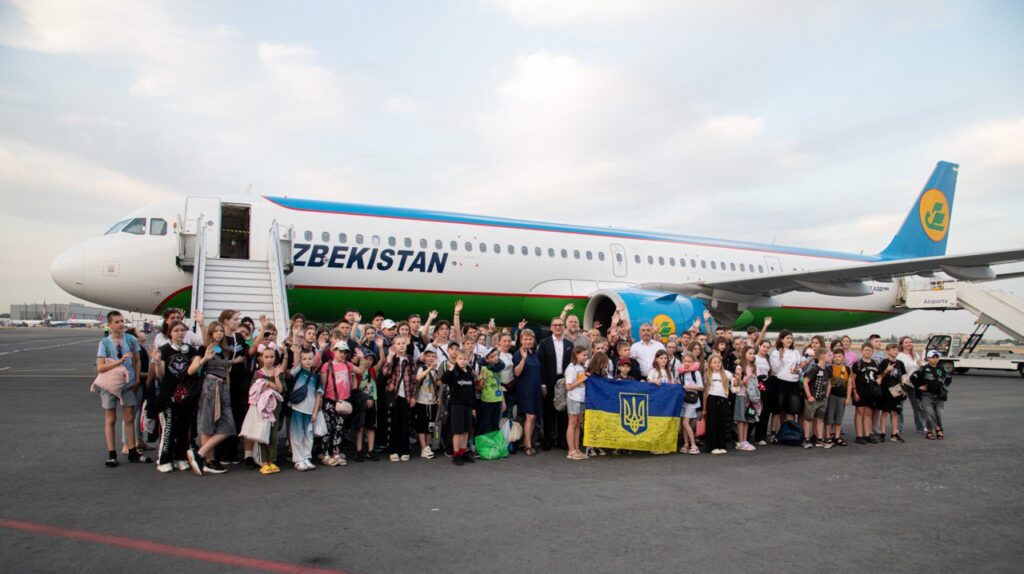
Ukrainian Children Arrive in Uzbekistan for Rest and Recovery

Just ahead of Eid al-Adha, a group of Ukrainian children have arrived in Tashkent for a 12-day program of rest and psychological rehabilitation. The Ukrainian Embassy in Uzbekistan reported that the visit was fully organized and funded by the Uzbek government. The children, who come from war-affected regions including Kharkiv, Kherson, Mykolaiv, Zaporizhzhia, Sumy, Khmelnytskyi, Lviv, and Kyiv, received a warm welcome upon arrival at Tashkent International Airport. From there, they traveled to a mountain camp nestled in a valley near the Tien Shan range. According to the embassy, the initiative was launched at the request of the Ukrainian side and is intended to help the children recover emotionally from the ongoing trauma of air raid sirens and missile strikes. The camp offers a structured program of daily themed events, such as “National Values Day” and “Sports and Health Day,” along with creative competitions and excursions. Evenings are reserved for social gatherings. Ukrainian adults are present to supervise the children throughout their stay. Nearly all major ministries and government agencies in Uzbekistan are participating in the effort, demonstrating strong coordination and compassion. The Ukrainian Embassy emphasized that the initiative reflects Uzbekistan’s genuine interest in supporting Ukrainian children during this difficult period. The program aims not only to provide physical and emotional relief, but also to express solidarity and goodwill from the Uzbek people. Uzbekistan previously provided similar humanitarian assistance to Palestinian civilians, evacuating 100 injured women and children, along with their guardians, from Rafah for medical treatment and care. Uzbekistan’s response to Russia’s war in Ukraine has been cautious yet distinct, reflecting its careful balancing act in international diplomacy. Tashkent has refrained from openly condemning Moscow, a key economic and regional partner, but has also demonstrated a firm commitment to Ukraine’s sovereignty and territorial integrity within the framework of its foreign policy principles. Uzbekistan has supported UN General Assembly resolutions calling for an end to the conflict, signaling alignment with global norms, while urging a peaceful resolution through dialogue. Officials have consistently avoided taking sides but have voiced concerns about the war’s human cost and economic repercussions. Beyond formal diplomatic statements, Uzbekistan’s humanitarian actions have highlighted its concern for those impacted by the war. The government’s decision to host Ukrainian children for rehabilitation reflects its broader efforts to provide tangible support to civilians in crisis zones.
