• KGS/USD = 0.01144 0%
  • KZT/USD = 0.00206 0%
  • TJS/USD = 0.10795 0%
  • UZS/USD = 0.00008 0%
  • TMT/USD = 0.28571 0%
  • KGS/USD = 0.01144 0%
  • KZT/USD = 0.00206 0%
  • TJS/USD = 0.10795 0%
  • UZS/USD = 0.00008 0%
  • TMT/USD = 0.28571 0%
  • KGS/USD = 0.01144 0%
  • KZT/USD = 0.00206 0%
  • TJS/USD = 0.10795 0%
  • UZS/USD = 0.00008 0%
  • TMT/USD = 0.28571 0%
  • KGS/USD = 0.01144 0%
  • KZT/USD = 0.00206 0%
  • TJS/USD = 0.10795 0%
  • UZS/USD = 0.00008 0%
  • TMT/USD = 0.28571 0%
  • KGS/USD = 0.01144 0%
  • KZT/USD = 0.00206 0%
  • TJS/USD = 0.10795 0%
  • UZS/USD = 0.00008 0%
  • TMT/USD = 0.28571 0%
  • KGS/USD = 0.01144 0%
  • KZT/USD = 0.00206 0%
  • TJS/USD = 0.10795 0%
  • UZS/USD = 0.00008 0%
  • TMT/USD = 0.28571 0%
  • KGS/USD = 0.01144 0%
  • KZT/USD = 0.00206 0%
  • TJS/USD = 0.10795 0%
  • UZS/USD = 0.00008 0%
  • TMT/USD = 0.28571 0%
  • KGS/USD = 0.01144 0%
  • KZT/USD = 0.00206 0%
  • TJS/USD = 0.10795 0%
  • UZS/USD = 0.00008 0%
  • TMT/USD = 0.28571 0%

Viewing results 1 - 6 of 15

Uzbekistan Completes Key Step in WTO Accession with China Agreement

Uzbekistan has successfully concluded bilateral negotiations with China regarding its accession to the World Trade Organization (WTO). Azizbek Urunov, Special Representative of the President for the WTO, announced this milestone in a LinkedIn post. “[It was a] very short but productive visit to Beijing! Yesterday, we completed bilateral negotiations on Uzbekistan’s accession to the WTO with the People’s Republic of China,” Urunov wrote. He expressed gratitude to China’s Ministry of Commerce, Deputy Minister Li Fei, Director Li Defeng, and their teams for their cooperation. “[It is] very important at [the] year-end to finish negotiations with the two biggest global trade players – the United States and China. Twenty-two countries are there, a few left!” The Times of Central Asia reported that this achievement follows Uzbekistan’s recent finalization of WTO accession negotiations with the United States, Uzbekistan’s WTO accession is a cornerstone of the country’s ongoing economic reforms, which aim to integrate its economy into the global trade system. Johanna Hill, WTO Deputy Director-General, praised Uzbekistan’s progress: “Uzbekistan has been one of the most active acceding governments of late. It has pushed ahead with economic reform in the strategic region of Central Asia, with WTO accession very high on the government’s agenda.” Hill referenced a WTO report indicating that countries implementing market reforms during WTO accession experience growth rates 1.5% higher than those without such reforms. With negotiations with major economies like the United States and China now complete, Uzbekistan is edging closer to its goal of WTO membership, a move poised to boost its global trade prospects and economic development.
WTO Momentum: Uzbekistan Wraps up Talks with U.S.

Uzbekistan has taken another big stride in its march toward membership in the World Trade Organization, a goal that it hopes to finalize ahead of the WTO ministerial meeting in the spring of 2026. A bilateral agreement with the United States has been reached after 14 months of negotiations, according to Azizbek Urunov, Uzbekistan’s chief negotiator on WTO accession. Uzbekistan has now completed talks with 21 countries as it seeks to implement reforms and integrate more closely with the global economy, demonstrating considerable momentum toward WTO accession since no deals had been negotiated at the beginning of 2023. “It has been an adventurous journey, tough but substantive negotiations,” Urunov said after the talks with American counterparts last week. Uzbekistan started the WTO accession process in 1994, several years after independence from the Soviet Union, and then dropped the effort a decade later. It resumed the campaign a few years ago. Johanna Hill, deputy director-general of the WTO, said last month that Uzbekistan’s goal was to “reduce the number of outstanding bilateral negotiations to under 10 WTO Members by next year.” [caption id="attachment_25176" align="aligncenter" width="1149"] Uzbekistan's accession process; image: WTO[/caption]   Uzbekistan is pursuing reforms in the role of state trading enterprises, exports restrictions and subsidies, technical barriers to trade and other areas, according to Hill. "Uzbekistan has been one of the most active acceding governments of late. It has pushed ahead with economic reform, in the strategic region of Central Asia, with WTO accession very high on the government's agenda,” she said. Hill cited a WTO report this year that says economies reforming their markets during WTO accession grew on average 1.5% more than economies that did not reform. The WTO report maintains that trade and more global cooperation are critical to fostering equality and inclusivity, while acknowledging rising geopolitical tensions, measures to restrict trade, greater urgency surrounding the push for sustainability and other challenges. Some analysts point to the WTO’s ministerial conference in Abu Dhabi, United Arab Emirates earlier this year as a showcase for the troubles that the organization is facing. “On the critical agenda items - agricultural trade, fisheries subsidies, and reform of the WTO’s dispute-settlement mechanism - ministers simply kicked the can down the road, undertaking to continue work and once more extend deadlines that few expect to be met,” wrote Evan Rogerson, an analyst at the S. Rajaratnam School of International Studies in Singapore. His commentary on the meeting was among several presented by the Council of Councils, an international group of policy institutes.

Turkmen Business Prepares for WTO Integration

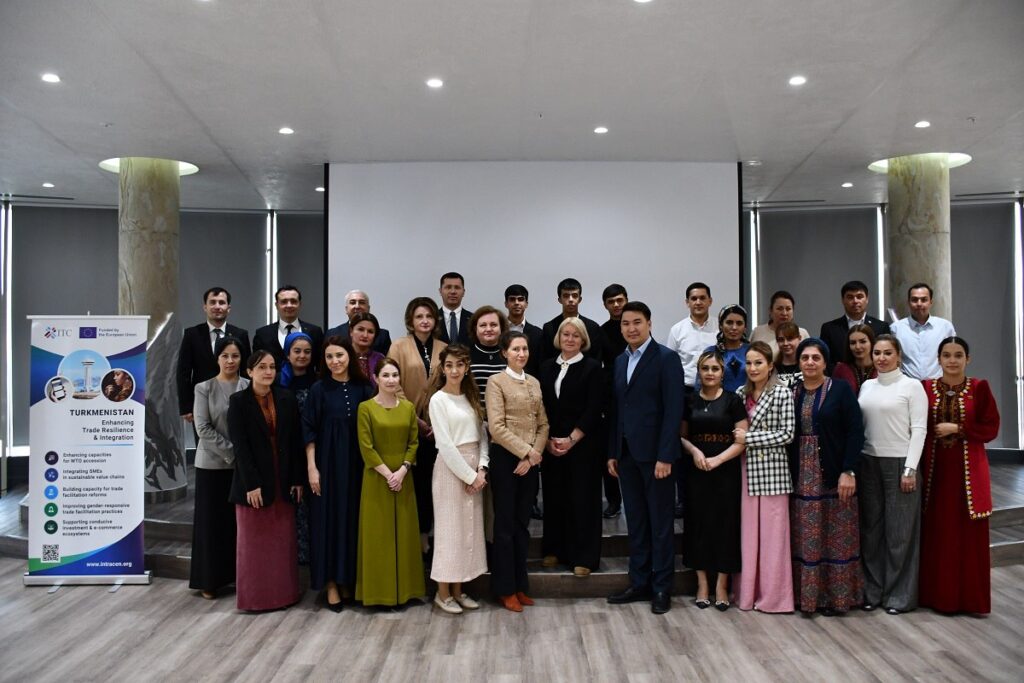
Ashgabat recently hosted a two-day seminar on Turkmenistan's prospects for joining the World Trade Organization. The event, organized by the Ministry of Finance and Economy and the International Trade Center (ITC), brought together representatives of the country's private sector and government agencies. ITC international experts Daria Karman, Alyson Hook, and Nurlan Kulbatyrov shared practical integration experience into the global trading system with the participants. Special attention was paid to Kazakhstan, whose path to the WTO can serve as an illustrative example for Turkmenistan. Among the key topics of discussion were the need to adapt legislation to international standards, reform trade policy, and modernize mechanisms for regulating foreign economic activity. For Turkmen entrepreneurs, accession to the WTO opens access to world markets and creates favorable conditions for increasing exports. However, this will require a significant increase in local enterprises' competitiveness and the introduction of modern production technologies. According to the event organizers, the active discussion of integration processes testifies to Turkmen business's serious attitude toward international cooperation. Such seminars are part of Turkmenistan's comprehensive preparation for accession to the WTO. In the future, this should create additional incentives for entrepreneurship and increase the country's export potential. Representatives of government agencies and the business community actively participated in the seminar, which confirmed Turkmenistan's interest in deepening integration processes and expanding international trade cooperation.

Uzbekistan Concludes WTO Membership Talks With 18 Countries

According to a report issued by Azizbek Urunov, President Special Representative on International Trade, Uzbekistan has now completed negotiations on membership of the World Trade Organization (WTO) with 18 countries. Negotiations with Argentina closed on September 13, and protocols on finalizing market access negotiations have been signed with 14 of the 18 member countries, including Brazil and Sri Lanka. Posting on LinkedIn on September 12, Urunov wrote: "In the margins of the WTO Public Forum, we had signing ceremonies with the participation of DPM Jamshid Khodjaev, DDG Xiangchen Zhang, and ex-DDG Alan Wolff. The Uzbek delegation, led by Madam Saida Mirziyoyeva, is participating in the 2024 WTO Public Forum in Geneva." After pursuing its goal for almost 30 years, Uzbekistan seeks further support from the U.S. support to join the World Trade Organization. To date, the U.S. has provided some technical help, and during a recent visit, U.S. Trade Representative Katherine Tai reaffirmed America’s support.  However, to forward progress and strengthen trade ties, Uzbekistan could benefit from greater involvement from such U.S. institutions as the Development Finance Corporation (DFC), Export-Import Bank (EXIM), and the U.S. Trade and Development Agency (USTDA). Following a meeting with Katherine Tai during her visit to Uzbekistan in June, Uzbekistan’s Presidential Assistant, Saida Mirziyoyeva stated,  “We intend to become a full-fledged participant in the international trade system and rely on the support of the United States to accelerate the process of Uzbekistan becoming a member of the WTO." For background, Uzbekistan initiated the process of joining the WTO in 1994 before abandoning it 2005. In 2019, the country strengthened its efforts to become a member of the WTO, and on July 7, 2020, the joint working group was restored.

U.S. Think Tank Calls on American Politicians to Make Uzbekistan a Valued Partner

Daniel Runde, a senior vice-president at the Washington, D.C.-based think tank the Center for Strategic and International Studies (CSIS), has called on American politicians to strengthen the U.S.'s relations with Uzbekistan. He believes that Uzbekistan, a key partner for the United States in Central Asia, deserves more attention from the West. With Russia’s invasion of Ukraine and growing competition with China, the U.S. could strengthen ties with Uzbekistan to promote regional stability and counterbalance Russian and Chinese influence. “Uzbekistan seeks more engagement with the United States through bilateral efforts and the “C5+1” (the five Central Asian countries plus the United States) diplomatic platform. We might never become Uzbekistan’s best friend. However, we could become better and more reliable friends. Uzbekistan has five bordering countries, and at one point in the early 2000s, it considered the United States its ‘sixth neighbor,’” Runde mentioned. “When the U.S. government was active in Afghanistan, we supported Uzbekistan’s efforts to develop its economy and invest in its security. With our disengagement from Afghanistan, we need to look at Uzbekistan as the valued partner that it could be and re-engage. We should work towards the day that Uzbekistan considers the United States its ‘sixth neighbor’ again.” According to Runde, there are several goals that the US could assist Uzbekistan in achieving. While some are significantly more difficult to handle, others are relatively straightforward: 1) Uzbekistan wants U.S. support to join the World Trade Organization (WTO), a goal it has pursued for almost 30 years. The U.S. has provided some technical help, and during a recent visit, U.S. Trade Representative Katherine Tai reaffirmed America’s support. For further progress, Uzbekistan could benefit from greater involvement from U.S. institutions like the Development Finance Corporation (DFC), Export-Import Bank (EXIM), and U.S. Trade and Development Agency (USTDA) to strengthen trade ties with the U.S. 2) Uzbekistan and other Central Asian countries want the U.S. to repeal the Jackson-Vanik Amendment, which restricts regular trade with them. This amendment, initially targeting Soviet-era policies, is now outdated and seen as disrespectful, as it treats these nations as if they are still part of the Soviet Union. Repealing it would show that the U.S. respects their independence and is ready to treat them as equal partners. “Jackson-Vanik now restricts normal trade relations with several existing and former nonmarket economies, including Uzbekistan. For countries like Uzbekistan, Jackson-Vanik is a sign of disrespect that encourages them to take their business to China, Russia, Turkey, or the Gulf,” Runde argues. 3) He notes that many developing countries, including Uzbekistan, would like to see Congress successfully renew the Generalized System of Preferences (GSP), a trade preference program. “The GSP benefited many developing countries by providing duty-free treatment for their products. With the absence of this program, trade volumes between Uzbekistan and the United States have not been as impressive as they might have been. Compare U.S. trade with Uzbekistan and Uzbekistan’s trade with China, Russia, or the EU. The lapse of the U.S. GSP has had a real impact on our influence...

Turkmenistan Officials in Georgia to Prepare for WTO Application

A delegation from Turkmenistan has arrived in the Georgian capital of Tbilisi on a study visit to research the best practices for accession to the World Trade Organization (WTO), and promotion of national trade policy. This was reported by the state media agency Turkmenportal. The visit, organized by the OSCE Centre in Ashgabat, will reportedly last from 27 to 31 May. The delegation includes representatives of the Ministry of Finance and Economy, Ministry of Justice,  the Central Bank, and the State Customs Service. Meetings have been held with Georgia's Ministry of Economy and Sustainable Development, Ministry of Foreign Affairs, Tax Service, and Customs Department.