

• KZT/USD = 0.00221
  • TJS/USD = 0.10830
  • UZS/USD = 0.00008
  • TMT/USD = 0.29760
  • KZT/USD = 0.00221
  • TJS/USD = 0.10830
  • UZS/USD = 0.00008
  • TMT/USD = 0.29760
  • KZT/USD = 0.00221
  • TJS/USD = 0.10830
  • UZS/USD = 0.00008
  • TMT/USD = 0.29760
  • KZT/USD = 0.00221
  • TJS/USD = 0.10830
  • UZS/USD = 0.00008
  • TMT/USD = 0.29760
  • KZT/USD = 0.00221
  • TJS/USD = 0.10830
  • UZS/USD = 0.00008
  • TMT/USD = 0.29760
  • KZT/USD = 0.00221
  • TJS/USD = 0.10830
  • UZS/USD = 0.00008
  • TMT/USD = 0.29760
  • KZT/USD = 0.00221
  • TJS/USD = 0.10830
  • UZS/USD = 0.00008
  • TMT/USD = 0.29760
  • KZT/USD = 0.00221
  • TJS/USD = 0.10830
  • UZS/USD = 0.00008
  • TMT/USD = 0.29760
17 October 2026

Viewing results 1 - 6 of 3

Teen in Kazakhstan Develops AI Sign Language Translator

Fifteen-year-old Sanzhar Yerezhepov is developing an artificial intelligence (AI) translator to make online information more accessible to deaf people in Kazakhstan. Called Tusin (“Understand”), the platform converts speech and text into lifelike sign language videos that reproduce facial expressions as well as hand movements. Yerezhepov attends Daryn, a specialized school for gifted children in Kokshetau, northern Kazakhstan. A boarding school for children with hearing and speech impairments is located nearby. Watching its students communicate in sign language made him wonder how easily they could access information online, giving him the idea for Tusin. Yerezhepov is from Shiyeli, a small village in Kazakhstan’s Burabay district. Neither of his parents works in science or IT. He is now working with the Kazakhstan Society of the Deaf to test an early version of Tusin and says five organizations have expressed willingness to work with him. The project reached the semifinals of an IT competition at Astana Hub, Kazakhstan’s international technology park for startups. In an interview with The Times of Central Asia, Yerezhepov explains why translating into sign language is more complicated than adding subtitles. He discusses the medical startup he put on hold and what he hopes to change in Kazakhstan’s education system. TCA: Tusin translates online content into sign language, but many videos already have subtitles. Why are those sometimes not enough for deaf viewers? Yerezhepov: For some deaf people, especially those whose primary language is sign language, understanding written text can be difficult. First, subtitles are not always available in a language they are comfortable with. They are often automatically generated and do not convey information accurately. Second, sign language has its own grammar and structure. So even someone living in Kazakhstan may have difficulty understanding subtitles in Kazakh or Russian. Many deaf people can read subtitles fluently, but others need sign language translation. TCA: Isn’t sign language the same around the world? Yerezhepov: No. Different countries use different sign languages. There is no single universal sign language that everyone on Earth understands. TCA: So which sign language is used in Kazakhstan? Yerezhepov: Kazakhstan, like some other former Soviet countries, uses Russian Sign Language. We do not have a separate Kazakh Sign Language, although some signs have been adapted. TCA: How do you teach artificial intelligence to understand and reproduce signs? Who checks its work? Yerezhepov: We work with representatives of the Akmola branch of the Kazakhstan Society of the Deaf and with sign language interpreters. Together, we examine each sign, check how accurately it is reproduced, and analyze the results. We have already demonstrated our technology to deaf and hard-of-hearing people, and they understand what the platform communicates. TCA: A sign can change meaning depending on the situation. How does Tusin handle that? Yerezhepov: Quite well, although we are still working on it. The same sign can have different meanings depending on the context. That is exactly the problem we are addressing with artificial intelligence, which can take context into account and determine what is being communicated. Our platform...
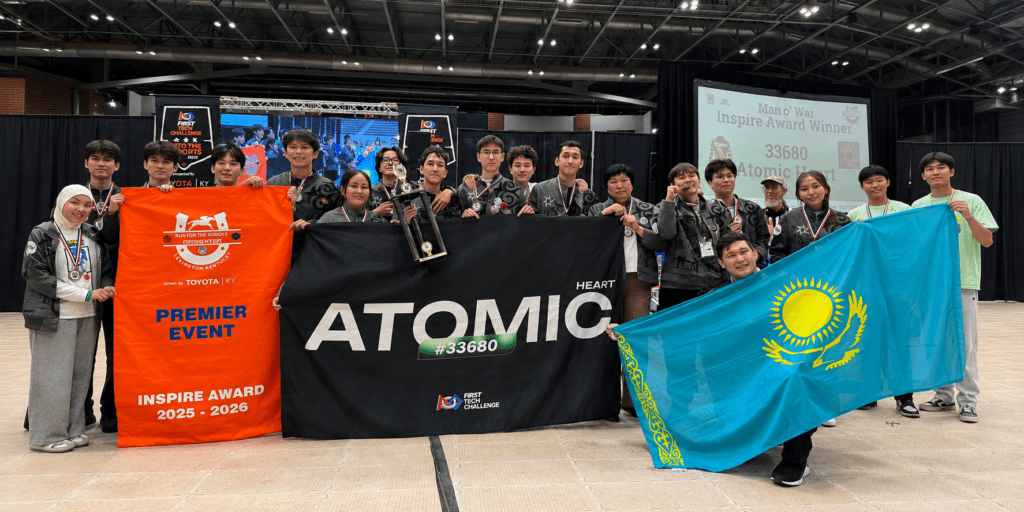

Kazakh Robotics Team Wins Top Judged Award at U.S. Tech Event

SHYMKENT — A school robotics team from southern Kazakhstan has won the Inspire Award in its division at a FIRST Tech Challenge Premier Event in the United States, giving Kazakhstan another international youth technology success. Atomic Heart, Team #33680 from NIS Shymkent Abai, won the Inspire Award at the Run for the Robots Premier Event - Man o' War Division, held May 28-30 at the Alltech Arena at the Kentucky Horse Park in Lexington, Kentucky. FIRST's official results list Atomic Heart as the division's Inspire Award winner, ahead of U.S. teams from Missouri and Pennsylvania. [video width="832" height="464" mp4="https://timesca.com/wp-content/uploads/2026/06/first_13_seconds_no_watermark.mp4"][/video] The Inspire Award is a judged prize rather than a match result. It recognizes a team that performs strongly across robot design, engineering documentation, presentation, outreach, and teamwork. For Atomic Heart, the result was notable because FIRST lists the team as a 2025 rookie team. "The first INSPIRE on Premier Event in KZ history," Asylbek Myrzakhmet, founder of Asylbek Robotics, said, describing the scale of the result for Kazakhstan's robotics community. Atomic Heart's route to Kentucky followed a difficult first season. The team competed in official events in Kazakhstan before reaching the U.S. event. Its early tournaments included technical failures and defeats, but those setbacks helped the students improve their robot and engineering process before the Premier Event. [caption id="attachment_50379" align="aligncenter" width="1774"] The robot ATOM[/caption] The competition also required the students to present their work in English to international judges, adding a public-speaking and project-defense challenge to the engineering task. Team member Alisultan Otan said the trip to Kentucky also brought an unexpected cultural connection. "When we arrived in Kentucky, I was surprised by how strong the horse culture is here," he said. "It immediately reminded me of Kazakhstan, where the horse is an integral part of our history and lifestyle. Despite the distance, it made us feel deeply connected to the place." FIRST Tech Challenge is a youth robotics program for students aged 12-18, in which teams design, build, and program robots for an annual game. FIRST says the program combines engineering, STEM skills, community outreach, and teamwork. Kazakhstan has placed growing emphasis on technical and digital skills in schools, including reforms focused on vocational education and digital technologies. Atomic Heart's result points to the value of school-level robotics programs that give students early exposure to engineering, programming, and international competition.

Dushanbe Teen Develops Tajikistan’s First AI Legal Assistant

Tajikistan has launched its first AI-powered legal assistant, designed to simplify access to legal information by explaining laws in plain language. The project, called Moni, was developed by 15-year-old Foteh Azizov, a tenth-grade student at School No. 6 in Dushanbe. Already, the platform is being used not only by the general public but also by practicing lawyers.  Azizov said the idea for Moni came from his own experience. While helping with content and promotion at his uncle’s law firm, he noticed how difficult it was for ordinary people and even himself, to understand the complex language used in legal documents. “Laws are often written in a complicated style, full of terminology,” Azizov explained. “That’s when I came up with the idea of creating a tool that explains the law in simple and accessible language for everyone.” He pitched the idea to his uncle, who supported the initiative and helped organize the project. “My motivation only grew, I wanted to build something that could really help people,” Azizov said. He taught himself the fundamentals of artificial intelligence, working through trial and error to create a functional prototype. A professional programmer later joined the team, assisting with website development and refining the platform’s features. Since its launch, Moni has proven useful not just to citizens but also to legal professionals, who use it as a convenient reference tool. The service is a free AI assistant specializing in Tajik law. It helps users locate relevant articles across a wide range of legal areas, including tax, land, labor, civil, and administrative law. Moni supports queries in multiple languages, including Tajik, Russian, English, and Kazakh. All inquiries are anonymous, and the platform does not collect any personal data. Its responses are based solely on publicly available legal documents. The most frequently asked questions revolve around taxes, business regulations, employment law, civil rights, and administrative violations. Looking ahead, Azizov says the team has many ideas for improving the platform, but their immediate goal is to continue developing the current product. “Our aim is to remain a free, user-friendly resource and become an indispensable legal advisor for everyone,” he said.
