Fifteen-year-old Sanzhar Yerezhepov is developing an artificial intelligence (AI) translator to make online information more accessible to deaf people in Kazakhstan. Called Tusin (“Understand”), the platform converts speech and text into lifelike sign language videos that reproduce facial expressions as well as hand movements.
Yerezhepov attends Daryn, a specialized school for gifted children in Kokshetau, northern Kazakhstan. A boarding school for children with hearing and speech impairments is located nearby. Watching its students communicate in sign language made him wonder how easily they could access information online, giving him the idea for Tusin.
Yerezhepov is from Shiyeli, a small village in Kazakhstan’s Burabay district. Neither of his parents works in science or IT.
He is now working with the Kazakhstan Society of the Deaf to test an early version of Tusin and says five organizations have expressed willingness to work with him. The project reached the semifinals of an IT competition at Astana Hub, Kazakhstan’s international technology park for startups.
In an interview with The Times of Central Asia, Yerezhepov explains why translating into sign language is more complicated than adding subtitles. He discusses the medical startup he put on hold and what he hopes to change in Kazakhstan’s education system.
TCA: Tusin translates online content into sign language, but many videos already have subtitles. Why are those sometimes not enough for deaf viewers?
Yerezhepov: For some deaf people, especially those whose primary language is sign language, understanding written text can be difficult. First, subtitles are not always available in a language they are comfortable with. They are often automatically generated and do not convey information accurately. Second, sign language has its own grammar and structure. So even someone living in Kazakhstan may have difficulty understanding subtitles in Kazakh or Russian. Many deaf people can read subtitles fluently, but others need sign language translation.
TCA: Isn’t sign language the same around the world?
Yerezhepov: No. Different countries use different sign languages. There is no single universal sign language that everyone on Earth understands.
TCA: So which sign language is used in Kazakhstan?
Yerezhepov: Kazakhstan, like some other former Soviet countries, uses Russian Sign Language. We do not have a separate Kazakh Sign Language, although some signs have been adapted.
TCA: How do you teach artificial intelligence to understand and reproduce signs? Who checks its work?
Yerezhepov: We work with representatives of the Akmola branch of the Kazakhstan Society of the Deaf and with sign language interpreters. Together, we examine each sign, check how accurately it is reproduced, and analyze the results. We have already demonstrated our technology to deaf and hard-of-hearing people, and they understand what the platform communicates.
TCA: A sign can change meaning depending on the situation. How does Tusin handle that?
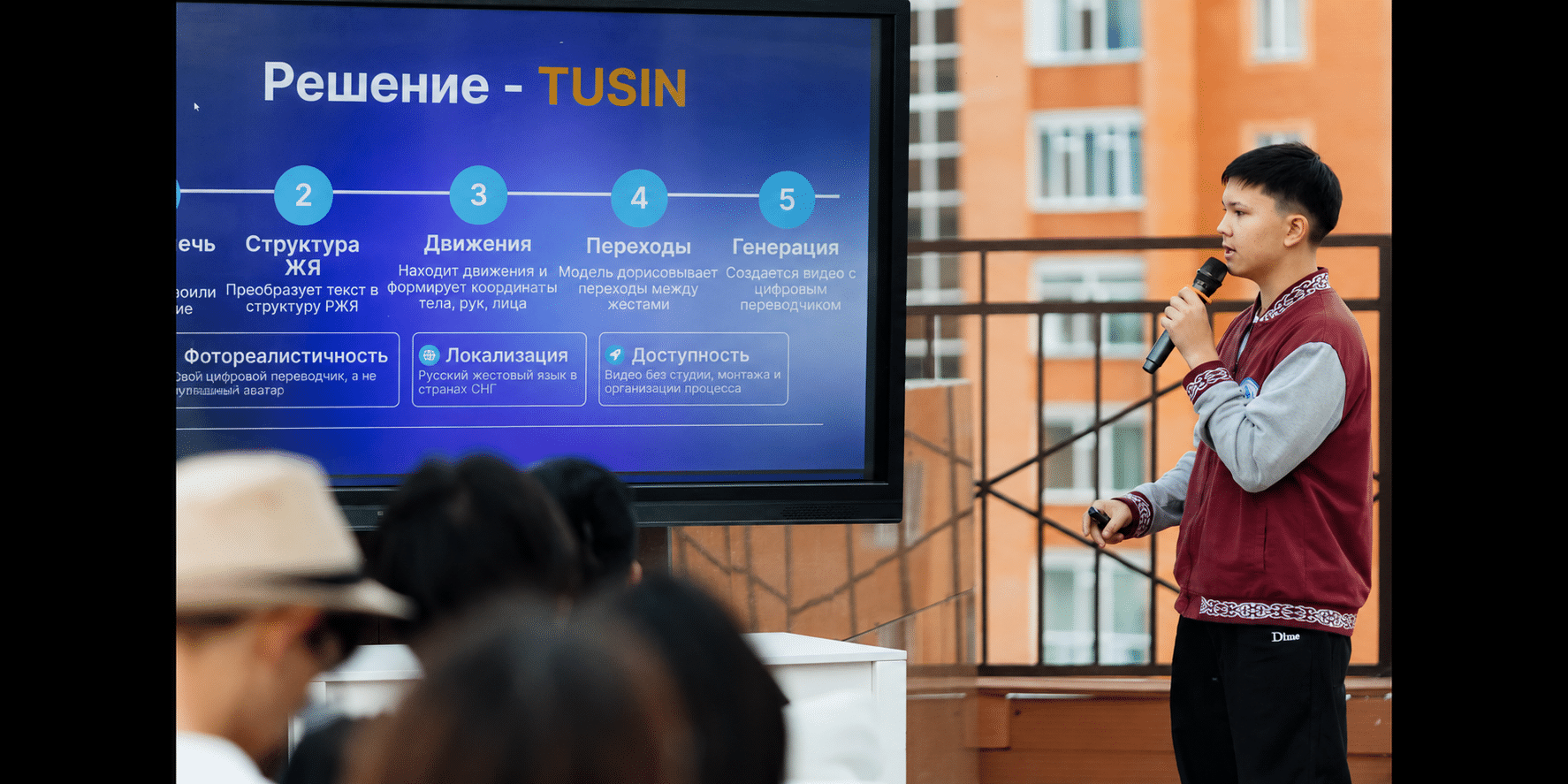
Yerezhepov: Quite well, although we are still working on it. The same sign can have different meanings depending on the context. That is exactly the problem we are addressing with artificial intelligence, which can take context into account and determine what is being communicated. Our platform also generates photorealistic videos that convey facial expressions and emotions, which are a very important part of sign language.
TCA: The Kazakhstani app SignBridge uses 3D avatars. Why did you decide to focus on photorealistic video?
Yerezhepov: During customer development, or research into whether potential customers need a product and are willing to pay for it, we discovered that ordinary 3D avatars do not always convey sign language accurately enough. As I mentioned, the same sign can have several meanings, so you also need to pay attention to emotions and facial expressions, and 3D models do not reproduce them well enough. That is why we focused on photorealism. There is currently no comparable product in the Commonwealth of Independent States market that pays this much attention to that aspect.
TCA: Will Tusin support other languages as you expand across the Commonwealth of Independent States (CIS)? What about English?
Yerezhepov: For now, we are working with Kazakh and Russian. Once we scale up the project in Kazakhstan, we plan to enter the CIS market and gradually add Central Asian languages. Russian Sign Language will remain the main sign language because, as I mentioned, it is used in several CIS countries. Our system can also recognize spoken English, but it will translate it into Russian Sign Language. If we eventually enter the international market, we will be able to add other sign languages, such as British and American Sign Language.
TCA: Are similar technologies already available abroad?
Yerezhepov: Yes, there is already a similar startup operating in the British market. It also emphasizes photorealism and uses the sign languages used in Britain and America. We studied its experience, and it inspired us.
TCA: Do you think you might compete with it someday?
Yerezhepov: I think it is possible, although, as I said, we are focusing primarily on Kazakhstan and the CIS countries. The British startup focuses on transportation and media, while we want to provide services to a broader range of customers. For example, any company could approach us with a specific request and receive a finished video translated into sign language.
TCA: Who might use Tusin first?
Yerezhepov: We expect our customers to include not only government institutions but also companies, so we are targeting both the business-to-government and business-to-business markets. It could be almost anyone. For example, television news channels are required to provide sign language interpretation for one of their daily news programs. Or transportation organizations: bus operators, railway stations, and airports, where important announcements are often made only over loudspeakers, without accompanying text. Private companies could also adopt our technology. Banks, for example, could use our platform at terminals and customer service locations.
TCA: Businesses in Kazakhstan are not required to translate all their information into sign language. What might persuade companies to pay for such a service?
Yerezhepov: Kazakhstan’s legislation does not currently require all private companies to provide sign language interpretation for their information. But quite recently, on September 7, 2026, sign language was officially recognized in Kazakhstan’s Social Code as an independent language system. We hope additional requirements for information accessibility will eventually be introduced. But demand for our product depends not only on legislation. It also depends on how much companies care about their reputation and social responsibility. For example, Freedom pays attention to inclusivity and making its services accessible to people with hearing and speech impairments. There are other examples, too. Samsung in Kazakhstan trains its employees in sign language so deaf customers can visit stores independently, communicate with sales assistants, and make purchases.
TCA: How large is Tusin’s potential audience? How many people in Kazakhstan need accessible translation?
Yerezhepov: According to the Ministry of Labor and Social Protection of the Population, Kazakhstan has more than 30,000 people with hearing impairments, although the actual number may be significantly higher. Experts estimate that there could be between 150,000 and 200,000. Worldwide, according to the World Health Organization, more than 1.5 billion people have some degree of hearing loss, and 430 million require rehabilitation services. The World Federation of the Deaf estimates that approximately 70 million people use sign language.
TCA: Who has helped you develop Tusin?
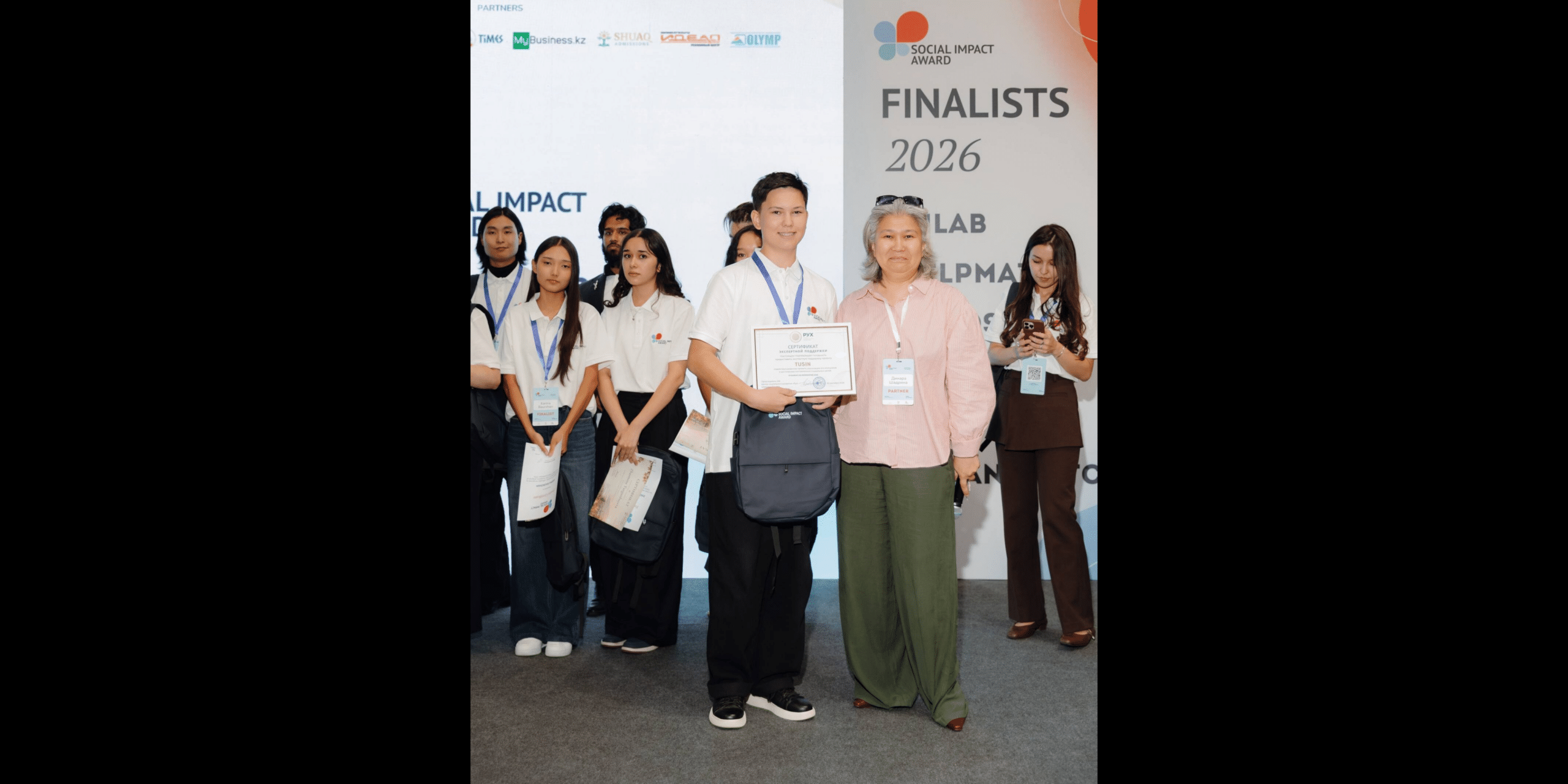
Yerezhepov: I developed the project together with my academic supervisor, Gulnur Maksetovna Karamanova, a computer science teacher at Daryn School. We also participated in incubation programs, including Startup Orda 2.0 and Social Impact Award Kazakhstan, where we worked with mentors Dauken Seitkali, co-founder of the startup Arlan Biotech, and Alina Akhmetshina. They helped us develop the project, organized meetings where we analyzed our decisions, introduced us to different people, and helped us build useful connections.
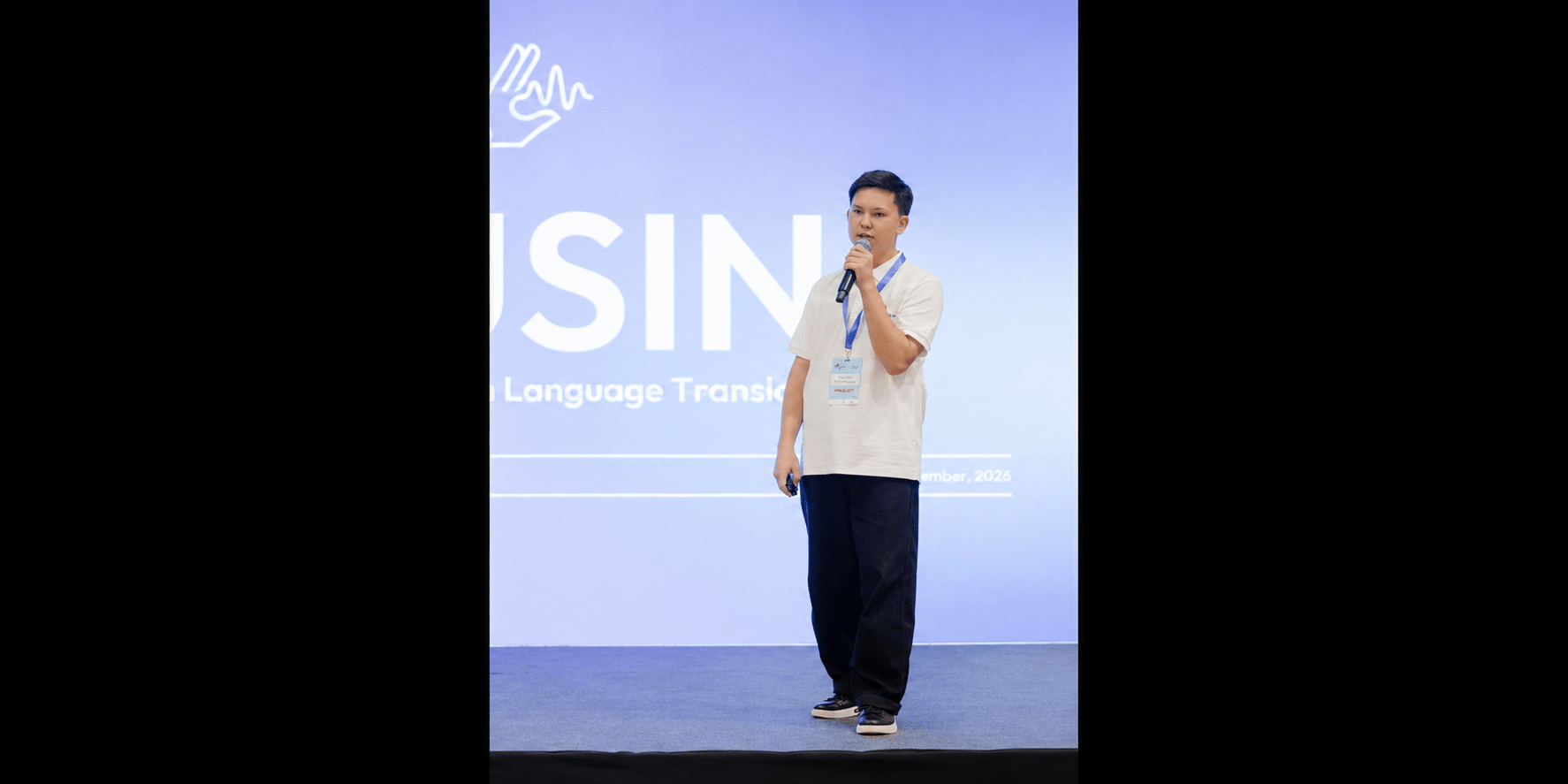
TCA: You are only 15, but you already have several scientific projects behind you. What have you worked on so far?
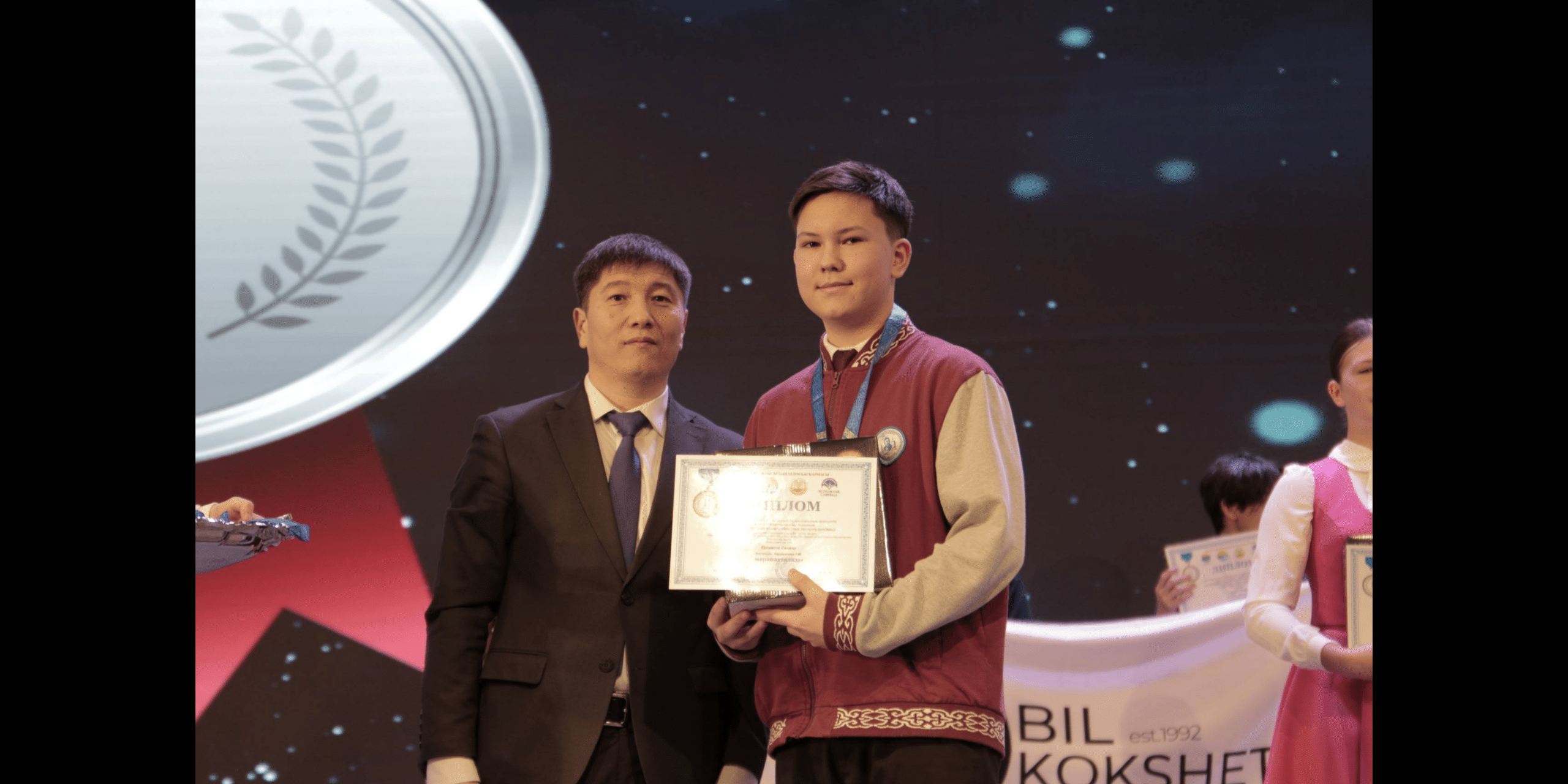
Yerezhepov: I enjoy programming and participate in computer science olympiads. I won a silver medal at the regional stage of the Republican Informatics Olympiad and also participated in the national finals. In addition, I have been working on scientific projects in chemistry, computer science, and IT for four years now. This year, I won a bronze medal in the Applied Science category at Infomatrix Asia 2026, an international competition for school students in computing and innovation.
TCA: You also worked on a medical technology project. What became of it?
Yerezhepov: This year, I worked on developing a system for the early detection of chronic kidney disease using standard blood and urine tests. I had previously tried to develop the idea as a startup through the Startup Orda incubation program, but after testing the idea and studying the market, I realized it was too early for me to enter medtech. So I decided to put the startup on hold and focus on another project.
TCA: Why did you decide that medical technology was still too complicated an area for a startup?
Yerezhepov: Well, I do not have a medical education, and there are also enormous costs and responsibilities involved. Registering such a software product as a medical device requires substantial funding. You need to attract investors and go through the relevant procedures, which is a very complicated process. Besides, medicine is a field where the cost of making a mistake is especially high. So I decided to focus on other social projects that also help people. After all, I came up with the idea for Tusin about a year ago. As for the kidney-related project, I am continuing to develop it as a scientific research project. If everything works out, we plan to try turning it into a full-fledged startup again in the future.
TCA: Why are you more interested in social projects than, say, developing computer games?
Yerezhepov: I guess I simply want to help people. I think that is one reason why I am not particularly interested in developing computer games. I play video games myself, but creating them is not as interesting to me. I much prefer working with real people, solving real problems, and creating products that can bring someone a specific benefit.
TCA: You also worked with waste from a gold mining company. What exactly did you study?
Yerezhepov: We had a chemistry project focused on removing heavy metals, particularly arsenic, from wastewater. Arsenic is one of the most difficult contaminants to remove. We worked with Shokan Ualikhanov University in Kokshetau and with Altyntau Kokshetau, one of Kazakhstan’s largest gold producers. We worked specifically with wastewater from that company and studied ways to treat it.
TCA: Was the goal to make the treated water safe to discharge into the environment?
Yerezhepov: Not only that. Our idea was to treat the wastewater and then reuse it in production rather than simply discharge it into the environment. In other words, we wanted to make it possible for the water to be used again in industrial processes after treatment.
TCA: You are preparing for the International English Language Testing System (IELTS) and SAT exams. What are your plans for university?
Yerezhepov: I want to become an AI engineer and study abroad, particularly in the United States. I am currently preparing for the IELTS and SAT exams. My goal is to score 7.5 on the IELTS.
TCA: And after studying in the U.S., do you plan to stay there or return home?
Yerezhepov: I plan to get an education abroad and then apply everything I have learned in Kazakhstan. In addition to social projects, I want to develop competitive programming, also known as olympiad programming, in our country. This is a field where participants compete to solve complex algorithmic problems. There are prestigious international competitions, such as the International Olympiad in Informatics for school students and the International Collegiate Programming Contest for university students. Results in these competitions are highly valued by leading universities and major technology companies such as Google and Amazon. AI olympiads are also developing. I would like Kazakhstan to achieve greater success in this field as well.
TCA: Why is it so important to you to develop competitive programming specifically in Kazakhstan?
Yerezhepov: I want children from villages and remote communities to have the same opportunities as students from major cities and specialized schools. Ordinary rural schools often have computer science teachers who have not received specialized training in competitive programming. As a result, their students find it much harder to compete with children from specialized schools and win prizes in competitions. I understand this problem very well because I live in a village myself. I don’t want where talented children are born or live to determine their opportunities.
TCA: Are there many people your age who could create their own technology companies?
Yerezhepov: A lot. I believe Kazakhstan has enormous potential in IT, artificial intelligence, and technology startups. We have many government and private programs aimed at developing these industries, such as Astana Hub and Startup Orda. Artificial intelligence is also being adopted very actively in the country, both by private companies and government institutions. I think when school students and young people encounter AI technologies, they become curious about how everything works. They start exploring how these systems are created and can gradually find their own way into the field. After all, big goals always begin with small steps, with simple curiosity and a desire to learn something new.
TCA: You work extensively with AI. Do you believe its widespread adoption is always beneficial?
Yerezhepov: Personally, I have a neutral attitude toward artificial intelligence. It all depends on how you use it. For example, if a student simply uses AI to copy homework answers, that is bad. But if you use it for research, to find information, discuss ideas, develop a preliminary research plan, understand difficult topics, or help with scientific papers and other projects, then it can be really useful. At the same time, you need to do the actual work yourself and verify information and conclusions against reliable sources.
TCA: Do you use AI yourself when developing Tusin? How do you verify its answers?
Yerezhepov: Yes, of course we use it. But we always double-check information we obtain through artificial intelligence. We also work with mentors and representatives of various organizations who help us verify data and evaluate the results.
TCA: Do you remember how your interest in computers began?
Yerezhepov: I have been interested in computers and different kinds of technology since early childhood. I got a phone at a fairly young age, and I think that helped spark my interest in technology. I also started programming when I was young, and I did not choose the easiest path. My first programming language was C++, a fairly complex language used even by experienced developers. In other words, instead of starting with something easy, I decided to challenge myself with something more difficult right away. And as you can see, it paid off.