• KGS/USD = 0.01144 0%
  • KZT/USD = 0.00201 0%
  • TJS/USD = 0.10448 -0.19%
  • UZS/USD = 0.00008 0%
  • TMT/USD = 0.28490 0%
  • KGS/USD = 0.01144 0%
  • KZT/USD = 0.00201 0%
  • TJS/USD = 0.10448 -0.19%
  • UZS/USD = 0.00008 0%
  • TMT/USD = 0.28490 0%
  • KGS/USD = 0.01144 0%
  • KZT/USD = 0.00201 0%
  • TJS/USD = 0.10448 -0.19%
  • UZS/USD = 0.00008 0%
  • TMT/USD = 0.28490 0%
  • KGS/USD = 0.01144 0%
  • KZT/USD = 0.00201 0%
  • TJS/USD = 0.10448 -0.19%
  • UZS/USD = 0.00008 0%
  • TMT/USD = 0.28490 0%
  • KGS/USD = 0.01144 0%
  • KZT/USD = 0.00201 0%
  • TJS/USD = 0.10448 -0.19%
  • UZS/USD = 0.00008 0%
  • TMT/USD = 0.28490 0%
  • KGS/USD = 0.01144 0%
  • KZT/USD = 0.00201 0%
  • TJS/USD = 0.10448 -0.19%
  • UZS/USD = 0.00008 0%
  • TMT/USD = 0.28490 0%
  • KGS/USD = 0.01144 0%
  • KZT/USD = 0.00201 0%
  • TJS/USD = 0.10448 -0.19%
  • UZS/USD = 0.00008 0%
  • TMT/USD = 0.28490 0%
  • KGS/USD = 0.01144 0%
  • KZT/USD = 0.00201 0%
  • TJS/USD = 0.10448 -0.19%
  • UZS/USD = 0.00008 0%
  • TMT/USD = 0.28490 0%

Viewing results 1969 - 1974 of 2928

Kazakhstan Seeks U.S. Cooperation to Develop Critical Minerals

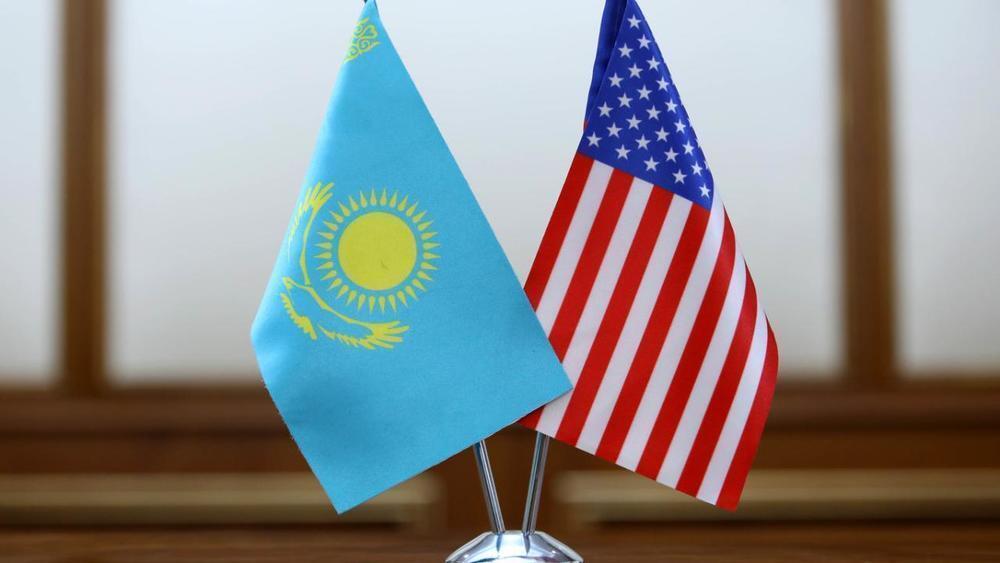
During a visit to the United States on March 1st, Kazakhstan’s Minister of Industry and Construction, Kanat Sharlapaev met David Applegate, director of the U.S. Geological Survey, to discuss expanding bilateral cooperation regarding mineral deposits in Kazakhstan. Of Kazakhstan’s 50 types of minerals, 17 were identified by the U.S. Geological Survey as critical. As reported by Sharlapaev, the key aims of future collaborations are attracting investment in geological exploration, mining, and the processing of rare and rare-earth metals, as well as facilitating Kazakhstan's integration to the global market through cutting-edge technologies and expertise. Speaking at a roundtable discussion at the U.S. Chamber of Commerce with members of the Kazakh-American Business Council (USKZBC) and representatives of American companies, the minister outlined the benefits afforded by consolidating the partnership between Kazakhstan and the USA. Emphasis was placed on the strategic potential of mining rare and rare earth metals and the development of related industries. In particular, he cited the importance of creating a cluster of industries in Kazakhstan to produce raw materials for batteries, including nickel, cobalt, manganese, and lithium and with reference to reforms on the use of subsoil to attract investment, encouraged US mining companies to participate in forthcoming auctions in Kazakhstan.

A New Railway Project for China, Kyrgyzstan and Uzbekistan

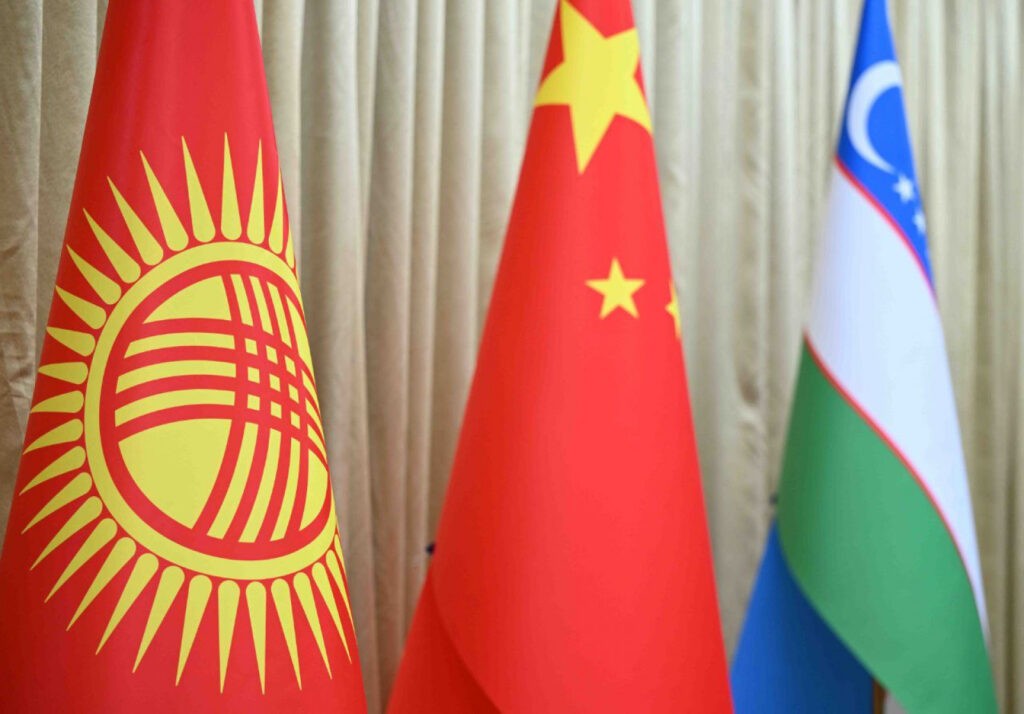
On March 1st, Akylbek Japarov Chairman of the Cabinet of Ministers of the Kyrgyz Republic, Abdulla Aripov Prime Minister of Uzbekistan and Ma Xingrui Communist Party Secretary of China’s western Xinjiang Uygur Autonomous Region, met in Kashgar (Xinjiang) to discuss the construction of the China-Kyrgyzstan-Uzbekistan railway. Japarov first praised the incentive for its potential to strengthen the development of trade and economic cooperation between the three countries and reported that a jointly funded feasibility study of the project had already been developed and approved. Uzbekistan’s Prime Minister Aripov expressed his country’s interest in developing multimodal transport routes to support the joint construction of the China-Kyrgyzstan-Uzbekistan railway. Addressing the insufficient throughput capacity of the Irkeshtam checkpoint on the Kyrgyz-Chinese border, Japarov stated, “increasing the volume of cargo throughput at the Irkeshtam checkpoint is an issue relevant to both the Kyrgyz and Chinese sides, as well as the Uzbek side. It is therefore important that all checkpoints are modernized and equipped with updated means of customs control.” He then reported that new customs inspection complexes at the Irkeshtam and Torugart checkpoints to be installed this year, will allow up to 125 vehicles per hour to cross the border, and added that the Kyrgyz side aims to increase the throughput capacity of these checkpoints to 1,000 vehicles per day. In the interest of developing trade and economic ties, the Secretary of Xinjiang’s Party Committee welcomed the Kyrgyz Prime Minister's proposals and supported his stance that Xinjiang is perceived as a gateway to China from Kyrgyzstan and in turn, several other Central Asian countries.

Rosatom Looks to Promote Small-Scale Nuclear Power in Central Asia

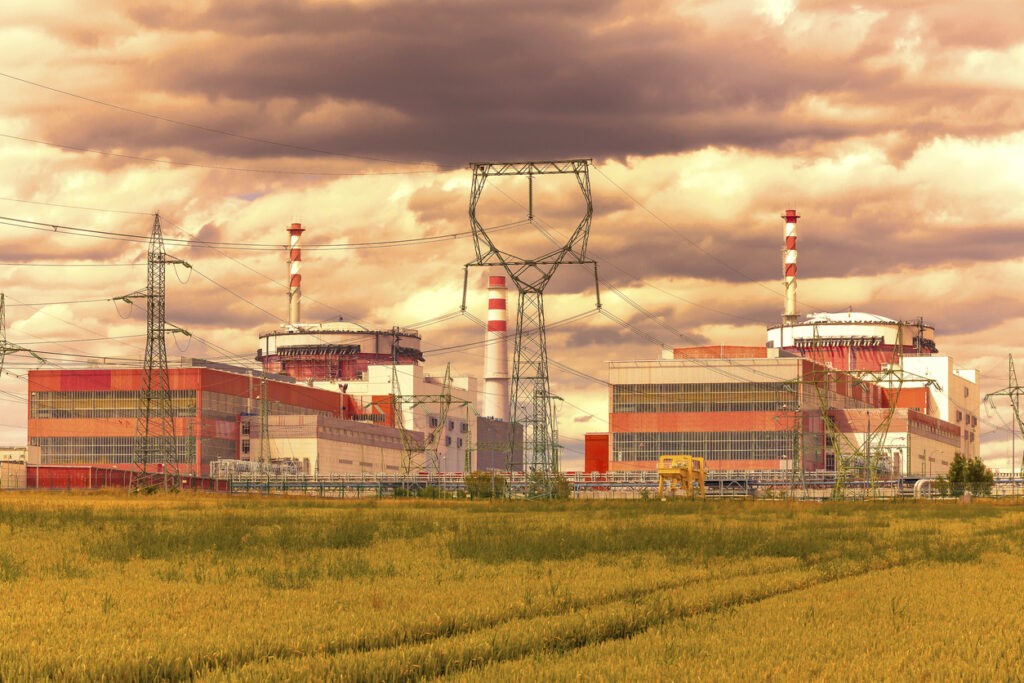
The Russian state corporation Rosatom is discussing the construction of small-capacity nuclear power plants (SCNPPs) with Kyrgyzstan, Uzbekistan, Myanmar and some island nations in East Asia, according to Rosatom's general director Aleksey Likhachev. According to him, demand for small-scale nuclear plants is increasing globally, and, according to Rosatom analysis, in the next 10-15 years up to 30-40 GW of small-capacity reactors will be commissioned. The company is now discussing joint projects on SCNPP with Norilsk Nickel, Gazprom, Lukoil and Russian Platinum. Last December Rosatom and the Mongolian company Mon-Atom signed a memorandum on the construction of a low-capacity nuclear power plant in Mongolia. In early 2023 the parties signed a memorandum on cooperation in the field of peaceful atomic use, and development of a project for the Center for Nuclear Science and Technology. In Uzbekistan, the issue of joint construction of a nuclear plant with Russia has been under discussion since 2018. Under one agreement Rosatom will build two VVER-1200 units with a capacity of 1.2 GW each near Lake Tuzkan in the Jizzakh region. The nuclear plant's potential to compensate for energy shortages and to decarbonize the country's energy sector form a clear rationale for its construction. The project, which should take six years to build, is assessed as promising by both power engineers and environmentalists. Furthermore, considering that Uzbekistan is one of the world's five biggest producers of uranium, it should always be able to fully supply its nuclear reactors with fuel. Rosatom is proposing a "dry cooling tower" design for Uzbekistan -- a technically more complicated option, but, given the growing water shortage in Central Asia, increasingly relevant. South Korea's Hyundai has also expressed interest in building SCNPPs in Uzbekistan. Hyundai is proposing its latest modular reactors based on integrated systems (SMART), where high-pressure water is used for cooling. Such reactors, despite their small size, are capable of generating up to 110 MW of energy, and their compactness and mobility allow them to be installed in the remote mountainous terrain of Central Asia. In addition to Uzbekistan, Rosatom is considering building a nuclear power plant in neighboring Kyrgyzstan. Experts suggest installing two power units of 55 MW each. The corresponding memorandum was signed by Rosatom and Kyrgyzstan in January 2022 during the World Expo-2022 in the UAE. Experts believe that an SCNPP project could appear in Kyrgyzstan no earlier than 2028.

Kyrgyzstan Makes Strides in Digital Technologies

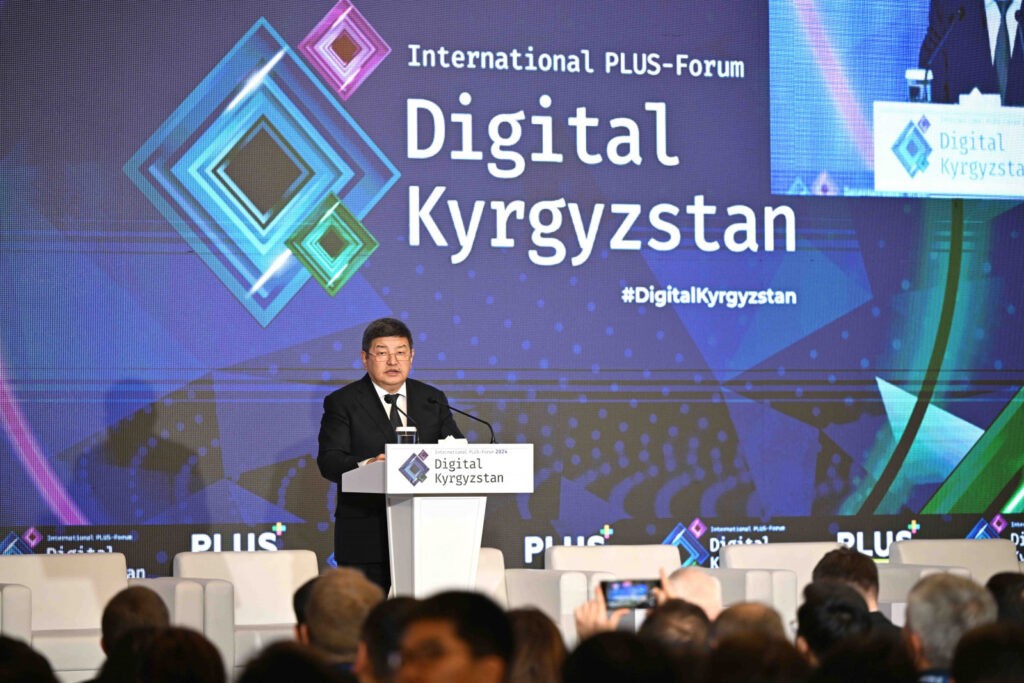
At the International PLUS-Forum ‘Digital Kyrgyzstan’ on 28th February, Akylbek Japarov, Chairman of the Cabinet of Ministers of the Kyrgyz Republic, announced that Kyrgyzstan is to create a Centre for Innovative Technologies. The centre for the advancement of developments in the field, including Artificial Intelligence and quantum computing, will be a non-governmental institution, financed through government subsidies and sponsorship. The prime minister emphasized the government’s commitment to introducing digital technologies and by expanding state provision, provide an open digital society in Kyrgyzstan. This year, the country is set to adopt its first-ever Digital Code. Online registration of motor vehicles, introduced back in September 2023, now allows the sale and purchase of cars through a mobile app. “It is now possible to create, re-register and liquidate a legal entity without leaving your home,” stated Mr Japarov, adding that online purchase and sale of real estate will be launched on March 1st. Touching upon the development of AI in Kyrgyzstan, he referenced the government’s purchase of a supercomputer which able to recognize and synthesize speech, is already being used to broadcast news in the Kyrgyz language on state radio channels.

Kazakhstan Gets New Logistics Terminal in China

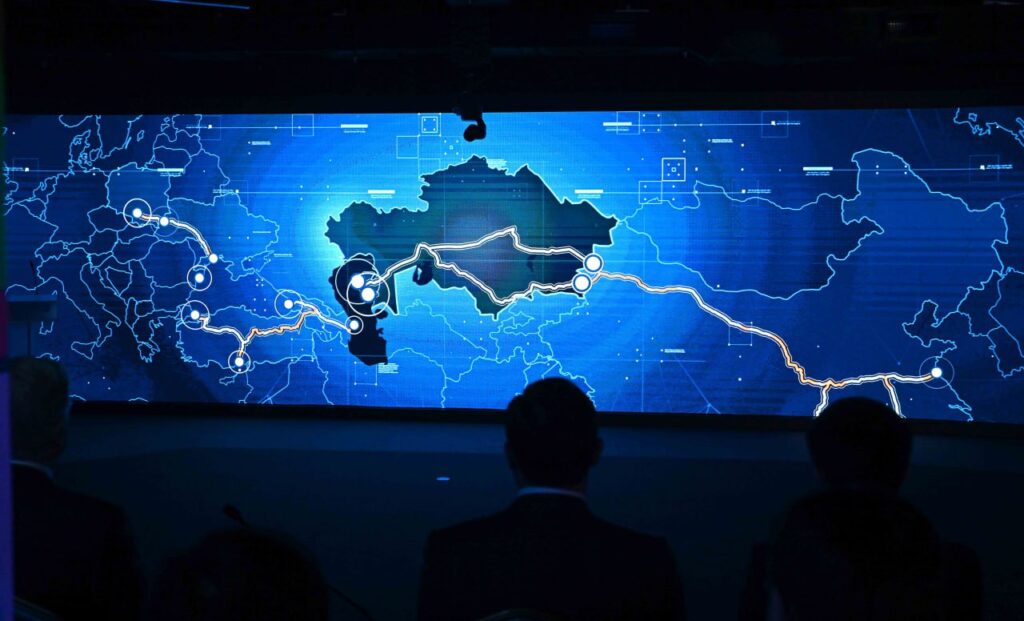
A new transport and logistics terminal has been opened in the Chinese dry port of Xi'an. It is the latest link in China's 'One Belt, One Road' initiative, in which Kazakhstan has become a leading partner. The terminal includes an innovation center created by Kazakhstan's national rail company, Kazakhstan Temir Zholy (KTZ), in partnership with Huawei. The center is part of the One Belt, One Road initiative's new 'Smart Railway' project. At its opening ceremony, Kazakhstan's president Kassim-Jomart Tokayev commented: "This project will give a new impetus to the development of the Trans-Caspian International Transport Corridor, as well as strengthen trade and economic cooperation in Eurasia". Xi'an, China's largest dry port, connects the city of Shaanxi with Central Asia and Europe. The capacity of Kazakhstan's terminal in Xi'an is more than 66,500 TEU (twenty-foot equivalent unit) per year. This will allow Kazakhstan to become an even bigger transit hub in Eurasia.

Kazakhstan’s Trade Policy Makes It a Nexus of Eurasian Supply Chains

Kazakhstan's foreign-trade priorities have markedly evolved in response to global market demands and geopolitical shifts. Historically, the country has relied on its neighbors, particularly Russia, for trade and economic security. However, in recent years, it has been strategically diversifying its trade partners to leverage its geographical position and resource wealth more effectively in the global market. This wealth includes significant reserves of oil, natural gas and minerals. In 2023, Kazakhstan's trade turnover broke a historical record and reached $139.8 billion. Top exports include crude petroleum, gold, refined copper, ferro-alloys, and copper ore. The strategy of diversification enhances Kazakhstan’s sovereignty and economic stability, providing support for President Kassym-Jomart Tokayev's multifaceted reform programs. These reforms include, among other things, increasing workers' salaries, reducing corruption, abolishing capital punishment, and decentralizing the government. In his state-of-the-nation address, Tokayev announced a transition to a new economic model involving further de-monopolization and diversification of the economy. The recent realignment of Kazakhstan's trade relationships is marked by China's ascendancy over Russia as the country's principal trading partner. This development in turn reflects regional trade dynamics and underscores broader geopolitical and economic trends within Central Asia. In 2023, yearly trade turnover between Kazakhstan and China surged 30% to $31.5 billion. This growth is emblematic of deepening economic ties and expanding trade routes across Eurasia, Asia, Africa, and Europe. China's investment in Kazakhstan, especially in infrastructure and energy sectors, is a critical factor in this ascendancy. China has invested $36.7 billion in Kazakhstan’s economy in the last 17 years, with two-thirds of this (or $25.2 billion) invested in the power sector. Approximately half of the investments are in oil and gas, while the rest are mainly in mining and ore processing, machine manufacturing, energy and food production. The partnership between Kazakhstan and China offers Kazakhstan significant economic growth opportunities, but necessitates careful navigation of its relationships with both China and Russia. President Tokayev is keenly attentive to balancing economic benefits with the need to maintain sovereignty and avoid over-dependence on a single partner. Russia's yearly trade turnover with Kazakhstan fell 3.7 percent to $26 billion in 2023. This decrease reflects the broader economic challenges and the volatility that Russia faces, impacting its capacity to engage in foreign trade at previous levels and pushing Kazakhstan to seek reliable and economically beneficial partnerships. This shift in trade dynamics illustrates the ongoing realignment in the geopolitical landscape of Eurasia. China's emergence challenges Russia's historical influence in Central Asia. Kazakhstan's enhanced cooperation with China reflects a strategic alignment and a hedging strategy against over-reliance on any single country. China's higher profile is not the only significant characteristic of Kazakhstan's evolving trade policy. Kazakhstan is actively expanding its trade relationships beyond its traditional partners to include countries in Europe and the Middle East. Italy has become Kazakhstan's third-largest trading partner, with a turnover of $16.1 billion in 2023, underscoring Kazakhstan's efforts to diversify its economic connections and enhance its trade portfolio with European nations. This growth highlights the potential for increased trade in goods...