• KGS/USD = 0.01144 0%
  • KZT/USD = 0.00209 0%
  • TJS/USD = 0.10523 0%
  • UZS/USD = 0.00008 0%
  • TMT/USD = 0.28530 0%
  • KGS/USD = 0.01144 0%
  • KZT/USD = 0.00209 0%
  • TJS/USD = 0.10523 0%
  • UZS/USD = 0.00008 0%
  • TMT/USD = 0.28530 0%
  • KGS/USD = 0.01144 0%
  • KZT/USD = 0.00209 0%
  • TJS/USD = 0.10523 0%
  • UZS/USD = 0.00008 0%
  • TMT/USD = 0.28530 0%
  • KGS/USD = 0.01144 0%
  • KZT/USD = 0.00209 0%
  • TJS/USD = 0.10523 0%
  • UZS/USD = 0.00008 0%
  • TMT/USD = 0.28530 0%
  • KGS/USD = 0.01144 0%
  • KZT/USD = 0.00209 0%
  • TJS/USD = 0.10523 0%
  • UZS/USD = 0.00008 0%
  • TMT/USD = 0.28530 0%
  • KGS/USD = 0.01144 0%
  • KZT/USD = 0.00209 0%
  • TJS/USD = 0.10523 0%
  • UZS/USD = 0.00008 0%
  • TMT/USD = 0.28530 0%
  • KGS/USD = 0.01144 0%
  • KZT/USD = 0.00209 0%
  • TJS/USD = 0.10523 0%
  • UZS/USD = 0.00008 0%
  • TMT/USD = 0.28530 0%
  • KGS/USD = 0.01144 0%
  • KZT/USD = 0.00209 0%
  • TJS/USD = 0.10523 0%
  • UZS/USD = 0.00008 0%
  • TMT/USD = 0.28530 0%

Viewing results 517 - 522 of 2389

Ukraine’s Drone Attack: Russian Region Bordering Kazakhstan Cited as Possible Staging Point

Much remains publicly unknown about how Ukraine pulled off a complex drone attack that targeted several Russian air bases, but some initial, unconfirmed Russian reports say the drones were assembled at a rented warehouse in Chelyabinsk, a Russian city in a region that borders Kazakhstan. When asked about the reports, a spokesman for Kazakhstan’s Ministry of Foreign Affairs said at a briefing on Monday that he was aware of them and could not confirm speculation that Ukraine may have smuggled the drone components into Russia from neighboring Kazakhstan. "I am not an expert in military affairs. Of course, I saw these reports this morning, of course, anonymous Telegram channels are spreading them, there is no official confirmation of this, so I cannot confirm it. I will leave this to the realm of theory for our experts," ministry spokesman Aibek Smatdiyarov said in remarks reported by media in Kazakhstan. The Russian sources said they geolocated the warehouse in Chelyabinsk by studying photos that purportedly show the drones and their containers as well as the interior of the rented building where they were assembled. The photos were published by Ukrainian media. Additional unconfirmed reports say Russian investigators have questioned several truck drivers who said they drove from Chelyabinsk and were duped into delivering the drones to their target areas. The Russian reports have not been confirmed by officials in either Ukraine or Russia. The pro-Russian War on Fakes channel on Telegram said it was “worth noting” that the Chelyabinsk region borders Kazakhstan and that there was a possibility that the drone parts could have been smuggled into Russia from there. It did not offer any direct evidence to support its speculation. International media analysts have described the War on Fakes channel as a disseminator of disinformation, though Russian military bloggers on the war between Russia and Ukraine are closely monitored because they sometimes offer more information than that provided by the Kremlin and other official channels. Some international observers of the war circulated the Chelyabinsk report on social media. Ukrainian President Volodymyr Zelenskyy has said the “office” of the drone operation was next to a regional headquarters of the FSB, the Russian security agency. He did not identify the region. The border between Russia and Kazakhstan is about 7,600 kilometers, making it one of the longest borders in the world. The two countries have a robust trade relationship. Kazakhstan and other Central Asian countries have tried to project a neutral stance in the war between Russia and Ukraine. Ukraine’s security service, known by its acronym SBU, said on Telegram that it hit “34% of strategic cruise missile carriers at the main airfields of the Russian Federation” and that it will provide details about the operation “a little later.” Russia’s Ministry of Defense said attacks on military airfields in the Ivanovo, Ryazan, and Amur regions were repelled. “In the Murmansk and Irkutsk regions, as a result of the launch of FPV drones from the territory located in the immediate vicinity of airfields, several units...

Italy Courts Central Asia: Trade, Transit, and Tech Take Center Stage

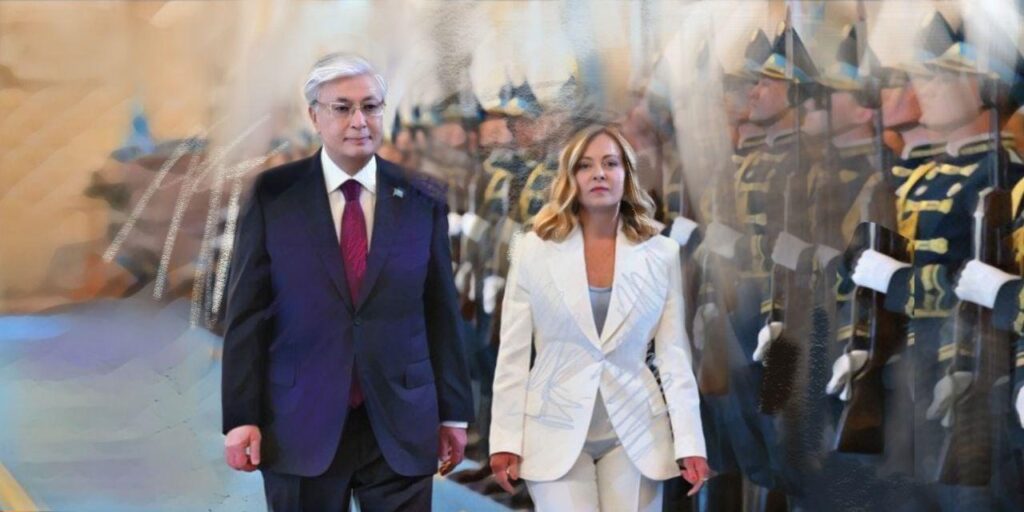
The inaugural Central Asia-Italy Summit, held on May 30, 2025, in Astana, marked a significant step in international diplomacy. It established a new framework for dialogue between the European Union and Kazakhstan, Kyrgyzstan, Uzbekistan, Tajikistan, and Turkmenistan. The participation of the leaders of all five Central Asian nations alongside Italian Prime Minister Giorgia Meloni underscores the region’s growing strategic and economic relevance. Bilateral Meetings Ahead of the summit, extended talks took place between Kazakh President Kassym-Jomart Tokayev and Italian Prime Minister Giorgia Meloni. Tokayev emphasized the depth and stability of bilateral ties, describing Italy as a key strategic partner. Trade between the two nations grew by 24% in 2024, reaching $20 billion. Italy is Kazakhstan’s third-largest trading partner and a major investor, with approximately $7.6 billion invested over the past two decades. Over 270 Italian companies currently operate in Kazakhstan. [caption id="attachment_32447" align="aligncenter" width="2560"] @akorda[/caption] Meloni praised the relationship as “exceptional,” highlighting Italy’s interest in expanding cooperation across trade, energy, and humanitarian domains. A pivotal outcome of the meeting was the signing of a Joint Statement on Strengthening Strategic Partnerships. [caption id="attachment_32448" align="aligncenter" width="2560"] @akorda[/caption] Additional agreements included: Security and Migration - Readmission agreement; Resources and Critical Materials - Cooperation on strategic mineral extraction; Investment and Industrial Development - Agreements involving Samruk-Kazyna, Maire Tecnimont, and Ansaldo; Water Management and Ecology - Memorandum with the Italian engineering association OICE; Finance and Project Lending - Agreements with Cassa Depositi e Prestiti and SACE SpA; Energy and Exports - Agreements with Samruk-Energo and Kazakh Invest. President Tokayev also met with Turkmen President Serdar Berdimuhamedov, emphasizing cultural and economic ties and expressing hope for the realization of joint projects. [caption id="attachment_32449" align="aligncenter" width="2560"] @akorda[/caption] Kazakhstan's Proposals Tokayev outlined proposals for expanding economic, technological, and humanitarian cooperation with Italy. He called for the development of logistics infrastructure and proposed establishing an Italian trading house in Almaty and launching the "Businessmen Plus Italy" platform. Tokayev highlighted Kazakhstan’s readiness to boost oil exports, already over 30 million tons in 2023, a 27% increase from the previous year, and expand exports of over 100 goods valued at $1 billion, particularly non-resource items. He also proposed increased cooperation in agro-industry and emphasized aligning certification standards with the EU. Kazakhstan invited Italian firms to participate in rare earth exploration under a model of “investment and technology in exchange for strategic raw materials.” Joint ventures in textiles, furniture, pharmaceuticals, and machinery were also encouraged. Tokayev stressed decarbonization as a national priority and praised Italian investments in renewable energy. He proposed collaboration on green hydrogen and ammonia production and urged Italy to engage with the Global Biofuels Alliance. [caption id="attachment_32450" align="aligncenter" width="2560"] @akorda[/caption] In education and research, Tokayev invited Italian technical universities to open branches in Kazakhstan, noting that 4,000 Kazakhstani students currently study in Italy. He proposed joint efforts in AI and innovation, including participation in the new Central Asia-EU Innovation Campus at the Astana Hub. Transport infrastructure also featured prominently. Tokayev advocated for integrating the Trans-Caspian International Transport Route (TMTR)...

Kazakhstan, Italy, and the Battle for Europe’s Energy Future

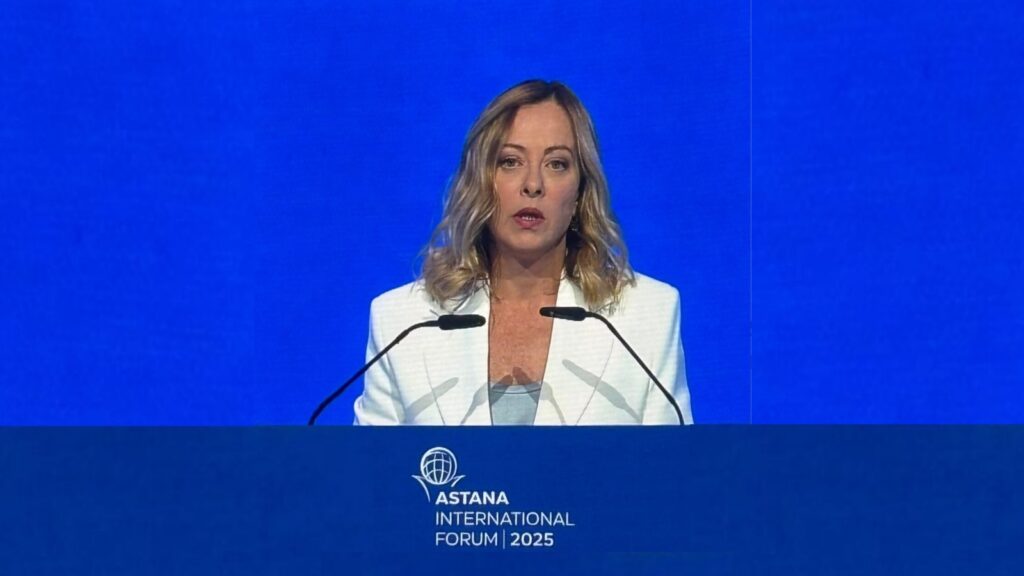
ASTANA - Central Asia is no longer on the periphery of global events, but a place where major countries come together with their ideas, money, and projects. In a turbulent and highly uncertain geopolitical environment, global powers are seeking to establish their presence in this strategic, energy-rich region. Italy is no exception. Italian Prime Minister Giorgia Meloni was initially scheduled to visit Kazakhstan in late April, but in light of Pope Francis' passing her trip to Astana was canceled. Coincidently or not, she came to the Kazakh capital on May 30 to attend the Astana International Forum (AIF) – a two-day event that saw the attendance of political, business, and thought leaders who gathered under an expanded agenda that included climate change, energy security, and sustainability. Meloni’s visit to Kazakhstan is part of her Central Asian tour; she previously visited Uzbekistan, where she met with the country’s President Shavkat Mirziyoyev. In Astana, she not only spoke at the AIF, emphasizing that the “Astana International Forum has become increasingly important in dialogue worldwide,” but also took part in the first-ever Central Asia–Italy summit. “Italy was the first Nation in the EU to decide to invest in relations with Central Asia and its individual member Nations, launching a permanent format in order to share ideas,” Meloni said at the AIF, emphasizing that the EU–Central Asia Summit, held in April in Samarkand, “elevated the relations between the region and the European Union to a strategic partnership.” In this relationship, Kazakhstan seems to play a crucial role. Italy is the largest Central Asian economy’s number one trading partner in Europe. According to Kazakhstan’s Ministry of Trade and Integration, trade turnover between Kazakhstan and Italy in 2024 amounted to $19.9 billion, which is 24% higher compared to the previous year ($16.1 billion). Oil is undoubtedly Kazakhstan’s main export to Italy, although critics argue that the third-most populous EU member is merely a transit country, as large amounts of Kazakh oil ultimately reach other European countries. “If we really want to shape the future, we must have the courage to look beyond our geographical boundaries and pave new paths. I am thinking of the energy sector, where our cooperation can help make a difference, and I am also referring to critical raw materials, where our collaboration aims to generate shared benefits and mutual opportunities,” Meloni stressed. Kazakhstan is one of the richest countries in the world in terms of natural resources. This makes it a nation of significant interest to Italy – with whom Astana signed a Strategic Partnership Agreement back in 2009 – as well as to other European states. But from the Kazakh perspective, it is important that this cooperation be mutually beneficial. Astana is seeking to avoid being seen merely as a source of raw materials and expects its partners to offer tangible benefits in return. That is why Kazakhstan’s President Tokayev has pushed forcefully for the renegotiation of oil agreements with foreign energy companies operating in the country. For Astana, it is...

Kazakhstan and Italy Forge a New Strategic Nexus

Italian Prime Minister Giorgia Meloni's visit to Kazakhstan marks a pivotal moment in the deepening relationship between the two nations. This diplomatic mission comes on the heels of historical ties reinforced by Pope Benedict XVI’s 2022 visit to the Central Asian nation, where he met with President Kassym-Jomart Tokayev. Benedict’s trip was a testament to Kazakhstan’s role in promoting interfaith dialogue and global peace, a legacy that continues to shape its international relationships. Now, with a new American Pope at the helm of the Vatican, Meloni has renewed Italy’s commitment to strengthening its partnership with Kazakhstan. Her meeting with Tokayev and participation in the C5+Italy Summit underline her focus on fostering collaboration in energy diversification, regional stability, and economic growth. The terms for Meloni’s arrival in Astana were set by Kazakhstan’s previous engagements with Italy, including President Kassym-Jomart Tokayev’s visit to Rome in early 2024 and his meeting with Meloni in Abu Dhabi in January 2025. Those substantive bilateral talks set the bilateral agenda in the joint context of Italian active Eurasian diplomacy and Kazakhstan’s own strategic vision. Meloni’s direct discussions with Tokayev focused on deepening bilateral diplomatic and economic ties; expanding cooperation in energy, trade, and defense; and discussing regional security and joint training programs. As she put it prior to departing Italy, “This visit confirms the strategic value of our collaboration and the excellent level of relations between our nations.” Kazakhstan’s geography, resource wealth, and evolving political posture since independence over a third of a century have also enabled it to craft a nuanced foreign policy balancing traditional ties with Russia and China against emerging alignments with Europe and beyond. Italy’s diplomacy, underpinned by proactive outreach and sustained by major trade and investment flows, has become Kazakhstan’s principal EU partner and third-largest global trading counterpart. Meloni’s engagement with Kazakhstan underscores her broader strategic vision of positioning Italy as a pivotal player in the evolving geopolitical landscape. Central to this ambition is her ability to connect Italy’s foreign policy with global power structures, including her relationship with former U.S. President Donald Trump, a bond that has bolstered both her personal stature and Italy’s diplomatic leverage. This alignment, rooted in shared ideologies of nationalism and sovereignty, allows Italy to project itself as a transatlantic bridge linking Europe, the United States, and strategically critical regions like Central Asia. Beyond energy and trade, Italy’s approach aims to institutionalize its presence in the region, as demonstrated by the simultaneous hosting of the Central Asia–Italy Summit, which builds on the “5+1” dialogue launched in 2019 and its 2024 iteration at the foreign-ministerial level. Convening this summit at the head-of-government/head-of-state level in Astana subtly underscores Kazakhstan’s linchpin role in regional coordination and Italy’s capacity to frame its engagement as a multilateral and strategic enterprise. Meloni’s ambitions extend to securing Italy’s role in stabilizing ties with Central Asia and former Soviet states. For instance, strengthening relationships with energy-rich nations like Kazakhstan underpins her focus on energy diversification, critical for reducing Europe’s reliance on Russian gas while...

Can Kazakhstan Lead Small and Middle Powers in Reforming the UN?

ASTANA – The United Nations, envisioned as a pillar of global cooperation, has often struggled to rise to the challenges it was created to address. Its inability to bridge cultural divides hampers meaningful solutions to regional issues, while structural weaknesses and the exclusion of diverse regional voices from the Security Council deepen its shortcomings. Compounding these flaws is the frequent deadlock among permanent members, whose competing agendas stifle consensus and action. These inefficiencies cast doubt on the organization's ability to hear and respond to regional voices, grievances, and expectations in a rapidly changing world. Amid these persistent challenges within the United Nations, Kazakhstan's proactive stance on global issues highlights its potential to lead efforts toward fostering peace and addressing critical gaps in international cooperation. For example, although Kazakhstan prioritizes nuclear energy in its national strategy, it simultaneously remains committed to advocating for the non-proliferation of nuclear and biological weapons. Such an approach, combined with its balanced foreign policy, enables the largest Central Asian nation to seek to position itself as a leading advocate for global peace. But how realistic is that in the current geopolitical climate? As conflicts and wars continue to rage around the world, leaders from several countries have gathered in Kazakhstan’s capital, Astana, for the Astana International Forum (AIF) to discuss key global challenges ranging from energy security and geopolitical cooperation to international trade and sustainable development. For Kazakhstan’s leadership, the event serves as an ideal opportunity to reaffirm its aspiration to position the country as a middle power. According to the Central Asian state’s President Kassym-Jomart Tokayev, it is middle powers that should be prepared to take on greater multilateral responsibilities. “We all should strongly remain adherent to the United Nations Charter with no biased and selective approaches to its principles,” Tokayev said on May 29 in calling for the expansion of the United Nations Security Council that, in his view, should include broader regional representation. This idea was firmly supported by President Gordana Siljanovska-Davkova of North Macedonia, who numbered among the major guests in Astana. She argues that small countries, along with middle powers, should be "the greatest advocates of effective multilateralism," as they stand to gain the most from institutions like the United Nations. “The Security Council should be expanded, reformed and democratized to make it more accountable and more responsible in maintaining international peace and security,” Siljanovska-Davkova stressed, adding that the international institution “should take its rightful place as a principal representative body, not only for debate and deliberative democracy but also for policymaking.” The problem, however, is that major global powers, as permanent members of the UN Security Council, are unlikely to voluntarily relinquish their positions within the organization. Small and middle powers will, therefore, undoubtedly have to work hard to achieve their ambitious geopolitical goals. In the meantime, they are expected to continue developing bilateral relations. “The task before us is clear – to preserve cooperation where it still exists and to restore it where it has broken down. We must widen this...

Tokayev Backs Expansion of UN Security Council for Greater Global Representation

Kazakhstan's President Kassym-Jomart Tokayev has called for expanding the United Nations Security Council to better reflect contemporary global dynamics. Speaking at the Astana International Forum (AIF), he emphasized that reforming the UN’s most powerful body is essential to restoring trust and maintaining international peace and security. The Security Council currently consists of 15 members, five permanent (the United States, China, Russia, France, and the United Kingdom) and ten non-permanent members elected for two-year terms by the UN General Assembly. “Kazakhstan supports the expansion of the UN Security Council to include broader regional representation,” Tokayev stated. “This year, we celebrate the 80th anniversary of the United Nations. Founded in 1945 by 51 states in the aftermath of a devastating global war, the UN envisioned a more peaceful and secure world. Today, it has grown to 193 member states.” Tokayev criticized the Council’s structure as outdated. “The gap between institutional design, frozen in the post-World War II era, and modern realities undermines both trust in the UN and its effectiveness. Critical decisions affecting billions should not rest in the hands of only a few,” he argued. He called for a structural overhaul of the Council to ensure its continued relevance, emphasizing that major powers must recommit to the foundational principles of peace, security, and respect for the territorial integrity of all nations. Highlighting the scale of current global unrest, Tokayev noted that 52 countries were in active armed conflict last year. The economic toll from these hostilities reached an estimated US$19 trillion, approximately 13.5% of global GDP. “Beyond the staggering numbers lies a more troubling reality,” he said. “Modern conflicts are becoming longer, more complex, and increasingly involve non-state actors. Many are rooted in deep historical and structural contradictions.” Tokayev emphasized the growing role of so-called “middle powers” in shaping a fairer and more inclusive world order. “Middle powers must be ready to assume greater responsibility in rethinking global governance,” he concluded. As previously reported by The Times of Central Asia, the 2025 Astana International Forum, themed “Uniting Minds, Shaping the Future,” gathered global leaders, international organizations, investors, businesspeople, and policy experts in Kazakhstan’s capital.