Samarkand: The City that Forged a Country’s Nationhood
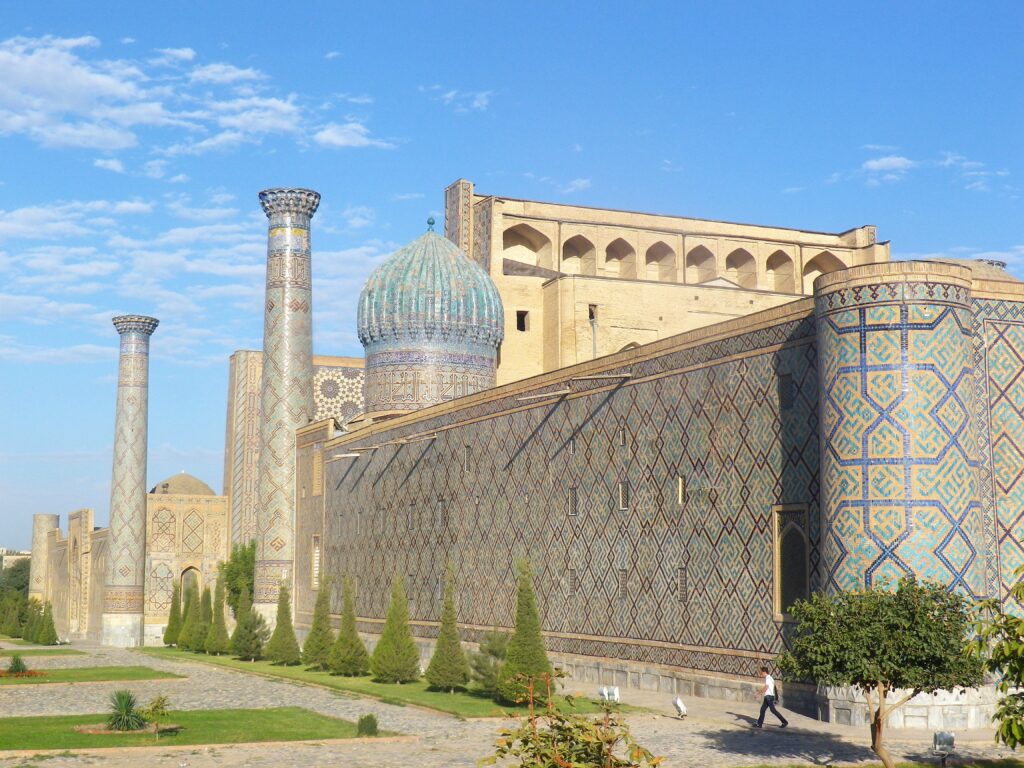
The city of Samarkand holds great significance in the history of Central Asia. The etymology of the name “Samarkand” has multiple possible origins. One train of thought is that it is derived from Sanskrit and Old Persian words, with “Samar” meaning “war” and “kand,” a “square” or “place.” Another roots it in the ancient Sogdian language with “Samar” interpreted as “stone” or “rock,” and “kand,” as “fort” or “town.” Some foreign toponymists claim the name originated in the Sanskrit word “Samaria,” signifying a gathering or meeting, whilst according to certain historical accounts, it evolved from the name of its king, Samar, and “kand,” the Turkish word for city. Yet another theory involves Shamar, a Yemen royal, who after seizing the town from the Sogdians, reconstructed and renamed it Samarkand. Today’s Samarkand, one of Central Asia’s oldest cities, is a testament to its enduring resilience and indomitable spirit against centuries of numerous conquests. According to the Encyclopaedia Britannica, the city then known as Maracanda, was the capital of Sogdiana prior to its conquest by Alexander the Great in the 4th century BC. It was subsequently ruled by various groups, including Central Asian Turks, Arabs, the Samanids of Iran, various Turkic peoples, and the Khwārezm-Shāh dynasty, before being ravaged by Genghis Khan in 1220. After a successful revolt against Mongol rulers in 1365, Samarkand rose to the fore as Central Asia’s economic and cultural capital under the reign of Timur (Tamerlane). In 1550, the city was conquered by Uzbeks and integrated into the Khanate of Bukhara. By the 18th century, the city had fallen into serious decline and remained uninhabited from the 1720s to the 1770s, but once again rose from the ashes when in 1887, it became a provincial capital of the Russian Empire and a railroad center. The city then served as the capital of the Uzbek Soviet Socialist Republic from 1924 to 1936. Samarkand is a city of two parts; the first dating back to medieval times, and the second after the Russian conquest in the 19th century. Despite large-scale destruction by the Russians, the old city’s walls, erected in the 11th century and spanning five miles, remain true to their original plan with the streets running from six gates towards the center housing some of the most magnificent monuments of Central Asian architecture. Constructed between the 14th and 20th centuries, these include the Bībī-Khānom Mosque (1399–1404), commissioned by Timur’s favorite Chinese wife, Timur’s tomb, the Gūr-e Amīr Mausoleum, built around 1405, and the late 15th century Ak Saray tomb with its superb interior fresco. The madrasahs (Islamic schools) of Timur’s grandson, the astronomer Ulūgh Beg (1417–20), and those of Shirdar (1619–1635/36) and Tilakari (mid-17th century) flanking the central Registan Square are but the finest of Samarkand’s many historic mausoleums, madrasahs, and mosques. Famously adorned with magnificent portals, vast colored domes, and remarkable exterior decorations in majolica, mosaic, marble, and gold, the city’s awe-inspiring architecture resulted in Samarkand’s recognition as a UNESCO World Heritage site in 2001. The newer...