• KGS/USD = 0.01144 0%
  • KZT/USD = 0.00216 0%
  • TJS/USD = 0.10616 -0.19%
  • UZS/USD = 0.00008 0%
  • TMT/USD = 0.28530 0%
  • KGS/USD = 0.01144 0%
  • KZT/USD = 0.00216 0%
  • TJS/USD = 0.10616 -0.19%
  • UZS/USD = 0.00008 0%
  • TMT/USD = 0.28530 0%
  • KGS/USD = 0.01144 0%
  • KZT/USD = 0.00216 0%
  • TJS/USD = 0.10616 -0.19%
  • UZS/USD = 0.00008 0%
  • TMT/USD = 0.28530 0%
  • KGS/USD = 0.01144 0%
  • KZT/USD = 0.00216 0%
  • TJS/USD = 0.10616 -0.19%
  • UZS/USD = 0.00008 0%
  • TMT/USD = 0.28530 0%
  • KGS/USD = 0.01144 0%
  • KZT/USD = 0.00216 0%
  • TJS/USD = 0.10616 -0.19%
  • UZS/USD = 0.00008 0%
  • TMT/USD = 0.28530 0%
  • KGS/USD = 0.01144 0%
  • KZT/USD = 0.00216 0%
  • TJS/USD = 0.10616 -0.19%
  • UZS/USD = 0.00008 0%
  • TMT/USD = 0.28530 0%
  • KGS/USD = 0.01144 0%
  • KZT/USD = 0.00216 0%
  • TJS/USD = 0.10616 -0.19%
  • UZS/USD = 0.00008 0%
  • TMT/USD = 0.28530 0%
  • KGS/USD = 0.01144 0%
  • KZT/USD = 0.00216 0%
  • TJS/USD = 0.10616 -0.19%
  • UZS/USD = 0.00008 0%
  • TMT/USD = 0.28530 0%

Viewing results 985 - 990 of 1508

Kazakhstan Comments on Russian Missile Tests on its Territory

Kazakhstan's Ministry of Defense has confirmed that Russia tests its missiles inside of Kazakhstan's borders. The country's deputy minister of defense Shaykh-Khasan Zhazykbayev has gone on record to say that in Kazakhstan there is a military test range called Saryshagan, where the 110th training center of the Russian Federation does indeed conduct missile tests. Zhazykbayev noted that Russia has a treaty dating back to 1993, according to which it has the right to use this land as a testing ground. "Missiles of up to 200 kilometers' range are tested there. There is no infrastructure and population [on] this range, so no one suffers," said Zhazykbayev. The deputy minister also noted that Russia conducts only 50 hours of missile testing at Saryshagan each year. The Saryshagan military training range in Kazakhstan is located in the Karaganda and Zhambyl regions, to the northwest and west of Lake Balkhash in the Betpak-Dala steppe. Its construction began in 1956, and its area now holds an active military airfield and several abandoned dirt airfields. The Yekaterinburg to Almaty highway runs through it. Presently it's considered to be the first and the only military range in Eurasia where missile weapons are developed and tested.

Kazakhstan Seeks U.S. Cooperation to Develop Critical Minerals

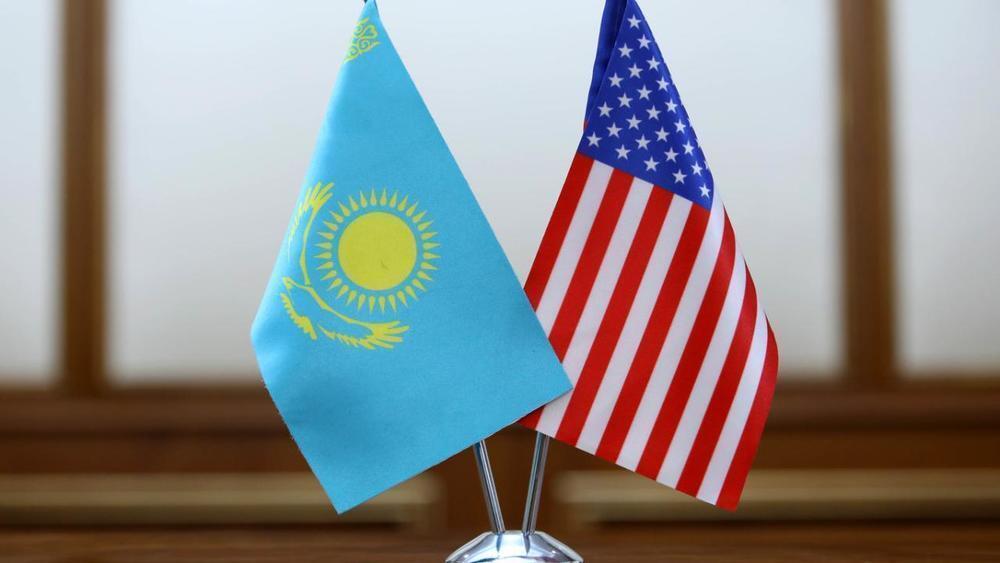
During a visit to the United States on March 1st, Kazakhstan’s Minister of Industry and Construction, Kanat Sharlapaev met David Applegate, director of the U.S. Geological Survey, to discuss expanding bilateral cooperation regarding mineral deposits in Kazakhstan. Of Kazakhstan’s 50 types of minerals, 17 were identified by the U.S. Geological Survey as critical. As reported by Sharlapaev, the key aims of future collaborations are attracting investment in geological exploration, mining, and the processing of rare and rare-earth metals, as well as facilitating Kazakhstan's integration to the global market through cutting-edge technologies and expertise. Speaking at a roundtable discussion at the U.S. Chamber of Commerce with members of the Kazakh-American Business Council (USKZBC) and representatives of American companies, the minister outlined the benefits afforded by consolidating the partnership between Kazakhstan and the USA. Emphasis was placed on the strategic potential of mining rare and rare earth metals and the development of related industries. In particular, he cited the importance of creating a cluster of industries in Kazakhstan to produce raw materials for batteries, including nickel, cobalt, manganese, and lithium and with reference to reforms on the use of subsoil to attract investment, encouraged US mining companies to participate in forthcoming auctions in Kazakhstan.

Kazakhstan Gets New Logistics Terminal in China

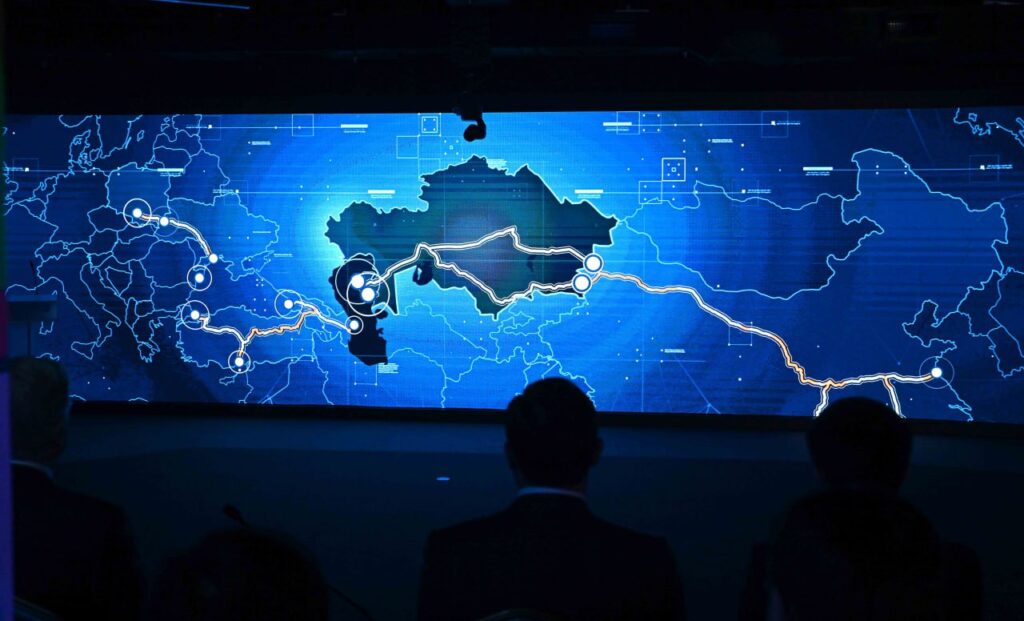
A new transport and logistics terminal has been opened in the Chinese dry port of Xi'an. It is the latest link in China's 'One Belt, One Road' initiative, in which Kazakhstan has become a leading partner. The terminal includes an innovation center created by Kazakhstan's national rail company, Kazakhstan Temir Zholy (KTZ), in partnership with Huawei. The center is part of the One Belt, One Road initiative's new 'Smart Railway' project. At its opening ceremony, Kazakhstan's president Kassim-Jomart Tokayev commented: "This project will give a new impetus to the development of the Trans-Caspian International Transport Corridor, as well as strengthen trade and economic cooperation in Eurasia". Xi'an, China's largest dry port, connects the city of Shaanxi with Central Asia and Europe. The capacity of Kazakhstan's terminal in Xi'an is more than 66,500 TEU (twenty-foot equivalent unit) per year. This will allow Kazakhstan to become an even bigger transit hub in Eurasia.

About 100 Kazakhs Are Enslaved Laborers in Southeast Asia

Kazakhstan's Ministry of Foreign Affairs has reported the release of two Kazakh nationals from labor slavery in Thailand. In January the country's consulate in Thailand received a message saying that a Kazakh woman had been enslaved in the Golden Triangle -- a geographical area in Southeast Asia that includes Thailand, Myanmar and Laos, known for its large volumes of drug production and trade. The trapped girl had asked for help. After working with local authorities, they learned that not one but two girls were enslaved. Ministry representatives spent about a month negotiating the release of the girls, before they were released and returned home. It transpired that the girls had been duped by an advertisement offering a high-paying job that turned out to be a scam. In order to buy their freedom, their captor demanded $10,000 from each of the girls. About 200 citizens of Kazakhstan have fallen into labor slavery in these territories over the past two years. About 30 of them were able to be freed with the help of the local Kazakh embassy. The ministry claims that about 100 Kazakhs are still enslaved laborers in the countries of Southeast Asia.

Kazakhstan to Report to UN on Events of January 2022 Unrest

Kazakhstan will report to the United Nations (UN) Committee against Torture on measures taken after the events of bloody January (Qantar) 2022. This is according to the Deputy Chairwoman of the International Bureau for Human Rights, Roza Akylbekova, who added that information on urgent recommendations, which primarily concern Qantar, should be provided no later than May 12th, 2024 "This is information about what happened, how many people were affected, and, of course, about deaths in closed institutions and how Kazakhstan is investigating them," Akylbekova said at a news conference at the office of the Kazakhstan International Bureau for Human Rights and the Rule of Law. In addition, according to the human rights activist, the Ministry of Defense of Kazakhstan will have to prepare information on the deaths of conscripts. It has been 25 years since Kazakhstan joined the UN Convention against Torture, since which time the Coalition of NGOs of Kazakhstan against Torture and the National Preventive Mechanism for the Prevention of Torture have been established created. Furthermore, Kazakhstan added an article on torture to the criminal code and opened up a path for individual appeals regarding torture directly to the UN Committee. At the same time, however, torture remains a pressing problem in the country. According to the Kazakhstan International Bureau for Human Rights and the Rule of Law, 200-250 people apply to the Coalition of NGOs against Torture every year. In 2022, 190 appeals were received in connection with the January events, and another 88 episodes that had no connection to the mass riots of that year. Since Qantar, the number of complaints has not fallen, with 283 appeals in 2023, during which year over 20 systemic recommendations were issued to Kazakhstan. Earlier this year, the European Union (EU) funded a three-year project by Kazakhstani human rights defenders that aims to eradicate torture. As part of this project, the Kazakhstan NGO Coalition against Torture and the Prison Reform International (PRI) office will analyze individual cases of criminal prosecution for torture which do not reach trial. However, these cases are difficult to identify and prosecute. "In Kazakhstan such crime as torture is adjacent to other articles of the Criminal Code: in addition to 'torture,' the concepts of 'ill-treatment' and 'abuse of power' are used. Therefore, the official statistics on those prosecuted for 'torture' (Article 146) do not give an understanding of how many cases are actually hidden behind the lighter articles. At the same time, Article 146 itself has been divided into two parts: 'torture,' which will be investigated by the prosecutor's office, and 'cruel and inhuman treatment,' which is left to the Interior Ministry, whose employees are most often the beneficiaries of torture," the press service of the Kazakhstan International Bureau for Human Rights and Rule of Law reported. The UN Committee against Torture was established in January 1987. It consists of 10 independent experts, who currently represent the United States, Turkey, China, Japan, Russia, France, Morocco, Moldova, Latvia, and Mexico. They monitor the implementation of the Convention...

Kazakhstan Peacekeepers Deployed to Golan Heights

According to the Ministry of Defense of the Republic of Kazakhstan, a memorandum of understanding (MoU) has been signed at United Nations (UN) headquarters in New York between the Kazakh government and the UN regarding the deployment of a peacekeeping contingent to the UN Disengagement Observer Force mission. This will be the first time in the history of Kazakhstan when the UN has given the country a mandate to carry out an independent peacekeeping mission. Earlier, Defense Minister Ruslan Zhaksylykov reported that 139 servicemen will be sent to the Golan Heights between Israel and Syria. They will maintain a ceasefire between the warring parties in accordance with the mandate of the UN mission. In order to fulfill the UN mission with professionalism, peacekeepers from Kazakhstan have undergone a thorough selection and training process in accordance with all the requirements and standards of the UN. The training lasted six months, and took place at the center for peacekeeping operations under the Kazakh Ministry of Defense. "The instructor staff of the centers of peacekeeping operations, demining and military medicine participated in the training of the servicemen. To improve practical skills and interoperability with officers of the contingent's headquarters, classes were held on military decision-making at the operational-tactical level," the Defense Ministry reported. Kazakhstan's peacekeepers were taught English, rules of engagement, and international and humanitarian law. They also trained in how to protect the peacekeeping base, organize roadblocks, patrols, disarm explosive devices, and provide assistance and evacuation. Based on the results of the training, experts said Kazakhstan's peacekeeping contingent showed a high level of training and motivation. Kazakhstan has painstakingly equipped the peacekeepers in accordance with UN standards. They have been provided with modern weapons and military equipment. The contingent has armored wheeled vehicles with combat modules, KamAZs, high cross-country vehicles and engineering equipment -- as well as all the necessary lifesaving equipment. Also, one of the vehicles has been converted for evacuation of the wounded. It's equipped with an oxygen machine, defibrillator, medicines and other medical equipment. The Kazakh ministry's specialized department says that during the peacekeeping mission the servicemen will be paid three times their monthly allowance, with an additional $1,448 from the UN budget. Moreover, after completion of service to the mission, they can count on treatment at a health resort and an extra 14 days added to their basic annual leave. Peacekeepers from Kazakhstan will include individual servicemen as military observers as well as staff officers. Members of specialized units are also in demand; they include infantry, medical, reconnaissance and engineering. Over the past 16 years, more than 600 Kazakh servicemen have participated in seven UN peacekeeping missions spread across Asia, the Middle East and Africa. Currently, 19 peacekeepers from Kazakhstan are serving in UN contingents in Lebanon, the Democratic Republic of Congo, Western Sahara and the Central African Republic.