• KZT/USD = 0.00224
  • TJS/USD = 0.10810
  • UZS/USD = 0.00009
  • TMT/USD = 0.29850
  • KZT/USD = 0.00224
  • TJS/USD = 0.10810
  • UZS/USD = 0.00009
  • TMT/USD = 0.29850
  • KZT/USD = 0.00224
  • TJS/USD = 0.10810
  • UZS/USD = 0.00009
  • TMT/USD = 0.29850
  • KZT/USD = 0.00224
  • TJS/USD = 0.10810
  • UZS/USD = 0.00009
  • TMT/USD = 0.29850
  • KZT/USD = 0.00224
  • TJS/USD = 0.10810
  • UZS/USD = 0.00009
  • TMT/USD = 0.29850
  • KZT/USD = 0.00224
  • TJS/USD = 0.10810
  • UZS/USD = 0.00009
  • TMT/USD = 0.29850
  • KZT/USD = 0.00224
  • TJS/USD = 0.10810
  • UZS/USD = 0.00009
  • TMT/USD = 0.29850
  • KZT/USD = 0.00224
  • TJS/USD = 0.10810
  • UZS/USD = 0.00009
  • TMT/USD = 0.29850
23 September 2026

Viewing results 7 - 12 of 244

After Bishimbayev, Kazakhstan’s Domestic Violence Laws Face an Enforcement Test

The release of Bakhytzhan Baizhanov, a cousin of former Kazakhstan Economy Minister Kuandyk Bishimbayev, following an amnesty has renewed public attention to one of the country’s most pressing social problems: domestic violence. The trial of Bishimbayev and Baizhanov attracted widespread attention in Kazakhstan and abroad. Bishimbayev was convicted of torturing and murdering his common-law wife. The proceedings were broadcast online and closely followed by journalists and the public. Bishimbayev was sentenced to 24 years in prison, while Baizhanov received a four-year sentence for concealing the crime. Amid the public outcry, Kazakhstan adopted legislation strengthening penalties for domestic violence. The legislation is commonly known as “Saltanat’s Law,” after the victim, Saltanat Nukenova. Observers say the new provisions allow tougher sanctions to be imposed on domestic abusers. However, the legislation was only a first step. Kazakhstan still needs effective mechanisms to prevent violence and better support services for victims.” The Country Followed the Trial Saltanat Nukenova died on November 9, 2023, at Bau, a restaurant inside the Gastro Center complex in Astana. Baizhanov was the director of the establishment. Bishimbayev was detained that day. An Astana court delivered its verdict on May 13, 2024. Bishimbayev was found guilty of murder committed with particular cruelty and of torture. Baizhanov was convicted of concealing the crime. Bishimbayev was sentenced to 24 years in a maximum-security prison. The court treated the fact that he had minor children as a mitigating circumstance. Aggravating circumstances included dangerous recidivism and intoxication at the time of the crime. In 2018, Bishimbayev had been sentenced to 10 years in prison for corruption offenses but was later pardoned. Baizhanov was sentenced to four years in a medium-security prison. The proceedings prompted a strong public response. Activists held demonstrations in Kazakhstan and abroad, while foreign correspondents attended the hearings. Kazakhstani and international media covered the case extensively. Public interest remains high. Many people in Kazakhstan continue to watch closely for any indication that Bishimbayev could be released before completing his sentence. Relatives of both Nukenova and Bishimbayev have also continued to make public statements. Baizhanov Disputed the Verdict Baizhanov’s early release under an amnesty has drawn mixed reactions. During the trial, he said he had not known how seriously Nukenova had been injured and denied that he was guilty of concealing the crime. His sentence had previously been reduced by one-third, and he had been expected to leave prison in November 2026. However, on July 22, his lawyer said the Stepnogorsk City Court had applied an amnesty act and ordered his immediate release. Baizhanov will remain under probation supervision following his release. He has also been placed under administrative supervision for six years. New Law, Old Problems On April 15, 2024, Kazakhstan adopted legislation amending several laws concerning women’s rights and children’s safety. Although the legislation had been drafted before Nukenova’s murder, the public attention surrounding her death and Bishimbayev’s trial led to it becoming informally known as “Saltanat’s Law.” The law expanded legal protections for women and children. Battery and the...

Kazakhstan Police Robot Dog Raises Privacy Questions

Kazakhstan’s police used a mobile facial-recognition robot to scan crowds during Metallurgist Day celebrations in Karaganda Region, saying the machine helped identify four people sought over legal or administrative violations. The deployment extends the country’s rapidly expanding surveillance network beyond fixed cameras, allowing police databases to be accessed through a platform that can move through crowded public spaces. The four-legged robot was used during celebrations held on July 17-18 in the industrial cities of Balkhash and Temirtau, which attracted more than 115,000 visitors. More than 1,000 police officers were also deployed to maintain public order, according to the Karaganda police. Robot dogs equipped with facial-recognition cameras have also been deployed at Astana’s railway stations in January, and by police in Aktau since May. Karaganda's robodog carries surveillance cameras and is connected to police databases. Authorities say it can scan faces within its field of view and compare them with records of people sought by law enforcement. Its main advantage over a fixed facial-recognition camera is mobility. During the earlier trial at Astana’s Nurly Zhol railway station, a robot moved through waiting rooms, escalators, and other public areas while transmitting live video to a police command center. The system was also able to compare images with police wanted lists and broadcast warnings through an onboard speaker. Police said the Karaganda robot helped identify one person wanted for evading child support payments, two people owing debts under enforcement proceedings, and a previously convicted man who had breached a court order requiring him to remain at home during specified hours. Officers took legal measures against all four. The authorities did not explain how the facial-recognition matches were verified by officers, how many false alerts the system generated, or how many people were scanned before the four matches were produced. The robot dog forms part of a much larger surveillance system operating across Kazakhstan. The country has approximately 1.6 million surveillance cameras, according to figures provided by the Interior Ministry to the independent outlet Vlast.kz. Around 545,000 are connected to police command centers, while more than 24,000 use artificial intelligence capable of recognizing faces. Vlast’s investigation found that Kazakhstan’s surveillance infrastructure has expanded rapidly, with facial recognition, biometric identification, and networked cameras becoming central elements of the government’s smart-city programs. Supporters argue that such systems can help police locate wanted people and respond more quickly to emergencies. Critics warn that the same infrastructure can be used to track activists, protesters, and other members of the public. Kazakhstan-based digital-rights specialists have called for tighter safeguards governing facial recognition. The Eurasian Digital Foundation has recommended restrictions on mass and indiscriminate surveillance, alongside greater transparency and clearer rules on how government agencies process biometric information. The organization has also argued that Kazakhstan needs stronger independent oversight of the collection, storage, and use of biometric data, as well as procedures allowing people to challenge the processing of their information by law enforcement agencies. The Interior Ministry’s account of the Karaganda deployment did not disclose the cost or the manufacturer of...

Kashagan Operator Faces July 20 Deadline to Pay $4.9 Billion Environmental Fine

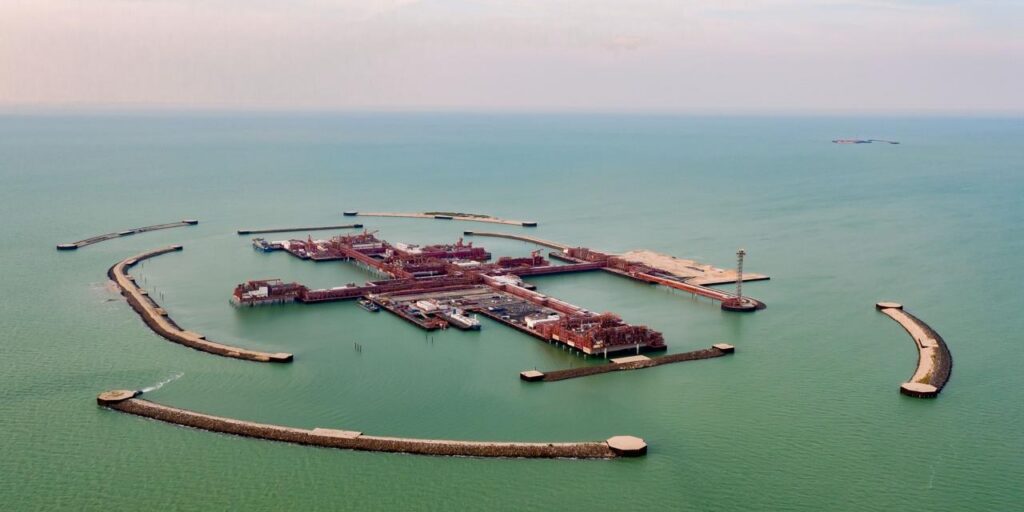
Kazakhstan says it will begin compulsory collection proceedings against the North Caspian Operating Company (NCOC), operator of the giant Kashagan oil field, if it does not pay a 2.3 trillion tenge ($4.9 billion) environmental fine by July 20. The deadline follows a domestic court ruling that has entered into legal force, even as the project’s foreign shareholders pursue international arbitration over the penalty. Deputy Minister of Justice Daniyel Vaisov announced the deadline on July 14. “Foreign companies currently have an obligation to pay 2.3 trillion tenge. If they fail to pay the fine by July 20, the Republic of Kazakhstan will proceed in accordance with the law, including enforcement proceedings and compulsory collection measures,” Vaisov said. However, in a statement to The Times of Central Asia, NCOC said a tribunal in parallel UNCITRAL arbitration proceedings had issued a restraining order prohibiting Kazakhstan from taking any measures to enforce the fine while the arbitration is pending. The company said the UNCITRAL proceedings had been initiated by Kazakhstan itself. NCOC and the contracting companies said they reject both the fine and the allegations underlying it and are contesting them through the UNCITRAL proceedings as well as the ICSID arbitration. They called on Kazakhstan to comply with the restraining order. The dispute stems from a 2022 inspection of Kashagan’s onshore processing facilities in the Atyrau Region. Environmental authorities said the operator had exceeded its permitted sulfur-storage limits, and the Ministry of Ecology and Natural Resources imposed the 2.3 trillion-tenge penalty in 2023. NCOC said it had obtained and maintained all required permits and had always conducted its sulfur management in full compliance with the law. The case has passed through several rounds of domestic litigation. On August 1, 2025, the Administrative Chamber of Astana City Court annulled the original penalty order because of procedural violations, without ruling on the substance of the environmental allegations. The ministry subsequently corrected the procedural defects and reissued the penalty later that month. An Astana court left the reissued fine in force on April 8, 2026. Vaisov said on July 14 that the ruling had entered into legal force. NCOC brings together Kazakhstan’s state-owned KazMunayGas and six foreign partners: Shell, TotalEnergies, Eni, ExxonMobil, CNPC, and Inpex. NCOC and the project’s six foreign shareholders have initiated treaty arbitration through the Washington-based International Centre for Settlement of Investment Disputes (ICSID), arguing that Kazakhstan’s conduct breaches protections owed to investors. Vaisov said the parties were finalizing the composition of the ICSID tribunal, which is expected to be completed by the end of July. “We believe the Republic’s actions regarding the alleged sulfur-storage permit violations are inconsistent with its obligations under international investment treaties, including its obligation to provide fair and equitable treatment to investors,” NCOC said. The Kazakh authorities maintain that the sulfur was stored in breach of environmental rules. The mechanics of compulsory collection may prove difficult. Nurlan Zhumagulov, executive director of the Energy Monitor Foundation, said that NCOC acts as the project’s operator while each shareholder markets its own...

Kazakhstan Olympic Boxing Champion Jailed for Drunk Driving After Multiple Crashes

Kazakhstan’s 2016 Olympic boxing champion Daniyar Yeleussinov has been sentenced to 20 days of administrative detention and banned from driving for seven years after being found guilty of driving under the influence and causing several traffic accidents in Astana. According to Astana’s Specialized Interdistrict Administrative Court, Yeleussinov admitted his guilt during the hearing. The ruling has not yet entered into legal force and may be appealed within 10 days. The incident occurred in Astana on July 9, when police detained Yeleussinov after he allegedly drove while intoxicated, causing a series of collisions and leaving the scenes of the accidents. According to the court, Yeleussinov first struck the supporting structure of an underground parking entrance. He then collided with another vehicle, causing it to hit a third car. In a subsequent collision, he struck another vehicle, which was pushed into a Toyota Hilux. The accidents caused mechanical damage to several vehicles and resulted in financial losses. Evidence presented to the court included a medical examination confirming mild alcohol intoxication, police reports, accident diagrams, video recordings, and witness statements. Yeleussinov admitted full responsibility. He was convicted under Article 608, Part 3 of Kazakhstan’s Code of Administrative Offenses, which covers driving under the influence resulting in property damage. The provision carries a mandatory penalty of 20 days of administrative detention and a seven-year driving ban. “The court found no circumstances preventing the application of administrative detention. Since the sanction under Article 608, Part 3 provides no alternative punishment, the court imposed 20 days of administrative arrest and deprivation of the right to drive vehicles for seven years,” the court said. Yeleussinov, who was born in Kazakhstan’s West Kazakhstan Region, enjoyed one of the country’s most successful amateur boxing careers. He won the 2013 World Championships in the 69-kilogram category, claimed Asian Championships and Asian Games titles between 2013 and 2015, and won Olympic gold at the 2016 Rio de Janeiro Games. After turning professional in 2018, Yeleussinov signed with Eddie Hearn’s Matchroom Boxing and won the International Boxing Organization welterweight title in 2021. His professional career subsequently slowed, and he has fought only twice since returning to the ring in 2024. In March 2025, he became the first Kazakhstani boxer to sign with Dana White’s Zuffa Boxing promotion, although he has yet to make his debut under the new banner. As previously reported by The Times of Central Asia, another prominent Kazakhstani boxer, Zhanibek Alimkhanuly, was stripped of one of his two middleweight world titles in March after testing positive for a banned substance.

Central Asian Women Recruited Into Georgia’s Surrogacy Market via Social Media

Women from Central Asia are being recruited into Georgia’s surrogacy market through social media, adding a new labor channel to an industry already under pressure from foreign demand and inadequate supervision. A University of Oxford study published in Mobilities identifies Kazakhstan, Kyrgyzstan, Uzbekistan and Tajikistan in that recruitment chain. The author, Dr. Polina Vlasenko of Oxford’s Centre on Migration, Policy and Society (COMPAS), carried out fieldwork in Kazakhstan and Georgia between 2023 and 2024, drawing on more than 100 interviews across the surrogacy and egg donation market. Georgia has allowed surrogacy since 1997. Under Article 143 of the Law of Georgia on Health Care, in vitro fertilization (IVF) may involve a surrogate mother if a woman does not have a uterus and the couple gives written consent. If a child is born, the couple is recognized as the parents. The donor or surrogate mother has no right to be recognized as a parent. That provision gives intended parents direct legal certainty in Georgia, unlike jurisdictions where legal parenthood may require a separate post-birth court process. For women recruited from Central Asia, the difference is in the hidden parts of the process. Opaque recruitment methods can lead into surveillance-style accommodation, while agents often mediate access to the clinic and to payments that may be delayed or disputed. According to a 2020 statement by Georgia’s Ministry of Justice, 98% of people using surrogacy services in Georgia were foreign-citizen couples, while 100% of surrogate mothers were Georgian-citizen women. Before the war, Chinese nationals accounted for 14% of people pursuing surrogacy in Georgia, and Chinese social media later carried accounts of newborns on flights from Tbilisi to Urumqi. Until Russia’s full-scale invasion of Ukraine in February 2022, Ukraine was considered Europe’s biggest surrogacy hub. By contrast, in December of that year, a Russian law barred foreign clients and stateless people from using the country’s surrogacy system, limiting access to Russian citizens. By 2022, Georgia was already gaining momentum as a reproductive tourism destination, but the war in Ukraine accelerated that rise. As demand grew, recruitment networks began reaching women in Central Asia through social media and private messaging channels. For women recruited from Central Asia, the complexity lies in the online posts and private contacts that turn economic need into pregnancy abroad. Russian-language advertising often uses “surmama,” a shorthand for surrogate mother that now sits inside the market’s online vocabulary. Public posts tied to Georgia programs refer to Tbilisi and Bishkek. Some use Kyrgyz-language wording and hashtags for Kyrgyzstan. The communication network is plentiful in posts yet sparse in detail, as a stack of cash appears in one Instagram post while other accounts use the polished visual language common to fertility advertising online, where smiling young women and clean graphics make paid pregnancy look simple. One Instagram account advertising surrogacy services in Georgia directs users to a WhatsApp number linked to a Kazakhstan-based contact. The account does not establish whether that person recruits women directly or represents a clinic. The WhatsApp profile image offers...

Kazakhstan Opens Drone Operator Training Lab for Interior Ministry

Kazakhstan is actively integrating modern unmanned aerial technologies into law enforcement, with the Interior Ministry opening a new training laboratory where police officers will receive comprehensive instruction in drone operations. According to Polisia.kz, the training program includes several stages: theoretical coursework, simulator-based exercises, and practical computer-based training. Particular attention is being given to the use of drones in real operational tasks, from rapid response missions to search and rescue operations. “On the instructions of the minister of internal affairs, a training laboratory for unmanned aerial systems has been established at the ministry’s Operational and Forensic Department. Our task is to prepare officers who can confidently and effectively use modern technologies in their daily work,” said Rolland Moldybayev, chief forensic specialist at the department. Unmanned aerial vehicles are already being used by police for night surveillance and aerial reconnaissance. Equipped with high-resolution cameras and thermal imaging systems, they allow officers to search for missing persons at night and in difficult weather conditions. Drones also provide an operational aerial view of crime scenes, allowing officers to document situations before investigative teams arrive and helping preserve critical evidence. In addition, drones are used to inspect hard-to-reach areas, including mountainous terrain, steppe zones, and abandoned facilities. This has significantly improved the effectiveness of searches for missing persons and supports the surveillance and apprehension of wanted suspects by enabling covert and safer monitoring. “The practical effectiveness of these technologies has already been proven in the field: in the Turkestan region, the use of a drone helped quickly solve a livestock theft case. Suspects were identified, their movements tracked, and evidence collected, which led investigators to the buyer of the stolen property,” the Interior Ministry said. The ministry added that the introduction of drone technologies marks an important step in the development of modern policing, increasing response speed, operational accuracy, and overall public safety. As previously reported by The Times of Central Asia, Kazakhstan also plans to launch mass production of drones for police needs, both at the Karaganda-based research and production association Perspektiva and at a correctional facility in the Akmola region.