• KGS/USD = 0.01144 0%
  • KZT/USD = 0.00212 0%
  • TJS/USD = 0.10456 0.19%
  • UZS/USD = 0.00008 0%
  • TMT/USD = 0.28490 0%
  • KGS/USD = 0.01144 0%
  • KZT/USD = 0.00212 0%
  • TJS/USD = 0.10456 0.19%
  • UZS/USD = 0.00008 0%
  • TMT/USD = 0.28490 0%
  • KGS/USD = 0.01144 0%
  • KZT/USD = 0.00212 0%
  • TJS/USD = 0.10456 0.19%
  • UZS/USD = 0.00008 0%
  • TMT/USD = 0.28490 0%
  • KGS/USD = 0.01144 0%
  • KZT/USD = 0.00212 0%
  • TJS/USD = 0.10456 0.19%
  • UZS/USD = 0.00008 0%
  • TMT/USD = 0.28490 0%
  • KGS/USD = 0.01144 0%
  • KZT/USD = 0.00212 0%
  • TJS/USD = 0.10456 0.19%
  • UZS/USD = 0.00008 0%
  • TMT/USD = 0.28490 0%
  • KGS/USD = 0.01144 0%
  • KZT/USD = 0.00212 0%
  • TJS/USD = 0.10456 0.19%
  • UZS/USD = 0.00008 0%
  • TMT/USD = 0.28490 0%
  • KGS/USD = 0.01144 0%
  • KZT/USD = 0.00212 0%
  • TJS/USD = 0.10456 0.19%
  • UZS/USD = 0.00008 0%
  • TMT/USD = 0.28490 0%
  • KGS/USD = 0.01144 0%
  • KZT/USD = 0.00212 0%
  • TJS/USD = 0.10456 0.19%
  • UZS/USD = 0.00008 0%
  • TMT/USD = 0.28490 0%

Viewing results 529 - 534 of 966

Focus on Ethnic Germans in Kazakhstan

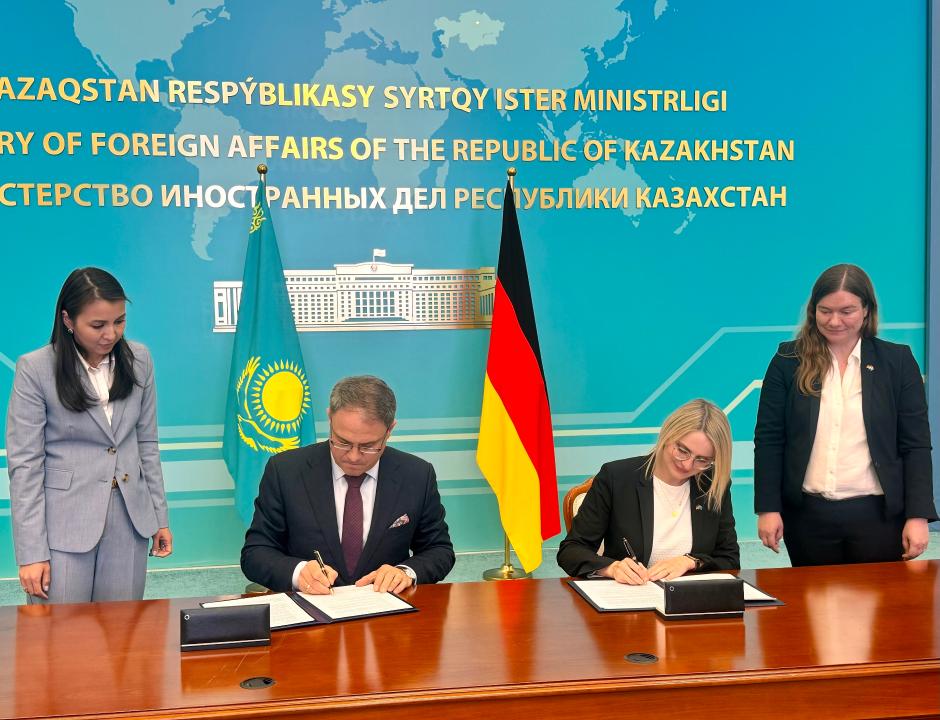
On 21 May, Astana hosted the 20th meeting of the Kazakh-German Intergovernmental Commission for the Affairs of Ethnic Germans in Kazakhstan, co-chaired by Deputy Minister of Foreign Affairs of Kazakhstan Roman Vassilenko and Germany’s Federal Government Commissioner for Matters Related to Ethnic German Resettlers and National Minorities, Member of the Bundestag, Natalie Pawlik. Representatives of the two countries’ ministries and organizations, including the Wiedergeburt (Rebirth) foundation also participated. The agenda focused on cooperation between Kazakhstan and Germany to support the cultural, linguistic, and national identity of Kazakh Germans, as well as the implementation of joint projects in science, education, and culture. The parties reiterated their mutual interest in expanding partnerships within the framework of the Intergovernmental Commission and strengthening the “living bridge” connecting Kazakhstan and Germany. During World War II, Stalin's henchman, Lavrentiy Beria supervized the mass deportation of the Volga Germans, Chechens, Ingush, Pontic Greeks, Crimean Tatars, Balkars and the Karachays, largely to Central Asia. With the crowded wagons stopping only to bury the dead in the snow, approximately 30% perished. According to statistics, 226,000 ethnic Germans reside in Kazakhstan, today, whilst some one million Germans have moved from Kazakhstan to their ancestral homeland. Emphasizing the importance of Kazakhstan’s multi-ethnic population in the successful development of the country, Vassilenko stated that: “Thousands of kilometers separating our countries do not hinder the development and deepening of Kazakh-German relations, as well as the promotion of rapprochement of our peoples. By virtue of history, Kazakhstan has a large German diaspora, while many former citizens of Kazakhstan have resettled in Germany.” Ethnic Germans are represented in all spheres of life in Kazakhstan. The Kazakh-German Center in Astana, the Kazakh-German University in Almaty, the Kazakh-German Institute of Sustainable Engineering in Aktau, the German Drama Theatre, as well as the Deutsche Allgemeine Zeitung newspaper play significant roles in strengthening cultural and humanitarian interaction between Kazakhstan and Germany. Natalie Pawlik welcomed the dynamically developing bilateral cooperation and emphasized that Germany regards Kazakhstan as a key partner in its relations with Central Asia. In her commendation of assistance provided by the German Federal Government to the Germans of Kazakhstan, she mentioned that the study of the German language in Kazakhstan can not only contribute to the preservation of the ethnic Germans’ national identity but prove beneficial to professionals engaging in joint investment projects.    

Alatau IT Hub Opens in Kazakhstan’s Almaty Region

The Alatau Hub, Kazakhstan's most recent regional  IT hub has now opened in Konaev in the Almaty region. Supported by the Ministry of Digital Development, Innovation and Aerospace Industry of Kazakhstan, the Alatau Hub is the 14th regional IT hub launched under the management of Astana Hub. Kazakhstan is now on course to establish similar hubs in all of its regions by the end of this year. During the launch, Ersultan Ermanov, director of the Information Technology Development Department at the Ministry of Digital Development, commented: “The opening of a hub in the Almaty region is a very significant event for IT specialists in the region. Our regional hubs play a key role in creating and developing an ecosystem that stimulates the emergence of new innovative projects, expansion of business activity and technological progress. In the future, Alatau Hub will become a center of attraction for young ambitious talents. It will also contribute to the emergence of new jobs, economic growth, and increased competitiveness of the country in the international arena.” The IT hubs currently in operation across 14 of Kazakstan's regions include: Abai IT Valley, Kyzylorda Hub, Digital Jetisu, Zhambyl Hub, Oskemen IT Hub, Jaiq Hub, Turkistan IT Hub, Qostanai IT Hub, Aqtobe IT Hub, Aqmola IT Hub, Pavlodar IT Hub, Terrikon Valley, Mangystau Hub, and Alatau Hub. By the end of 2024, further hubs will open in the cities of Atyrau, Shymkent, Zhezkazgan, Petropavlovsk, and Zhanaozen.      

Higher Education in Central Asia: Leaders and Outsiders

In June, it will be three years since the signing of a declaration at a forum held in the city of Turkestan between the heads of the Ministries of Education of Kazakhstan, Uzbekistan, Tajikistan, Turkmenistan, and Kyrgyzstan. According to the document, the Central Asian states agreed to expand cooperation and unite the scientific, intellectual, and creative potential of higher education institutions throughout the region. However, only Kazakhstan and Uzbekistan have made progress in terms of synergy during this time. The reason for this is the serious gaps between the Central Asian states in the level of provision of higher education for their citizens.   The pace of reform In the 1990s, the reform of education in Central Asia occurred at different rates. Although the Central Asian republics had similar problems at the time of the collapse of the Soviet Union, they began to address them depending on the degree of influence of global trends. For example, Kazakhstan signed the Bologna Declaration and joined the European Higher Education Area in 2010, while Turkmenistan switched to two-stage higher education under the "Bachelor's - Master's" system only in 2013. Some started organizing English-language curricula at their universities as soon as the early 1990s, such as Kazakhstan's KIMEP University or the University of Central Asia in Kyrgyzstan. Uzbekistan, on the other hand, only came around to the idea of the need for English-language education in the noughties. In the 2000s, universities established jointly with foreign partners, such as the Kyrgyz-Russian Slavic University and the Kazakh-British Technical University, began to open in the region. Uzbekistan was again somewhat late to the trend, first opening the International Westminster University (a branch of the University of London) and a branch of Turin Polytechnic University. In 2014, the first university established jointly with foreign partners from South Korea - Inha University, specializing in the training of IT specialists - appeared. Kazakhstan, Kyrgyzstan, and Uzbekistan are currently implementing reforms in the recognition of diplomas and attracting foreign employees and students, while Tajikistan and Turkmenistan are experiencing problems of a different nature related to low levels of enrollment in higher education.   Kazakhstan Kazakhstan has been the most successful nation in reforming higher education. Degrees have been reduced to four years, and the Unified National Testing (UNT) and credit system of education appeared, creating favorable conditions for accession to the Bologna Process in 2010. By 2016, almost every second Kazakhstani was studying at a higher education institution. Now, Kazakhstan has more than 120 universities. There are more than 600,000 students, and about 40% of Kazakhstanis are certified specialists. Kazakhstan's supremacy in this arena is confirmed by international rankings. For example, the international organization, Times Higher Education included four Kazakhstani universities in its rating for 2024: the Eurasian National University named after L.N. Gumilev; Satpayev University; the Kazakh National University named after Al-Farabi; Nazarbayev University (NU). Participating in these rankings for the first time, the latter was recognized as the best in Central Asia. NU is the first university of its...

Prospective Kazakh Citizens Must Know Country’s Language and History

Under a new law, people applying for Kazakh citizenship will be refused if they do not show at least basic knowledge of the country's language, history and constitution, reports Kursiv. Ministry of Internal Affairs representative Shyngys Alekeshev commented on the law: "The elementary level will be determined by the Ministry of Science and Higher Education. The purpose of the amendments is rapid adaptation and integration into society. Knowledge of the language, first of all, is necessary for the citizens themselves, wishing to obtain our citizenship, to more quickly integrate into society and participate in the life of the state". The ministry added that the legislative amendments are in line with global practice. Earlier it was reported that the authorities intend to teach the Kazakh language to Russian-speaking children and toddlers who have arrived from other countries. For this purpose, the Ministry of Education will create a program of "early immersion in the Kazakh language" in kindergartens and schools. Officials emphasize that this will help to form "Kazakh identity in young citizens".

A Demographic Phenomenon in Kazakhstan — the Population is Rapidly Getting Younger

Kazakhstan stands out sharply on the demographic map of the world, according to Alexei Raksha, a Russian demographer. The republic's government supports high birth rates, which not only bring significant benefits but can also be a source of risk. Independent demographer Raksha has repeatedly said that Kazakhstan does not fit into global fertility trends. By all parameters (relatively high GDP, rising living standards, urbanization, etc.), the republic belongs to countries that should have already completed the first demographic transition. This term means a decline in mortality and fertility due to improved nutrition and medicine, resulting in simple generational replacement. That is, women no longer give birth to 10-15 children, hoping that two or three of them will survive. The first demographic transition has ended almost everywhere except in Africa, scientists believe. Nevertheless, according to Raksha, Kazakhstan -- along with Israel -- shows other indicators. In both countries, both religion and the desire for some kind of historical justice play a role. However, the demographer emphasizes that Kazakhstan's fertility figures are unevenly distributed regionally and ethnically. The fertile southern and western regions contrast sharply with the north, where the population is aging. Raksha recently commented on Kazakhstan's birth rate by women's ethnicity in 2022-2024. "If Kazakhs, Uzbeks and Uyghur women have birth rates at 2.9 to 4.2 children per woman, then representatives of European nations have an average of 1.3-1.5 children (average European level). It is obvious that there is a deep difference in cultural attitudes, both in the degree of social conservatism and in the level of religiosity," he wrote online. According to his data, in recent years, Kazakhstan has been steadily overtaking Uzbekistan, formerly considered the regional leader in population "production". This is confirmed by the data of the study of the leading medical journal The Lancet "Institute for Health Metrics and Evaluation" (IHME) on fertility in 204 countries and territories in the period from 1950 to 2021 with forecasts up to 2100. According to the report, Kazakhstan has surpassed all its neighbors in Central Asia and all countries in the Northern Hemisphere in terms of fertility over 70 years. For contrast, Raksha constantly cites data on prolonged depopulation in Europe, North America, China, Korea, and Japan. Countries whose population is inexorably aging and whose birth rate is below the level of simple reproduction (less than two children per woman) are doomed to attract labor migrants, the expert believes. In addition, the SWO plays a destructive role in the post-Soviet space. Russia has faced precisely unrecorded but obvious demographic losses, while Ukraine is on the verge of social catastrophe. Kazakhstan will not face the fate of an endangered country in the coming generations. In late April, the Bureau of National Statistics of Kazakhstan reported that the total fertility rate in 2023 amounted to 19.52 per 1000 people. In 2022 it was at the level of 20.57 births per 1000 people. The highest birth rates are noted in Mangistau region (26.74 people per 1000 people), Turkestan region (26.18) and Shymkent...

“I Hope Saltanat’s Family Can Find Peace” – Women of Kazakhstan Speak Out on Bishimbayev’s Sentence

On November 9, 2023, former Kazakh Minister of the National Economy, Kuandyk Bishimbayev was caught on surveillance cameras arguing with and then brutally beating his common-law wife, 31-year-old Saltanat Nukenova, for around eight hours outside a restaurant he owned in Astana. A forensic examination showed that she had been strangled, but the cause of death was recorded as traumatic injury to the brain. The high-profile case which was live-streamed garnered international attention. Despite pleading not guilty to premeditated murder, Bishimbayev was sentenced to 24 years’ imprisonment for torturing and murdering Nukenova, and his cousin Bakytzhan Baizhanov to four years for his part in covering up the crime. Prosecutor Aizhan Aimaganova, who became widely-known during the trial, said in an interview with Tengrinews.kz that she believes the verdict will change the country forever. "Family and domestic violence is a pressing problem... I hope that after this trial, women will realize that going to law enforcement is not useless. It is necessary to talk about problems. I think now any domestic tyrant will think twice before raising his hand," she said. [caption id="attachment_18029" align="aligncenter" width="872"] Prosecutor Aizhan Aimaganova; image: Press service of the Astana Court[/caption] While the length of the sentence is a victory for advocates against gender-based violence, both within Kazakhstan and in the many parts of Europe where the trial was also followed closely, many Kazakhs feel it is still too early to say that justice has been done. In an open discussion that is rare in Central Asia, many citizens are posting their concerns on social media that the Nazarbayev-era official will find a way to get out of prison early: there is already speculation that Bishimbayev, a former member of the country’s elite, will leverage his political connections to secure an early release – or be recognized as terminally ill. Following the verdict, TCA took to the streets of Kazakhstan to ask women their opinion. "I finally feel relieved,” Sara, an SMM manager from Astana told TCA. “Twenty-four years is a justified sentence in my opinion. Although tragic, this case drew public attention to a great many issues, such as the need for both a new law against domestic abuse and charities to support victims of domestic violence, which is very prominent in Kazakhstan. The whole country watched the case unfold, and that attention was put to good use since many other domestic violence cases got the attention they deserved. I hope that our justice system will make sure that Bishimbayev doesn't get a chance to get out early and serve his full sentence. The same applies to Baizhanov." "Considering various aspects, including the status of his family and the presence of his children, this sentence is probably objective, especially given the jury's involvement,” 21-year-old journalist, Kamila told TCA. “The main issue now is to prevent his release on parole once the unrest subsides, though I know this is only possible if the victim’s family give their consent.” "From an objective point of view, 24-years for a brutal...