• KGS/USD = 0.01144 0%
  • KZT/USD = 0.00212 0%
  • TJS/USD = 0.10456 0.19%
  • UZS/USD = 0.00008 0%
  • TMT/USD = 0.28490 0%
  • KGS/USD = 0.01144 0%
  • KZT/USD = 0.00212 0%
  • TJS/USD = 0.10456 0.19%
  • UZS/USD = 0.00008 0%
  • TMT/USD = 0.28490 0%
  • KGS/USD = 0.01144 0%
  • KZT/USD = 0.00212 0%
  • TJS/USD = 0.10456 0.19%
  • UZS/USD = 0.00008 0%
  • TMT/USD = 0.28490 0%
  • KGS/USD = 0.01144 0%
  • KZT/USD = 0.00212 0%
  • TJS/USD = 0.10456 0.19%
  • UZS/USD = 0.00008 0%
  • TMT/USD = 0.28490 0%
  • KGS/USD = 0.01144 0%
  • KZT/USD = 0.00212 0%
  • TJS/USD = 0.10456 0.19%
  • UZS/USD = 0.00008 0%
  • TMT/USD = 0.28490 0%
  • KGS/USD = 0.01144 0%
  • KZT/USD = 0.00212 0%
  • TJS/USD = 0.10456 0.19%
  • UZS/USD = 0.00008 0%
  • TMT/USD = 0.28490 0%
  • KGS/USD = 0.01144 0%
  • KZT/USD = 0.00212 0%
  • TJS/USD = 0.10456 0.19%
  • UZS/USD = 0.00008 0%
  • TMT/USD = 0.28490 0%
  • KGS/USD = 0.01144 0%
  • KZT/USD = 0.00212 0%
  • TJS/USD = 0.10456 0.19%
  • UZS/USD = 0.00008 0%
  • TMT/USD = 0.28490 0%

Viewing results 2473 - 2478 of 4651

Kazakhstan to Invest $1 Billion in Repairing Water Management Infrastructure

Kazakhstan's minister of national economy, Nurlan Baibazarov, has announced that the country is to repair its water management system following recent severe floods. "The floods that took place in the spring showed the underdeveloped infrastructure of the country's water management system. We have identified 16 projects that require investments of more than 500 billion tenge [over $1 billion]," Baibazarov said. According to the minister, preferential financing will come from from the Saudi Islamic Development Bank. Funds are provided for an extended period at a very low rate, enabling the resolution of long-standing issues in this sector. The renovation of the water management system will include the construction of reservoirs and irrigation canals and the fortification of the technical infrastructure for all services. "First of all, according to the instructions of the head of state, we will carry out a complete renewal of equipment and facilities in the Ministry of Emergency Situations system. In the water sector, we will also equip the Kazvodkhoz system with the necessary equipment," Baibazarov added.
UNDP and Samruk Kazyna Support Socially Vulnerable Young People in Kazakhstan 

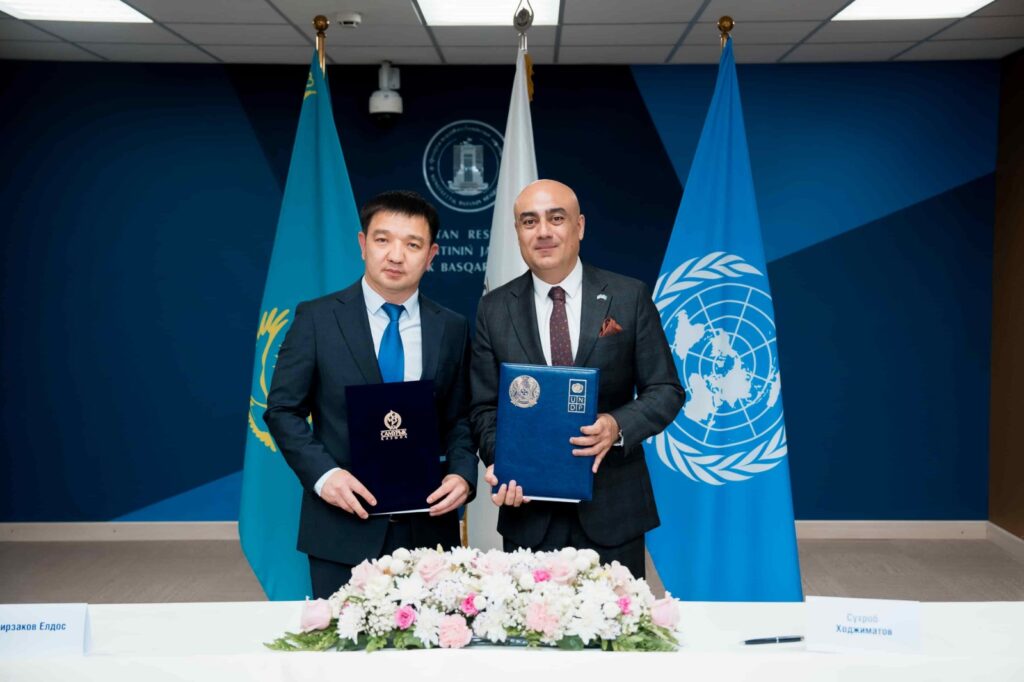
The United Nations Development Programme (UNDP) in Kazakhstan and Kazakhstan’s National Welfare Fund Samruk-Kazyna JSC have signed a non-financial statement of intent on cooperation to support socially vulnerable young people in the regions of Kazakhstan. According to a report issued by UNDP Kazakhstan, the agreement will also promote responsible business practices addressing potential human rights violation risks, and introduce principles of gender equality to overcome gender discrimination in companies associated with the Samruk-Kazyna Fund. Gibrat Auganov, Managing Director for Corporate Governance, Social and Labour Relations and Occupational Health and Safety of Samruk-Kazyna JSC, commented: "As part of our cooperation with the UNDP, we are launching an internship programme at our companies to support socially disadvantaged young people from the various regions of Kazakhstan. We are also planning a number of initiatives in the field of human resources and social policy - based on global standards of gender equality and human rights protection." Over 300 young people from the Mangystau and Kyzylorda regions are expected to complete internships at Samruk-Kazyna companies this year. The joint internship programme is a key component of the UNDP regional initiative "Strengthening Community Resilience to Prevent Violent Extremism in Central Asia," funded by the government of Japan. As part of the partnership, UNDP will also provide technical support to Samruk-Kazyna JSC to conduct a gender assessment of the holding's activities, develop an action plan and provide training on human rights due diligence and gender equality. "This partnership has three main objectives that reflect our shared desire to create a more just, responsible and inclusive future,” said Sukhrob Khojimatov, UNDP Deputy Representative in Kazakhstan. “Implementing human rights standards and gender equality strategies brings tangible economic benefits. This helps businesses attract and retain talented employees, encourages innovation, improves financial performance and enhances their reputation among consumers and investors.”  

Kazakhstan Pushes New Measures to Utilize its Transit Potential

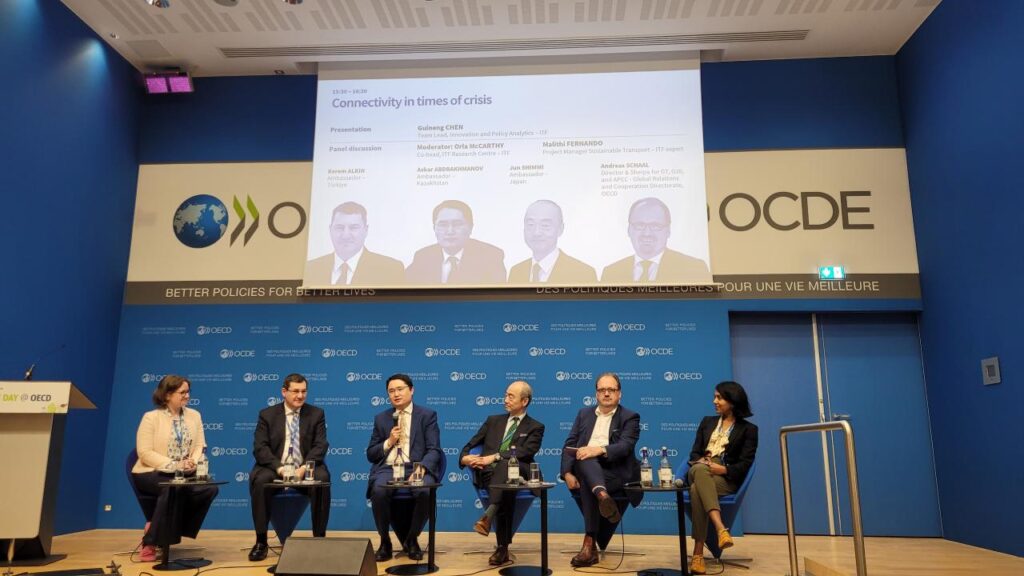
On June 20, Permanent Delegate of Kazakhstan to International Organizations in Paris, Askar Abdrakhmanov, attended the International Transport Forum (ITF) Day at the Organization for Economic Co-operation and Development (OECD) headquarters. In his presentation on “Connectivity in Times of Crisis,” Ambassador Abdrakhmanov focused on Kazakhstan’s measures to further develop its transport infrastructure and international freight transportation, and Astana’s efforts to develop transport cooperation with the country’s neighbouring states. Regarding the potential of both old and new routes, Abdrakhmanov highlighted the construction of second tracks on the Dostyk – Moynty railway on the Kazakhstan and China border, a container hub and dredging projects at Aktau and Kuryk seaports, a new Darbaza – Maktaral railway line with further access through Uzbekistan, Turkmenistan and Iran to the Persian Gulf and the Indian Ocean, and functioning the eastern branches of the North-South corridor. Special attention was paid to the Trans-Caspian International Transport Route (TITR), widely known as the Middle Corridor. He emphasized the importance of the recent joint government venture to establish a single, unified operation of cargo transportation along the Middle Corridor, as well as the launch of the TITR Coordination Platform with the participation of Central Asian states, the South Caucasus, and the European Commission. “The current geopolitical situation has created new economic and logistical challenges for Kazakhstan and other countries in the region, and the answers to them lie in closer cooperation with our neighbours and international partners,” stated the Kazakh diplomat. The International Transport Forum (ITF) at the OECD is an intergovernmental organization with 69 member countries which serves as a think tank for transport policy and organizes annual summits of transport ministers. Kazakhstan has been an ITF member  since 2017.    

Results of Visit of the U.S. Trade Representative to Kazakhstan

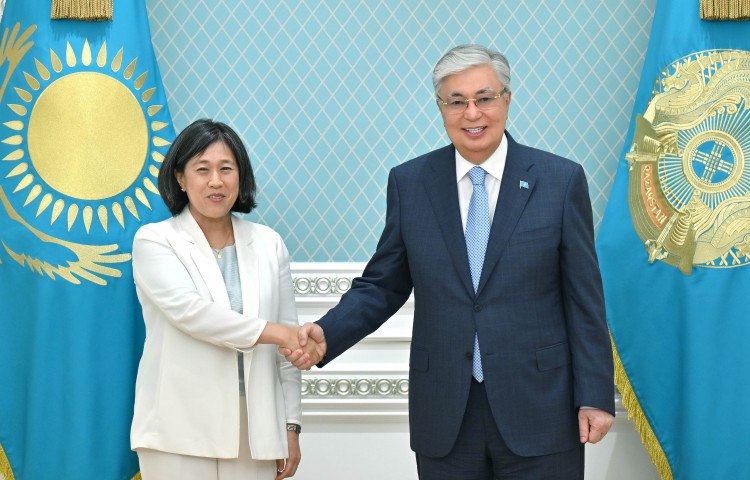
By Vagit Ismailov President of Kazakhstan Kassym-Jomart Tokayev, Deputy Prime Minister Serik Zhumangarin, Minister of Trade and Integration Arman Shakkaliev, Minister of Labor and Social Protection Svetlana Zhakupova, and other officials met with U.S. Trade Representative Catherine Tye. The United States and Kazakhstan reaffirmed their commitment to expanding and diversifying bilateral trade relations. Both sides pledged to deepen cooperation in agriculture and make progress in the near term. This includes increasing U.S. meat and poultry production capacity, optimizing the issuance of digital export certificates, and facilitating increased shipments of U.S. agricultural equipment to Kazakhstan. Tye noted Kazakhstan's interest in repealing the Jackson-Vanik amendment and expressed support for the U.S. Congress' efforts to update the Generalized System of Preferences program. She also recognized the program's importance in diversifying Kazakhstan's trade. The U.S. and Kazakhstan pledged to strengthen joint work on regional connectivity and increase the capacity of the Trans-Caspian Trade Route. The parties discussed increasing bilateral engagement to create diverse, secure, and sustainable supply chains. They stressed the importance of continuous cooperation in trade facilitation, including the harmonization and digitization of customs processes. Tye noted the contribution of U.S. companies' supply of high-quality products and the development of alternative trade routes. She also thanked Kazakhstan for the success of the 15th meeting of the Board of the U.S.-Central Asia Trade and Investment Framework Agreement (TIFA). The working groups noted progress on several issues, including sanitary and phyto-sanitary measures, customs procedures, intellectual property protection, women's economic empowerment, and digital trade. Tye further emphasized the importance of a transparent and consultative regulatory process in regional harmonization. Kazakhstan and the U.S. reaffirmed their commitment to utilize the TIFA mechanism further to deepen trade and investment ties between the U.S. and Central Asia. The U.S. also expressed interest in working closely with Kazakhstan to support internationally recognized labor rights, including promoting workers' rights to freedom of association and collective bargaining. The United States and Kazakhstan pledged to continue working to achieve concrete trade results, maintaining the positive momentum of the bilateral trade and investment relationship.

Firefighters Evacuate People from Burning High-Rise in Astana

A large fire broke out at a 26-storey building in Kazakhstan’s capital on Saturday, sending dense clouds of smoke billowing across the city. Firefighters evacuated people, including a three-month-old baby, from the Rixos Khan Shatyr Residences in Astana, the Ministry of Emergency Situations said. It posted photographs and video of firefighters escorting people into the street and using a crane and hose to extinguish the flames. Much of the blaze appeared to be on part of the building’s outer covering material. Built by Turkish company Sembol Construction, the building is on Turan Avenue and near the Khan Shatyr shopping and entertainment center, which has a distinctive cone-like structure. “Fully equipped apartments and high-level finishes, full range of services and infrastructure, as well as comfortable and spacious offices will be a hallmark of the project,” Sembol Construction said when the building project was underway. Eight people, including one child, were evacuated from the building. According to the official representative of the Ministry of Emergency Situations of the Republic of Kazakhstan Dinara Nurgalieva, there was no information about the severely injured. A firefighting headquarters has been set up at the scene, with firefighters continuing to extinguish not only the cladding of the building, but also working inside the complex. The causes of the fire have not yet been reported, and specialists continue to work at the scene.

Aidos Sadykov Shooting: First Suspect Detained by Kazakhstan Authorities

Yesterday, TCA reported that two suspects had been identified by the Ukrainian authorities just three days after after the shooting of Aidos Sadykov, a Kyiv based political blogger. Both are Kazakhstan citizens, 33-year-old Meiram Karataev and 36-year-old Altay Zhakanbaev, whose names have been corroborated by the Prosecutor General of Ukraine’s website. Immediately following the attack, President Tokayev of Kazakhstan said that “the official bodies of the Republic of Kazakhstan are ready to join the investigation.” According to the Kazakhstan Office of the General Prosecutor, on June 21, Zhakanbaev independently turned himself in to the Ministry of Internal Affairs, where he was questioned on the circumstances of the case. On the same day, he was detained on suspicion of involvement in the crime against Aidos Sadykov. Sadykov and his wife, Natalya Sadykova left Kazakhstan in 2014 following allegations of slander by a Kazakh MP, a charge no longer considered a criminal offense as of 2020. Since 2014, they have resided in Kyiv, where they have received refugee status. From Kyiv, the couple host the YouTube channel @base-kazakh, which, according to their description, “covers events in Kazakhstan and the world and does not depend on the authorities, oligarchs and grants”. Sadykov has criticized the Kazakh authorities in the regional press since 2000 and the YouTube channel has been consistently critical of Kazakhstan’s government, starting with President Nazarbayev’s term and continuing under the new President, Kassym-Jomart Tokayev. Since the war broke out in Ukraine, Sadykov and his wife have claimed that Kazakhstan’s leadership is colluding with the Kremlin. The apparent assassination attempt of Sadykov has raised questions about the motive. Kazakhstan parliamentary deputy, Ermurat Bapi has suggested that the assassination attempt was due to “third forces” that want to create a “quarrel between Kazakhstan and some countries”. Sadykova has accused President Tokayev of ordering the assassination. The detainment of the first suspect by Kazakhstan authorities is a positive development in determining the actual motive behind the attack.