• KGS/USD = 0.01144 0%
  • KZT/USD = 0.00194 0%
  • TJS/USD = 0.10879 0%
  • UZS/USD = 0.00008 0%
  • TMT/USD = 0.28571 0%
  • KGS/USD = 0.01144 0%
  • KZT/USD = 0.00194 0%
  • TJS/USD = 0.10879 0%
  • UZS/USD = 0.00008 0%
  • TMT/USD = 0.28571 0%
  • KGS/USD = 0.01144 0%
  • KZT/USD = 0.00194 0%
  • TJS/USD = 0.10879 0%
  • UZS/USD = 0.00008 0%
  • TMT/USD = 0.28571 0%
  • KGS/USD = 0.01144 0%
  • KZT/USD = 0.00194 0%
  • TJS/USD = 0.10879 0%
  • UZS/USD = 0.00008 0%
  • TMT/USD = 0.28571 0%
  • KGS/USD = 0.01144 0%
  • KZT/USD = 0.00194 0%
  • TJS/USD = 0.10879 0%
  • UZS/USD = 0.00008 0%
  • TMT/USD = 0.28571 0%
  • KGS/USD = 0.01144 0%
  • KZT/USD = 0.00194 0%
  • TJS/USD = 0.10879 0%
  • UZS/USD = 0.00008 0%
  • TMT/USD = 0.28571 0%
  • KGS/USD = 0.01144 0%
  • KZT/USD = 0.00194 0%
  • TJS/USD = 0.10879 0%
  • UZS/USD = 0.00008 0%
  • TMT/USD = 0.28571 0%
  • KGS/USD = 0.01144 0%
  • KZT/USD = 0.00194 0%
  • TJS/USD = 0.10879 0%
  • UZS/USD = 0.00008 0%
  • TMT/USD = 0.28571 0%
15 December 2025

Viewing results 2503 - 2508 of 3296

Breaking Down Kazakhstan’s Claims Against International Oil Consortiums

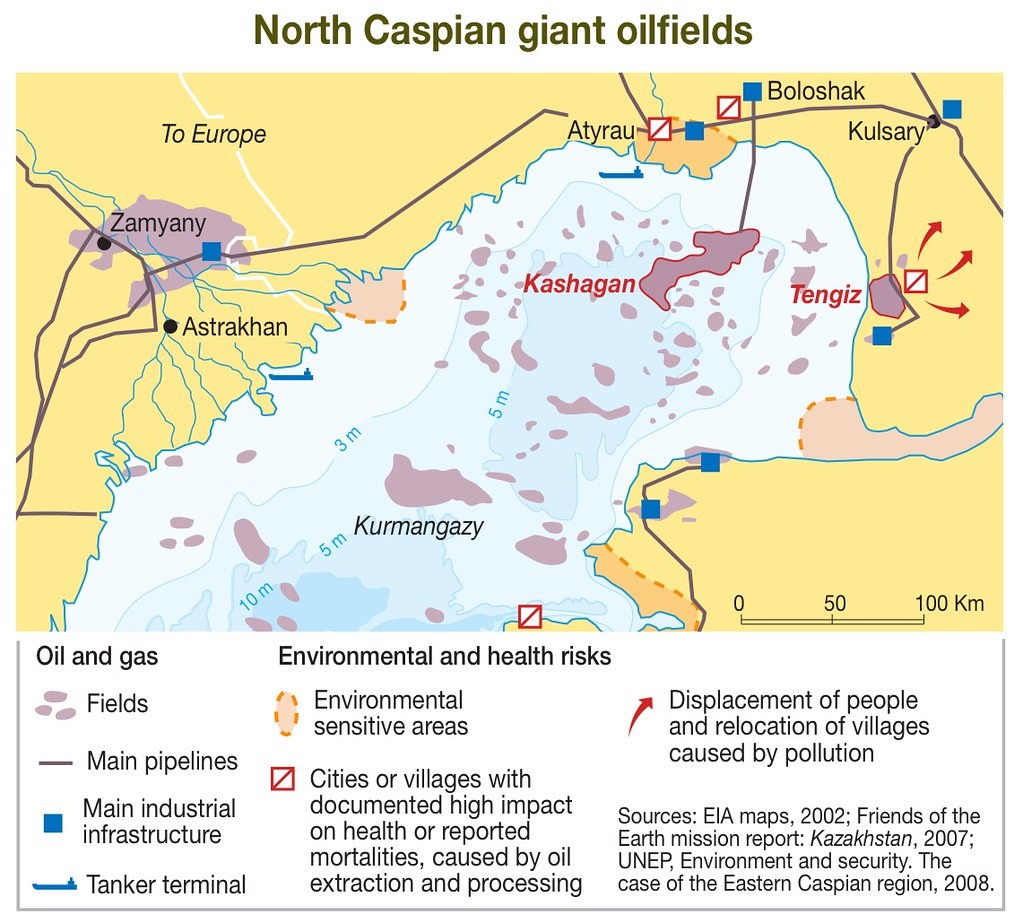
The total amount of claims brought against the consortiums, North Caspian Operating Company (NCOC) and Karachaganak Petroleum Operating (KPO) is the largest in the history of Kazakhstan. In March 2023, PSA LLP, the authorized state institution overseeing these projects, brought forward claims in international arbitration in relation to Kashagan and Karachaganak for $13.5 billion and $3.0 billion, respectively. In addition, the Atyrau Region environmental regulator filed a claim for $5.1 billion against the NCOC consortium for storing too much sulfur on site, discharging wastewater without treatment, etc. The claims of PSA LLP cover the period 2010-19 and relate to the oil consortiums’ costs for carrying out large projects, as well as tenders and insufficient work completed. The shareholders of NCOC, which is developing the offshore Kashagan Field, include: KMG Kashagan (16.877% stake), Shell Kazakhstan Development (16.807%), Total EP Kazakhstan (16.807%), Agip Caspian Sea (16.807%), ExxonMobil Kazakhstan (16.807%), CNPC Kazakhstan (8.333%) and INPEX North Caspian Sea (7.563%). Their total investments over the period have not been disclosed, but, according to various estimates, exceed $60 billion – meaning the state is currently calling into question about 23% of all costs. The KPO consortium is Shell (29.25%), Eni (29.25%), Chevron (18.0%), Russia’s Lukoil (13.5%) and Kazakhstan’s state-owned KazMunayGas (10.0%). Investments in this oil and gas condensate field are estimated at $27 billion, hence the filed claim is significantly smaller both in absolute terms and as a percentage of costs, standing at about 11%. A production sharing agreement was signed in 1997 for Karachaganak and in 1998 for Kashagan, with the contracts to be in effect for 40 years. In 2022, the sole participant in PSA LLP became Samruk-Kazyna Trust Corporate Fund, part of the state holding National Welfare Fund Samruk-Kazyna, while Kazakhstan’s Ministry of Energy is currently entrusted to run PSA LLP. NCOC and KPO dominate the industry through control of three fields. Tengiz, Kashagan and Karachaganak are the largest oil and gas fields in Kazakhstan. The country’s oil and gas condensate production in 2023 amounted to 89.9 million tons (about 1.8 million barrels per day), with the share of the “three whales” – as these projects are called – accounting for 67% of oil production: Tengiz with 28.9 million tons, down 1% versus the 2022 level; Kashagan with 18.8 million tons, a 48% increase; Karachaganak with 12.1 million tons, up 7% year-on-year. The stabilization contract for Tengiz was one of the first signed at the dawn of Kazakhstan’s independence in 1993, also for a term of 40 years, meaning it should be the first to expire in 2033. The shareholders of the Tengizchevroil JV are Chevron (50%), ExxonMobil (25%), KazMunayGas (20%) and Lukoil (5%). After completion of its FGP (Future Growth Project), Tengiz should produce about 900,000 barrels per day, a significant figure even by world standards. It is surprising that Kazakhstan has not yet raised or voiced any claims against TCO, even though the FGP budget has swelled from an initial $12 billion to $25 billion – due to the addition...

Chinese Hackers Accessed Kazakh Telecoms Data for Two Years 

A Chinese company engaged in cyberintelligence operations in a number of countries has also operated in Kazakhstan, according to the Center for Analysis and Investigation of Cyberattacks (TSARKA). Secret data from the company iSoon (also known as Anxun) were published by unknown persons. The company is a contractor of China's Ministry of Public Security. There are also rumors that iSoon is linked to Chengdu 404, China's notorious cyberintelligence structure also known as APT41. "The leak sheds light on the forms and methods of Chinese intelligence, which include infiltrating and obtaining information. The attackers targeted both general information, such as databases, and pinpointed information of specific individuals: monitoring correspondence, calls and movement. Data analysis showed that the volume of stolen information is measured in terabytes," TSARKA reported. Cyberattacks were launched at the infrastructure of a number of countries, among them Kazakhstan. The hacker group had access to the infrastructure of Kazakhstani telecom operators Kcell, Tele2, Beeline and others for two years. The hackers had access to the operators' event logs, call duration, IMEI of devices and call billing. The leak includes files with information about subscribers of the telecom operators. The cybercriminals also knew the user data of IDNET, IDTV with personal data of subscribers, their logins and passwords, and even logs of individual subscribers with details of all calls and activities. Furthermore, data from Kazakhstan's Unified Accumulative Pension Fund (JSC UAPF), information on the mail server of the Kazakh Ministry of Defense, and data from airline Air Astana were also among those accessed by iSoon. TSARKA found screenshots of correspondence between members of the cybercriminal group, in which they discussed the hacked subscribers and their information. Investigations revealed that targeted attacks were also carried out on employees of law enforcement agencies. "The Trojan Horse (malware) could pull out all host information, manage processes, files (view, delete, execute, modify), execute commands (CMD operations), take screenshots, record every button pressed on the keyboard, and more. The authors claim that 95% of antivirus programs will not be able to detect this trojan, including Kaspersky, Symantec and others. At the same time, the Trojan Horse is able to uninstall and restart on its own," TSARKA claims. Moreover, the hackers had a Mac OS version of the trojan. They could also control iOS and Android systems. However, the functionality for iOS was much smaller than Android. In addition, the hackers had Linux versions and an implantable Wi-Fi device. TSARKA noted that the Chinese group had access to Kazakhstan's data for at least two years. The group suggested creating an independent cybersecurity agency. TSARKA experts believe that as long as the information security committee is subordinate to the Ministry of Digitalization, the structure of the state will be vulnerable. The Unified Accumulative Pension Fund denies any knowledge of a data breach concerning ordinary Kazakhs. "UAPF, in connection with the spread of information in the network about the leakage of personal data of Kazakhstanis from the database of the EAPF, which allegedly posted by unknown persons in...

Kazakhstan to Increase Production of Auto Components

A conference was recently held in Astana to discuss the localization of automotive components production in Kazakhstan. Kazakh and foreign investors are currently channeling more than $900m to organize manufacturing of auto components in the country, to make vehicles more affordable for drivers.  At the conference, Shyngys Suyunbaev, deputy chairman of the Industry Committee at the Ministry of Industry and Construction, said that automakers in Kazakhstan are now required to gradually increase the production of vehicles using the Completely Knocked Down (CKD) method from 20% of the total number of vehicles produced in 2024 up to 50% in 2027.  “To deepen the localization and development of CKD production of vehicles, the development of the automotive component base is required. Currently, projects are being implemented in Kazakhstan for the production of exhaust systems, bumpers, sandwich panels, polyurethane mats and plastic parts, multimedia, seats, wheels, tires, cylinder heads, mechanical gearboxes, and batteries,” Suyunbaev said. The president of the Kazakhstan Automobile Union, Anar Makasheva, commented that the industry has significantly increased production rates and domestically-assembled vehicles are now more popular among the population. According to Ms Makasheva, in 2023 the production of passenger and commercial vehicles in Kazakhstan increased by 30%, and sales of vehicles increased by more than 60%. The share of domestically assembled cars in the market was 70.7% in 2023. “Localization of auto components production will be the starting point for the transition of domestic automotive enterprises to a more complex level of production,” Makasheva added. In 2023, 148,900 motor vehicles were manufactured in Kazakhstan. Local automakers assemble passenger and commercial vehicles by brands including Chevrolet, Lada, Kia, Renault, JAC, Hyundai, Golden Dragon, Shacman, Dongfeng, Daewoo, Yutong, and Iveco.

Spanish Company Ready to Explore for Groundwater in Kazakhstan

Cooperation in groundwater exploration was discussed during a February 21st meeting of Kazakhstan’s minister for water resources and irrigation, Nurzhan Nurzhigitov, with the Spanish ambassador Jorge Urbiola López de Montenegro, and representatives of the Spanish company Xcalibur Smart Mapping, the global leader in natural resource mapping.  Xcalibur, whose technologies are widely used in Australia, Canada, the USA, and Europe, said that it was ready to help attract grants and funding for joint projects in groundwater exploration in Kazakhstan.  According to the Ministry of Water Resources and Irrigation, 4,540 groundwater deposits have so far been explored in Kazakhstan. Today the water reserves of Kazakhstan total 102.3km³ and the operational reserves of groundwater in the country amount to 15.7km³. Slightly more than 1% of the total volume of water is used to provide the population with drinking water. 

Kazakhstan to Report to UN on Events of January 2022 Unrest

Kazakhstan will report to the United Nations (UN) Committee against Torture on measures taken after the events of bloody January (Qantar) 2022. This is according to the Deputy Chairwoman of the International Bureau for Human Rights, Roza Akylbekova, who added that information on urgent recommendations, which primarily concern Qantar, should be provided no later than May 12th, 2024 "This is information about what happened, how many people were affected, and, of course, about deaths in closed institutions and how Kazakhstan is investigating them," Akylbekova said at a news conference at the office of the Kazakhstan International Bureau for Human Rights and the Rule of Law. In addition, according to the human rights activist, the Ministry of Defense of Kazakhstan will have to prepare information on the deaths of conscripts. It has been 25 years since Kazakhstan joined the UN Convention against Torture, since which time the Coalition of NGOs of Kazakhstan against Torture and the National Preventive Mechanism for the Prevention of Torture have been established created. Furthermore, Kazakhstan added an article on torture to the criminal code and opened up a path for individual appeals regarding torture directly to the UN Committee. At the same time, however, torture remains a pressing problem in the country. According to the Kazakhstan International Bureau for Human Rights and the Rule of Law, 200-250 people apply to the Coalition of NGOs against Torture every year. In 2022, 190 appeals were received in connection with the January events, and another 88 episodes that had no connection to the mass riots of that year. Since Qantar, the number of complaints has not fallen, with 283 appeals in 2023, during which year over 20 systemic recommendations were issued to Kazakhstan. Earlier this year, the European Union (EU) funded a three-year project by Kazakhstani human rights defenders that aims to eradicate torture. As part of this project, the Kazakhstan NGO Coalition against Torture and the Prison Reform International (PRI) office will analyze individual cases of criminal prosecution for torture which do not reach trial. However, these cases are difficult to identify and prosecute. "In Kazakhstan such crime as torture is adjacent to other articles of the Criminal Code: in addition to 'torture,' the concepts of 'ill-treatment' and 'abuse of power' are used. Therefore, the official statistics on those prosecuted for 'torture' (Article 146) do not give an understanding of how many cases are actually hidden behind the lighter articles. At the same time, Article 146 itself has been divided into two parts: 'torture,' which will be investigated by the prosecutor's office, and 'cruel and inhuman treatment,' which is left to the Interior Ministry, whose employees are most often the beneficiaries of torture," the press service of the Kazakhstan International Bureau for Human Rights and Rule of Law reported. The UN Committee against Torture was established in January 1987. It consists of 10 independent experts, who currently represent the United States, Turkey, China, Japan, Russia, France, Morocco, Moldova, Latvia, and Mexico. They monitor the implementation of the Convention...

Bodies of Kazakh Rescue Workers Swallowed by Sinkhole Still Missing After Seven Weeks

The search for rescuers who fell into a sinkhole at a mine owned by JSC Maikainzoloto may resume in ten to fourteen days, it has been announced by Deputy Chairman of the Committee of Industrial Safety of the Ministry of Emergency Situations, Musa Tanabaev. "Work on expansion and deepening" must be completed, Tanabaev said, and only then can a "direct search for the missing begin." The wife of Aidos Shaimerden, one of the missing rescue workers, has repeatedly asked local authorities to involve foreign specialists in the search. The Ministry of Emergency Situations has responded that this is not required yet. In the early hours of January 4th, near the Maikainsky mine in the Pavlodar Region, a bus carrying three rescue workers and a driver fell into a sinkhole. Shortly before the incident, they had received an emergency call about smoke in the area of the mine and proceeded to the site. Preliminary measurements of the sinkhole put the width of the collapse at 500 meters, with a depth of 150 meters. At noon of the same day, the bodies of two rescue workers who fell into the breach were found in the debris at a depth equal to that of a 25-story building. They were 53-year-old Oleg Tyshkevich, and 24-year-old Berdikan Sarkyt. The rescue operation was, however, complicated by the fact there could be more collapses at the edge of the newly formed pit. On January 5th, the police began an investigation into the tragedy. According to details of the special investigation, dust at the site of the sinkhole was mistaken for smoke, and at 01:14 a bus with first responders went to the location of a possible fire. The director of the mine followed them by car. When he saw the bus fall, he managed to slow down and report what had happened - thus preventing the death of four firefighters who were following. During the ensuing search, a tracking device showed that the bus was buried at a depth of about five meters from the bottom of the funnel. Two days later, rescuers with a surveyor descended to the bottom of the breach and examined it for the first time. On January 18th, heavy equipment completed the laying of a side ramp and lowered a small excavator down to the center of the sinkhole on a safety cable. During the initial excavation, parts of the bus, an oxygen cylinder, breathing apparatus and a rescue worker's bag were located. Later, a helmet, parts of the interior of the bus, and a first responder's hand-held radio were discovered. On January 26th, a special commission found that the collapse of rock mass into the abandoned mine was caused by unsatisfactory production management, there having been no proper oversight of the breaches formed as a result of the company's activities. An investigation was launched for "violation of safety rules during mining or construction works," and more than 40 employees and the management of the LLP were questioned, whilst documents and video...