• KGS/USD = 0.01144 0%
  • KZT/USD = 0.00210 0%
  • TJS/USD = 0.10438 0%
  • UZS/USD = 0.00008 0%
  • TMT/USD = 0.28490 0%
  • KGS/USD = 0.01144 0%
  • KZT/USD = 0.00210 0%
  • TJS/USD = 0.10438 0%
  • UZS/USD = 0.00008 0%
  • TMT/USD = 0.28490 0%
  • KGS/USD = 0.01144 0%
  • KZT/USD = 0.00210 0%
  • TJS/USD = 0.10438 0%
  • UZS/USD = 0.00008 0%
  • TMT/USD = 0.28490 0%
  • KGS/USD = 0.01144 0%
  • KZT/USD = 0.00210 0%
  • TJS/USD = 0.10438 0%
  • UZS/USD = 0.00008 0%
  • TMT/USD = 0.28490 0%
  • KGS/USD = 0.01144 0%
  • KZT/USD = 0.00210 0%
  • TJS/USD = 0.10438 0%
  • UZS/USD = 0.00008 0%
  • TMT/USD = 0.28490 0%
  • KGS/USD = 0.01144 0%
  • KZT/USD = 0.00210 0%
  • TJS/USD = 0.10438 0%
  • UZS/USD = 0.00008 0%
  • TMT/USD = 0.28490 0%
  • KGS/USD = 0.01144 0%
  • KZT/USD = 0.00210 0%
  • TJS/USD = 0.10438 0%
  • UZS/USD = 0.00008 0%
  • TMT/USD = 0.28490 0%
  • KGS/USD = 0.01144 0%
  • KZT/USD = 0.00210 0%
  • TJS/USD = 0.10438 0%
  • UZS/USD = 0.00008 0%
  • TMT/USD = 0.28490 0%

Viewing results 811 - 816 of 1483

China and Central Asian Countries to Jointly Respond to Emergencies

China and the five Central Asian countries plan to sign a memorandum of understanding to establish a mechanism of cooperation in the field of emergency management, Wang Manda, head of the International Cooperation Department of China's Ministry of Emergency Management, said at a press conference in Beijing, Xinhua reports. Manda specified that the signing of the memorandum is expected to take place during a ministerial meeting between China and the Central Asian countries on emergency management to be held on May 30 in Urumqi, the administrative center of Xinjiang Uyghur Autonomous Region. “Both China and the five Central Asian countries, namely Kazakhstan, Kyrgyzstan, Tajikistan, Turkmenistan, and Uzbekistan, are at high risk of natural disasters, including earthquakes, floods, forest, and steppe fires. The upcoming meeting will review cooperation between the two sides in areas such as disaster prevention, damage mitigation, disaster management, industrial safety supervision, and comprehensive rescue work, and put forward new proposals to deepen practical cooperation,” Wang said. The two sides will also hold drills on emergency responses to accidents at oil and gas pipelines. Following the first China-Central Asia summit in May 2023, the emergency management agencies of China and the Central Asian states pledged to establish a new platform for regional cooperation and deepen cross-border cooperation in rescue operations. Over the past year, the Chinese side has held several events within the framework of cooperation on emergency management in the “China-Central Asia” format. Among them are forums of high-level think tanks on emergency management, seminars on improving industrial safety, and the exchange of experience in safety risks.


The Geography of Labor: Where Do Central Asian Migrants Travel To?

Since February 2022, international observers have been predicting changes in labor migration in Central Asia. It is no secret that for 30 years Russia was the main attraction for labor resources in the region, and in the "noughties," Kazakhstan joined as a viable alternative. Over the past two years, the geography of labor migration from Central Asia has expanded somewhat, but still not to the extent that one could say that the region is slipping away from Moscow's economic influence. In Russia itself, despite growing anti-migrant sentiment after the terrorist attack at the Crocus City concert hall, the country's leadership has no intention of refusing to accept migrants from Central Asia. The current phase of Russia's economic development requires a constant inflow of labor resources, so Moscow is even talking about expanding the geography of sources of labor on an industrial scale, particularly to African countries. However, the movement of labor resources from Central Asia to the outside world is a process that benefits both the countries of origin of migrants and those who receive them. The region's countries shed their excess population, thus avoiding possible social explosions, while the receiving countries get workers willing to do low-paid and low-skilled labor. This is true for three of the five Central Asian countries. We do not consider Turkmenistan -- a republic closed to the outside world -- but labor migration from Kazakhstan is more like a "brain drain," which puts it on a par with Russia, which is experiencing similar problems. In the Central Asian republics, the topic of labor migration is still victimized, and the pejorative term "gastarbeiters" remains in common use. Thus, research on these processes is not permanent, which makes it difficult to work with statistical data. And since the largest receiving country is Russia, where chaos reigns regarding labor migration, we can only operate with approximate data. Uzbekistan Let us start with Uzbekistan, the most populous republic in Central Asia. Uzbekistan does not have the same opportunities as Kazakhstan with mineral resources, primarily oil. In Uzbekistan, the rate of labor migration abroad remains the fastest; only the pandemic has been able to affect it. Before the pandemic, in 2019, according to official data, more than 2.5 million Uzbek citizens were listed as labor migrants. In 2021, this number dropped to 1.67 million people, but now, the number of those who left for work has recovered. The main labor migration flows come from Russia - 71%, Kazakhstan - 12%, South Korea - 4% and Turkey - 3%. In the first quarter of 2024, cross-border remittances to Uzbekistan increased from $2.3 billion to $2.5 billion. Russia's share dropped to 68% (78-87% in previous years). Kyrgyzstan Russia, Turkey, and Kazakhstan are also the main destinations for migrants from Kyrgyzstan. South Korea and the UK have been added to the list recently. According to open-source data, in 2022, 1.2 million labor migrants from Kyrgyzstan were registered in Russia, with about 30,000 in Turkey and Kazakhstan. In Kyrgyzstan, labor migration has become important...

World Economic Forum Names Kazakhstan Best Tourism Destination in Central Asia

The World Economic Forum recently announced the Travel and Tourism Development Index for 2024. In this rating, the USA took first place, followed by Spain and Japan, which took second and third place respectively. France, Australia, Germany, Great Britain, China, Italy, and Switzerland completed the top ten. The Times of Central Asia has reviewed this report on the scale of Central Asian countries. When compiling the rating, 119 countries were considered in several categories: enabling environment, policy and condition, infrastructure and service, resources, and sustainability. In this rating, Kazakhstan takes 52nd place with a score of 4.07. Kazakhstan’s healthcare infrastructure, accessibility, and health security are rated at 5.98 points; it occupies 23rd place in this category. Another high indicator of the country is its socio-economic impact, in which Kazakhstan took 5th place. According to Kazakhstan's Ministry of Tourism, 1,084,800 foreign tourists visited the country in 2023. This is 156,800 more people than last year. “Our goal to develop the tourism sector in terms of quality is reflected in the rating improvement according to various criteria, including price competitiveness, quality of service, and socio-economic impact,” said Ermek Marjikpayev, minister of tourism and sports. Uzbekistan takes 78th place in the rating, up from 94th in 2019. The indicators' growth indicates that the country's tourism initiatives are gradually improving. Uzbekistan records relatively good indicators in terms of price competitiveness (25), safety and security (26), socio-economic impact (33), and demand sustainability (40). The lowest indicator is the prioritization of travel and tourism. Uzbekistan’s potential in this regard is estimated at 3.30, occupying 105th place. According to the Statistics Agency of Uzbekistan, 6.6 million tourists visited the country in 2023. During the year, citizens of the neighboring republics of Tajikistan, Kyrgyzstan, and Kazakhstan recorded the largest number of visits. The Central Asian countries record a good result in terms of price competitiveness. Tajikistan takes 10th place in this direction; its overall capabilities are estimated at 3.42 points, and it takes 99th place among 119 countries. We can also see that the country’s capabilities are relatively good in the categories of demand sustainability (21), safety, and security (33). The lowest results are non-leisure resources (113) and openness to travel and tourism (111). For reference, 1 million 256 thousand tourists visited Tajikistan in 2023, with 92.5% of them being citizens of the CIS. This is 20.2% more than in 2022. Kyrgyzstan recorded the lowest indicator in the region with 3.38 points, occupying 102nd place. Although its results are low compared to those of the other countries in the region, it ranks 11th in terms of price competitiveness. According to Nurgozi Toychuyev, the Kyrgyz representative for the economy ministry's tourism department, the republic's situation in the field of tourism is stable. “If we do not consider the coronavirus period, the number of tourists is increasing yearly. For example, at the end of 2023, Kyrgyzstan received 8 million 557 thousand foreign citizens,” he said.

Dushanbe: Water for Sustainable Development

Tajikistan is collaborating with the United Nations to host an international meeting next month about water, an increasingly scarce resource in Central Asia. The June 10-13 conference will promote the role of water in sustainable development, building on two similar gatherings in Dushanbe in 2018 and 2022. It follows a climate change conference currently underway in Almaty, Kazakhstan. Delegates to the Tajikistan meeting will talk about safe drinking water and sanitation, cross-border cooperation on water resources and the impact of climate change. Academic researchers, government officials, representatives of financial institutions and civil society members are expected to attend.

Tajikistan and Russia Discuss Labor Migration, Security

Tajikistan's president Emomali Rahmon met recently with the Russian minister of internal affairs Vladimir Kolokoltsev in Dushanbe. The statesmen discussed cooperation between two countries' law enforcement agencies, as well as labor migration from Tajikistan to Russia. Rahmon spoke about the countries' joint efforts to combat terrorism, extremism, drug trafficking, and other forms of transnational organized crime. His press service quotes him as saying: "With satisfaction, it was pointed out the aspiration of the parties to the practical realization of the agreements reached recently at the highest level regarding the resolution of the problems that have arisen in the migration sphere. The leader of the nation emphasized the importance of taking all necessary measures to strengthen the legal and social protection of Tajik labor migrants staying in Russia." Kolokoltsev arrived in Dushanbe as part of the next round of negotiations between Russia and Tajikistan on the issue of migration.

Korean Company to Build Solar Panel Production Plant in Tajikistan

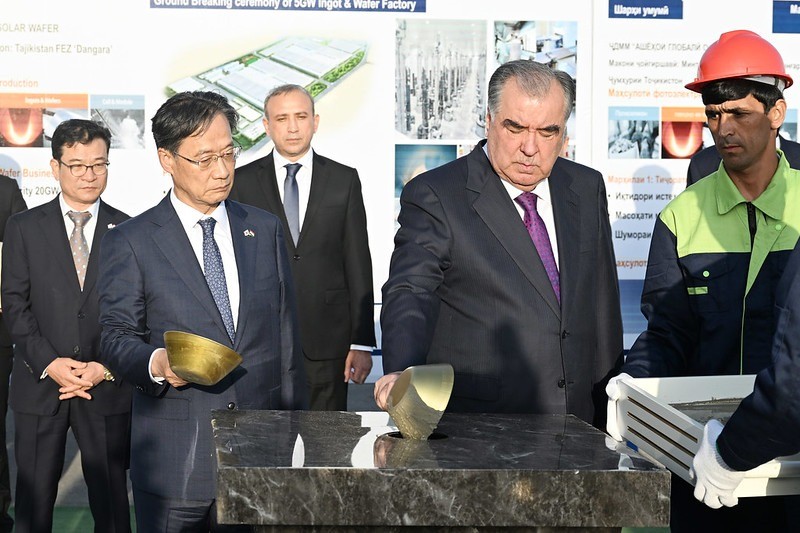
On 24 May, Tajikistan President Emomali Rahmon laid the foundation stone for the construction of the first solar panel production plant in the country’s Danghara Free Economic Zone. According to the Tajik president’s press service, the facility will be built in four phases with government support and investment by the Global Solar Wafer company of the Republic of Korea totalling $2 billion. Construction on 22 hectares of land in the western part of Danghara Free Economic Zone is scheduled to begin in July this year. The first phase, comprising a facility to manufacture solar panels with a capacity of 5 thousand megawatts, will be completed in March 2025. Once fully operational, the plant will provide 8,000 jobs, 95 percent will be allocated to Tajik citizens. The launch of the domestic production of solar panels will contribute to the realization of goals set by Tajikistan’s green economy development strategy which aims to generate at least 1000 megawatts of green energy by 2030.