• KGS/USD = 0.01144 0%
  • KZT/USD = 0.00216 0%
  • TJS/USD = 0.10659 0%
  • UZS/USD = 0.00008 0%
  • TMT/USD = 0.28530 0%
  • KGS/USD = 0.01144 0%
  • KZT/USD = 0.00216 0%
  • TJS/USD = 0.10659 0%
  • UZS/USD = 0.00008 0%
  • TMT/USD = 0.28530 0%
  • KGS/USD = 0.01144 0%
  • KZT/USD = 0.00216 0%
  • TJS/USD = 0.10659 0%
  • UZS/USD = 0.00008 0%
  • TMT/USD = 0.28530 0%
  • KGS/USD = 0.01144 0%
  • KZT/USD = 0.00216 0%
  • TJS/USD = 0.10659 0%
  • UZS/USD = 0.00008 0%
  • TMT/USD = 0.28530 0%
  • KGS/USD = 0.01144 0%
  • KZT/USD = 0.00216 0%
  • TJS/USD = 0.10659 0%
  • UZS/USD = 0.00008 0%
  • TMT/USD = 0.28530 0%
  • KGS/USD = 0.01144 0%
  • KZT/USD = 0.00216 0%
  • TJS/USD = 0.10659 0%
  • UZS/USD = 0.00008 0%
  • TMT/USD = 0.28530 0%
  • KGS/USD = 0.01144 0%
  • KZT/USD = 0.00216 0%
  • TJS/USD = 0.10659 0%
  • UZS/USD = 0.00008 0%
  • TMT/USD = 0.28530 0%
  • KGS/USD = 0.01144 0%
  • KZT/USD = 0.00216 0%
  • TJS/USD = 0.10659 0%
  • UZS/USD = 0.00008 0%
  • TMT/USD = 0.28530 0%

Viewing results 223 - 228 of 435

Pakistan Can Become a Transport Hub for Central Asian Countries

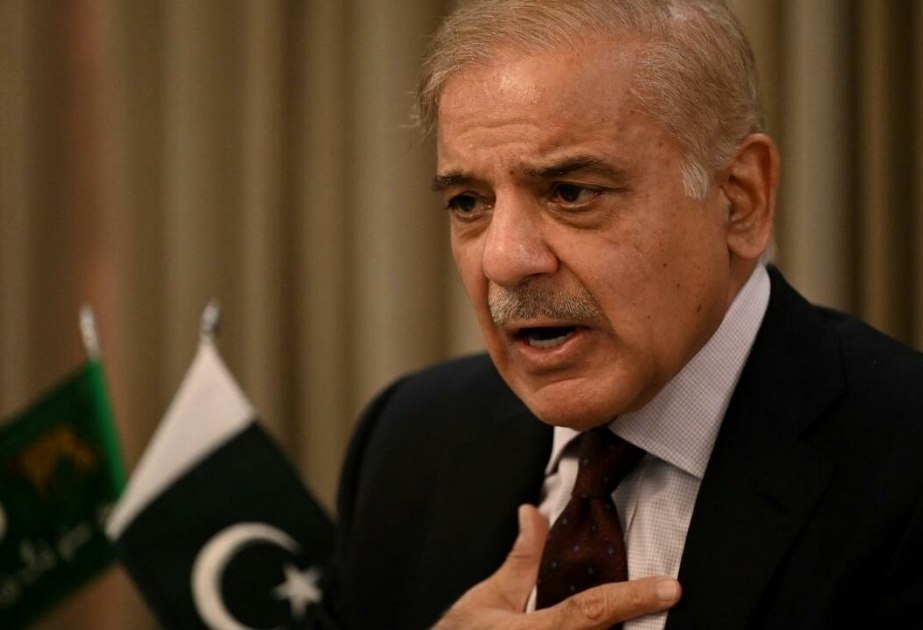
The Prime Minister of Pakistan, Shahbaz Sharif has chosen Tajikistan for his first foreign visit after being re-elected as the head of government. On July 2, he will hold talks with Tajik President Emomali Rahmon in Dushanbe, before traveling with him to the SCO summit in Astana. The head of Tajikistan and Sharif are expected to discuss the implementation of agreements reached during Rahmon's visit to Pakistan two years ago. Pakistan's capital, Islamabad, is interested in speeding up the start of the CASA-1000 energy project and expanding cooperation in transport and security. In exchange, Tajikistan is seeking access to Pakistan’s ports of Karachi and Gwadar. In December 2022, Rahmon visited Islamabad, where eight documents were signed at the end of negotiations with Sharif. “The fact is that Tajikistan’s intelligence services have historically not had warm relations with Pakistan, whose intelligence services have supported various militant groups in Afghanistan. But times are changing. In addition, it should be noted that today, Pakistan is closely cooperating with China economically and politically in the same way that active cooperation between China and Dushanbe is taking place,” said Alexander Vorobyov, a researcher at the Institute of Oriental Studies of the Russian Academy of Sciences and head of the Center for Public Diplomacy and World Policy Analysis. According to Vorobyov, improving relations between Tajikistan and Uzbekistan, whose authorities are actively promoting a project to create the Trans-Afghan railway “Termez–Mazar-i–Sharif–Kabul—Peshawar,” will help improve Tajikistan’s transport connectivity with the outside world and offer the possibility of access to South Asia. The shortest route from Tajikistan to the sea passes through Afghanistan to Pakistan. It is approximately 2,720 kilometers from Dushanbe to Karachi or Gwadar, whilst it is 3,400 kilometers to the Iranian port of Bandar Abbas in the Strait of Hormuz. Tajikistan is separated from Pakistan by the Wakhan Corridor, a narrow strip of territory in the Badakhshan province of Afghanistan. This corridor is about 350 kilometers long. Experts believe that if Afghanistan's stability and security can be ensured, then Pakistan can become a transport hub for the countries of Central Asia. Pakistan's interest in Central Asian meanwhile, lies in energy resources, of which it is desperately short. To access them, the Pakistani government is promoting several major transit projects in the region that will open access to global markets and trade opportunities for the region's countries. However, as Hina Rabbani Khar, who served as Pakistan's deputy foreign minister in February 2023, said, the situation in Afghanistan is preventing Pakistan from realizing its potential in relations with Central Asia. In particular, the Central Asia-South Asia-1000 (CASA-1000) project to transmit electricity from Tajikistan and Kyrgyzstan to Afghanistan and Pakistan still needs to be completed. The World Bank stopped financing the project after the Taliban came to power. Following an appeal by the project's participants, implementation of CASA-1000 was resumed in May 2024 with the financial support of the World Bank. In recent years, Tajikistan and Kyrgyzstan have required additional kilowatts, so the completion date of the construction still...

The Government of Tajikistan and FLSmidth to Cooperate in Mining

Sherali Kabir, Minister of Industry and New Technologies of Tajikistan, and Peter Flanagan, representative of the transnational company FLSmidth have signed a memorandum of cooperation in the mining sector. FLSmidth is one of the world's leading mining equipment suppliers. During their meeting, the parties exchanged views on priority areas of cooperation in the mining sector and the development of joint projects in the mining industry and under the memorandum, will form a working group to instigate plans. It was noted that 93% of Tajikistan's territory is occupied by mountains possessing essential breakthrough minerals, including lithium, copper, antimony, and others.

Tajikistan to Export 70% of Rogun Electricity to Central Asia

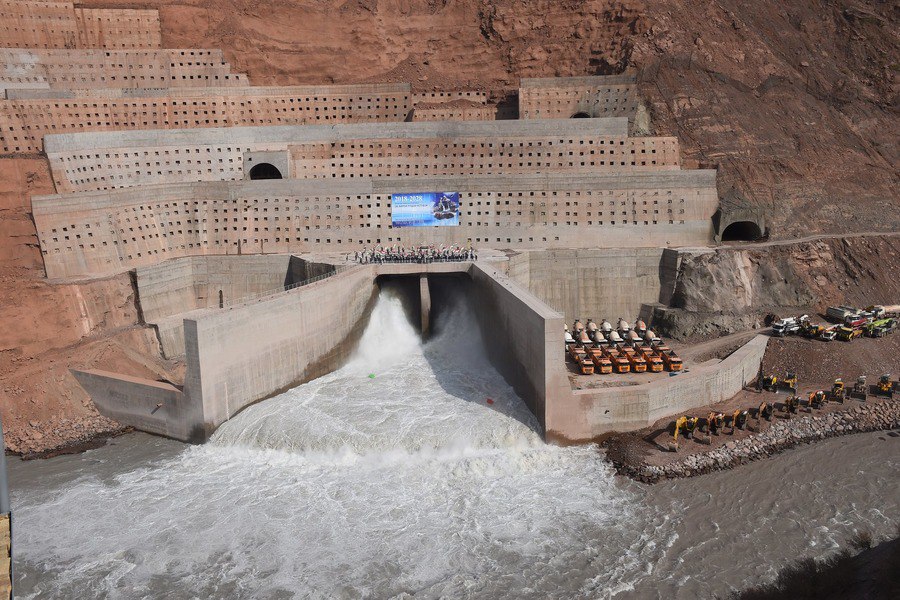
About 70% of the electricity generated after the Rogun hydroelectric power plant (HPP) in Tajikistan reaches full capacity will be exported to other Central Asian countries. This is according to agreements signed with Uzbekistan and Kazakhstan, which Tajikistan's minister for energy and water resources, Daler Juma, announced at a recent meeting of the energy ministers of Shanghai Cooperation Organization (SCO) member states in Astana. “The Republic of Tajikistan, which has a huge hydropower potential, continues the construction of the Rogun HPP with a capacity of 3,780 MW. The Rogun HPP ensures the energy security of the Republic of Tajikistan and contributes to increasing the volume of exports to neighboring countries. It should be noted that 70 percent of the produced products are exported to cover the growing demand in the region's countries,” said Juma. Construction of Rogun the HPP began in 1976, but it was suspended in 1991 after the collapse of the USSR. Subsequently, Tajikistan continued constructing 600 MW hydroelectric power stations, as outlined in the project, using its resources and support from international funds and organizations. Two of the six aggregates have already been operational, and the third is planned to be operational in 2025. Juma reported that the two hydraulic units produced more than 7 billion kWh of electricity.

Sogd-2024 International Trade Fair Marks First Decade

The international trade fair, Sogd-2024 officially opened at the sports palace in Khojand, Tajikistan, on June 18th. This year marks a decade of the Sogd—Valley of Opportunities fair, which will run from June 18th-19th. More than 500 guests from Tajikistan and abroad have gathered, Andar Rahmani, the head of the press service of the Sogd regional administration informed Sputnik Tajikistan, adding that regional ambassadors are also participating in this important economic event. “Ambassadors and representatives of the diplomatic corps of Russia, Turkey, Uzbekistan, Saudi Arabia, Azerbaijan, Japan, Iran, Belarus, Turkmenistan, Slovakia, Poland, Pakistan, Kyrgyzstan and Kazakhstan visited the region,” Rahmani said. Representatives from the Tashkent, Namangan, Ferghana, Samarkand, Bukhara, and Syr Darya regions of Uzbekistan, and business- people from China’s Shaanxi province and representatives of international financial organizations also participated.

Eurasian Connectivity Comes One Step Closer at the 2024 CAMCA Forum in Bishkek

The wider Eurasia region took another step towards cooperation and connectivity last week, as the 10th annual CAMCA Regional Forum was held in Bishkek. CAMCA – standing for Central Asia, Mongolia, the Caucasus and Afghanistan – is an initiative to accelerate dialogue between governments, private enterprises and media figures from these ten nations. Organized by the Washington, D.C.-based Central Asia-Caucasus Institute and the Rumsfeld Foundation, this year’s Forum – the first such event to take place in Kyrgyzstan – featured over 300 delegates across its two days, and presented insights from over 70 speakers. Attendees came from 25 countries in total. Professor Frederick Starr, the Central Asia-Caucasus Institute’s chairman, used his opening address to call on the countries of the region to start preparing for a future within a cohesive international bloc. Dr Starr reasoned that Russia and China, imperial powers that have traditionally had a controlling presence in Central Asia, may see their global influence wane in the coming decade. This would give the countries of Central Asia, and their neighbors, more space to create projects that serve their economies directly. A leading CAMCA regional project is the ‘Middle Corridor’ trade route, which bypasses Russia to transport goods more efficiently between Europe and China. Discussions are also taking place concerning the creation of single business and tourist visas for the whole Central Asia region. The importance of collaboration between countries in the Caucasus and Central Asia to mitigate the impact of climate change has never been so great. Addresses by senior members of the Kyrgyz government highlighted the progress that Kyrgyzstan has made since the administration of president Sadyr Japarov began its work in 2021. The country’s deputy prime minister Edil Baisalov reported that Kyrgyzstan is on track to double its GDP to $30 billion by 2030, while the minister for digital development, Nuria Kutnaeva, spoke about the rapid digitalization of the country’s government services.  In a noticeably warm and collaborative atmosphere, the event nonetheless highlighted the barriers that prevent the ten countries from forming a tangible ‘CAMCA’ space in the present. A key goal is the harmonization of their legislation and policy directions; however, no delegates from Tajikistan could travel to Bishkek for the Forum, as otherwise solid relations between Tajikistan and Kyrgyzstan are still strained by a dispute over their common border. Likewise, Armenian voices were also absent this time, in light of several of the sessions featuring Azerbaijani speakers and talking points. The event featured only one guest from Turkmenistan.  Even in these conflicts, however, Central Asian diplomacy is at work. The conflict on the Kyrgyz-Tajik border, mainly in Tajikistan’s Vorukh district, is being resolved through negotiations between the two countries’ governments, which would have been unthinkable even five years ago. Meanwhile, Kazakhstan is acting as a mediator between Baku and Yerevan in the aftermath of the war in Nagorno-Karabakh. Other topics on the agenda included security priorities for Central Asia, digital innovation in business, cooperation with Afghanistan, transitions in global energy markets, and infrastructure projects...

USAID Supports Central Asian Women Working in Hospitality

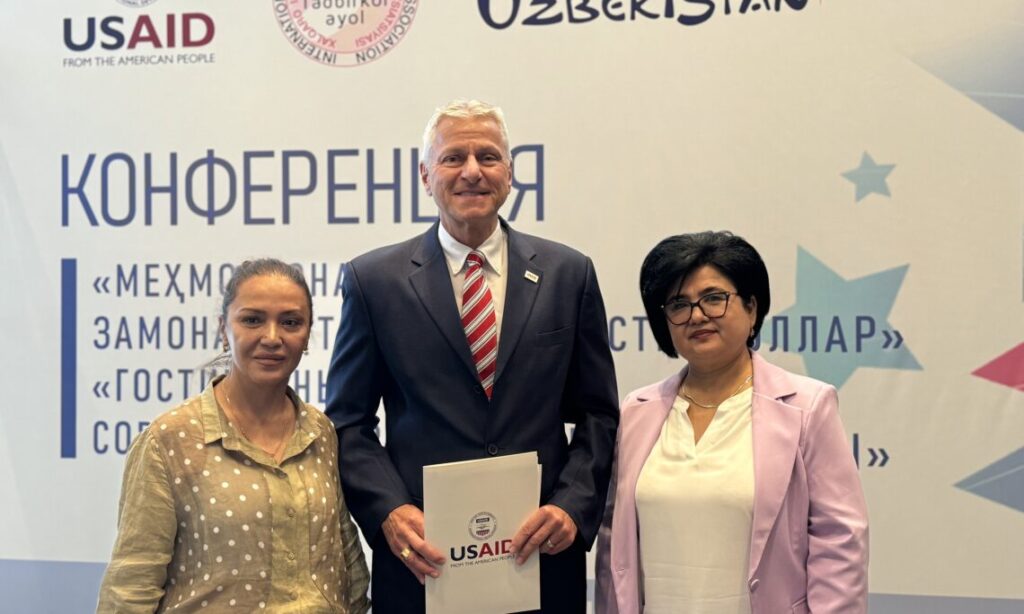
The U.S. Agency for International Development (USAID) and the International Association of Businesswomen “Tadbirkor Ayol” last week hosted a Central Asian Conference on “Women of Central Asia in the Hospitality Business: Current Challenges and Opportunities”. The event in Tashkent attracted some 200 women entrepreneurs, professionals, and industry experts from Uzbekistan, Tajikistan, and Kyrgyzstan to discuss achievements, trends, and challenges in the region’s hospitality sector. As reported by the U.S. Embassy in Uzbekistan, the conference focused on service quality, digitalization, and modern standards in tourism, culminating in recommendations to enhance regional cooperation in tourism and hospitality. Praising the resilience and creativity of women in the hospitality industry and emphasizing their role in the sector’s future, Edward Michalski, USAID Deputy Mission Director in Uzbekistan, commented: “Investing in women and girls is essential to transforming communities. When women do better, families do better, communities do better, and countries do better.” Gulnora Makhmudova, Chairwoman of “Tadbirkor Ayol,” noted that the growing importance of the region’s hotel business and the increasing involvement of women, had spurred the association into launching “Women in the Hotel Business: Hospitality from the Future;” a project aimed to introduce innovation and digitalization in the hospitality sector. Since its launch in April 2024, with support from USAID, the project has provided training for 115 women in modern hotel management in Tashkent, Andijan, and Samarkand.