• KGS/USD = 0.01144 0%
  • KZT/USD = 0.00216 0%
  • TJS/USD = 0.10456 0%
  • UZS/USD = 0.00008 0%
  • TMT/USD = 0.28571 0%
  • KGS/USD = 0.01144 0%
  • KZT/USD = 0.00216 0%
  • TJS/USD = 0.10456 0%
  • UZS/USD = 0.00008 0%
  • TMT/USD = 0.28571 0%
  • KGS/USD = 0.01144 0%
  • KZT/USD = 0.00216 0%
  • TJS/USD = 0.10456 0%
  • UZS/USD = 0.00008 0%
  • TMT/USD = 0.28571 0%
  • KGS/USD = 0.01144 0%
  • KZT/USD = 0.00216 0%
  • TJS/USD = 0.10456 0%
  • UZS/USD = 0.00008 0%
  • TMT/USD = 0.28571 0%
  • KGS/USD = 0.01144 0%
  • KZT/USD = 0.00216 0%
  • TJS/USD = 0.10456 0%
  • UZS/USD = 0.00008 0%
  • TMT/USD = 0.28571 0%
  • KGS/USD = 0.01144 0%
  • KZT/USD = 0.00216 0%
  • TJS/USD = 0.10456 0%
  • UZS/USD = 0.00008 0%
  • TMT/USD = 0.28571 0%
  • KGS/USD = 0.01144 0%
  • KZT/USD = 0.00216 0%
  • TJS/USD = 0.10456 0%
  • UZS/USD = 0.00008 0%
  • TMT/USD = 0.28571 0%
  • KGS/USD = 0.01144 0%
  • KZT/USD = 0.00216 0%
  • TJS/USD = 0.10456 0%
  • UZS/USD = 0.00008 0%
  • TMT/USD = 0.28571 0%

Viewing results 679 - 684 of 2886

Russia Responds to Uzbekistan’s Concerns Over Police Treatment of Migrants

The Russian government has acknowledged Uzbekistan's concerns regarding recent police actions targeting Uzbek nationals and is currently reviewing the matter, according to a statement by Russian Foreign Ministry spokesperson Maria Zakharova, as reported by state news agency TASS. Zakharova confirmed that the Russian Foreign Ministry had received a formal diplomatic note from the Uzbek Embassy in Moscow, requesting explanations over reports of mistreatment during recent police operations. She said the contents of the note are being examined thoroughly and have been forwarded to the appropriate Russian authorities. “We are studying the content of the note with full attention,” Zakharova said. “We maintain direct communication with our Uzbek partners, including through law enforcement channels. We are allies, and all such signals are taken seriously.” Zakharova stated that Russia would provide Uzbekistan with verified and objective information following internal investigations. She also reaffirmed the strategic importance of bilateral ties. “Uzbekistan is our ally and strategic partner. We approach all issues in our bilateral relations with this in mind,” she said. Tensions Over Police Conduct The diplomatic exchange follows a statement earlier this week by Uzbek Foreign Ministry spokesperson Akhror Burkhanov, who expressed concern over the reported mistreatment of Uzbek citizens during recent police raids in Russia. In response, the Uzbek Embassy submitted a diplomatic note formally seeking clarification and legal assessment of the incidents. The most prominent of these occurred on June 8 in the Strogino district of Moscow, where Russian law enforcement reportedly raided a dormitory housing migrants, including Uzbek nationals. Videos circulated by Russian media showed officers using force, with reports of beatings and verbal abuse. A similar incident was reported in St. Petersburg. Uzbek officials emphasized that such conduct contradicts the “close and friendly” nature of Uzbek-Russian relations and called for a transparent review of law enforcement actions. Uzbekistan’s Migration Agency stated that it is closely monitoring the situation. It confirmed that a small number of Uzbek citizens were detained due to documentation issues and are currently undergoing further checks.

The Ripple Effects of the Israel-Iran Conflict on Central Asia

The Israel-Iran conflict has escalated dramatically, with Israel launching large-scale strikes on Iranian nuclear facilities and military targets, including the killing of top Iranian commanders and nuclear scientists. Characterizing these attacks as a “declaration of war,” Iran has retaliated by deploying approximately 100 drones toward Israeli territory, which have been intercepted. The strikes, part of Israel's "Operation Rising Lion," aim to neutralize what it perceives as an existential threat from Iran's nuclear ambitions. The situation has triggered reactions globally, with heightened tensions and calls for de-escalation. Meanwhile, in an interview with ABC News, U.S. President Trump called the strikes "excellent" and vowed there was "more to come. A lot more." The rapidly escalating conflict between Israel and Iran will undoubtedly exert a tangible influence on Central Asia, a region that shares both historical and geographic proximity to Iran. Turkmenistan, which directly borders Iran, is at the forefront, demonstrating how Central Asia sits strategically within a broader landscape of global power struggles. Geopolitical Tensions Within Reach Central Asia’s geographic and political ties to Iran make the region a key area of influence for Tehran. Iran’s relationship with Turkmenistan, grounded in a shared border and energy cooperation, highlights its immediate relevance. Turkmenistan and Iran collaborate on trade and natural gas exports, ensuring intertwined economies. However, these connections make Central Asia exposed to the consequences of Tehran’s ambitions, particularly as tensions with Israel spill over. Israel, meanwhile, has been steadily cultivating its influence in the region through strategic partnerships. Its strong alliance with Azerbaijan, Iran’s neighboring competitor to the north, has allowed Israel to counter Tehran’s reach. Additionally, Israel has deepened ties with Kazakhstan and Uzbekistan, offering expertise in cutting-edge technologies in agriculture, water-saving technologies, defense, and cybersecurity. This influence balances Iran’s predominance but risks elevating the regional stakes should the conflict further intensify. The nations of Central Asia are navigating a multitude of competing external pressures close to home, relying on multi-vector diplomacy to manage relationships with Iran, Israel, Russia, China, and the West. Economic Interdependence and Vulnerabilities Central Asia’s landlocked geography makes trade routes essential, with Iran serving as a critical gateway to global markets. The Bandar Abbas port facilitates the export of Central Asian goods, particularly for Turkmenistan. In January, Kazakhstan, Turkmenistan, Russia, and Iran reaffirmed their commitment to increasing cargo transportation along the North-South transport corridor. However, sanctions on Tehran and the conflict's unpredictability cast uncertainty over these vital corridors. The Chabahar port, developed in partnership with India, is another crucial lifeline for trade. Unlike Pakistan's China-aligned Gwadar port, Chabahar links Central Asia to the Indian Ocean, offering a more stable and independent trade route. For nations like Turkmenistan and Uzbekistan, the port diversifies transit options and reduces reliance on routes controlled by Russia or China. Social Dynamics and Security Challenges Culturally and religiously, Sunni-majority countries like Turkmenistan, Kazakhstan, and Uzbekistan remain alert to both Iranian propaganda and organizations like Hamas, which are considered destabilizing actors. Governments actively look to suppress rhetoric or movements that could spark unrest, prioritizing...

Central Asia Responds to Escalation Between Israel and Iran

Following extensive Israeli airstrikes on Iranian territory, defined by the Israeli military as a “preventive action” targeting Tehran’s nuclear infrastructure, Central Asian governments have begun responding to the escalating conflict by reinforcing security protocols for their citizens in the region. Kazakhstan: Embassy Issues Guidelines for Citizens in Israel The Embassy of the Republic of Kazakhstan in Tel Aviv has issued an official advisory to Kazakh citizens residing in or visiting Israel. The statement recommends: Adhering strictly to instructions from the Israeli Home Front Command; Maintaining heightened vigilance; Monitoring verified news and official announcements; Staying in regular contact with the Kazakh diplomatic mission. Emergency hotlines have also been activated to provide immediate assistance to nationals. Uzbekistan: Warning to Citizens in Iran and Israel Uzbekistan’s Ministry of Foreign Affairs has released a public advisory urging citizens in both Iran and Israel to exercise maximum caution. Recommendations include: In Iran, being prepared to take shelter in designated bomb shelters; In Israel, strictly following the directives of local authorities and the military; Keeping identification documents and embassy contact information readily accessible; Following updates through official and verified information channels. The Foreign Ministry emphasized that the security situation remains volatile and requires prompt attention from Uzbek citizens in the affected areas. Airlines Reroute to Avoid Conflict Zone Kazakh carriers Air Astana and FlyArystan have altered several flight routes to avoid Iranian and Iraqi airspace, which has been closed amid rising tensions. Destinations affected include Dubai, Doha, Sharm El-Sheikh, Manama, and Medina. Passengers are advised to check their flight status in advance, as changes to departure and arrival times are expected. Regional Watch: Kyrgyzstan, Tajikistan, Turkmenistan As of June 13, Kyrgyzstan, Tajikistan, and Turkmenistan have not issued formal statements regarding the conflict. However, diplomatic sources report that embassies and consulates across the region have been placed on high alert and are closely monitoring developments. Earlier today, the Israeli military confirmed the launch of a military operation targeting what it described as “dozens of strategic sites” in Iran, including suspected nuclear facilities. Tehran has condemned the strikes and pledged a “harsh and symmetrical response.” The international community has expressed growing concern that the conflict could broaden, destabilizing the wider region.

Opinion: China–Central Asia Partnership – Seeking Opportunity in a World of Uncertainty

Leaders from China and the five Central Asian countries will gather in Astana on Monday, two years after their inaugural summit in the Chinese city of Xi’an. However, as Chinese President Xi Jinping has often noted, “Our world is undergoing profound changes unseen in a century." The geopolitical landscape is markedly different from that of their first meeting, with both China and the Central Asian nations now facing a world of increasing uncertainty. In April, foreign ministers from China and the Central Asian countries convened in Almaty, Kazakhstan, where Chinese Foreign Minister Wang Yi expressed concern over the rising tide of protectionism and unilateralism. He criticized the United States for launching a tariff war against more than 180 countries, saying it undermines international trade and destabilizes the global economy. Wang reaffirmed China’s commitment to openness. “China will consistently promote a high degree of openness, share opportunities with the world, and take responsibility for upholding international norms,” he said. Wang’s remarks were echoed by the Central Asian representatives, who voiced strong support for China’s vision of building a “community with a shared future” and pledged to deepen cooperation under the Belt and Road Initiative (BRI). Kazakhstan’s Foreign Minister Murat Nurtleu, said that China and Central Asian nations have set clear guidelines for collaboration in trade, energy, transport and logistics, education, and science. The ties between China and Central Asia stretch back to the ancient Silk Road camel caravans that carried not only goods but also cultures. At the first China-Central Asia summit in Xi’an, Chinese President Xi said: “Back in 2013, I put forward the initiative of jointly building a Silk Road Economic Belt during my first visit to Central Asia as Chinese president.” Like an echo of millennia past, the ancient Silk Road now finds its modern expression through connectivity and cooperation. In May, the first tourist train linking the Chinese city of Xi’an and Almaty, the largest city in Kazakhstan, made its inaugural journey. Also in May, Kyrgyzstan’s State Civil Aviation Agency reached an agreement with Chinese aviation authorities to open a new air route to the Chinese city of Kashgar. As part of the Air Silk Road initiative, this will become the second direct air link between Central Asia and Western China. [caption id="attachment_32911" align="aligncenter" width="1179"] The first tourist train between Xi'an and Almaty; image: CGTN[/caption] This is in addition to a key milestone in the China–Kyrgyzstan–Uzbekistan railway project. In April, construction began on a 12-kilometer tunnel in Kyrgyzstan’s Jalal-Abad region. At the groundbreaking ceremony, Kyrgyz Deputy Chairman of the Cabinet of Ministers, Bakyt Torobayev, stated: “This project is not only of infrastructural importance. It paves the way for improved quality of life, economic growth, and stronger ties between regions and peoples.” [caption id="attachment_32913" align="aligncenter" width="1179"] China–Kyrgyzstan–Uzbekistan railway; image: CGTN[/caption] Beyond infrastructure, Kyrgyzstan is working to integrate with China’s banking payment system. A significant step was taken during a recent meeting in Beijing, where the finance ministers of both countries agreed to establish financial infrastructure for cross-border settlements...

EBRD Provides $250 Million Loan to Upgrade Uzbekistan’s Irrigation Pumps

The European Bank for Reconstruction and Development (EBRD) has approved a sovereign loan of up to $250 million (€240 million) to support the modernization of 110 irrigation pumping stations across Uzbekistan. The funding, allocated to the Ministry of Water Resources, will enable the installation of modern, energy-efficient pumps in 10 regions. According to the EBRD, the project is expected to reduce electricity consumption by approximately 251,000 megawatt-hours (MWh) annually and cut CO₂-equivalent emissions by more than 117,000 tons per year. The financing will also cover refurbishment of related infrastructure and the installation of rooftop solar panels at select stations. This initiative is a core part of Uzbekistan’s national irrigation modernization program, which aims to reduce electricity consumption across the irrigation system by 25%. The program also includes the deployment of water-saving technologies that will reach nearly half of the country’s irrigated farmland. Currently, Uzbekistan operates over 1,600 irrigation pumping stations, an energy-intensive network crucial for the country’s agricultural sector. Recognizing the need for improved efficiency, the water management sector has declared 2025 the "Year of Enhancing Pumping Station Efficiency." In recent years, the country has invested $1 billion in upgrading major stations such as Karshi, Amu-Bukhara, and Amu-Zang. However, the degradation of smaller and mid-sized stations has continued to drive up irrigation water costs. Efforts to conserve water are also underway. By concreting 550 kilometers of canals and ditches, water supply to 200,000 hectares of farmland has been stabilized, saving an estimated 450 million cubic meters of water annually. In 2025, Uzbekistan plans to concrete an additional 18,000 kilometers of main canals nationwide.

Uzbek President Welcomes U.S. Officials and Business Leaders Ahead of Tashkent International Investment Forum

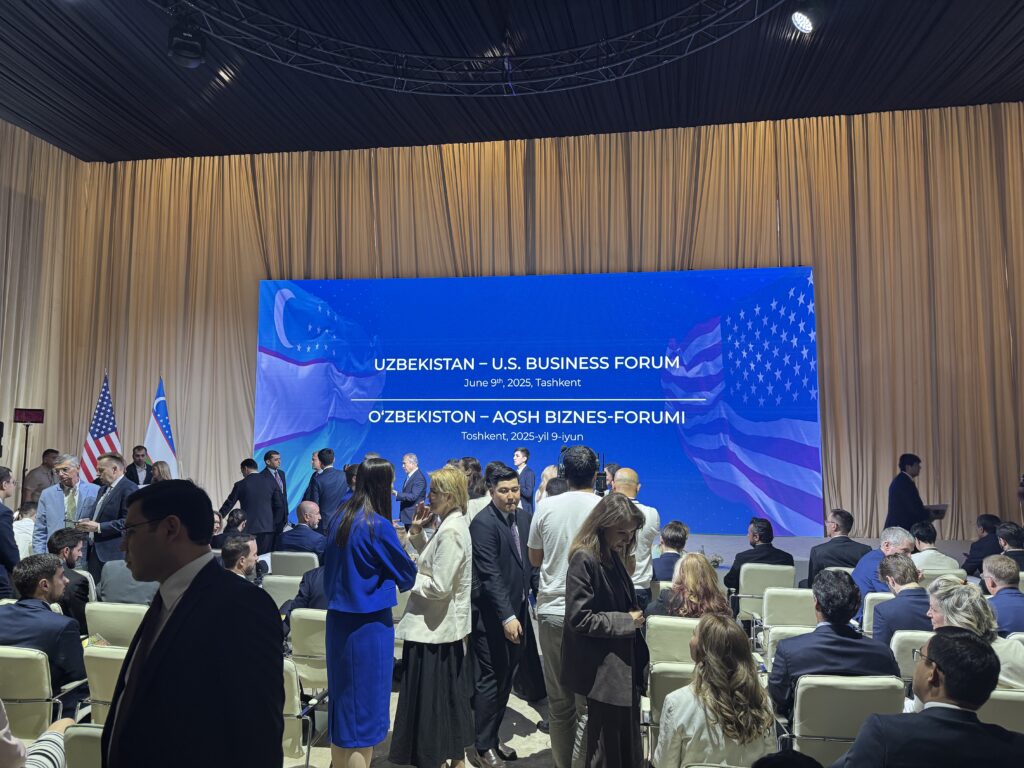
On June 9, ahead of the Tashkent International Investment Forum, President Shavkat Mirziyoyev welcomed a senior delegation of U.S. business leaders and government officials, underscoring deepening economic ties between Uzbekistan and the United States. Among the participants were U.S. Assistant Secretary of State Eric Meyer, U.S. International Development Finance Corporation (DFC) Vice President Bethany Brez, American-Uzbek Chamber of Commerce Chair Carolyn Lamm, and executives from Boeing, Visa, NASDAQ, Coca-Cola, Morgan Stanley, Franklin Templeton, FLS, Air Products, and others. Mirziyoyev noted that the meeting reflected growing U.S. interest in Uzbekistan’s reform-driven and investment-oriented economy. In 2024, bilateral trade between Uzbekistan and the U.S. reached $882 million, a 15.2% increase from 2023. Of this, Uzbek exports to the U.S. totaled $314.7 million, while imports stood at $564.3 million. Despite this growth, exports to the U.S. still account for only 1.2% of Uzbekistan’s total export volume, according to economist Mirkomil Kholboyev. During the Uzbekistan-U.S. Business Forum in Tashkent, DFC Vice President Brez led discussions on joint projects in critical minerals. The DFC, with a $60 billion mandate, supports global investment in sectors such as energy, infrastructure, and advanced manufacturing. [caption id="attachment_32862" align="aligncenter" width="2560"] Image: Uzbekistan–U.S. Business Forum[/caption] Digital innovation emerged as a key area of cooperation. According to a recent UNDP study, Uzbekistan plans to implement 100 priority artificial intelligence models by 2030 and establish supercomputing labs at major universities. USAID has previously supported this digital agenda by enabling Uzbek startups to engage with Silicon Valley investors and participate in TechCrunch Disrupt in October 2024, strengthening linkages with the U.S. tech ecosystem. Transport and energy infrastructure modernization also featured prominently in the talks. In January 2025, Uzbekistan Airways signed a memorandum with Boeing to acquire fourteen 787-8 Dreamliners, a multibillion-dollar deal with deliveries expected by 2032. Meanwhile, USAID partnered with Uzbekistan on energy sector reform, including support for drafting the “Law on the Electric Power Industry,” which introduces transparent tariff policies and facilitates private-sector entry. Tourism and small business development were additional focus areas. USAID’s five-year, $17.7 million Business Support Project has targeted key sectors such as ICT, tourism, textiles, and the green economy. Under this initiative, the Association of Private Tourism Agencies of Uzbekistan launched new training modules and classification standards for family-run guesthouses in Bukhara, Samarkand, and Tashkent, promoting sustainable, community-based tourism. Throughout the meeting, U.S. business leaders expressed support for Uzbekistan’s reform agenda and presented specific proposals, ranging from expanding fintech infrastructure to piloting AI-driven logistics platforms. The exchanges reflected a mutual commitment to strengthening the U.S.-Uzbek partnership across a wide range of strategic sectors.