• KGS/USD = 0.01144 0%
  • KZT/USD = 0.00214 0%
  • TJS/USD = 0.10508 0.48%
  • UZS/USD = 0.00008 0%
  • TMT/USD = 0.28571 0%
  • KGS/USD = 0.01144 0%
  • KZT/USD = 0.00214 0%
  • TJS/USD = 0.10508 0.48%
  • UZS/USD = 0.00008 0%
  • TMT/USD = 0.28571 0%
  • KGS/USD = 0.01144 0%
  • KZT/USD = 0.00214 0%
  • TJS/USD = 0.10508 0.48%
  • UZS/USD = 0.00008 0%
  • TMT/USD = 0.28571 0%
  • KGS/USD = 0.01144 0%
  • KZT/USD = 0.00214 0%
  • TJS/USD = 0.10508 0.48%
  • UZS/USD = 0.00008 0%
  • TMT/USD = 0.28571 0%
  • KGS/USD = 0.01144 0%
  • KZT/USD = 0.00214 0%
  • TJS/USD = 0.10508 0.48%
  • UZS/USD = 0.00008 0%
  • TMT/USD = 0.28571 0%
  • KGS/USD = 0.01144 0%
  • KZT/USD = 0.00214 0%
  • TJS/USD = 0.10508 0.48%
  • UZS/USD = 0.00008 0%
  • TMT/USD = 0.28571 0%
  • KGS/USD = 0.01144 0%
  • KZT/USD = 0.00214 0%
  • TJS/USD = 0.10508 0.48%
  • UZS/USD = 0.00008 0%
  • TMT/USD = 0.28571 0%
  • KGS/USD = 0.01144 0%
  • KZT/USD = 0.00214 0%
  • TJS/USD = 0.10508 0.48%
  • UZS/USD = 0.00008 0%
  • TMT/USD = 0.28571 0%

Viewing results 649 - 654 of 983

UNDP Gives Boost to Fish Farming in Uzbekistan

The European Union delegation to Uzbekistan, along with the United Nations Development Program (UNDP), has delivered equipment to Uzbekistan's Scientific Research Institute of Fish Farming to support more sustainable fish-farming methods. The new equipment will help to save water and improve water quality. Wim Riepma, head of cooperation for the EU delegation to Uzbekistan, commented "healthy fish means healthy food and healthy people. Filters also help to improve the environment, as the fish farm will emit fewer pollutants. In addition, the use of solar water heaters, which will greatly improve fish growth in the early stages of development, contribute to energy savings." Uzbekistan, with its fish consumption of 3.5-4 kg per person per year, is far below the World Health Organization's (WHO) recommended norm of 16 kg. The reason for this is the country's lack of access to the sea -- and its outdated, river-based fish-farming methods. However, the country is trying to remedy the situation. This year, as part of a program called Every Family is an Entrepreneur, Uzbek entrepreneurs can access unsecured loans of up to $4,000 for fish-farming projects. The equipment donated by the EU -- under its Innovation in Agriculture (EU-AGRIN) project -- will contribute to the development of scientific research, and improve the work of the Fisheries Research Institute and the affiliated vocational school in Fergana province. In addition to the practical benefits of an increase in fish production, the project will also contribute to creating jobs in rural areas. The project, amounting to €4.15m ($4.5m), is financed by the EU and will last for four years. EU-AGRIN is a UNDP project aimed at promoting innovative solutions and cooperation in agriculture. So far the project has established partnerships with 18 different innovation groups. At the end of 2023, Uzbekistan had 5,775 fish farms where 24 species of fish are cultivated for human consumption. Last year the aquaculture industry supported 2,500 jobs in the country.


Kyrgyzstan Resumes Construction Work on Pakistan Electricity Export Project

As the process of normalizing relations continues between Kyrgyzstan and Tajikistan, representatives of both sides have met in Bishkek to discuss the CASA-1000 (Central Asia-South Asia) power export project. According to Kyrgyzstan's Ministry of Energy, Kyrgyzstan has signed a joint declaration with Pakistan and Tajikistan to resume construction of high-voltage transmission lines in Kyrgyzstan, Tajikistan, Afghanistan and Pakistan, to export electricity to Pakistan. It is reported that construction work on the CASA-1000 project has been resumed in Afghanistan, where it was frozen after the Taliban came to power in 2021.  "This declaration thanks the World Bank for its prompt approval of the resumption of construction work on the CASA-1000 project in Afghanistan. It also reaffirms its readiness to fully support the implementation of the preconditions agreed with the World Bank Board for the resumption of construction in [Afghanistan]. This is a serious step forward in the region's desire for energy cooperation", said the Kyrgyz Ministry of Energy's press service. "Tajikistan is expected to supply 70 percent of the CASA-1000 project [electricity], and Kyrgyzstan the remaining 30 percent. [They'll supply] a total of 1,000-1,300 MW of electricity per year," Elzada Sargashkayeva, head of the public relations department of NENK (National Electricity Networks of Kyrgyzstan), told the Times of Central Asia. In Afghanistan, construction of the power lines was 60% complete, the agency said. Late last year, the World Bank allocated an additional $18.3m for Kyrgyzstan under CASA-1000 -- on top of the $216m previously allocated for the project. "For the Kyrgyz Republic, the CASA-1000 project provides for the construction of A/C power transmission lines (500 kV), with a length of about 456 kilometers. Currently, the project implementation is proceeding at an active pace: 1,243 [transmission towers] have already been installed (100 percent), work on suspension of wires on 287 kilometers of power lines has been completed (63 percent)," said World Bank Senior Energy Specialist Dmitry Glazkov. Work on the project was suspended when the Taliban came to power in Afghanistan -- and also due to the armed border conflict between Kyrgyzstan and Tajikistan, the international institute said. But the scope of work remains the same. The World Bank is allocating the additional support to bridge the funding gap caused by rising prices for goods and transportation after the Covid-19 pandemic and its ensuing broad economic crisis. The money will be given to Kyrgyzstan in the form of an interest-free loan for 50 years, with a 10-year grace period. The project's target completion time is March 2025. According to the World Bank, Central Asia has many renewable energy sources, and is strategically positioned to develop regional trade in electricity, the exchange of which is still limited. "In Kyrgyzstan and Tajikistan, hydropower plants generate more than 80-90 percent of electricity, but these countries use less than five percent of their hydropower potential, which is several times the combined demand of the entire region. At the same time, 90 percent of the energy needs of Uzbekistan, Turkmenistan and Kazakhstan are met by fossil fuels,...

Foreign IT Companies Earned Over $50 Million in Uzbekistan Last Year

Foreign IT companies who pay tax in Uzbekistan almost doubled their profits last year. That's according to statistical data published by the Uzbek State Tax Committee. In 2023 their total profit amounted to $50.8m. There are currently 57 foreign firms providing internet and IT services in the country. In 2023 alone the list grew by 17 -- including the Singaporean company TikTok PTE LTD. TikTok has been blocked in Uzbekistan since July 2021 for violating the law on personal data, which requires that data servers must be located in Uzbekistan. Compared to 2022, the taxes paid by foreign IT companies to the Uzbek budget increased by 56.2%. The lion's share of payments falls on tech giants such as Facebook parent company Meta ($2.114m), Google ($1.6m), Apple ($1m) and Amazon ($176,000). Booking.com, Netflix, Xsolla, Zoom, Yandex and Adobe Systems make up the top ten. Foreign companies providing internet services in Uzbekistan have paid taxes in the country since 2020. Blogger and co-founder of the business publication Spot.uz Temurmalik Elmuradov notes that recently in Uzbekistan "the digital market is growing, and people's consumer habits are changing. There are more people willing to pay for movies and TV series rather than search for them on free online [movie sites]." In February, president Shavkat Mirziyoyev received a presentation on key strategic reforms for 2024, according to which over the past 10 years the volume of services in the telecom sector has grown 6.5 times -- and the coverage of the population with mobile internet has risen to 98%. As part of the reforms, among other things, there is a plan to give bandwidth providers direct access to the international internet channel. That means that an independent regulator of telecommunications should appear in the country by September 1. As of today, almost all Uzbek internet providers get access through the International Packet Switching Center of Uzbektelecom.

Uzbekneftgaz’s Gas Production Target Declines Again

Uzbekistan's state-owned JSC Uzbekneftegaz plans to produce 29.3 billion cubic meters of natural gas in 2024, according to the Kun.uz website. The company’s gas-production metrics have shown declines for the past three years. Among the geological and technical scopes of work that lie ahead for Uzbekneftgaz are 42 technological measurements, comprehensive overhauls of 81 wells, and the drilling of 95 operational production wells. In 2021 and 2022 the company produced 33.9 billion and 32.2 billion cubic meters of natural gas respectively. That means that by the end of 2024 the company will have decreased gas production by 13.6 percent over just three years, considering the production target of 29.3 billion cubic meters this year. Although official figures for 2023 have not yet been released, Uzbekneftgaz in 2023 twice lowered its full-year 2023 forecast for natural gas production. Initially, at the end of 2022 representatives of the company said that they expected 34.1 billion cubic meters of gas production for 2023, with 1.8 billion of those cubic meters coming from geological exploration. However, the estimate was lowered to 32.8 billion cubic meters in February 2023 and 32.3 billion cubic meters in August of last year. According to Uzbek statistics, 53.8 billion cubic meters of gas were extracted in 2021 across the country, which then decreased to 51.7 billion cubic meters in 2022, and 46.7 billion cubic meters in 2023.

A New Railway Project for China, Kyrgyzstan and Uzbekistan

On March 1st, Akylbek Japarov Chairman of the Cabinet of Ministers of the Kyrgyz Republic, Abdulla Aripov Prime Minister of Uzbekistan and Ma Xingrui Communist Party Secretary of China’s western Xinjiang Uygur Autonomous Region, met in Kashgar (Xinjiang) to discuss the construction of the China-Kyrgyzstan-Uzbekistan railway. Japarov first praised the incentive for its potential to strengthen the development of trade and economic cooperation between the three countries and reported that a jointly funded feasibility study of the project had already been developed and approved. Uzbekistan’s Prime Minister Aripov expressed his country’s interest in developing multimodal transport routes to support the joint construction of the China-Kyrgyzstan-Uzbekistan railway. Addressing the insufficient throughput capacity of the Irkeshtam checkpoint on the Kyrgyz-Chinese border, Japarov stated, “increasing the volume of cargo throughput at the Irkeshtam checkpoint is an issue relevant to both the Kyrgyz and Chinese sides, as well as the Uzbek side. It is therefore important that all checkpoints are modernized and equipped with updated means of customs control.” He then reported that new customs inspection complexes at the Irkeshtam and Torugart checkpoints to be installed this year, will allow up to 125 vehicles per hour to cross the border, and added that the Kyrgyz side aims to increase the throughput capacity of these checkpoints to 1,000 vehicles per day. In the interest of developing trade and economic ties, the Secretary of Xinjiang’s Party Committee welcomed the Kyrgyz Prime Minister's proposals and supported his stance that Xinjiang is perceived as a gateway to China from Kyrgyzstan and in turn, several other Central Asian countries.

French Company to Build a Solar Plant in Uzbekistan

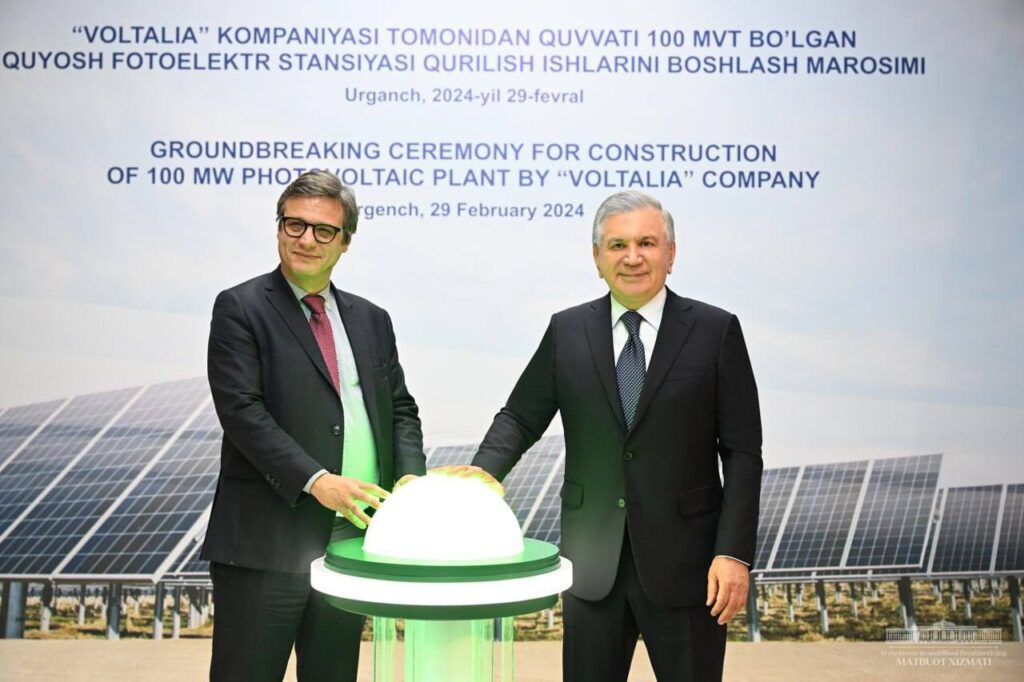
Attended by Uzbek President Shavkat Mirziyoyev, a ground-breaking ceremony for the construction of a solar power plant with a capacity of 100 megawatts took place in Uzbekistan’s Khorezm region on February 29th. Built by the French company Voltalia, the new photovoltaic plant will generate 254 million kilowatt-hours of green energy per annum and increase the volume of electricity generated in Khorezm by 30%. In addition to providing 11% of the region's annual electricity consumption by the end of the year, the new plant will save 76 million cubic meters of natural gas and prevent the release of 106 thousand tons of harmful substances into the atmosphere. The project will also harness agrovoltaics technology and by combining energy production and agriculture, allow crops to be grown under solar panels for the first time in Uzbekistan. In discussion with Sébastien Clerc, CEO of Voltalia, President Mirziyoyev emphasized his support of both the Khorezm project and the construction of a hybrid power plant in the Bukhara region, and reiterated the extent to which such innovative projects strengthen multifaceted cooperation between Uzbekistan and France.