• KGS/USD = 0.01144 0%
  • KZT/USD = 0.00215 0%
  • TJS/USD = 0.10691 0.09%
  • UZS/USD = 0.00008 0%
  • TMT/USD = 0.28530 0%
  • KGS/USD = 0.01144 0%
  • KZT/USD = 0.00215 0%
  • TJS/USD = 0.10691 0.09%
  • UZS/USD = 0.00008 0%
  • TMT/USD = 0.28530 0%
  • KGS/USD = 0.01144 0%
  • KZT/USD = 0.00215 0%
  • TJS/USD = 0.10691 0.09%
  • UZS/USD = 0.00008 0%
  • TMT/USD = 0.28530 0%
  • KGS/USD = 0.01144 0%
  • KZT/USD = 0.00215 0%
  • TJS/USD = 0.10691 0.09%
  • UZS/USD = 0.00008 0%
  • TMT/USD = 0.28530 0%
  • KGS/USD = 0.01144 0%
  • KZT/USD = 0.00215 0%
  • TJS/USD = 0.10691 0.09%
  • UZS/USD = 0.00008 0%
  • TMT/USD = 0.28530 0%
  • KGS/USD = 0.01144 0%
  • KZT/USD = 0.00215 0%
  • TJS/USD = 0.10691 0.09%
  • UZS/USD = 0.00008 0%
  • TMT/USD = 0.28530 0%
  • KGS/USD = 0.01144 0%
  • KZT/USD = 0.00215 0%
  • TJS/USD = 0.10691 0.09%
  • UZS/USD = 0.00008 0%
  • TMT/USD = 0.28530 0%
  • KGS/USD = 0.01144 0%
  • KZT/USD = 0.00215 0%
  • TJS/USD = 0.10691 0.09%
  • UZS/USD = 0.00008 0%
  • TMT/USD = 0.28530 0%

Viewing results 37 - 42 of 560

The Language Nobody Wants to Speak About: Russian’s Uneasy Place in Central Asia’s Cultural Conversation

Rhetoric in segments of the Russian media has sharpened debates over sovereignty and influence across Central Asia, pushing these concerns beyond policy circles and into everyday conversations. The region is reassessing not only pipelines and alliances, but language itself. In politics, this shift is visible and symbolic. In culture, it is more difficult to discern. The Russian language still shapes how Central Asian art is funded, circulated, and institutionally processed, even as institutions distance themselves from Moscow’s influence. This contradiction sits at the heart of contemporary cultural life in the region. Artists produce work rooted in Kazakh, Uzbek, Kyrgyz, Tajik, or Turkmen histories. They title exhibitions in local languages. They speak passionately about decolonial futures and cultural sovereignty. But when the catalogue is written, the grant application submitted, or the curatorial text sent abroad, the language quietly shifts. First to Russian, sometimes to English, and only occasionally does it remain in the local language. This is not nostalgia, but a structural inheritance. Russian remains the shared professional language of much of the urban cultural sector. Edward Lemon, President of the Oxus Society for Central Asian Affairs, argues that the language’s endurance reflects both ideology and pragmatism. “While local languages have become much more widespread as the Central Asian republics have strengthened their nationhood and as there has been an increase in anti-Russian sentiments since the invasion of Ukraine, Russian language use remains widespread,” Lemon told TCA. “Despite the ideological imperative to reduce reliance on Russian, there are some pragmatic reasons why it remains prominent. High levels of migration to Russia, particularly from Uzbekistan, Kyrgyzstan, and Kazakhstan, mean that a basic competence in the language is essential to survival for many Central Asians. Russian remains a language of interethnic communication, particularly in Kazakhstan, where ethnic Russians, for the most part, are reluctant to speak Kazakh. While English has become more widespread and some of the Central Asian languages are mutually intelligible, Russian retains a status as a diplomatic, business, and civil society language for those working in multiple countries. Russia also remains a language of education. Over 200,000 Central Asians study in Russia, by far the largest destination in the world. Russian-language schools remain prominent at every level in Central Asia, from kindergarten to graduate schools. In short, while the usage of Russian is in slow decline, its position is relatively entrenched.” For cultural institutions, this reality means that distancing from Moscow politically does not automatically sever the linguistic infrastructure through which grants are written, exhibitions travel, and contracts are signed. Naima Morelli, an arts writer focused on contemporary art across Asia-Pacific and the Middle East, argues that the issue is less about elimination than coexistence. “For me, it makes sense that Russian continues to function as a practical operating language across Central Asia’s cultural infrastructure, as an inherited connective tissue of sorts. In the hypothesis of getting rid of it, the most obvious alternative for a shared language for exchanges across countries in Central Asia is English, which the global...

Researchers Name Abdukodir Khusanov Fastest Center Back in Champions League

Uzbekistan national team defender Abdukodir Khusanov has been ranked the fastest central defender currently competing in the UEFA Champions League, according to new data released by the CIES Football Observatory. The Switzerland-based research group published its latest Weekly Post featuring exclusive Gradient data on running speeds among players whose clubs remain in the competition. The report analyzed maximum speeds and distance covered across different speed categories for five positional groups. Khusanov, who plays for Manchester City, recorded a top speed of 35.8 kilometers per hour, placing him first among center backs. He finished ahead of Tottenham Hotspur defender Micky van de Ven in the same category. The CIES report also highlighted the fastest players in other positions. Among full-backs, Achraf Hakimi and Nuno Mendes led the rankings, while Archie Gray topped the central midfield category. Anthony Gordon was the fastest among wide midfielders and wingers, and Kylian Mbappé led among center forwards. The data further examined how players distributed their movement across different speed ranges. Among the 100 players analyzed, Mbappé, Victor Osimhen, and Luis Suárez covered the highest proportion of distance at walking pace, defined as below 7 kilometers per hour. In contrast, central midfielders Häkon Evjen, João Simões, and Lucas Bergvall recorded the lowest share of walking distance. Earlier this month, the 21-year-old Khusanov was named Manchester City’s Player of the Month for January after winning a fan vote by a wide margin. The club praised his composure and tactical discipline, noting that his decision-making under pressure stood out during seven appearances across competitions.

Uzbekistan’s Umarov Appointed to Board of World Motorsport Body

Otabek Umarov, the First Deputy Chairman of Uzbekistan’s National Olympic Committee, has become the first ever Central Asian to join the Senate of the Fédération Internationale de l'Automobile (FIA) – the governing body for motorsport and the federation for mobility organizations. Umarov’s appointment to the FIA Senate ensures that there will be a Central Asian voice at the highest level of the motorsport industry. The FIA’s Senate controls the overall governance of the FIA and oversees the Federation’s financial and administrative matters, covering both sport and mobility.  Umarov is married to Shakhnoza Mirziyoyeva, the youngest daughter of President Shavkat Mirziyoyev. He has spent several years as Deputy Head of the Uzbek State Security Service. In addition to his role at Uzbekistan’s Olympic Committee, Umarov is the Vice President of the Olympic Council of Asia (OCA). In recent years he has led the modernization of the country’s sports infrastructure, which will bring major international events to Uzbekistan this year. Samarkand will host the World Triathlon Championship Series (25-26 April) and the 46th Chess Olympiad (15-28 September), while the World Aquatics Swimming World Cup will be held in Tashkent on 8-10 October. Uzbekistan has also been named host of the 2029 Asian Youth Games. The country’s athletes are currently competing at the Winter Olympic Games in Milan.

On the Eve of Valentine’s Day: Customs of Love and Marriage in Central Asia

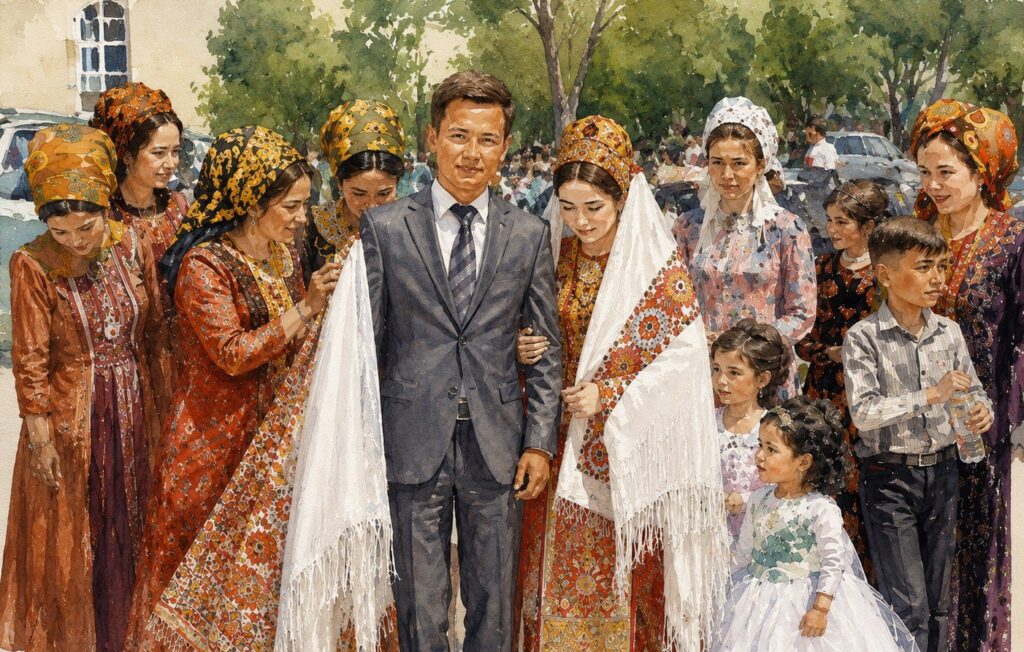
On the eve of Valentine’s Day, Central Asia is once again debating whether to celebrate the holiday or regard it as a symbol of foreign influence. Yet the region has its own rich and diverse customs related to love, matchmaking, and marriage. Accusations of Alien Influence and “Corruption” Valentine’s Day, like Halloween, spread to the former Soviet republics after the collapse of the USSR. In the first decades, young people embraced the new holidays. In recent years, however, critics have increasingly argued that commemorating a Catholic saint in a format centered on romantic love contradicts the traditions of the region’s peoples. For example, in Kazakhstan last year, deputies of the Mazhilis, the lower house of parliament, sharply criticized Valentine’s Day. Some deputies argued that it corrupts young people, promotes “free love,” and even carries “homosexual overtones.”  It is worth noting that Kazakhstan recently adopted legislation prohibiting so-called “propaganda of non-traditional sexual relations.” The Spiritual Administration of Muslims of Kazakhstan has also stated that Valentine’s Day promotes alien values and encourages promiscuity. Gratitude for Raising a Daughter Many matchmaking and marriage customs remain common across Central Asia, particularly the significant role of the bride’s and groom’s parents in ceremonies and celebrations. While traditions have evolved, many are still practiced in modern engagements and weddings. The well-known custom of paying bride price, kalym, has been preserved, though it has undergone significant change. Today, kalym varies depending on the wealth of the families. It may include apartments or cars, or it may amount to several hundred dollars. Importantly, kalym is now generally regarded as financial support for the young family and, as a rule, remains at the disposal of the bride and groom. Historically, in Kazakhstan and Kyrgyzstan, kalym was paid in livestock, and wedding celebrations could last more than a month.  One of the main Kazakh wedding rituals is the groom’s visit to the bride’s village or, in modern practice, her home. Before his first visit, the groom sends gifts to the bride’s family, known as Ilu,  an expression of gratitude for raising their daughter. In some regions of Kazakhstan, this ritual is called ana suty (“mother’s milk payment”). In the past, it included horses, camels, sheep, and riding equipment for the bride’s father. Today, it may consist of any valuable gift, and jewelry is often presented to the women in the bride’s family. The bride traditionally gives the groom a scarf as a symbol of her purity. Festivities then begin, with singing and dancing. Kazakh traditions often involve two weddings: one at the bride’s home and one at the groom’s. The bride’s farewell from her family home remains especially significant, reflecting her relatives’ wishes for her future life. Today, this ceremony is often held in a restaurant. The bride does not wear a white wedding dress at the farewell celebration but appears in an elegant outfit and a traditional headdress known as a saukele. During the farewell, the groom and his friends are subjected to playful pranks, for which they must...

Uzbekistan and Russia to Develop Nuclear Medicine Strategy Ahead of 2026 Center Opening

Uzbekistan will develop a roadmap and long-term strategy for the advancement of nuclear medicine, according to the press service of the Atomic Energy Agency under the Cabinet of Ministers, Uzatom. The announcement followed a working meeting held on February 10 at Uzatom to discuss prospects for expanding nuclear medicine in the country. The meeting brought together representatives of the Ministry of Health, the Healthcare Projects Center, the Committee for Industrial, Radiation and Nuclear Safety, the Institute of Nuclear Physics of the Academy of Sciences, the state enterprise Radiopreparat, leading medical centers, and experts from Rosatom’s engineering division, underscoring growing cooperation between Uzbekistan and Russia in the sector. During the discussions, the Russian side presented its experience in building modern nuclear medicine infrastructure, including cyclotron complexes, radiopharmaceutical production facilities, and PET/CT diagnostic centers, as well as implementing turnkey international projects. Following the talks, the parties agreed to jointly draft a roadmap and strategy that will provide a framework for technology transfer, specialist training, and improvements in healthcare services. The initiative is intended to strengthen early cancer diagnosis and expand access to advanced treatment methods based on nuclear technologies. The construction of a Nuclear Medicine Center in Tashkent has begun. The center is scheduled to be equipped in 2026 with PET/CT scanners, a cyclotron, a radiopharmaceutical laboratory, as well as Gamma Knife and CyberKnife systems. The broader program also involves upgrading oncology services, promoting early cancer detection, training medical personnel to international standards, and deepening cooperation with Russia and Rosatom. Uzatom stated that it will continue to support the introduction of advanced technologies aimed at improving access to modern cancer diagnostics and treatment. As previously reported by The Times of Central Asia, citing IQVIA data, Uzbekistan’s pharmaceutical market reached $2.14 billion in the twelve months to September 2025, reflecting continued expansion and rising demand for medical services.

Uzbekistan’s Population Reaches 38.2 Million Despite Second Year of Declining Birth Rate

Uzbekistan’s permanent population stood at 38,236,704 as of January 1, 2026, marking a nearly 85% increase since independence, according to data released by the National Statistics Committee. In 1991, when Uzbekistan gained independence, the population was approximately 20.6 million. Over the past 35 years, the country has added 17.6 million people, a steady demographic expansion. However, the latest figures suggest emerging shifts in birth rate trends. In 2025, the number of registered births totaled 879,500, a 5.1% decrease compared to 2024, or 46,800 fewer births year-on-year. This marks the second consecutive annual decline in the national birth rate. Economist Mirkomil Kholboyev, writing on his “Mirkonomika” channel, cautioned against drawing premature conclusions. “Births have declined for the second year in a row,” he wrote. “Since the overall fertility indicators have not yet been updated, it is difficult to determine whether the 2025 decline is mainly due to a smaller cohort of people of childbearing age, or to changes in reproductive decisions.” The decline has also become more geographically widespread. In 2025, 179 districts and cities recorded a drop in births, the highest number in 15 years, compared to 155 districts in 2024. These areas accounted for a combined reduction of 48,400 births, representing approximately 90% of all registered births nationwide. By contrast, only 25 districts recorded an increase in births in 2025, with a total gain of 1,722. For comparison, in 2024, birth increases in growing districts totaled 9,000 and represented 24% of all births, while in 2025 that share fell sharply to 8.6%.