• KGS/USD = 0.01144 0%
  • KZT/USD = 0.00206 0%
  • TJS/USD = 0.10760 -0.46%
  • UZS/USD = 0.00008 0%
  • TMT/USD = 0.28571 0%
  • KGS/USD = 0.01144 0%
  • KZT/USD = 0.00206 0%
  • TJS/USD = 0.10760 -0.46%
  • UZS/USD = 0.00008 0%
  • TMT/USD = 0.28571 0%
  • KGS/USD = 0.01144 0%
  • KZT/USD = 0.00206 0%
  • TJS/USD = 0.10760 -0.46%
  • UZS/USD = 0.00008 0%
  • TMT/USD = 0.28571 0%
  • KGS/USD = 0.01144 0%
  • KZT/USD = 0.00206 0%
  • TJS/USD = 0.10760 -0.46%
  • UZS/USD = 0.00008 0%
  • TMT/USD = 0.28571 0%
  • KGS/USD = 0.01144 0%
  • KZT/USD = 0.00206 0%
  • TJS/USD = 0.10760 -0.46%
  • UZS/USD = 0.00008 0%
  • TMT/USD = 0.28571 0%
  • KGS/USD = 0.01144 0%
  • KZT/USD = 0.00206 0%
  • TJS/USD = 0.10760 -0.46%
  • UZS/USD = 0.00008 0%
  • TMT/USD = 0.28571 0%
  • KGS/USD = 0.01144 0%
  • KZT/USD = 0.00206 0%
  • TJS/USD = 0.10760 -0.46%
  • UZS/USD = 0.00008 0%
  • TMT/USD = 0.28571 0%
  • KGS/USD = 0.01144 0%
  • KZT/USD = 0.00206 0%
  • TJS/USD = 0.10760 -0.46%
  • UZS/USD = 0.00008 0%
  • TMT/USD = 0.28571 0%

Our People > Jonathan Campion

Jonathan Campion's Avatar

Jonathan Campion

Contributor

Jonathan Campion has worked in the Eurasia region since 2007. After leaving Exeter University with a degree in Russian Language, he worked as a writer, editor, analyst and translator for international law firms, market research firms and business forums serving the CIS region's major industries.

With a passion for Central Asia, he has covered the region in esteemed publications such as the Lonely Planet, Open Central Asia magazine, and National Geographic Traveler.

Jonathan's first book, about a sports team from the Eurasia region, was shortlisted at the Charles Tyrwhitt Sports Book Awards in 2025.

Articles

Tokayev Calls For Expanded SCO to Play Greater Role on Global Stage

A meeting entitled “Strengthening Multilateral Dialogue – Striving for Sustainable Peace and Development” was held to conclude the Shanghai Cooperation Organization summit in Astana on July 4. The meeting was was held in the "SCO Plus" format. and was attended by the leaders of the SCO full member states who participated in the Summit earlier in the day, plus leaders of the organization's observer countries and dialogue partners. These included the UN Secretary-General António Guterres, presidents Recep Tayyip Erdoğan of Turkey and Ilham Aliyev of Azerbaijan, and the Emir of Qatar, Sheikh Tamim bin Hamad Al Thani. The SCO Plus session of the Summit took on greater importance this year, amid suggestions that the alliance is primed to expand next year. Countries interested in joining the SCO as full members include Turkey, Qatar and Egypt.  In his speech at the meeting, Kazakhstan's President Kassym-Jomart Tokayev emphasized the role that the SCO can play as a stabilizing force in the international arena. “Today the world is faced with serious challenges caused by unprecedented geopolitical contradictions and growing conflict potential,” said Tokayev. “The international security architecture is under threat, which could lead to dire consequences for all of humanity. In such a fateful period, we are entrusted with a huge responsibility for strengthening peace, stability, and security through collective efforts at the regional and global levels. The Shanghai Cooperation Organization, taking into account its authority, significant economic and human resources, is capable of developing effective solutions to achieve sustainable development goals and overcome modern challenges.”  Concerning the role of the United Nations, Tokayev said that its potential is far from being exhausted. “Our common task is to strengthen the role of the UN as the main international institution for ensuring global security, capable of effectively confronting the challenges of the 21st century. The voice of the SCO should and will sound louder in the international arena, promoting a consolidated position on various problems of our time,” he emphasized. In his own speech, Gutteres referred to the SCO as "a valuable partner of the United Nations". With reference to strengthening trade and economic ties, Tokayev said: “At the current stage, the economies of the SCO member countries are demonstrating high growth rates of 4% to 9%. The share of the SCO states in global GDP is 30% already. Today, the foreign trade of the SCO participating countries exceeds $8 trillion, which is equivalent to a quarter of all world trade.”  Tokayev emphasized the fact that economic growth in Asia is largely due to the SCO states. On behalf of Kazakhstan, he also welcomed China’s intention to expand access for SCO countries to its market, and increase trade turnover with the SCO member states to $3 trillion. “It is important for us to fully unleash the colossal economic potential of the SCO. The interaction of the SCO with such integration associations as the EAEU, BRICS and ASEAN opens up broad prospects. A powerful driver for sustainable growth in global trade is further strengthening of transport connectivity. More than...

2 years ago
SCO Summit: Eurasian Alliance Signs Security Agreements; Welcomes Belarus

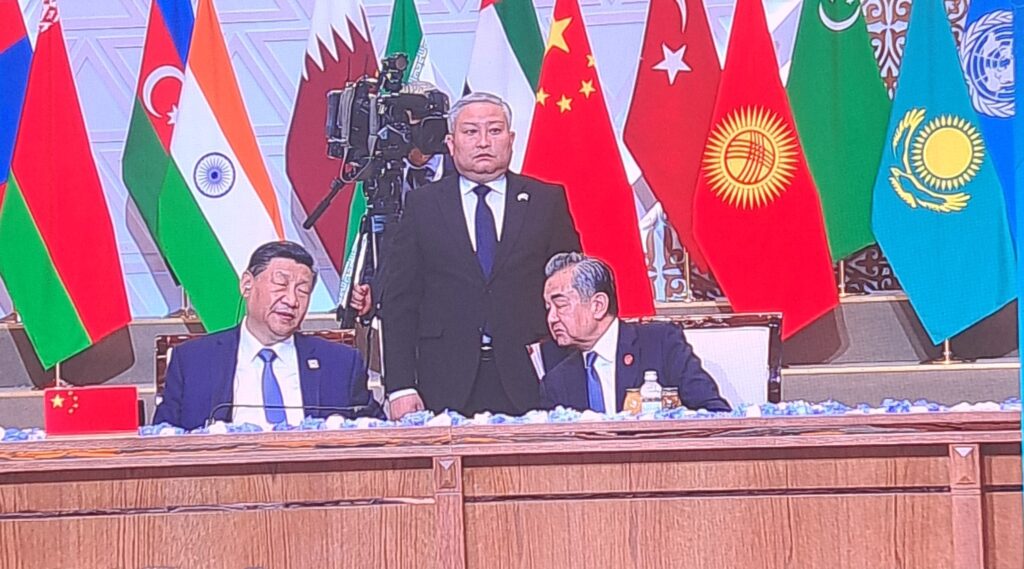
By Jonathan Campion, reporting from the SCO Summit in Astana   At the Shanghai Cooperation Organization (SCO) Summit in Astana this morning, leaders from the bloc’s member states signed a host of agreements intended to promote cohesion in the Eurasia region. The first session, which was held behind closed doors, had begun with the signing of the document that accepted Belarus as the SCO’s 10th full member. The SCO is a political, security and economic alliance, of which Kazakhstan, Kyrgyzstan, Tajikistan and Uzbekistan are founding members. The group also includes China, Russia, Iran, India, Pakistan, and now Belarus. The organization has four observer states and 14 dialogue partners, covering half of the world’s population, and almost a third of global GDP.  The first agreement signed was a document outlining the Shanghai Cooperation Organization’s development strategy for the next 12 months. In 2025 Kazakhstan will pass chairmanship of the alliance to China, and there is speculation that the SCO may grow further next year, to include at least one new member. With security a growing concern for members, particularly in light of the March terrorist attack outside Moscow, for which the terror group Islamic State Khorasan Province (ISIS-K) have claimed responsibility, leaders approved the SCO’s latest three-year Cooperation Program to counter terrorism, separatism and extremism. The parties also signed an agreement on the organization’s regional anti-drug strategy. Another high-profile document is the SCO’s development strategy for cooperation in the energy sphere. Kazakhstan is at the forefront of the region’s transition to green energy, with Chinese leader Xi Jinping mentioning the country’s new Zhanatas wind farm and the Turgusun hydropower station as key joint projects with China in an article published in the Kazakh press this week. The heads of state were welcomed to the Summit by Kazakh President Kassym-Jomart Tokayev, with his Russian counterpart Vladimir Putin, Aleksandr Lukashenko of Belarus and Chinese leader Xi Jinping the last to arrive, ten minutes after the other dignitaries. Some leaders did not arrive at all: India’s Narendra Modi is not attending this year’s SCO Summit, and has sent the country’s external affairs minister Subrahmanyam Jaishankar in his place.  The Summit's afternoon session is styled as "SCO Plus". In attendance are the heads of state of the alliance's dialogue partners, including the presidents of Turkey and Azerbaijan, Recep Tayyip Erdogan and Ilham Aliyev. Turkmenistan – which is not affiliated to the SCO but which is invited as a guest – is led not by its President Serdar Berdimuhamedov, but by his father Gurbanguly Berdimuhamedov, the former leader who is now the chairman of the country’s People’s Council.  

2 years ago

Astana Hosts SCO Summit: A New Platform for Kazakh Diplomacy

With the first events of the Shanghai Cooperation Organization (SCO) Summit taking place this morning in Kazakhstan’s capital, Astana, conversations are beginning about what the host country will be discussing – and with whom. The SCO is a political, security and economic alliance in the wider Eurasia region, aimed at promoting trade and investments between member states, as well as global security. Its nine full members are Kazakhstan, Kyrgyzstan, Tajikistan, Uzbekistan, China, Russia, Iran, India and Pakistan. The Organization – which includes four observer states and 14 dialogue partners – covers half of the world’s population, and almost a third of global GDP. Kazakhstan’s multi-vector approach to its foreign policy has seen the country combining its role within the SCO with cooperation with Western governments, through dialogue with the European Union and the United States’ C5+1 platform. President Tokayev recently commented that: “Kazakhstan is committed to multilateral cooperation. In our foreign policy we proceed from the national interests, and are in favor of solving all disputable issues on the basis of rational compromise. In addition to the SCO, this year our country is chairing five other international organizations. This is an unprecedented case, one could say an achievement in the history of Kazakh diplomacy.” This multi-vector approach is key to Kazakhstan’s international diplomacy. Indeed, ‘mutually beneficial cooperation’ and ‘mutually beneficial strategic partnership’ have become the watchwords of Tokayev’s presidency. Over the past decade, Kazakhstan has become an increasingly important land-bridge between East and West, both in terms of trade and diplomacy. Due to projects such as the Belt and Road Initiative and the Middle Corridor, Kazakhstan’s location has made it an indispensable ally to China, whilst playing a pivotal role in the expansion of transcontinental trade has led to Central Asia, in the words of Tokayev, “become a global stakeholder.” In the opinion of experts, more of the same can be expected at this week’s SCO Summit. In an interview conducted by the Kazinform news agency, local political analyst Valery Volodin stressed that: “It goes without saying that each government will be defending its own interests [at the Summit]. But Kazakhstan will be placing an emphasis on regional stability, which will allow countries to implement a host of joint projects with China and Russia. Besides this, Kassym-Jomart Tokayev’s gift for diplomacy will push the SCO to become not just a discussion club, but a real mechanism to solve problems in Eurasia using dialogue between governments.” In an article in The Geopolitics, Michael Rossi, a professor of political science at Long Island University, posited that Kazakhstan is not playing the so-called ‘Great Game’ between East and West, but rather pointing out the scope for "Big Opportunities". “Kazakhstan’s positive relations with countries often in conflict, such as Russia and Ukraine, China and the United States, Azerbaijan and Armenia, and Israel and the Palestinian territories, grant Astana legitimacy,” Rossi writes, “to act as a buffer and stabilizing force among major powers. This positioning allows Kazakhstan to reduce tensions and potentially mediate conflicts. Under...

2 years ago

SCO Summit in Astana: Correspondents from China Global Television Network, Times of Central Asia Discuss Upcoming Meeting

National leaders and other dignitaries from over 20 countries will be in the Kazakh capital of Astana this week for the annual summit of the Shanghai Cooperation Organization (SCO). The Times of Central Asia will be covering the SCO Summit live on 3 and 4 July from the city’s Palace of Peace and Reconciliation. The SCO is a political, security and economic alliance in the wider Eurasia region. This year’s Summit host Kazakhstan was a founding member of the Organization in 2001, alongside China and Russia, and its Central Asian neighbors Kyrgyzstan, Tajikistan and Uzbekistan. The last time the Summit was held in Astana, in 2017, India and Pakistan became full members. There are currently nine full member states, four observer states, and 14 dialogue partners, covering half of the world’s population, and almost a third of global GDP. This year's Summit will have significant implications for regional and global affairs. It is likely to produce initiatives aimed at reducing trade barriers, and promoting investments between SCO member states. High on the agenda will be the Belt and Road Initiative (BRI) – a crucial framework for enhancing connectivity and economic ties between China and its Central Asian partners. Other anticipated outcomes include new initiatives on climate change and sustainable development, as well as strengthened cultural and educational exchanges. Upon the initiative of Kazakhstan’s President Kassym-Jomart Tokayev, 2024 has been named the SCO “Year of Ecology”. Ahead of the Astana Summit, The Times of Central Asia’s senior editor Jonathan Campion spoke with an anchor from China Global Television Network, Mr Zhong Shi, about the role of the Shanghai Cooperation Organization plays in the Central Asia region. Their talk can be viewed in full in the videos below. In response to The Times of Central Asia’s question about what makes the SCO different from other alliances that the countries of Central Asia are aligned with, Mr Zhong explained that: “The SCO has been truly effective in combatting what we call the three enemies of all members, namely terrorism, extremism and separatism. There have been joint military drills conducted to enhance the coordination among armed forces”. Listen to Mr Zhong’s full response below: [video width="1920" height="1080" mp4="https://timesca.com/wp-content/uploads/2024/06/fullscreen-Zhong-Shi-answer-2-questions.mp4"][/video]   [video width="1920" height="1080" mp4="https://timesca.com/wp-content/uploads/2024/06/tw0-windows-Zhong-Shi-answer-2-questions.mp4"][/video] In turn, Mr Campion gave The Times of Central Asia’s perspective on the upcoming Summit. Asked about the impact that the Belt and Road Initiative has had on Central Asia, he replied: "Central Asia is evolving as a land bridge component to the Belt and Road Initiative linking China to the Caspian Sea. We’re seeing that investments in transport infrastructure are unlocking the region’s vast natural resources. With the world making a green transition, Kazakhstan stands out, as it has an abundance of critical materials – or green metals as they are known – that are used in the components of green technologies.” Listen to Mr Campion’s full response below: [video width="1920" height="1080" mp4="https://timesca.com/wp-content/uploads/2024/06/Jonathon-answer-Q2.mp4"][/video]   [video width="1920" height="1080" mp4="https://timesca.com/wp-content/uploads/2024/06/Jonathon-answer-Q3.mp4"][/video]  

2 years ago