• KGS/USD = 0.01143 0%
  • KZT/USD = 0.00216 0%
  • TJS/USD = 0.10633 -0.28%
  • UZS/USD = 0.00008 0%
  • TMT/USD = 0.28571 0%
  • KGS/USD = 0.01143 0%
  • KZT/USD = 0.00216 0%
  • TJS/USD = 0.10633 -0.28%
  • UZS/USD = 0.00008 0%
  • TMT/USD = 0.28571 0%
  • KGS/USD = 0.01143 0%
  • KZT/USD = 0.00216 0%
  • TJS/USD = 0.10633 -0.28%
  • UZS/USD = 0.00008 0%
  • TMT/USD = 0.28571 0%
  • KGS/USD = 0.01143 0%
  • KZT/USD = 0.00216 0%
  • TJS/USD = 0.10633 -0.28%
  • UZS/USD = 0.00008 0%
  • TMT/USD = 0.28571 0%
  • KGS/USD = 0.01143 0%
  • KZT/USD = 0.00216 0%
  • TJS/USD = 0.10633 -0.28%
  • UZS/USD = 0.00008 0%
  • TMT/USD = 0.28571 0%
  • KGS/USD = 0.01143 0%
  • KZT/USD = 0.00216 0%
  • TJS/USD = 0.10633 -0.28%
  • UZS/USD = 0.00008 0%
  • TMT/USD = 0.28571 0%
  • KGS/USD = 0.01143 0%
  • KZT/USD = 0.00216 0%
  • TJS/USD = 0.10633 -0.28%
  • UZS/USD = 0.00008 0%
  • TMT/USD = 0.28571 0%
  • KGS/USD = 0.01143 0%
  • KZT/USD = 0.00216 0%
  • TJS/USD = 0.10633 -0.28%
  • UZS/USD = 0.00008 0%
  • TMT/USD = 0.28571 0%

Viewing results 1 - 6 of 18

Iran Proposes Defense Cooperation to SCO Partners at Bishkek Meeting

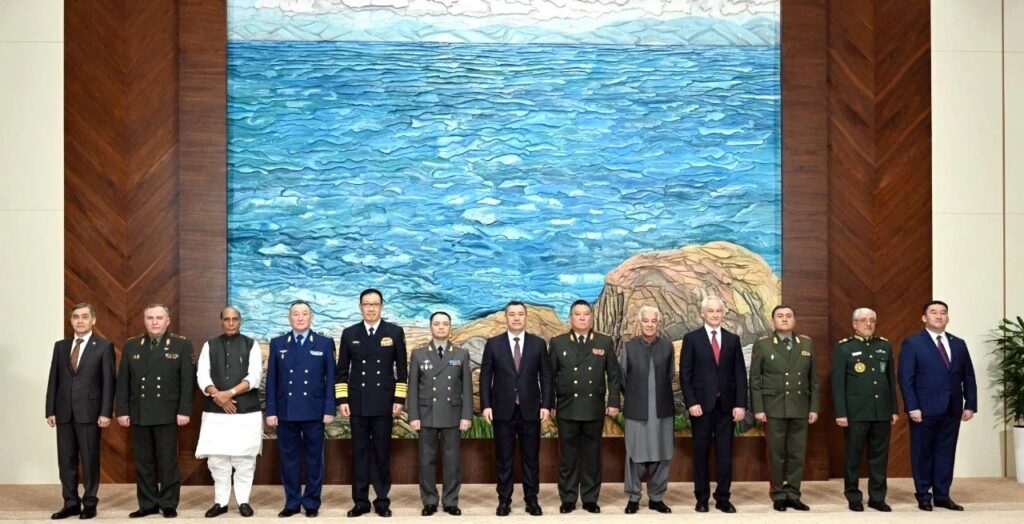
Iran used a Shanghai Cooperation Organization defense meeting in Bishkek to signal that it is ready to share military experience and defense capabilities with other SCO members, giving a sharper geopolitical edge to the gathering hosted by Kyrgyzstan under its current chairmanship of the bloc. The meeting of SCO defense ministers opened on April 28 at the Ala-Archa state residence in Bishkek. Defense officials from the organization’s member states attended, along with SCO Secretary General Nurlan Yermekbayev. Kyrgyzstan’s Defense Minister Ruslan Mukambetov chaired the session. Iran was represented by Deputy Defense Minister Reza Talaei-Nik. In a statement carried by Mehr News Agency, Talaei-Nik said Iran was ready to share its defense weapons capabilities and experience with “independent countries,” especially SCO member states. He also described the SCO as part of a wider shift away from what Tehran called a “unipolar” international order. The remarks came after weeks of fighting between Iran, the United States, and Israel, including Iranian drone and missile strikes on U.S. bases in the region and Israeli sites. A ceasefire announced earlier this month reduced hostilities, but efforts to reach a wider settlement have stalled. Talaei-Nik also used the meeting to frame the recent conflict as a lesson for other states, declaring, “We are ready to share our experiences in defeating America with other members of the organization.” The SCO meeting gave Tehran a platform inside a bloc that now includes China, Russia, India, Pakistan, Iran, Belarus, Kazakhstan, Kyrgyzstan, Tajikistan, and Uzbekistan. Iran became a full member in 2023. The SCO also has a wider circle of observer states and dialogue partners, including 15 dialogue partners listed by the organization’s secretariat. Kyrgyz President Sadyr Japarov received the SCO defense delegations before the ministerial session. He said Kyrgyzstan, as the SCO chair, attaches special importance to practical defense cooperation, including joint exercises, experience-sharing, and stronger coordination. He said agreements reached in Bishkek should strengthen defense cooperation and security across the SCO region. Kyrgyzstan’s SCO chairmanship is being held under the slogan “25 Years of the SCO: Together Towards Sustainable Peace, Development, and Prosperity.” Kyrgyzstan’s Defense Minister Mukambetov said the organization needed solidarity, mutual trust, and collective responsibility to respond to current security challenges. Kyrgyz state agency Kabar said the participants discussed military cooperation, regional security, and joint responses to current threats. The SCO began as a border-security framework. Its roots go back to agreements signed in 1996 and 1997 by Kazakhstan, China, Kyrgyzstan, Russia, and Tajikistan on military trust and troop reductions along border areas. Uzbekistan later joined, and the Shanghai Cooperation Organization was formally founded in 2001. Since then, the bloc has grown into a wider Eurasian platform covering security, defense contacts, counterterrorism, transport, energy, and economic cooperation. Talaei-Nik also held talks with Russian and Belarusian defense officials on the fringes of the Bishkek meeting, with both sides discussing continued cooperation with Tehran. For Central Asian governments, including non-SCO member Turkmenistan, the Bishkek meeting highlighted the pressures facing multi-vector diplomacy. All five have spent years balancing security...

Kazakhstan Proposes Digital Platform for SCO Agricultural Trade

At a recent gathering of agricultural ministry officials from Shanghai Cooperation Organization (SCO) member states in Beijing, Kazakhstan’s Deputy Minister of Agriculture, Yermek Kenzhekhanuly, proposed establishing a unified digital platform to streamline and enhance agricultural trade across the bloc. According to the Ministry of Agriculture of the Republic of Kazakhstan, the country exported $5.1 billion worth of agricultural products in 2024, a 3.9% year-on-year increase to 16.1 million tons. Notably, 69% of this trade involved nine SCO member countries, underscoring both regional interdependence and the potential for expanded agricultural cooperation. The SCO includes Kazakhstan, China, Russia, Belarus, India, Iran, Kyrgyzstan, Pakistan, Tajikistan, and Uzbekistan. “We view the agricultural sector as an area for strategic partnership, not competition,” Kenzhekhanuly stated. He emphasized Kazakhstan's readiness to help develop a unified agricultural space grounded in trust, coordination, and complementarity. The proposed digital platform would incorporate tools for electronic certification, logistics tracking, and product traceability. The Kazakh delegation also stressed the importance of harmonizing technical regulations and phytosanitary standards to facilitate mutual trade and eliminate non-tariff barriers. The meeting concluded with the signing of the Protocol of the Tenth Meeting of SCO Ministers of Agriculture, reaffirming the member states' commitment to deepening cooperation in the agricultural sector. As previously reported by The Times of Central Asia, Kazakhstan is also working to diversify its agricultural export markets, including recent wheat shipments to North Africa.

Tajikistan Announces Preliminary Parliamentary Election Results; OSCE Absent

Bakhtiyor Khudoyorzoda, the chairman of Tajikistan's Central Commission for Elections and Referenda (CCER), has announced the preliminary results of the March 2 parliamentary elections to the Assembly of Representatives. According to Khudoyorzoda, 4.71 million of the 5.52 million registered voters participated in the election, representing an 85.3% turnout. The election results for party-list voting were as follows: The People's Democratic Party of Tajikistan secured the most support, receiving 2,435,541 votes (51.9%). The Agrarian Party of Tajikistan garnered 986,887 votes (21%). The Economic Reform Party of Tajikistan received 595,281 votes (12.7%). The Socialist Party of Tajikistan obtained 248,064 votes (5.3%). The Democratic Party of Tajikistan received 237,536 votes (5.1%). The Communist Party of Tajikistan received 89,738 votes (1.9%), failing to meet the 5% threshold required for parliamentary representation. Additionally, 50,895 voters chose the "against all" option. As a result of the party-list vote count, the 22 parliamentary seats allocated through the national proportional system were distributed as follows: People's Democratic Party of Tajikistan - 12 seats Agrarian Party of Tajikistan - 5 seats Economic Reform Party of Tajikistan - 3 seats Socialist Party of Tajikistan - 1 seat Democratic Party of Tajikistan - 1 seat The Communist Party of Tajikistan did not secure any seats. In total, five of the six registered parties gained representation in the Majlisi Oli, Tajikistan’s parliament. The remaining parliamentary seats were allocated through single-mandate districts. On February 6, 2025, the OSCE/ODIHR canceled a planned election observer mission, stating that the Tajik authorities' failure to accredit the observers had "denied the people of Tajikistan an impartial and independent assessment of the elections." A mission from the Shanghai Cooperation Organization, meanwhile, characterized the election as "transparent, credible and democratic." In the latest presidential elections, held in 2020, incumbent Emomali Rahmon won a fifth consecutive term, securing a purported 92.08% of the vote. Rahmon has been president since 1994, having previously led the country as Chairman of the Supreme Assembly from 1992 to 1994. TCA has previously reported on long prison sentences for Tajik opposition figures. Elections to the National Assembly will be held on March 28, 2025.

Economy Minister: 70% of Tajikistan’s Trade is With SCO Countries

The Pakistani capital of Islamabad has hosted the 23rd meeting of the Ministers of the Shanghai Cooperation Organization (SCO) Member States responsible for Foreign Economic and Trade Activities. The Minister of Economic Development and Trade of Tajikistan, Zavqi Zavqizoda, who participated in the meeting, said that the country considers the development of relations within the SCO as one of its foreign policy priorities. “Foreign trade turnover between Tajikistan and the SCO countries demonstrates steady growth, and every year, more than 70% of the republic’s foreign trade is with SCO countries,” Zavqizoda said. He recalled that the SCO accounts for almost half of the world’s population and 27% of global GDP, making the region a massive market with great opportunities. Zavqizoda noted that Tajikistan initiated the economic development strategy for the next five years with the SCO, which was developed and adopted by the organization's member states. He proposed to the participants a plan related to developing and implementing large infrastructure projects and expanding cooperation in digital and green economy, green energy, and e-commerce. It was also noted that wide use of transit opportunities of Tajikistan is envisaged. The Times of Central Asia has reported that Tajikistan seeks to become a central international transit hub. In the next two years, 317 kilometers of international highways will be commissioned in Tajikistan. In the remaining months of 2024, Tajikistan will continue implementing projects for highway reconstruction, with the construction of 32 bridges, five tunnels with a length of 11.2 km, and seven avalanche corridors aiming to turn the country into an international transit route.

Erdogan: Turkey Wants to Become Full SCO Member

Turkish President Recep Tayyip Erdogan has announced his country's aspiration to become a full member of the Shanghai Cooperation Organization (SCO), at a press conference in Washington after the conclusion of the NATO summit. "Turkey's goal, which is now an observer in the SCO, is full membership. Now, it should join the Shanghai Five," Erdogan stated. The Turkish president attended the SCO summit held in Astana on July 3-4. SCO Secretary-General Zhang Ming said that despite its membership of NATO, Turkey actively participates in the organization's activities, which are not directed against other states. He emphasized that interaction with Ankara is based on the principles set out in the SCO charter and is in line with the "Shanghai spirit."

SCO Summit: A Battle for Influence in Central Asia

For Central Asian countries, the Shanghai Cooperation Organization (SCO) is a tool that allows them to improve their position in the global arena, and develop closer economic ties with other members of the world’s largest multilateral group. But for Russia and China, the SCO is an instrument that gives them an opportunity to strengthen their influence in the strategically important region of Central Asia. Last week, the SCO (whose members are Russia, China, India, Iran, Kyrgyzstan, Kazakhstan, Pakistan, Tajikistan, Uzbekistan, as well as Belarus, the entrant at the meeting in Astana on July 3-4) held the summit of the Council of Heads of State of the SCO in the Kazakh capital of Astana where its leaders adopted a series of documents – from the Astana Declaration, underscoring the organization’s role in bolstering global peace, security and stability, through the SCO Development Strategy until 2035, to the group’s Economic Development Strategy’s Action Plan until 2030. Prior to the meeting of what is often described as “the world’s least known and least analyzed” multilateral group, Kazakhstan’s President Kassym-Jomart Tokayev repeatedly stated that, over the past 20 years it was not possible to implement a single major economic project under the auspices of the SCO. Indeed, ever since its foundation in 2001, the SCO has mostly been focusing on security issues, and during the summit in Astana security was yet again at the top of the agenda. But as the largest Central Asian nation’s Deputy Foreign Minister Roman Vassilenko told me at the briefing with the foreign journalists on July 4, SCO members still work more on a bilateral rather than on a multilateral basis. In his view, advancing economic cooperation within the organization of very diverse nations is not an easy task. Quite aware of that, China seeks to strengthen its economic presence in Central Asia through other formats such as the Belt and Road Initiative, and the China-plus-Central Asia format. In the past, Beijing was actively pushing for closer economic integration between SCO members, but Russia reportedly blocked Chinese initiatives. As a result, the People’s Republic began to sign bilateral agreements with regional countries, aiming to strengthen its role in Central Asia. Kazakhstan, as the region’s largest economy, is no exception. Despite being a Russian ally in the Collective Security Treaty Organization (CSTO), and a member of the Russian-led Eurasian Economic Union, Astana seems to see Beijing, rather than Moscow, as the de facto leader of the SCO. As Vassilenko stressed, out of 10,000 people who came to Astana for the summit, more than half of them were Chinese, which indicates that the SCO holds a huge importance in Beijing’s foreign policy. Moreover, Chinese President Xi Jinping seems to have received a warmer welcome in the Kazakh capital than Russian leader Vladimir Putin or the heads of states of other SCO members. At the airport, where Xi was welcomed by his Kazakh counterpart Kassym-Jomart Tokayev, a group of Kazakh children sang the song "Ode to the Motherland" in Chinese, while Chinese...