• KGS/USD = 0.01144 0%
  • KZT/USD = 0.00199 0%
  • TJS/USD = 0.10736 0.28%
  • UZS/USD = 0.00008 0%
  • TMT/USD = 0.28490 0%
  • KGS/USD = 0.01144 0%
  • KZT/USD = 0.00199 0%
  • TJS/USD = 0.10736 0.28%
  • UZS/USD = 0.00008 0%
  • TMT/USD = 0.28490 0%
  • KGS/USD = 0.01144 0%
  • KZT/USD = 0.00199 0%
  • TJS/USD = 0.10736 0.28%
  • UZS/USD = 0.00008 0%
  • TMT/USD = 0.28490 0%
  • KGS/USD = 0.01144 0%
  • KZT/USD = 0.00199 0%
  • TJS/USD = 0.10736 0.28%
  • UZS/USD = 0.00008 0%
  • TMT/USD = 0.28490 0%
  • KGS/USD = 0.01144 0%
  • KZT/USD = 0.00199 0%
  • TJS/USD = 0.10736 0.28%
  • UZS/USD = 0.00008 0%
  • TMT/USD = 0.28490 0%
  • KGS/USD = 0.01144 0%
  • KZT/USD = 0.00199 0%
  • TJS/USD = 0.10736 0.28%
  • UZS/USD = 0.00008 0%
  • TMT/USD = 0.28490 0%
  • KGS/USD = 0.01144 0%
  • KZT/USD = 0.00199 0%
  • TJS/USD = 0.10736 0.28%
  • UZS/USD = 0.00008 0%
  • TMT/USD = 0.28490 0%
  • KGS/USD = 0.01144 0%
  • KZT/USD = 0.00199 0%
  • TJS/USD = 0.10736 0.28%
  • UZS/USD = 0.00008 0%
  • TMT/USD = 0.28490 0%
04 February 2026

Our People > Naima Morelli

Naima Morelli's Avatar

Naima Morelli

Journalist

Naima is an arts writer and journalist specialized in contemporary art from Asia-Pacific and the MENA region. She has written for the Financial Times, Al-Jazeera, The Art Newspaper, ArtAsiaPacific, Internazionale and Il Manifesto, among others, and she is a regular contributor to Plural Art Mag, Middle East Monitor and Middle East Eye as well as writing curatorial texts for galleries. She is the author of three books on Southeast Asian contemporary art.

Articles

Unbent, Unbowed, Unbroken: The Art of Saule Suleimenova

“I’m a very emotional person,” says artist Saule Suleimenova with a bright, open laugh from her home studio in Almaty. Widely recognized as one of the most significant Kazakh artists working today, Suleimenova’s spontaneity and passion emerge clearly as the artist lightens up when talking about the joy and necessity of making work, when she excavates memories of the early days of making art, or when suddenly, she grows gloomy, remembering some of the most painful moments in the history of her country. Behind her back stands a large canvas, where translucent elements, almost resembling stained glass from a distance, slowly reveal themselves as fragments of discarded plastic bags fused together through heat and a whole lot of patience. Born in 1970, Suleimenova has developed a practice that spans painting, drawing, photography, and public art, consistently navigating the delicate and often hard to define boundary between personal memory and collective history: “I feel my personal life can’t be detached from politics and everything that happens around me,” she says, embodying, in a way, a motto from the seventies: “the personal is political.” Suleimenova was an early member of the Green Triangle Group, an experimental artist collective known for its avant-garde and punk-influenced art, which emerged during the Perestroika era and the collapse of the USSR, playing a significant role in revolutionizing contemporary art in Kazakhstan. Today, she is working mostly with archives, vernacular imagery, and the visual language of contemporary urban space. In her work, she investigates how narratives are formed, distorted, and even rewritten over time, particularly within the historical and political context of Kazakhstan. An example is her ongoing series, Cellophane Paintings, composed entirely from used plastic bags, transforming everyday waste into luminous, layered pictorial fields that hold together subjects as vast as socio-political trauma, from the Kazakh famine of 1930–1933, human rights violations, Karlag, one of the largest Gulag labor camps, and the Uyghur genocide. Those heavy themes are associated with some that are more intimate: family members, flowers, and cityscapes. Suleimenova is currently participating in the Union of Artists at the Center of Modern Culture Tselinny in Almaty (15 January – 19 April 2026), curated by Vladislav Sludsky, an exhibition reflecting on artistic partnerships as systems of survival in a region where art historically survived through shared spaces and personal alliances between artists, rather than institutional support. The Times of Central Asia spoke to Suleimenova about memory, material, and the ways personal experience and political history converge in her art. [caption id="attachment_42718" align="aligncenter" width="2500"] From the series, One Step Forward[/caption] TCA: Your recent work at the Bukhara Biennial, Portraits of the people of Bukhara, was made from polyethylene bags collected by the community itself. Can you tell me how your work on this project took shape? Suleimenova: From the beginning, the work was meant to be collaborative with local artists or artisans rather than something already finished and brought from outside. I decided to collaborate with a folk ensemble of Bukhara women - the retired performers...

5 days ago

Mapping the Inner Landscape: An Interview with Oyjon Khayrullaeva

In recent years, a new generation of Uzbek artists has begun to reshape how culture, history, and identity are visually narrated. Among them is Oyjon Khayrullaeva, whose practice moves fluidly between photography, digital collage, and large-scale public installations. Born after independence and largely self-trained outside formal art institutions, Khayrullaeva works with inherited visual languages such as Islamic ornament and traditional textiles, reassembling them into contemporary forms that speak to the present moment. Her recent project for the Bukhara Biennial, called “Eight Lives,” marks a turning point in this exploration. Installed in the public and historical spaces of the ancient city, the work consists of monumental mosaic organs that connect physical vulnerability with emotional states and collective memory. Through the human body, Khayrullaeva maps experiences of anxiety, healing, spirituality, and social pressure, transforming ornament into anatomy and architecture into inner landscape. The Times of Central Asia spoke with the artist to trace how Eight Lives emerged, how collaboration with mosaic masters shaped its final form, and how audiences in Uzbekistan are responding to seeing contemporary art in public spaces. TCA: Can you tell me about your beginnings as an artist? Did you always want to become one? Khayrullaeva: From early childhood, my parents noticed that there was something a bit unusual about me. My father has always called me - and still does - an “alien,” because I’m probably the only person in my family who chose a creative path. No one else in my family has been involved in art, at least not for the past seven generations. I was always a creative child, but I never imagined that I would become an artist. As a child, I tried many things; I went to music school, studied piano, and attended various creative clubs. Still, the idea of pursuing art professionally never crossed my mind. Becoming an artist was, in many ways, an unexpected turn in my life. For a very long time, honestly, until around the age of 24, I had no clear idea of what I wanted to do or what my profession would be. I was never certain about it. So yes, life is an interesting thing. You never really know where it’s going to lead you. TCA: Your artistic journey began with photography before evolving into digital collage. How did your early work in photography shape the way you now approach layering, texture, and composition in your digital pieces? Khayrullaeva: When I was around 17 or 18, I became interested in photography. At that time, I didn’t have a camera, so I was shooting with my phone. For my birthday, I was given some money, and I decided to use it to buy a camera. My father added a bit more, and I bought my very first one. It was an incredible feeling taking photos, holding the camera, and shooting. Mobile photography and working with a camera are completely different experiences, and that difference brought me so much joy. I remember the pure pleasure of photographing everything...

3 weeks ago

Where Wings Grow: New Show at Aspan Gallery, Almaty

Let’s move Aspan Gallery from name to place, from reputation to reality. As one of the Kazakh galleries most visible on the fair circuit, known for its impeccable presentations and strong roster of Central Asian artists, visiting its headquarters in Almaty felt almost inevitable. It didn’t disappoint. Tucked into the underground floor of a shopping complex in a leafy area of Almaty, where you might catch a glimpse of a stylish passerby balancing a matcha cup before descending the stairs, the gallery unfolds as a quiet enclave. There, Where Wings Grow opens as a multifaceted meditation on the cycles of nature, and particularly on the steppe, explored by several Central Asian artists through ecological, historical, and mythic lenses. What emerges is not a nostalgic portrait of a nomadic past but a layered reflection on resilience and renewal. At the center of the curatorial vision is Alan Medoev, the archaeologist whose 1960s expeditions uncovered hundreds of sites across the Kazakh steppe. His discoveries challenged Soviet portrayals of the region as an empty expanse and instead presented it as a cradle of memory. The exhibition extends that lineage, tracing how the steppe continues to act as an archive where cultural, personal, and ecological time intersect. The installation is clean and deliberate: suspended collages, unframed paintings, and subtle shifts in light. Walking through, one feels the exhibition itself has been conceived as a kind of landscape. [caption id="attachment_37355" align="aligncenter" width="1920"] Where Wings Grow, installation view; image: Theo Frost[/caption] The Interplay Between Distance and Proximity This quality resonated strongly when encountering the works. At a distance, some pieces seemed almost naïve or casual in their painterly surfaces, but up close, their textures, materials, and embedded details revealed far more intricate worlds. This is true of Saule Suleimenova’s Plasticographies (two works titled Zhana Omir – New Life and Steppe Romanticism). From afar, they appear to be simple, even sentimental landscapes. Up close, however, they are revealed as collages of discarded plastic: fragments of packaging, commercial logos, counterfeit brands, and old ID cards. Suleimenova, who grew up in Almaty and trained as an architect before turning to socially engaged art, calls plastic “a treasure” and uses it to question both waste and memory. Within these luminous surfaces are startling details such as embryonic forms and small figures hidden in the texture. These unsettling images evoke new generations coming into a world shaped by waste, suggesting both renewal and ecological crisis. Steppe Romanticism distills the landscape into minimal horizons and contemplative silence. Yet knowing it is made of plastic prevents forgetting the contradiction, serenity marked by civilization’s residue. It recalls how landscapes themselves operate, inviting from afar but, up close, layered with scars, residues, and histories. [caption id="attachment_37353" align="aligncenter" width="2560"] Moldakul Narymbetov, "Untitled"; image: Aspan Gallery.[/caption] In a similar spirit, Moldakul Narymbetov’s paintings establish the exhibition’s tone. A founding member of the radical Kyzyl Tractor collective and one of the central figures in Kazakh contemporary art, Narymbetov (1948–2012) was known for fusing folklore, shamanic motifs, and gestural abstraction....

4 months ago

Kazakhstan’s Cultural Reawakening: Almaty Opens Its New Museum of Arts

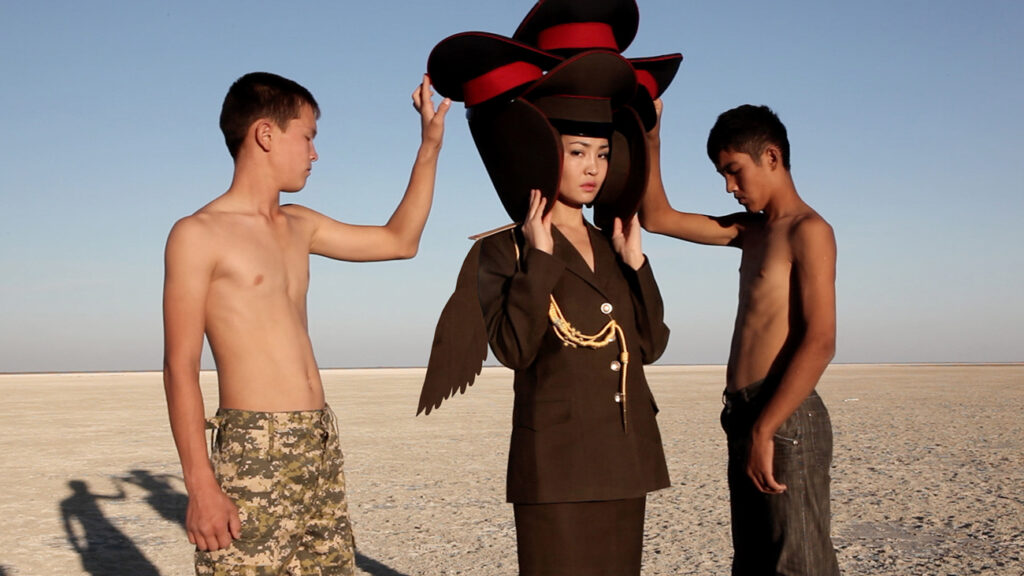
First, a young Kazakh schoolgirl in a black dress with a starched collar, her hair tousled by the wind of the Aral Sea, clutches a large Russian book tightly to her chest as she stands before a lonely school building in the middle of nowhere. Then, a camel speaks: “Give me back the sea!” “No!” cries a woman, her face hidden beneath a military hat. She stands before an abandoned edifice, her head wrapped in fur, her body strangely adorned with eggs. [caption id="attachment_36257" align="aligncenter" width="900"] Image: Almagul Menlibayeva[/caption] This series of surreal images is from the video Transoxiana Dream, by one of Central Asia’s pioneering contemporary artists, Almagul Menlibayeva. The Times of Central Asia attended her major solo show, I Understand Everything, curated by Thai curator Gritiya Gaweewong, a powerful exploration of memory, trauma, and identity, which provides the “treble clef” for the opening of the Almaty Museum of Arts. The show brings together works spanning decades, from Menlibayeva’s early paintings and collages in the 1980s, to her recent internationally recognized video and photography works. Through a variety of mediums, she charts the collapse of the Soviet Union, the ecological devastation of Kazakhstan, and suppressed cultural memory. [caption id="attachment_36258" align="aligncenter" width="2560"] Almagul Menlibayeva, People Talking against a Blue Background, 1988; image: Almaty Museum of Arts[/caption] As always in her practice, the feminine and feminist narratives are at the forefront. Menlibayeva’s women are at times bound with nature or with military rule, alternately merciful or merciless. Her works tackle ecological concerns, tying them directly to the destruction of patriarchy. “For us, opening our program with Menlibayeva’s show was highly significant,” says Meruyert Kaliyeva, the museum’s artistic director. “She is a pioneering Central Asian artist who is known internationally but at the same time has always dealt with topics and themes that are important locally.” A New Museum in Almaty The inauguration of the Almaty Museum of Arts represents a decisive step in shaping Kazakhstan’s creative future. As the country’s first large-scale contemporary art museum, it houses over 700 works collected across three decades, offering a panoramic view of modern Kazakh art while opening pathways to Central Asian and international dialogues. [caption id="attachment_36265" align="aligncenter" width="2560"] Almaty Museum of Arts; image: Alexey Poptsov[/caption] Its mission extends beyond exhibitions: the institution positions itself as a center for education, research, and collaboration, aiming to nurture local artists and connect them to global networks. For Kazakhstan, long without a dedicated contemporary art museum, this moment signals a new era, one in which cultural identity is asserted with confidence, and the arts are recognized as a vital force for national memory as well as international visibility. Kaliyeva emphasizes how essential it is that Kazakh artists now have a platform where voices once peripheral to national culture can take center stage. She also stresses the urgency of the moment: in a world reshaped by geopolitical fractures, climate crises, and cultural decolonization, this opening is necessary: “It’s a moment for Kazakhstan to assert its own narratives, to host...

5 months ago

Bridging Continents: Launching the VIMA Art Fair in Cyprus

In the art world, fairs often have a meteoric rise and fall in an oversaturated market of competing events. But every so often, one lands with a quiet, deliberate weight, embedding itself in the soil of its context and revitalizing it. VIMA Art Fair in Limassol, Cyprus, is one such project. Unfolding in a transformed wine warehouse near the sea, VIMA resisted the sterile polish of typical fair venues. Here, the Mediterranean wind mingled with the hum of languages, from Russian to Arabic, Greek, and Turkish, to English. The fair was founded by three Russians who have established themselves in Cyprus - Edgar Gadzhiev, Lara Kotreleva, and Nadezhda Zinovskaya - all of whom have brought a deep well of curatorial and institutional experience from Central Asia, Eurasia, and beyond. The trio have diverse backgrounds: Zinovskaya used to manage Ayarkut, an international art foundation operating across Kazakhstan and Mexico, together with Gadzhiev, who specialized in marketing in the cultural sector. Lara Kotreleva, meanwhile, has a museological background in Moscow and founded Sphere Space, an ongoing research initiative dedicated to architectural heritage in Limassol. To set up the fair, they teamed up with an expert committee comprising the Cypriots Alexandros Diogenous and Tasos Stylianou, co-founders of Limassol Art Walks, and Andre Zivanari, director of the Point Center for Contemporary Art in the capital, Nicosia. Of the 27 participants at the fair, there was an emphasis on the ten Cypriot galleries, commercial, not-for-profit, and artist-run spaces, part of Cyprus’s flourishing contemporary art scene, as well as on a number of Middle Eastern and Greek galleries. The Caucasus also made an appearance, with Georgia’s Window Project (Tbilisi) presenting a thoughtful mix of Georgian and international artists. Their mission centers on bridging generational narratives, with a particular emphasis on promoting emerging Georgian talents alongside an often-overlooked older generation of artists. At VIMA, the gallery highlighted the work of female artists, including Tamar Giorgadze, Sigrid Gloerfelt, Natela Grigalashvili, Tamara K.E., and Anie Toidze. Representing Azerbaijan, pop/off/art (Baku) featured a dynamic selection of artists primarily from the post-Soviet sphere as well as Eastern and Central Europe, showcasing works by Despina Flessa, Andrey Krasulin, and Shamil Shaaev. The mood was easygoing and fresh, but did not shy away from important socio-political themes that are unavoidable on the island, from the Greek-Turkish divide, to the arrival of a number of expats fleeing wars. Through a program of talks and a collateral exhibition, the fair leaned into this complexity and spelled out the necessity of communities coexisting, as well as articulating the desire to create new cultural infrastructure through public and private collaboration. The Times of Central Asia spoke with Edgar Gadzhiev, Lara Kotreleva, and Nadezhda Zinovskaya. [caption id="attachment_32435" align="aligncenter" width="1920"] Portrait of the co-founders of the VIMA Art Fair, Edgar Gadzhiev, Nadezhda Zinovskaya, and Lara Kotrelevaimage; image courtesy of the VIMA Art Fair[/caption] TCA: Why did you choose Cyprus as the location to launch this project? Gadzhiev: It wasn’t a random decision. We conducted long-term research, and it became...

8 months ago