ASHGABAT (TCA) — Russia seeks to maintain and strengthen its influence on former Soviet republics — including Turkmenistan and Azerbaijan — in the oil and gas sphere. This gives Ashgabat an opportunity to resume natural-gas export to Russia. We are republishing the following article on the issue, written by Rahim Rahimov:
Swiss firm Vitol and Azerbaijan’s state oil company SOCAR have been embroiled in a quarrel over the transportation of crude oil from Turkmenistan. While the respective companies and government officials from Azerbaijan, Russia and Turkmenistan have kept silent on the matter, media outlets tend to suggest that the dispute was sparked by commercial concerns (Report.az, February 9, 12, 13; EurAsia Daily, February 15). Nevertheless, the preceding and ongoing developments surrounding the oil transit disagreement suggest that the issue has a considerable political dimension.
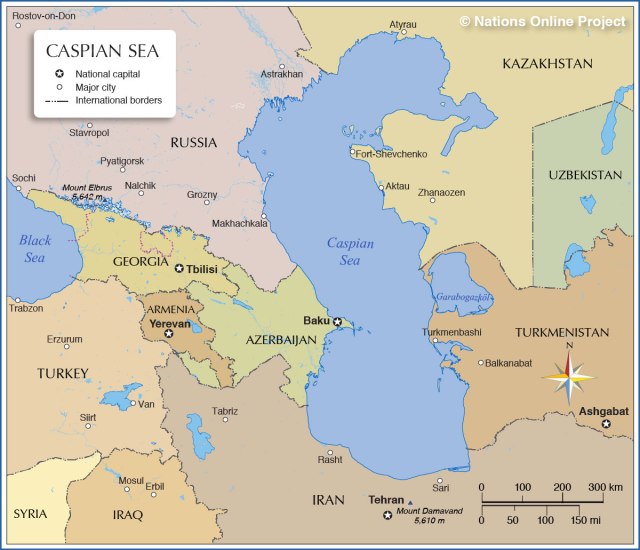
The Dragon Oil firm, which operates the Cheleken oilfield in Turkmenistan, granted an oil shipping contract to Vitol in January 2019 to transport locally produced petroleum by tankers to Russia’s Caspian Sea port of Makhachkala, from where it comes under control of the Russian pipeline monopoly Transneft. However, Vitol lacks the tankers to deliver the contract. Azerbaijan’s SOCAR, which has built the largest fleet of small- and medium-sized vessels in the Caspian, categorically refused to rent its tankers to Vitol. Subsequently, Turkmenistani oil exports have dropped during January–February 2019, hence leading to accretion of oil in the country’s storage sites. If the problem remains unsettled, Turkmenistan may need to slash its oil production levels (Hronikat.com, Regnum, February 15). Incidentally or accidentally, in early February, the European Bank for Reconstruction and Development also canceled a loan intended to support maritime transportation for Turkmenistan because the funds were found to be “servicing Dragon Oil offshore oil development” (Gundogar.org, February 4; Crudeaccountability.org February 7).
Oil produced in Turkmenistan had been shipped to international markets via the Russian route until 2016, when Ashgabat abandoned it amidst a natural gas price dispute with Moscow. At that point, Ashgabat granted the oil transport contract to SOCAR, which had, since July 2010, already been shipping some Turkmenistani crude by tankers to Azerbaijan across the Caspian Sea to fill the Baku–Tbilisi–Ceyhan (BTC) pipeline (Orient.tm, April 5, 2018; Oilgas.gov.tm, April 6, 2018; Vestifinance.ru, Meduza.io, January 4, 2016; Azernews.az, July 25, 2012).
In November 2018, SOCAR announced that it was supplying the high-quality Turkmenistani oil to its newly inaugurated Star refinery in Turkey (Sng.today, November 10, 2018). Azerbaijani President Ilham Aliyev paid a rare official visit to Ashgabat on November 22, 2018, to sign various documents on transportation and energy transit. However, no concrete statement nor document was released specifically concerning the transit of Turkmenistani oil or gas via Azerbaijan (President.az, Nezavisimaya Gazeta, November 22, 2018; Moscow-baku.ru, November 23, 2018).
Meanwhile, the president of Russia’s energy giant Gazprom, Alexei Miller, paid two visits to Turkmenistan in October and November 2018 to discuss gas issues (see EDM October 22, 2018; Gazprom.com, October 9, 2018 and November 28, 2018). This month (February 6), Russian Foreign Minister Sergei Lavrov also visited Ashgabat. He stated that the two sides discussed “oil and gas issues” and “cooperation in the Caspian Sea.” Despite some early characterizations of Lavrov’s Ashgabat visit as an exchange of “hackneyed,” “throwaway” lines and criticism for the trip’s alleged “lack of purpose” (EurasiaNet, February 11), these assessments proved premature and superficial. According to Lavrov, Turkmenistan’s President Gurbanguly Berdimuhamedov voiced satisfaction with the way the gas problems were being treated now by Moscow and Ashgabat “with a focus on far-reaching major agreements” (TASS, February 6).
Indeed, Russia and Turkmenistan have reportedly reached a preliminary consensus to resume Gazprom’s purchases of Turkmenistani gas, and the two sides are close to settling their gas dispute with the Stockholm arbitrage court through a reconciliation agreement (1prime.ru, November 12, 2018; Infoshos.ru, November 14, 2018; Turkmenportal.com, October 9, 2018). As noted above, Ashgabat had originally stopped oil shipments to Russia in response to Gazprom’s earlier cancelation of Turkmenistani gas purchases. So in this light, the transportation of Turkmenistani oil via Russia (through the intermediary Vitol) is likely be part of a wider bilateral agreement.
Another factor that further politicizes the Swiss-Azerbaijani row is that Vitol is reported to have chartered tankers from Russian companies under United States sanctions for oil delivery to Crimea and Syria. Vitol has reportedly also been in negotiations with the US-sanctioned Russian firm Trans-Flot JSC to rent two tankers that have been in operation for more than 45 years and fail to meet environmental standards (Report.az, February 9, 12, 13; News.ru, February 11, 12). Moreover, two top managers of Vitol are implicated in a US Federal Bureau of Investigation (FBI) probe regarding a bribery case involving Brazil’s oil company Petrobas (Rambler.ru, News.ru, February 11, 14).
Finally, the Vitol-SOCAR story is developing against the background of the recent signing of the treaty on the Legal Status of the Caspian Sea, in August 2018. The five-party (Azerbaijan, Russia, Kazakhstan, Turkmenistan and Iran) agreement initially gave rise to some cautious optimism about the possibility of finally realizing the long-proposed Trans-Caspian gas pipeline and underwater cable projects as well as settlement of Azerbaijan and Turkmenistan’s dispute over important offshore oil fields. Gazprom’s sudden intended resumption of Turkmenistani gas purchases and Ashgabat’s redirection of its oil exports via Russia are thus likely a signal that Moscow is still quite sensitive about the prospects of the aforementioned trans-Caspian projects (Milli-firka.org, October 11, 2018; Hronikat.com, October 25, 2018).
Interestingly, Russian oil has also flowed through the BTC since 2014, and a new contract was signed on August 23, 2018, to supply Russian oil to SOCAR’s Star refinery in Turkey (see EDM May 30, 2014; Report.az, February 13, 2019). This fact raises a logical question as to why Russian oil is flowing via the BTC while Turkmenistani oil is being redirected away from the BTC to the Russian route. The answer is geopolitical. By doing this, Russia seeks a presence in Azerbaijan’s BTC pipeline, which is meant to bolster European energy security; whereas, by purchasing oil from Turkmenistan, Russia seeks to similarly maintain its influence over other energy sources for Europe. Thus, Moscow gains further leverage over Turkmenistan and Azerbaijan—two former Soviet countries that have, to date, refrained from joining Russia-led regional integrationist structures such as the Eurasian Economic Union and the Collective Security Treaty Organization (CSTO).
This article was originally published by The Jamestown Foundation’s Eurasia Daily Monitor




 TCA
TCA