ASTANA (TCA) — The role of the Russian language has been very strong in Kazakhstan since the Soviet era, but the most recent policies pursued by Astana are gradually changing the situation, which is fraught with consequences. We are republishing this article on the issue, written by Farkhad Sharip:
In mid-October, the nationalist-leaning Qazaquni.kz website, run by the Ak Zhol (Democratic Party) of Kazakhstan, published an appeal to Russian-speaking compatriots, calling on them to learn Kazakh. The article stresses that “it is not obligatory for Kazakhs to know Russian,” and therefore, now Kazakhs are just as likely to know Russian as Russians know Kazakh (Qazaquni.kz, October 19).
Ruslan Tusupbekov, the author of the appeal, refers to Article 7 of the Constitution of the Republic of Kazakhstan, which defines Kazakh as the state language of Kazakhstan while granting an official status to Russian. But in fact, the only language that is widely used in all state institutions and at government meetings is Russian. Over the last several years, Kazakh nationalist organizations have insistently demanded the removal of Article 7, Point 2 of the Constitution, which recognizes Russian as an official language. According to these groups, that constitutional point ends up hampering the use of Kazakh in all spheres of public life (Tilalemi.kz, June 1, 2017).
At a cabinet meeting last February, a week after he endorsed the new version of a Latin-based alphabet for the Kazakh language (see Commentaries, March 5, 2018), President Nursultan Nazarbayev instructed government members and parliamentary deputies to conduct all official meetings and sessions exclusively in Kazakh. At the same time, however, he added that the rights of state employees to use Russian should be respected (Altyn-orda.kz, March 3).
This ambiguity in promoting Kazakh has left many guessing about whether the government genuinely intends to prioritize the state language. Mukhtar Taizhan, a well-known public activist, believes that as long as top ethnic-Kazakh government officials who do not speak their mother tongue remain in power, nothing will change (Qazaquni.kz, October 25).
The rapidly changing demographic situation in Kazakhstan—with a natural growth in the Kazakh-speaking population complemented by the continuing emigration of ethnic Russians—is creating an increasingly favorable social climate for extending the scope of the state language. Yet, on the other hand, this process is also likely to have a significantly negative impact on the economic growth of Kazakhstan for the foreseeable future due to the increased outflow of technically trained industrial workers, who tend to come from the Russian minority. The problem stems from the Soviet period, when an unwritten rule-set crystalized a division of labor among the republic’s various ethnicities. Kazakhs traditionally lived in rural areas, and their main economic activities revolved around cattle breeding. But after the collapse of the Soviet Union and independence, they started moving from economically run-down villages to industrial cities, though largely without having ever acquired any technical background—heretofore the domain mainly of ethnic Russians.
Amidst this internal migration, Kazakhstan has continued to experience a serious outflow of its Russian minority, which numbered over 6.2 million (38 percent of the overall population) in 1989 (Demoscope.ru, accessed November 1), but had fallen to about 3.7 million (21 percent) by 2016 (see EDM, February 2, 2016). Two thirds of the remaining Russian community expressed wishes to leave, according to polling conducted in 2015. However, the actual emigration figures have been relatively steady, at about 20,000 per year. But of those who do say they wish to leave, approximately half attribute this to Kazakhstan’s language policies—only 2 percent of Kazakhstani Russians speak Kazakh fluently, while 33 percent claim they do not know even one word of it. Another quarter of ethnic Russians looking to emigrate say they want to escape what they see as worsening inter-ethnic relations (see Commentaries, March 17, 2015). According to Russian journalist Irina Jorbanadze, ethnic-Russian emigration has been ramping up in recent years due to rising nationalism in Kazakhstan fueled by mistrust toward ethnic Russians after the annexation of Ukrainian Crimea by Moscow (Kursiv.kz, September 21).
Earlier this year, the Statistics Committee of Kazakhstan announced that in the first half of 2018, as compared to the same period of 2017, the number of emigrants from the country increased by 14 percent. And crucially, in 2017, qualified technical workers made up 54 percent of the outgoing population—a 17 percent increase over 2015 (Central Asia Monitor, February 20).
Mindful of potentially dangerous social and economic consequences of the ongoing depopulation of the predominantly Russian-populated northern parts of the country, in 2015 the government launched a resettlement program, encouraging inhabitants from southern Kazakhstan to move north. According to Madina Abylkassymova, the minister of labor and social protection, this year about 3,000 settlers from South Kazakhstan province will be provided housing in rural localities of North Kazakhstan province. However, only 1,424 of them have been offered jobs so far. The government plans to channel $40 million between 2019 and 2021 to implement this resettlement program (Sputniknews.kz, October 30).
The Russian language continues to retain its strong position in Kazakhstan and remains in the school curriculum as an obligatory subject. Moreover, it is part of the authorities’ widely publicized trilingual policy aimed at prioritizing learning Kazakh, English and Russian. Nevertheless, the process of de-russification is slowly but surely gaining ground in the country. Recently, in East Kazakhstan province, the name of Lenin Street, in the city of Semipalatinsk (generally identified as Semey in Kazakh-language media), was changed to Mangilik Yel (the Everlasting Country). Moreover, the town of Zyryanovsk and the district of the same name were renamed Altay and Altay district, respectively (Russianskz.info, October 10).
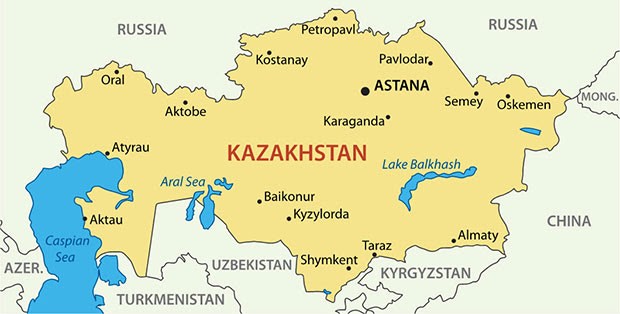
With the tacit endorsement of the Kremlin, Russian nationalists have in the past voiced their claims to five majority-Russian-speaking northern provinces of Kazakhstan (see EDM, February 27, 2014; October 21, 2014; December 16, 2014). But as the Russian language gradually loses its hitherto unchallenged place to Kazakh and English, Astana is likely to face mounting political pressure from Moscow.
This article was originally published by The Jamestown Foundation’s Eurasia Daily Monitor




 TCA
TCA