• KGS/USD = 0.01144 0%
  • KZT/USD = 0.00196 -0%
  • TJS/USD = 0.10899 -0%
  • UZS/USD = 0.00008 -0%
  • TMT/USD = 0.28490 0%
  • KGS/USD = 0.01144 0%
  • KZT/USD = 0.00196 -0%
  • TJS/USD = 0.10899 -0%
  • UZS/USD = 0.00008 -0%
  • TMT/USD = 0.28490 0%
  • KGS/USD = 0.01144 0%
  • KZT/USD = 0.00196 -0%
  • TJS/USD = 0.10899 -0%
  • UZS/USD = 0.00008 -0%
  • TMT/USD = 0.28490 0%
  • KGS/USD = 0.01144 0%
  • KZT/USD = 0.00196 -0%
  • TJS/USD = 0.10899 -0%
  • UZS/USD = 0.00008 -0%
  • TMT/USD = 0.28490 0%
  • KGS/USD = 0.01144 0%
  • KZT/USD = 0.00196 -0%
  • TJS/USD = 0.10899 -0%
  • UZS/USD = 0.00008 -0%
  • TMT/USD = 0.28490 0%
  • KGS/USD = 0.01144 0%
  • KZT/USD = 0.00196 -0%
  • TJS/USD = 0.10899 -0%
  • UZS/USD = 0.00008 -0%
  • TMT/USD = 0.28490 0%
  • KGS/USD = 0.01144 0%
  • KZT/USD = 0.00196 -0%
  • TJS/USD = 0.10899 -0%
  • UZS/USD = 0.00008 -0%
  • TMT/USD = 0.28490 0%
  • KGS/USD = 0.01144 0%
  • KZT/USD = 0.00196 -0%
  • TJS/USD = 0.10899 -0%
  • UZS/USD = 0.00008 -0%
  • TMT/USD = 0.28490 0%
08 December 2025

Kyrgyzstan urges Russian businesses to invest in five economic sectors

BISHKEK (TCA) — Founders and top managers of more than two hundred leading enterprises of Kyrgyzstan and Russia discussed ways to expand cooperation within the Eurasian Economic Union (EEU). On September 14, a Kyrgyz-Russian business forum was held at the Ala-Archa state residence near the Kyrgyz capital Bishkek.

Two contracts were signed at B2B meetings. The Kyrgyz-Russian Development Fund and the Russian Export-Import Bank signed a contract on concessional lending for the supply of Russian equipment to a Kyrgyz state-owned company, and the Imperial Group of Companies, Kyrgyzstan’s footwear manufacturer, and Russian Leather JSC signed a contract for the supply of raw materials.

Five promising sectors

Kyrgyz Deputy Economy Minister Eldar Abakirov told the guests about five economic sectors profitable to invest in, as well as measures taken by the Kyrgyz authorities to create favorable conditions for doing business and improve the investment climate in the country.

Abakirov urged to consider the possibility of investing in the garment industry, processing of agricultural products, tourism, information technologies, and medicine. According to experts, these sectors can give high growth, and invested funds could be paid off in three-five years, he said.

Large investors can conclude investment agreements with the Kyrgyz Government and negotiate special conditions as part of the agreements. The country also introduced a stabilization regime under which investors have the right to choose the most favorable way to pay taxes including VAT for ten years. If taxes are raised, the investors will be able to use the tax rates fixed in their contracts.

The primary Government’s task is to ensure the private property rights and protect businesses from unreasonable interference of state bodies, Abakirov concluded.

Trade relations

The adaptation period after Kyrgyzstan’s entry to the Eurasian Economic Union has been passing without significant shocks, and this is the merit of both the state agencies and the business, Charge d’Affaires of Russia in Kyrgyzstan Vadim Chekmazov said.

Russia is trying to maintain its role of a strategic partner and ally, helping to smoothly overcome the transition period when the markets of the two countries unite. The Russian-Kyrgyz Development Fund has already allocated hundreds of millions of dollars to entrepreneurs in loans aimed at developing the food industry, transport logistics, agro-industrial complex and construction. As a result, production and exports are growing in Kyrgyzstan.

Exports of Kyrgyz goods to Russia increased by 41% over the first half of 2018 and by 47% in 2017.

In 2017, trade between Kyrgyzstan and Russia amounted to $1.5 billion and increased by 12.4% compared to 2016, of which Kyrgyz exports were $265 million, and imports — $1.3 billion. Kyrgyzstan exports clothing, machinery, agricultural raw materials, and glass to Russia, and imports oil products, ferrous and non-ferrous metals, consumer goods, timber, cardboard, chemical products, perfumes and cosmetics, plastics, agricultural products, and household appliances.

At the same time, imports of goods from Russia are growing more slowly. Over the first six months of 2018, it has grown by 10%, and in 2017 — by 34%. This is encouraging and shows that the economy of Kyrgyzstan is developing. This trend contributes to the improvement of the trade balance between the two states, Chekmazov said.

It is necessary to create new enterprises to provide products not only to the Kyrgyz market but also to the EEU countries, he added.

According to the Association of Russian manufacturers of specialized equipment, agricultural machinery manufacturers increased their supplies to Kyrgyzstan up to 111 million rubles, which is 3.5-fold compared to the same period last year. There are all conditions for substantially increasing the exports in the future, they said.

According to representatives of Russian businesses, the currency risks have a negative impact on trade relations between the two countries and make some projects unpredictable.

New markets

Many Russian investors are thinking about opening new businesses in Kyrgyzstan, because they are attracted by new markets.

Russian Leather Enterprise signed a contract with a Kyrgyz company that produces footwear. The head of the Russian company said that he had been searching for partners in Kyrgyzstan for a long time.

“We had no fears about entering the Kyrgyz market, and there is no shortage of labor in the light industry, so we are very interested in cooperation,” he told Sputnik news agency.

The delegation of the Sverdlovsk region of Russia met with representatives the Ministry of Transport and Roads of Kyrgyzstan and offered to use materials of Russian manufacturers for laying roads, noting that crushed stone and mastic asphalt concrete is cheaper than that currently used in Kyrgyzstan.

The head of a Russian company engaged in supplies of wool processing equipment offered to open a new business in Kyrgyzstan. There are many sheep in the country, but no large wool processing workshops, except for small private companies. Farmers sell mostly untreated wool, and this is unprofitable.

The Russian company has the necessary equipment that allows producing goods from sheep wool, including traditionally national ones, yurt felt, koshmas and kiyiz (felt carpets).

It is important to restore the merino breed, since their wool is highly valued.

In the Soviet era, Kyrgyzstan was famous for its merino breed. The development of sheep breeding was put on a scientific basis, and new, highly productive sheep breeds, including fine wool ones, were bred. In 1991 (before Kyrgyzstan’s independence), there were over 10 million sheep in the country, and 92% of them were fine-fleeced. After the poorly conducted economic reforms, the merino sheep breed became unclaimed.

The merino breeding has only recently begun to recover, but the lack of financing and marketing services for the wool sale adversely affect its development. To interest farmers in the merino breeding, it is necessary to raise the cost of wool and provide with other incentives.

According to the forum participants, foreign businesspeople do not have enough information about the economy of Kyrgyzstan. Foreign investors may be attracted by cheap labor force in Kyrgyzstan, as it makes doing business more profitable.

Russian-Kyrgyz Development Fund

If joint projects are created in the priority sectors for the Russian-Kyrgyz Development Fund, it will provide concessional financing from 4% per annum in US dollars, the Fund Chairman Erkin Asrandiyev said at the forum.

The Fund has approved 1,530 projects worth $28 million in 2018. Of these, more than 55% of loans were allocated to entrepreneurs in the production and agro-industrial sector.

Since the beginning of 2018, 549 small and medium enterprises have been financed in the regions, and 349 of them are engaged in the agricultural sector. The regions’ financing has increased by 12% this year in such key areas as agriculture, processing of agricultural products and products of animal origin, and intensive gardening. The Fund is implementing three sectoral programs on the development of fine-fleeced sheep breeding, intensive gardening and fisheries.

The Fund is using a mechanism to stimulate entrepreneurs. If projects are successfully implemented and entrepreneurs timely repay their loans, the Fund returns half of the paid interest at the end of each year.

Uzbekistan’s president rebrands his administration, but keeps stalwarts

TASHKENT (TCA) — Along with political and economic reforms, Uzbekistan’s President has made some changes in his administration in an effort to redistribute executive powers and make the country’s governance more effective. We are republishing this article on the issue, written by Umida Hashimova, originally published by The Jamestown Foundation’s Eurasia Daily Monitor:

The president of Uzbekistan, Shavkat Mirziyoyev, issued a decree, on August 27, changing the official name of the 27-year-old “Presidential Executive Office” (Devon in Uzbek and Apparat Russian) to the “Presidential Administration.” Along with the new name, the Administration saw some personnel changes and possibly limitation of powers of certain advisors. Overall, these reforms are largely superficial as the Presidential Administration inherited not only the same departments and functions from the Executive Office, but maintains all the major stalwarts of the previous government structure.

President Mirziyoyev’s office was not the only government body to be renamed. The heads of nine departments within the administration will now be called “Presidential Advisors,” dropping the word “State,” which had heretofore preceded their titles. Presidential advisors will reportedly now monitor and control the activities of the eight deputy prime ministers and work in concert with them (Gazeta.uz, August 27). A government official commented that, under the new arrangement, “the personal responsibility of presidential advisors will increase” (Gazeta.uz, August 27).

Yet, in actuality, the organization might mean advisors will have to share their authority with relevant ministries and, more importantly, their power will be limited to the deputy prime minister level. Under Mirziyoyev’s predecessor, Islam Karimov, presidential state advisors had long arms of power, while ministries and state enterprises were merely bodies subservient to the advisors (BBC News—Uzbek service, August 28). The reorganization may narrow the distance between ministers and the president, thus allowing the government greater access to the head of state. This is all logical in the context of Mirziyoyev’s attempts to decentralize governmental powers while increasing the accountability of various government bodies.

The presidential decree also precipitated some reshuffles of his team. Notably, Khayriddin Sultonov stepped down from the administration’s Mass Media, Cultural and Educational Affairs Department—a post he had held since 2000 (Facebook.com, August 27). Sultonov, however, remains in the administration as President Mirziyoyev’s speech writer. One of two longest serving officials remaining from the late Karimov’s Executive Office, Sultonov had joined the presidential administration in 1993, at the age of 37, where he led the analytical center. As of 2000, his tight supervision of Uzbekistan’s media outlets earned him the title of the country’s “chief censor” (Ozodlik, August 22, 2017).

On the other hand, Mirziyoyev’s Administration will continue to be headed by the little-known Zaynilobiddin Nizomiddinov. The exact date he had joined Mirziyoyev’s team is not clear. But he and his three deputies are all young men in their 30s. The head of the Administration is a powerful position: the law gives Nizomiddinov and his deputies control over information flows to the president by way of compiling and analyzing anything addressed to the head of state (Lex.uz, March 1, 2017). A peculiar function of the head of the Administration is monitoring and informing the president on the ongoing reforms in the country (thus indicative of the high priority Mirziyoyev places on internal reforms) as well as Uzbekistan’s standing in foreign relations and foreign economic affairs.

Zelimkhan Khaydarov, the second-longest serving official along with Khayriddin Sultonov, used to hold Nizomiddinov’s position in Karimov’s Office, beginning in 1993. Khaydarov unlike Sultonov will now hold an advisory role by heading the Administration’s Financial and Economic Department. Another official, Umar Ismailov, who oversaw the Staffing Department in Karimov’s Executive Office, will maintain the same position in Mirziyoyev’s Administration (Facebook.com, August 27).

The former head of the extremely powerful National Security Service (NSS), Rustam Inoyatov, also remains in the Administration under the same position he received in January 2018, after he stepped down from leading the NSS for 23 years (see EDM, February 8). At the time of Inoyatov’s new appointment, the division he was charged with was named the Political and Legal Affairs Department. However, as of April, this body has been renamed the Department for Legal Support for Reforms and Coordination of Law Enforcement Activities; and it has received a number of new functions (Lex.uz, March 1, 2017). The department’s tasks, among others, include identifying obstacles to the efficient functioning of the government or to its modernization, providing legal support to undergoing reforms in the country, as well as adapting foreign experience on better governance. These responsibilities in many ways represent the antithesis to Inoyatov’s previous professional functions as head of the NSS—raising concerns about the rationale of his appointment to this advisory role.

Any change in the presidential administration in Uzbekistan is significant given that the administration advisors are the closest officials to the president. In the previous regime, advisors were the most powerful state officials in the area they were responsible for; in effect, they ran the country by heavily influencing the president. With the recent administrative changes, Mirziyoyev is attempting to limit the reach of his advisors by transferring some of their power to the ministries and enhancing cooperation between his Administration and the Cabinet. Yet, at the same time, long-serving officials such as Khaydarov, Sultonov and Inoyatov—who matured under Karimov and were his heavy influencers—continue to linger in the new governing structures under President Mirziyoyev. And this raises the question as to whether they are being lined up for a phased honorary departure from the ruling administration.

Weekly Digest of Central Asia

BISHKEK (TCA) — The Publisher’s note: Throughout the 19th and 20th centuries, Central Asia was the scene of intense geopolitical struggle and the Great Game between the British and Russian Empires, and later between the Soviet Union and the West, over Afghanistan and neighboring territories. Into the 21st century, Central Asia has become the area of a renewed geopolitical interest, dubbed the New Great Game, largely based on the region’s hydrocarbon and mineral wealth. On top of that, the region now is perhaps the most important node in the implementation of China’s One Belt, One Road initiative through which Beijing aims to get direct access to Western markets. Every week thousands of news appears in the world’s printed and online media and many of them may escape the attention of busy readers. At The Times of Central Asia, we strongly believe that more information can better contribute to peaceful development and better knowledge of this unique region. So we are presenting this Weekly Digest which compiles what other media have reported on Central Asia over the past week.

KAZAKHSTAN

Kazakhstan and the Xinjiang Problem

Ethnic Kazakhs in China have opened the ‘window for the world’ to hear what is happening in Xinjiang, but official Kazakhstan remains quiet on this sensitive issue

Sept 11 — “Ethnic Kazakhs have served as a critical window for the world into the political re-education camps, into which Human Rights Watch claimed in a recent report an estimated 1 million people have been sent by Chinese authorities in Xinjiang. At the same time, Kazakhstan — like much of the international community — has hesitated to take a public stand against Chinese policies.” READ MORE: https://thediplomat.com/2018/09/kazakhstan-and-the-xinjiang-problem/

Feature: Kazakhstan’s green energy future

Progress may be slow, but Kazakhstan is on the right track in its pursuit of renewable energy

Sept 12 — “As of this year, Kazakhstan has moved to a system of procuring electricity from renewable energy sources at international auctions. The initiative is aimed at bringing down the cost of electricity from renewable sources throughout the country. It is hoped that this shift from fixed rate purchase to auctions will reduce costs as well as attracting foreign investment, forming the latest step in Kazakhstan’s gradual, but ambitious, direction toward meeting 50% of its energy needs by 2050 from renewable sources.” READ MORE: https://www.energydigital.com/renewable-energy/feature-kazakhstans-green-energy-future

Kazakhstan’s National Fund resources intended for long-term economic growth, says economist

The National Fund was created in 2000 to serve as a cushion to ensure that Kazakhstan’s economy remains stable in the face of price swings in oil, gas and metals

Sept 12 — “Kassymkhan Kapparov, a graduate of Al-Farabi Kazakh and Yokohama national universities, studies macroeconomic trends as director and founder of the private institution Bureau for Economic Research in Kazakhstan. As a 2016 research fellow at George Washington University’s Elliott School of International Affairs’ Central Asia Programme, he examined his country’s public debt. In an interview with The Astana Times, he identifies opportunities and risks for Kazakhstan in the current economic climate.” READ MORE: https://astanatimes.com/2018/09/kazakhstans-national-fund-resources-intended-for-long-term-economic-growth-says-economist/

Kazakhstan plans to buy $1.2 bln of Tsesnabank loans

The government of Kazakhstan continues to inject public money into the country’s troubled, private banking sector

Sept 14 — “Kazakh authorities said on Friday they would buy 450 billion tenge ($1.2 billion) of agricultural sector loans from Tsesnabank in order to boost its financial strength, while the country’s No.2 lender reshuffled its management.” READ MORE: https://www.reuters.com/article/tsesnabank-loans/update-3-kazakhstan-plans-to-buy-12-bln-of-tsesnabank-loans-idUSL5N1W00KZ

KYRGYZSTAN

Exclusive: Kyrgyzstan wants transparency to curb corruption

The Kyrgyz government hopes that secure online services will help reduce corruption in the country, and a “Digital Kyrgyzstan” will “minimize corruption”, according to the Taza Koom strategy

Sept 11 — “In a nationwide poll of Kyrgyzstan in February, an overwhelming 95% said that corruption is a big problem for the central Asia country. Despite this, the Kyrgyz people are optimistic. 66% in the same survey believed that the country is headed in the right direction. The country last year launched a national vision called Taza Koom, meaning ‘transparent society’, to use technology to transform the economy into a “digital silk road” hub and build trust with citizens.” READ MORE: https://govinsider.asia/connected-gov/exclusive-kyrgyzstan-wants-transparency-to-curb-corruption/

From Kyrgyzstan to the Stars: The Kyrgyz Space Program

A group of teenage girls want to make Kyrgyzstan the next country to launch a microsatellite

Sept 11 — “In July, Bhutan launched its first satellite from the International Space Station, joining a growing list of small countries that have successfully sent CubeSats – microsatellites only 10x10x10 centimeters large – into orbit. Bhutan follows Ghana, Mongolia, Estonia, Bangladesh, and Latvia in having sent such a satellite into space — and it won’t be the last country to do so.” READ MORE: https://thediplomat.com/2018/09/from-kyrgyzstan-to-the-stars-the-kyrgyz-space-program/

Are Kyrgyzstan’s glaciers under threat? This ecologist think so

Kyrgyz ecologist Kaliya Moldogaziyeva tells about the environmental threat to the area from the mining operations at Kumtor gold mine, the new amendments to Kyrgyzstan’s Water Code, and the future of the region’s water resources

Sept 12 — “Kumtor is an open-cast gold mining site in Kyrgyzstan’s Central Tian Shan mountain system, situated in the mountains’ central permafrost massif which reaches heights of 3800-4400 metres above sea level. Commercial exploitation at Kumtor began in 1997. The site is 100% owned by the Canadian gold-mining company Centerra Gold, which manages it through its subsidiaries, the Kumtor Gold Company (KGK) and the Kumtor Operating Company (KOK). Kyrgyzstan, in its turn holds roughly 33% of shares in the company through its OJSC Kyrgyzaltyn Joint Stock Company.” READ MORE: https://www.opendemocracy.net/od-russia/editors-of-opendemocracy-russia/are-kyrgyzstans-glaciers-under-threat

Kyrgyzstan and Turkey: There’s no getting past Gulen

In the issue relating to a network of Turkish schools in Kyrgyzstan, Bishkek has found itself between a rock and a hard place with regard to its relations with Ankara

Sept 12 — “A disagreement over a network of Kyrgyzstani schools that Turkey views as havens for state sabotage and even terrorism is fast turning into a game of chicken. Judging by Bishkek’s latest salvo, the smaller country is reluctant to roll over, even in the face of increasingly strident demands from Ankara. On September 11 Kyrgyzstan’s Foreign Ministry summoned Turkey’s ambassador and told him to “only reflect objective information” in his public speeches, after the diplomat had referenced the schools in a press conference the previous day.” READ MORE: https://timesca.com/index.php/news/20243-kyrgyzstan-and-turkey-there-s-no-getting-past-gulen

TAJIKISTAN

Tajik mosques repair Lenin statue

Some in Tajikistan believe that if it had not been for Lenin, all Central Asians would be illiterate like in Afghanistan, and that it is better to acknowledge the country’s Soviet past and its achievements

Sept 7 — “The media in Central Asia has been intrigued by the story that a group of Muslim clerics in southern Tajikistan have spent their congregations’ weekly donations on fixing a statue of Lenin, the leader of the Bolshevik Revolution that imposed 70 years of atheism on their country.” READ MORE: https://www.bbc.com/news/blogs-news-from-elsewhere-45446494

Tajikistan’s Islamist shadow

Tajikistan recently witnessed the first-ever terrorist attack claimed by the Islamic State in the country and entire Central Asia region. And it remains to be seen whether such incidents will ever occur in the future

Sept 10 — “A sedan struck seven foreign cyclists riding through Tajikistan’s Danghara district on July 29. Despite initial confused reports that it was nothing more than a car accident, grainy footage quickly emerged of the vehicle’s driver deliberately swerving to hit the bikers. A group of men then “exited the car and stabbed the cyclists with knives,” according to the United States Embassy in Dushanbe. Within minutes, four cyclists—two American, one Dutch and one Swiss—were dead, with several more injured.” READ MORE: https://timesca.com/index.php/news/20234-tajikistan-s-islamist-shadow

Tajikistan: Is rumored amnesty for real or a bluff?

Some sources say that dozens of political prisoners are set to be released in Tajikistan

Sept 11 — “It is a deeply confusing time for anybody trying to understand what Tajikistan’s official line on the opposition is these days. One moment, there is talk of mass amnesties of political prisoners. The next, state officials are assaulting exiled activists in European capitals.” READ MORE: https://www.eurasianet.org/tajikistan-is-rumored-amnesty-for-real-or-a-bluff

TURKMENISTAN

Turkmenistan fires starting pistol on desert auto rally

Turkmenistan has taken one more step in the promotion of the country as potential stage for international sports events

Sept 11 — “Turkmenistan’s authoritarian leader on Tuesday launched the isolated country’s first international auto rally running through the Karakum desert and tracing a spur of the Old Silk Road. The five-stage race involving more than 80 teams representing 20 countries is set to wind up on Saturday and will serve as a qualifying tournament for a longer, two-week rally through three African countries next year.” READ MORE: https://www.france24.com/en/20180911-turkmenistan-fires-starting-pistol-desert-auto-rally

Turkmenistan: Undernourished and overpowered

In its ‘Akhal-Teke: A Turkmenistan Bulletin’, Eurasianet reviews the main news and events in the Central Asian country for the previous week

Sept 11 — “Loyalist Ashgabat-based outlet Arzuw News this week uploaded an interview with UNICEF’s Turkmenistan representative Shaheen Nilofer that was anodyne but for the unwitting insights it offered into the deep-lying problems affecting the country. As Nilofer explained, UNICEF has been involved in supporting government-financed flour-fortification efforts to combat anemia among adolescents and young people. And that is not all.” READ MORE: https://www.eurasianet.org/turkmenistan-undernourished-and-overpowered

Caspian Convention signing and the implications for Trans-Caspian gas pipeline

Even after the signing of the Caspian Sea’s Legal Status Convention, prospects of Turkmenistan being someday able to export its natural gas via the proposed Trans-Caspian gas pipeline remain vague and problematic

Sept 13 — “The governments of Azerbaijan, Kazakhstan, Russia, Iran and Turkmenistan gathered in the Kazakhstani port city of Aktau, on August 12, and signed the Convention on the Caspian Sea’s Legal Status. Among other important points, Article 14 of the Convention recognizes the parties’ right to lay underwater pipelines or cables in the Caspian, subject only to the agreement of the countries through whose maritime sector the pipeline or cable traverses (Kremlin.ru, August 12).” READ MORE: https://timesca.com/index.php/news/26-opinion-head/20248-caspian-convention-signing-and-the-implications-for-trans-caspian-gas-pipeline

UZBEKISTAN

Uzbekistan: A Gangsta’s Paradise?

The names of infamous figures linked to criminal activities are appearing more frequently in Uzbekistan since Mirziyoev became president than they did under late President Karimov

Sept. 8 — “Many things have changed in Uzbekistan in the two years since longtime President Islam Karimov died and Shavkat Mirziyoev came to power. Many of those changes appear to have been positive. But there have also been some arguably negative developments, including the attitude of Uzbek authorities toward suspected or known underworld figures.” READ MORE: https://www.rferl.org/a/uzbekistan-a-gangsta-s-paradise-/29478612.html

Uzbek Imam Fired After ‘Deviating From The Script’

Religion in Uzbekistan remains strictly regulated by authorities, and the government continues to bar the wearing of the Islamic hijab in schools and offices

Sept 10 — “An Uzbek imam is out of a job after he posted a video appeal to President Shavkat Mirziyoev asking him to allow more religious freedoms, including lifting the state’s ban on women’s Islamic head scarves and on men’s beards. Fazliddin Parpiev was serving as imam of Tashkent’s Omina mosque when he was relieved of his duties on September 8, just a day after he shared the 20-minute video on Facebook after having delivered Friday Prayers.” READ MORE: https://www.rferl.org/a/uzbek-imam-parpiev-fired-deviating-from-the-script-/29482370.html

New chapter in Uzbekistan opens opportunities for region

Central Asian experts on the implications of Uzbekistan’s ongoing reforms for the region

Sept 12 — “Since Shavkat Mirziyoyev came to power in 2016 after the death of Islam Karimov, Uzbekistan, the most populous country in Central Asia, has been witnessing significant changes both in domestic and foreign policy. The former Soviet republic has progressed significantly in the last two years following the 27 years of Karimov’s rule, affecting almost every sphere in the country of 34 million people.” READ MORE: https://astanatimes.com/2018/09/new-chapter-in-uzbekistan-opens-opportunities-for-region/

Uzbekistan’s forward-looking policies secure a bright future

Analyst believes that the proactive policies being taken on fintech and globalization today will position Uzbekistan light-years ahead on the world stage tomorrow

Sept 13 — “Uzbekistan is arguably best known for its dazzling ancient cities that are dotted along the Silk Road, the legendary trade route between China and the Mediterranean, and its great mountains and deserts.” READ MORE: http://www.atimes.com/uzbekistans-forward-looking-policies-secure-a-bright-future/

AFGHANISTAN

Afghanistan: Trade Offers A Glimmer Of Hope For Economic Growth – OpEd

Afghanistan has taken measures to revolutionize its trade turnover and doing business environment, with the first and foremost goal being to increase exports to 1 billion USD by the end of 2020

Sept 11 — “Afghanistan has suffered negative economic growth after the withdrawal of large portion of international coalition forces. Also, a new report from World Bank indicates more than 50 percent of the Afghan population is living under the poverty line. Moreover, based on statistics of Ministry of Economy population growth is faster than economic growth, which conveys an excessive poverty with its all outcomes for the future.” READ MORE: https://www.eurasiareview.com/11092018-afghanistan-trade-offers-a-glimmer-of-hope-for-economic-growth-oped/

Privatizing the U.S. effort in Afghanistan seemed a bad idea. Now it’s even worse.

Privatizing the U.S. effort in Afghanistan also seems likely to complicate what is already a fraught relationship with the Afghan government, a US analyst says

Sept 11 — “It’s been 17 years since 9/11, the pivotal event that precipitated the start of the U.S. war in Afghanistan. In recent weeks, there has been new talk of privatizing that war. As I and many others have written before, this was not a good idea when Erik Prince introduced it in May 2017, or when he and Stephen A. Feinberg (owner of DynCorp International) reportedly met with President Trump and his top advisers in July of that year.” READ MORE: https://www.washingtonpost.com/news/monkey-cage/wp/2018/09/11/privatizing-the-u-s-effort-in-afghanistan-seemed-a-bad-idea-now-its-even-worse/?noredirect=on&utm_term=.1c6ed8c41bf9

Playing Fields, Sports Clubs, Gyms Becoming Afghanistan’s Bloody New Battlegrounds

The recent Taliban attacks on sports facilities are part of a larger assault on civilian targets including schools, media outlets, and mosques

Sept 12 — “Sayed Ali Rezwan was lifting dumbbells when an explosion ripped through Kabul’s Maiwand sports club, where scores of young wrestlers were in the middle of a training session. The blast threw 23-year-old Rezwan against a wall. Wounded and covered in dust, he stumbled through the debris to help pull the bodies of the dead and wounded out of the burning gym. The floor was splattered with blood, and the wrestling ring was strewn with body parts.” READ MORE: https://www.rferl.org/a/playing-fields-sports-clubs-gyms-becoming-afghanistan-s-bloody-new-battlegrounds/29485880.html

Afghanistan: Peace Prospects at the Abyss

Professor of International and Public Affairs at Columbia University believes that after 17 years, the war in Afghanistan presents a credible threat of disaster for all parties involved—or a settlement that could end the fighting on terms ‘we can accept’

Sept 14 — “America’s war in Afghanistan will soon enter its 17th year. Most Americans tired of the war long ago, but its odd invisibility in American domestic politics has allowed it to carry on, mostly out of sight, with little real political pressure to change a stalemated status quo.” READ MORE: https://www.the-american-interest.com/2018/09/13/afghanistan-peace-prospects-at-the-abyss/

WORLD

Pakistan Pushes China to Realign Goals in Its Belt-and-Road Initiative

Pakistan has been the showcase for China’s Belt and Road Initiative to build and finance transport and other infrastructure across the globe, as Beijing experiences rising criticism and pushback on its program across a range of countries

Sept 12 — “Pakistan’s new government is pushing China to establish factories and poverty-alleviation initiatives in Pakistan instead of solely the big infrastructure programs that so far have dominated Beijing’s high-profile overseas investment program, Pakistani officials said after talks with Chinese officials.” READ MORE: https://www.wsj.com/articles/pakistan-pushes-china-to-realign-goals-in-its-belt-and-road-initiative-1536773665

It’s Not Too Late to Prevent a Russia-China Axis

Russia is deepening military cooperation with China as Moscow’s relations with the West have deteriorated

Sept 14 — “Chinese tanks splashed through the mud, while a few dozen helicopters flew in formation overhead in eastern Russia, and a young Chinese military recruit explained, “I have never experienced an overseas deployment of this scale.” The scene neatly summed up the much-written-about, enormous Russian military exercises that took place this week. Participants included 300,000 Russian and 3,200 Chinese soldiers. They deeply rattled the West.” READ MORE: https://www.theatlantic.com/international/archive/2018/09/china-russia-alliance-military-exercises/570202/

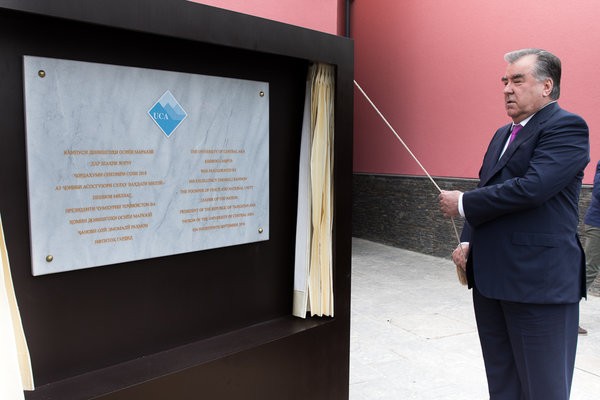
President Rahmon inaugurates first regional university in Tajikistan

DUSHANBE (TCA) — The first private regional university in Tajikistan was inaugurated by Tajik President Emomali Rahmon on 14 September 2018. The formal opening of the University of Central Asia’s Khorog campus is another historic milestone, and the second campus to go into operation since its Naryn campus was inaugurated in Kyrgyzstan in 2016.

The University of Central Asia (UCA) was founded in 2000 as a private, not for profit, secular university through an International Treaty signed by the Presidents of Tajikistan, Kyrgyzstan, and Kazakhstan, and His Highness the Aga Khan; ratified by the respective parliaments, and registered with the United Nations. The Presidents are the Patrons of the University, and His Highness is the Chancellor.

Addressing a gathering of 1000 guests, President Rahmon said that “the University of Central Asia in Khorog is opening a new page in our country’s education system… I am convinced that the operation of this newly established facility will benefit not only our country, but it will also strengthen the multifaceted cooperation between the countries of the region in the field of education.”

On behalf of UCA, Dr. Shamsh Kassim-Lakha, Chairman of the Board of Trustees, expressed deep appreciation to the President of Tajikistan for gracing the occasion, and for his foresight and commitment to higher education. He also offered special gratitude to His Highness the Aga Khan, “whose vision, continued stewardship, and attention to every aspect of this University have enabled us to witness this special day.”

UCA’s mission is to promote the social and economic development of Central Asia, particularly its mountain communities, by offering an internationally recognized standard of higher education, and enabling the peoples of the region to preserve their rich cultural heritage as assets for the future. The University brings with it the commitment and partnership of the broader Aga Khan Development Network.

The majors offered at UCA in Khorog are Economics and Earth and Environmental Sciences. At the Naryn campus it is Computer Science and Media and Communications. The campus in Tekeli, Kazakhstan, is expected to open by 2022, and will offer Business Management and Engineering Sciences.

The Mountain Societies Research Institute of UCA is also located at the Khorog campus to allow closer integration with the Department of Earth and Environmental Sciences. This Institute is also involved in developing the research capacity of the Faculty of Natural and Biological Sciences at Khorog State University.

Since 2006, the UCA’s School of Professional and Continuing Education (SPCE) has been responding to community needs with 12 learning centres in Tajikistan, Kyrgyzstan, and Kazakhstan, including six in Afghanistan. Over 12,000 learners participate in these courses each year, of which 53 percent are women. To date, over 120,000 have graduated from SPCE’s programmes.

The architectural design of the master plan of UCA was prepared by the award-winning Japanese architect Arata Isozaki. The buildings on the campus represent only its first phase, and were constructed mainly by small and medium size Tajik contractors to ensure maximum economic benefit for the local and regional economy. The investment of US $95 million in the Khorog campus was provided by the Aga Khan Development Network, supplemented by a soft loan from the Overseas Private Investment Corporation of the United States.

In the first phase of campus construction, UCA operations created more than 1,400 jobs in Tajikistan and Kyrgyzstan, with 90% being local residents. The University also created over 200 permanent new faculty and staff jobs in Naryn and Khorog.

In Khorog, UCA has paved roads to Dasht Village from the main town, a gravel road to Upper Dasht Village and an access road from the community of Khitjd. The University also installed streetlights in the area. To extend quality healthcare services to the Khorog community, the Aga Khan Development Network’s Khorog Medical Centre is also under development. In addition, two kindergartens and a training centre for early childhood educators have also been established.

Kyrgyzstan: Young leaders trained to contribute to community development

BISHKEK (TCA) — The International Foundation for Electoral Systems (IFES) in the Kyrgyz Republic, with the support of the United States Agency for International Development (USAID), completed the first Election Schools held in the country. During the month of August, a total of 140 youth aged between 18 and 28 participated in a series of activities designed to increase civic responsibility and community involvement among young citizens. The Election Schools were held in every oblast of the country, the US Embassy in Kyrgyzstan reported.

Continue reading