• KGS/USD = 0.01144 0%
  • KZT/USD = 0.00193 -0%
  • TJS/USD = 0.10876 0.55%
  • UZS/USD = 0.00008 0%
  • TMT/USD = 0.28490 0%
  • KGS/USD = 0.01144 0%
  • KZT/USD = 0.00193 -0%
  • TJS/USD = 0.10876 0.55%
  • UZS/USD = 0.00008 0%
  • TMT/USD = 0.28490 0%
  • KGS/USD = 0.01144 0%
  • KZT/USD = 0.00193 -0%
  • TJS/USD = 0.10876 0.55%
  • UZS/USD = 0.00008 0%
  • TMT/USD = 0.28490 0%
  • KGS/USD = 0.01144 0%
  • KZT/USD = 0.00193 -0%
  • TJS/USD = 0.10876 0.55%
  • UZS/USD = 0.00008 0%
  • TMT/USD = 0.28490 0%
  • KGS/USD = 0.01144 0%
  • KZT/USD = 0.00193 -0%
  • TJS/USD = 0.10876 0.55%
  • UZS/USD = 0.00008 0%
  • TMT/USD = 0.28490 0%
  • KGS/USD = 0.01144 0%
  • KZT/USD = 0.00193 -0%
  • TJS/USD = 0.10876 0.55%
  • UZS/USD = 0.00008 0%
  • TMT/USD = 0.28490 0%
  • KGS/USD = 0.01144 0%
  • KZT/USD = 0.00193 -0%
  • TJS/USD = 0.10876 0.55%
  • UZS/USD = 0.00008 0%
  • TMT/USD = 0.28490 0%
  • KGS/USD = 0.01144 0%
  • KZT/USD = 0.00193 -0%
  • TJS/USD = 0.10876 0.55%
  • UZS/USD = 0.00008 0%
  • TMT/USD = 0.28490 0%
11 December 2025

Afghanistan, US reject Russia-hosted peace talks scheduled for September

KABUL (TCA) — The United States and Afghanistan both say they will not attend Russia-hosted peace talks scheduled for next month, with Kabul asserting it prefers instead to hold direct talks with the Taliban, RFE/RL’s Radio Free Afghanistan reported.

Afghan Foreign Ministry spokesman Sibghatullah Ahmadi told RFE/RL on August 22 that the decision not to participate in the planned Moscow conference was made after consultations between President Ashraf Ghani and other officials — a move that could lead Moscow to call off its planned gathering of a dozen countries.

Without being specific, an unidentified official working with the Afghan Foreign Ministry was quoted as saying that the government in Kabul would “hold direct talks” with the Taliban without the direct involvement of foreign powers.

Meanwhile, a State Department spokesman confirmed earlier reports that the United States would not take part in the meeting scheduled for September 4, saying the talks were “unlikely to yield any progress toward” a peace settlement.

Russia says it has invited the Taliban and 12 countries, including Afghanistan and the United States, to the Moscow talks.

Taliban spokesman Zabihullah Mujahid confirmed that the militant group will send a delegation to Russia.

An unidentified Taliban commander was quoted as saying that the delegation will be led by Sher Mohammad Abbas Stanekzai, head of the Islamist group’s political office in Qatar’s capital, Doha.

Another commander said Taliban delegates also would be sent to other countries in the region — including Pakistan and China — “to take them into confidence and address their concerns.”

The U.S. decision not to attend the Moscow talks drew an angry response from Moscow.

The Russian Foreign Ministry said on August 22 that Washington’s “refusal to attend the Moscow meeting on Afghanistan shows Washington has no interest in launching a peace process in Afghanistan.”

The Russian Foreign Ministry said other countries invited to the talks include Pakistan, China, Iran, India, and the five former Soviet republics in Central Asia.

Moscow also rejected the claim, made by Afghanistan’s ambassador to Russia, Abdul Qayyum Kochai, that Russia aims to use the Taliban to fight against the Islamic State (IS) extremist group.

The Foreign Ministry said that the allegation “completely distorts the meaning of Russia’s policy on Afghanistan.”

An IS affiliate in Afghanistan has staged a series of major attacks in recent years and has repeatedly clashed with Taliban fighters.

That Afghan branch of the IS has been seen as threatening to Russia and the former Soviet republics in Central Asia because it includes many battle-hardened Uzbek militants.

Taliban leaders have so far ignored an offer by the Afghan government of direct peace negotiations, calling instead for direct talks with the United States.

Turkish lira casts pall over Caucasus and Central Asia

BISHKEK (TCA) — The fall of the Turkish lira against the US dollar may have a negative impact on Central Asia and Caucasus countries which have extensive trade and economic relations with Turkey, with the economy of Turkmenistan facing the most serious consequences. We are republishing this article on the issue, written by Maximilian Hess*, originally published by Eurasianet:

The Turkish lira last week ended one of the most turbulent weeks in its history, settling uneasily at six to the dollar. Turkey’s borrowing spree and President Recep Tayyip Erdoğan’s insistence on low interest rates hastened the lira’s fall. But more trouble could be around the corner as a spat rumbles on between Erdoğan and his equally capricious American counterpart, Donald Trump.

Such are the trade, political and person-to-person contacts between Turkey, Central Asia and the Caucasus that many fear the rot could spread.

Trading trouble

Turkey’s trade with Kyrgyzstan and Kazakhstan has been growing steadily, despite some hiccups caused by the creation of external tariff barriers under the Moscow-led Eurasian Economic Union. Ankara’s business ties with Tajikistan, which does not share a Turkic language like the other Central Asian states, have steadily grown as well.

But it is Uzbekistan that has offered the most promise as a result of the gradual opening-up effected by President Shavkat Mirziyoyev, who has worked hard to mend strained ties with Turkey as part of his global charm offensive.

The textile industry is seen as one of the strongest potential areas for growth in Turkish-Central Asian trade and it is a useful bellwether for understanding what impact the currency crisis will leave.

When, last September, Uzbekistan caved after many years of resistance and allowed its domestic currency, the som, to float freely, the devaluation suddenly offered the prospect of significantly cheaper Uzbek cotton for Turkish buyers. But the lira’s sustained fall means that while one lira bought 2,300 Uzbek som in September 2017 – compared to 1,200 som in August of that same year – the lira has now fallen back to 1,300.

Neighboring Kyrgyzstan has put up a reasonably strong defense of its currency, which is also affecting the textile sector. Small-scale clothes-making studios are a precious and rare job-generator.

“The Kyrgyz som has so far maintained its position, which means that Turkish goods, in particular clothing, have become cheaper for Kyrgyz people,” Aziz Soltobayev, chief executive of Kyrgyzstan’s leading e-commerce platform Svetofor.info, told Eurasianet. “But this will have the opposite effect for Kyrgyzstan’s light industry. Cheaper imported clothing from Turkey could significantly reduce the competitiveness of Kyrgyz textiles in the local market.”

Caucasus concerns

Elsewhere, the lira’s fall is already pushing down the Georgian lari and the Azeri manat.

Georgia-based investment bank Galt & Taggart lowered its forecast for the Georgian lari in light of Turkey’s turbulence, although it is also insisted contagion should be contained. Given Georgia’s reliance on imports for secondary goods, the lira’s weakening will have some benefits. At the same time, any upside will be mitigated by the fact that Turkish firms are among the largest foreign investors in Georgia.

Azerbaijani economist Gubad Ibadoglu told Eurasianet that the lira’s depreciation would not only impact the competitiveness of Azerbaijan’s non-oil sectors but would also hit the all-important Socar state oil and gas company. According to Ibadoglu, Socar’s investments in Turkey have totaled $19 billion – but as they are denominated in lira, they are set to depreciate in line with the lira against the dollar. And Baku’s sovereign wealth fund, the State Oil Fund of the Republic of Azerbaijan, or SOFAZ, has around 0.9 percent of its holdings in Turkish government bonds, which have fallen precipitously this year.

Azerbaijan has more exposure to the Turkish banking sector than other Caucasian and Central Asian states. The lira crisis is likely to have a particularly strong impact on Turkey’s banks, given their propensity for taking loans in dollars and euros. The Turkish subsidiary of Azerbaijan’s Pasha Bank, long tied to Azerbaijan’s ruling Aliyev family, issued $25 million in new bonds just this June.

Remittance reliance

One country in a rather unique position is Turkmenistan, as the sole remaining Eurasian state that refuses to lift its dollar peg. The official 3.51 Turkmen manat to-the-dollar rate is far below black-market price for the currency and further maintaining the peg will all but eradicate any regional competitiveness.

Turkmenistan may be particularly affected, however, by the lira’s weakness given there is every reason to believe Turkey has become a reliable source of remittances.
Reliable figures are all-but-impossible to come by, but as Turkmenistan’s economy tanks, Turkey serves as a natural destination for laborers and small-time shuttle traders. The erosion of the lira’s value will cause the value of remittances to fall drastically so long as Ashgabat refuses to budge on its own currency.

The negative effect on remittances is being felt in other places too. Studies of migration patterns have documented how Turkey is a particularly tempting destination for Azerbaijanis. Turkey’s role in Georgia’s remittances flow has been growing sizably in recent years as well.

Uzbekistan, Tajikistan, Kazakhstan and Kyrgyzstan are likely to be less impacted, comparatively speaking, although the lack of hard data makes this difficult to assess.

Armenian anxieties

Armenia is the most insulated from trade and remittance impacts related to the lira’s fall. The lack of formal relations between Ankara and Yerevan have long hindered cross-border investment. Less than 0.1 percent of remittances come from Turkey.

Armenia is not wholly insulated from the lira’s woes, however. With the ever-worsening fall-out in relations between Turkey and the United States, there are some who believe Ankara could make a turn to Russia. Turkey’s refusal to countenance U.S. calls for a reconsideration of plans to purchase Russia’s S-400 missile system have recently led to questions about whether Turkey could leave NATO altogether. These are all troubling developments for Yerevan, which implicitly relies for its security guarantees on Russia through its Collective Security Treaty Organization obligations.

The story of the lira is as much about politics as economics.

“The situation with the lira in Turkey cannot be viewed in isolation from the political context in the country, region and world as a whole,” Almaty-based economist Denis Krivosheyev told Eurasianet. “Investors are withdrawing money from the country believing, not without reason, that a dictatorship is coming, in which a free market is impossible.”

As to whether it would lead to a wholesale geopolitical shift for Eurasia, Krivosheyev said “Erdoğan’s threats to create a united front against the dollar should not be taken seriously.”

“To believe Russia will join Turkey in this matter is ill-advised.” After all, Krivosheyev continued, “the elites keep their money in dollars, as always.”

* Maximilian Hess is a London-based political risk analyst and writer

OSCE, IOM work with Turkmenistan on establishing Advance Passenger Information system

ASHGABAT (TCA) — The International Organization for Migration (IOM) office in Turkmenistan and the OSCE Centre in Ashgabat organized a workshop from 16 to 17 August on how to set up an Advance Passenger Information (API) system in Turkmenistan. The event was part of wider efforts to prevent the movement of foreign terrorist fighters (FTFs) and enhance aviation security.

Continue reading

Uzbekistan and Tajikistan talk up new era of amity

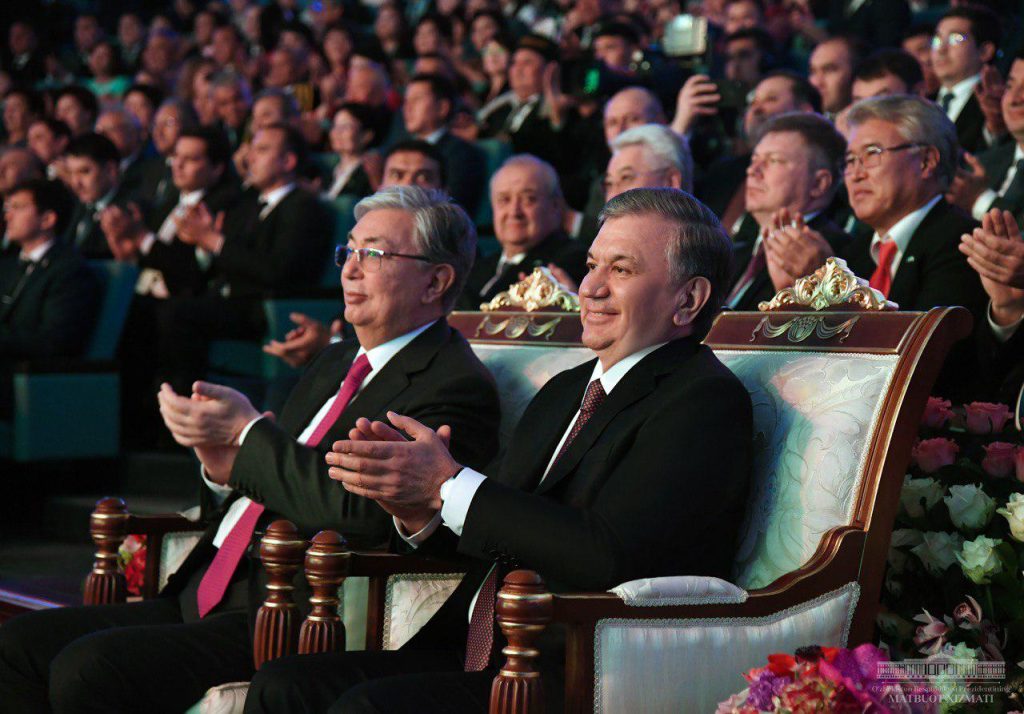
TASHKENT (TCA) — Uzbekistan and Tajikistan have signed a Strategic Partnership Treaty — a move unimaginable some two years ago and now made possible thanks to bridge-building efforts of Uzbek President Mirziyoyev. We are republishing this article on the issue, originally published by Eurasianet:

For the first time since coming to power in the early 1990s, Tajikistan’s President Emomali Rahmon traveled to Uzbekistan on a state visit.

The occasion was billed as a historic, and even unexpected, breakthrough that would put to rest decades of ill-feeling between the fractious neighbors.

“Who could have imagined this one-and-a-half years ago?” Uzbek President Shavkat Mirziyoyev asked rhetorically at a banquet event on the first evening of the visit.

The tone was set as soon as Rahmon stepped off his plane August 17 onto a green carpet unfurled at Tashkent international airport, where he was met in person by Mirziyoyev. The pair immediately clinched in a tight embrace. Similar gestures of affection would be exchanged repeatedly throughout Rahmon’s two-day stay as the presidents routinely addressed one another as “dear friend” or “brother.”

Dushanbe-based political analyst Abdughani Mamadazimov said this diplomatic thaw showed what regional players could achieve while larger geopolitical powers are otherwise distracted.

“The main world players are busy with problems like Syria, the United States pulling out of the nuclear deal with Iran, and there is the ongoing issue of Ukraine,” Mamadazimov told Eurasianet. “They are all busy with other problems, and so the region is dealing with its own issues. All the initiatives have come from the region itself and are being supported by the local population.”

In diplomatic terms, the most momentous document to emerge from the visit was the bilateral Strategic Partnership Treaty – an accord that will at a stroke turn the uneasiest of neighborships into what will on paper be a robust alliance.

“The decision to upgrade interstate cooperation to a higher level of strategic partnership is a natural and logical result of the huge positive changes seen in our relationship,” Rahmon said, following one-on-one talks with his Uzbek counterpart.

Another 27 bilateral governmental agreements addressed cooperation in industry, education, border security, agriculture and much else.

The bad feelings between Tajikistan and Uzbekistan have their roots in a number of long-standing recriminations. One stemmed from Tashkent’s unabashed interference in the civil war that tore Tajikistan apart in the 1990s. Most grievously, that involvement was aimed at backing foes of the regime in Dushanbe.

In more recent years, Uzbekistan has been a staunch opponent of Tajikistan’s potentially epoch-defining Roghun hydroelectric dam. Tashkent has argued that the creation of the dam could imperil its agricultural heartland and that Tajikistan has no right to unilaterally exploit a shared water legacy. Uzbekistan has softened its rhetoric significantly on this front, however, even suggesting that it could get involved in the multibillion-dollar Roghun project.

In a more modest gesture of intent, Mirziyoyev signaled on August 17 that Uzbekistan would participate in the construction of two hydroelectric stations on the Zeravshan River in Tajikistan. The river rises in the Pamirs and flows into a high-walled valley in northwest Tajikistan and further into Uzbekistan, north of the city of Samarkand.

“We will build them together. The power produced will be sent to both Tajikistan and Uzbekistan,” said Mirziyoyev, speaking about two mooted 300-megawatt plants.

Rahmon, meanwhile, reprised an oft-rehearsed line about Tajikistan’s respect for regional water security.

“I have said many times and in many places, and I want to repeat it once more – we will not leave our neighbors without water,” he said.

Pressing this point further, Rahmon said that both countries are jointly looking at how to exploit resources from Lake Sarez, a lake deep inside the Pamir Mountains that was formed by a massive earthquake in 1911 and now holds approximately 17 cubic kilometers of water.

“We could use water from Sarez to supply drinking water to the region,” Rahmon said.

The glowing language has already translated into firm results, going by the two leaders’ account. Rahmon said that trade had doubled in the first half of 2018, as compared with the same period a year earlier, although he provided no figures.

More firm was news that companies from the two countries sealed 17 commercial agreements collectively worth more than $600 million during this state visit.

A lot has been done on that front by an Uzbekistan-based white-goods company called Artel, which retails directly on the Tajik market and has been advertising intensively.

Rahmon was taken for a tour of the Artel factory in Tashkent and, according to the Uzbek presidential administration, “noted the quality and price competitiveness of Uzbek goods.” In truth through, consumers in Uzbekistan seek, whenever possible, to buy Chinese goods, which are typically cheaper.

Tajikistan wants goods to flow the other direction too. But the Made in Tajikistan fair held in Tashkent to coincide with Rahmon’s visit suggested items going toward Uzbekistan will be mainly low-tech industrial materials, such as coal, aluminum and cement. Goods that even the Tajik government freely admits are the product of an import-substituting agenda – beverages, canned goods, dairy and meat products – will likely have trouble gaining a perch in Uzbekistan.

In any event, a day of pleasantries was capped by the Evening of Friendship concert, which brought together performers from both countries. It was there that mutual greetings reached an apogee of effusiveness.

“Uzbeks and Tajiks are like two branches of one tree, like two banks of one river, our land and water is as one, we have one holy religion,” Mirziyoyev said.

In that spirit, the second day of Rahmon’s visit took him to the historic city of Samarkand.

Much ink has been spilled by government-endorsed Tajik historians grumbling about the injustice of Samarkand and Bukhara, two eminent centers of Persian language and culture, being claimed in Soviet times by the Turkic Uzbek SSR rather than the Persian Tajik SSR. Rahmon has himself in the past, only half-secretly, played to the gallery by claiming that Tajikistan would one day take the cities back.

While in Samarkand, Rahmon was taken on a touristic whistle-stop tour. He posed for a photo in front of the famous Registan square with something that was half-smile, half-grimace. The sightseeing also took in visits to the graves of possibly the two most famous leaders of Uzbek history, Tamerlane, and Rahmon’s arch-enemy, the late President Islam Karimov. It was the latter’s death in September 2016, as it happens, that led to the improvement in bilateral ties.

Mamadazimov, the analyst in Dushanbe, cautioned that although great strides have been made, there are some details that need resolving.

“There are some mined areas [of the border]. This throws a shadow on the full-scale rapprochement. When the de-mining ends, then we can say that there are no problems left between the countries,” he said.