ASHGABAT (TCA) — Turkmenistan’s new Caspian Sea port will give its landlocked neighbors — Afghanistan, Uzbekistan, and Kyrgyzstan — a vital maritime transport link to Western markets. We are republishing this article on the issue, written by John C. K. Daly, originally published by The Jamestown Foundation’s Eurasia Daily Monitor:
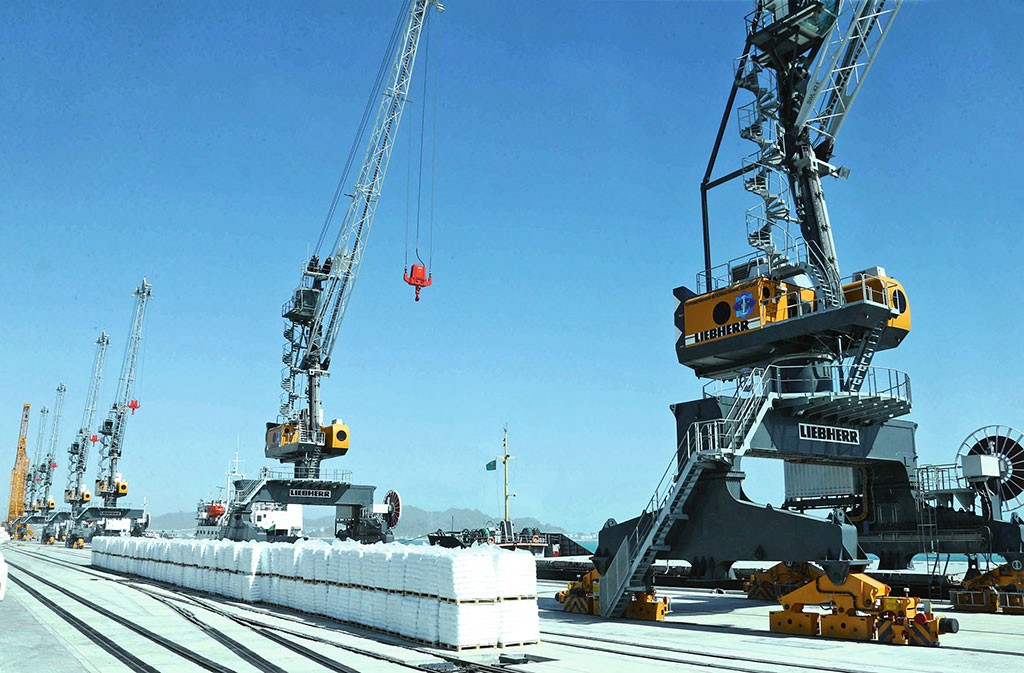
Turkmenistan’s President Gurbanguly Berdimuhamedov visited the Caspian shore, on May 2, to inaugurate the Turkmenbashi International Seaport. The new $1.5 billion facility, Berdimuhamedov told attendees, is important not only for Turkmenistan but the wider region as well. It promises to become an important link in the formation of a modern system of maritime transport across the Caspian. He added that his government is offering use of the port to neighboring countries, including the other Central Asian republics (Regnum, May 3).
Designs for the port’s expansion were drawn up five years ago, before record-low prices for natural gas decimated Turkmenistan’s primary source of export revenue. According to the Ministry of Foreign Affairs, construction of the Turkmenbashi International Seaport began in August 2013. The new port covers an area of about 375 acres and includes ferry, passenger and cargo terminals, with 1.1 miles of berths designed to serve 17 vessels at once (Mir24, May 2).
The Turkmenbashi International Seaport’s projected throughput capacity is considerable: the government states that the new facility will be able to service 300,000 passengers, 75,000 trailer trucks, and 400,000 twenty-foot equivalent unit (TEU) containers a year (Mfa.gov.tm, May 2). The projected annual total throughput capacity of the new port is 17–18 million tons of cargo; the ship-to-shore berths (STS) will operate with a capacity of 25 TEUs per hour (Turkmenportal.com, May 3).
Another important component in the expanded Turkmenbashi port is the “Balkan” shipbuilding and ship-repair plant. The enterprise, built by the Turkish company Gap Inşat, under a May 2014 contract with the Turkmenistan State Service of Sea and River Transport, has the capacity to process 12,000 tons of steel per year. The facility will be able to construct 4–6 vessels annually while providing maintenance facilities for another 20–30 ships per year, allowing for repair works to be carried out on civilian vessels such as tankers, dry cargo vessels and tugboats (Arzuw News, May 3). In addition, Turkmenbashi, formerly Krasnovodsk, is the home port of the modest Turkmenistani Navy (Military-az.com, July 27, 2012).
The Turkmenbashi International Seaport’s potential is already being recognized across the Caspian region. Speaking at Turkmenistan’s “Great Silk Road—To New Development Milestones” international forum, held to commemorate the port’s opening, Russian Astrakhan region Governor Aleksandr Zhilkin told participants, “The port opening in Turkmenbashi will also work in the interests of the Astrakhan region,” referring to the resumption in the near future of shipping between Turkmenbashi and Russia’s Caspian port of Olya. Zhilkin added that Astrakhan “has been developing closer relations with all the countries of the Caspian region for a long time, and with Turkmenistan in particular” (Kaspyinfo.ru, May 3).
Kyrgyzstan, the easternmost of the former Soviet Central Asian states, has also expressed interest in utilizing the new seaport. Kurmanbek Akyshev, the director of Kyrgyzstan’s Civil Aviation Agency, who also attended the forum at the head of a delegation, told reporters, “…it is very important that the International Sea Port was put into operation on the Turkmen coast of the Caspian Sea. As you know, Kyrgyzstan has no access to the sea… [T]he new port will significantly reduce the distance and travel time for large-scale cargo flows, bringing to a qualitative new level economic and trade cooperation between Asia and Europe” (Turkmenportal.com, May 3).
Beyond individual countries, at the forum Berdimuhamedov stated that his government is also exploring the possibility of international organizations utilizing the new port facility, including the Shanghai Cooperation Organization (SCO), the Commonwealth of Independent States (CIS) and the Organization for Economic Cooperation and Development (OECD) (Turkmenistan.gov.tm, May 2).
For many hundreds of years, up to the beginning of the 20th century, the Caspian developed as one of the key points of the transcontinental Great Silk Road because of coordination between interested parties from China to Europe. The imposition of Communism in the former Russian Empire, between 1917 and 1991, largely severed these connections; and today, the Caspian’s sole maritime access to the ocean remains the sovereign Russian internal Volga-Don Canal (see EDM, May 5, 2014). Since 1991, growing interest in the Caspian’s hydrocarbon resources has produced tension between the five states with a Caspian shoreline (see EDM, April 5, 2018). Even as these issues remain unresolved between the four new former Soviet states and Iran, the new Turkmenbashi International Seaport has the potential to benefit not only them but countries further afield from, East Asia to Europe. The new facility’s estimated annual throughput of 18 million tons of cargo, if utilized, will make it the Caspian’s largest port.
Turkmenistan’s “transport diplomacy,” accordingly, has the potential to increase the prosperity not only of Turkmenistan but its landlocked eastern neighbors, from Uzbekistan to Afghanistan to Kyrgyzstan, by providing a vital maritime transport link for their products to reach Western markets. While China remains the primary impetus behind the development of Eurasian transport networks, for Russia the route provides yet another export vector, with the added attraction of not transiting any North Atlantic Treaty Organization (NATO) countries, with whom relations are deteriorating.
Given the two Eurasian superpowers’ guaranteed interest in promoting international trade, combined with the Turkmenistani government’s outreach to the SCO, CIS and OECD, it seems probable that Ashgabat has made a wise investment.




 TCA
TCA