• KGS/USD = 0.01144 0%
  • KZT/USD = 0.00196 -0%
  • TJS/USD = 0.10899 -0%
  • UZS/USD = 0.00008 -0%
  • TMT/USD = 0.28490 0%
  • KGS/USD = 0.01144 0%
  • KZT/USD = 0.00196 -0%
  • TJS/USD = 0.10899 -0%
  • UZS/USD = 0.00008 -0%
  • TMT/USD = 0.28490 0%
  • KGS/USD = 0.01144 0%
  • KZT/USD = 0.00196 -0%
  • TJS/USD = 0.10899 -0%
  • UZS/USD = 0.00008 -0%
  • TMT/USD = 0.28490 0%
  • KGS/USD = 0.01144 0%
  • KZT/USD = 0.00196 -0%
  • TJS/USD = 0.10899 -0%
  • UZS/USD = 0.00008 -0%
  • TMT/USD = 0.28490 0%
  • KGS/USD = 0.01144 0%
  • KZT/USD = 0.00196 -0%
  • TJS/USD = 0.10899 -0%
  • UZS/USD = 0.00008 -0%
  • TMT/USD = 0.28490 0%
  • KGS/USD = 0.01144 0%
  • KZT/USD = 0.00196 -0%
  • TJS/USD = 0.10899 -0%
  • UZS/USD = 0.00008 -0%
  • TMT/USD = 0.28490 0%
  • KGS/USD = 0.01144 0%
  • KZT/USD = 0.00196 -0%
  • TJS/USD = 0.10899 -0%
  • UZS/USD = 0.00008 -0%
  • TMT/USD = 0.28490 0%
  • KGS/USD = 0.01144 0%
  • KZT/USD = 0.00196 -0%
  • TJS/USD = 0.10899 -0%
  • UZS/USD = 0.00008 -0%
  • TMT/USD = 0.28490 0%
08 December 2025

Energy, transportation dominate Turkmenistan president’s visit to Tashkent

TASHKENT (TCA) — In terms of cooperation in energy, transportation and transit spheres, Turkmenistan and Uzbekistan are perhaps the most interdependent countries in Central Asia. We are republishing this article on the issue by Umida Hashimova, originally published by The Jamestown Foundation’s Eurasia Daily Monitor:

Uzbekistani President Shavkat Mirziyoyev’s first foreign trip, in March 2017, nearly seven months after coming to power, took him to Turkmenistan. The salient point of the visit was the opening of a mile-long rail-and-car bridge connecting both countries over the Amudarya river and the signing of a strategic agreement, one of only two Uzbekistan ever signed with its Central Asian neighbors (President.uz, March 7, 2017; Gazeta.uz, March 6, 2017). Mirziyoyev visited Turkmenistan two more times following his first visit. And on April 23–24, 2018, a little more than a year since the first official bilateral summit, he hosted President of Turkmenistan Gurbanguly Berdimuhamedov in Uzbekistan.

The latest meeting between both leaders did not deliver the same political and economic milestones as the first. Nevertheless, the abundance of cultural events tailored for President Berdimuhamedov seemingly made him the most culturally entertained foreign leader to ever visit Uzbekistan (President.uz, April 24; BBC News—Uzbek service, April 23). Talks on trade and transportation dominated the official part of the meeting. The two sides underlined that bilateral trade reached $177.3 million in 2017 and set a target of tripling this amount by 2020. Already in the first quarter of 2018, trade turnover increased by 55 percent year-on-year (Gazeta.uz, April 25; Kun.uz, April 24). Additionally, within the framework of the official visit, business leaders of both countries met at special events and signed agreements cumulatively worth $250 million (Gazeta.uz, April 25).

During Berdimuhamedov’s visit, the government of Uzbekistan reconfirmed its participation in the Turkmenistan–Afghanistan–Pakistan–India (TAPI) natural gas pipeline project (Kun.uz, April 24). Tashkent first expressed its desire to partner with Turkmenistan on the project in the middle of 2017, when Mirziyoyev paid a follow-up meeting to Turkmenistan (Kun.uz, May 22, 2017). In turn, Turkmenistan offered Uzbekistan use of its territory to access Middle Eastern and European markets via the planned Uzbekistan–Turkmenistan–Iran–Oman and Uzbekistan–Turkmenistan–Caspian Sea transportation corridors (Kun.uz, April 24; Uzbekistan 24 TV, April 23).

For Uzbekistan’s government, Turkmenistan indeed offers unique opportunities that no other bordering country can match. In particular, Turkmenistan (and transit through this state) can offer Uzbekistan’s growing industrial base quick access to world ports and markets (BBC News—Uzbek service, April 25). Tashkent is presently explicitly pursuing international transit corridors traversing Turkmenistan. And to this end, Berdimuhamedov expressed his support for the Uzbekistan–Turkmenistan–Iran–Oman corridor, which Uzbekistan’s government had focused on last year in its negotiations with Iran and Oman (Kun.uz, April 23, 2018; Gazeta.uz, April 20, 2017; UzA, March 14, 2017).

Neutral Turkmenistan also offered to host Uzbekistani-led negotiations among rival belligerent Afghan factions (Kun.uz, April 23). Uzbekistan’s recent attempt to hold peace talks in its capital between Afghans and world leaders was the latest example of Tashkent’s endeavors to influence the situation in the bordering country (UzA, March 28). Besides, Ashgabat is well aware that stabilizing the situation in Afghanistan is not merely important to Uzbekistan, but to Turkmenistan as well. Both Central Asian republics have strong economic and political interests in a peaceful and stable Afghanistan as a prerequisite for building the TAPI pipeline and other major projects.

Meanwhile, Turkmenistan’s economic stake in Uzbekistan’s ongoing development continues to grow. Turkmenistan has been shipping natural gas to China via Uzbekistani territory since 2009, when Ashgabat broke its decades-long unfavorable dependency on Russia as consumer and transit country. Additionally, Turkmenistan recently announced an interregional project to sell electricity produced on its territory to South Asia that will pass through Uzbekistan’s power grid (Kun.uz, March 6, 2017).

Despite the reactivated diplomacy and major economic projects that increasingly link both countries, Turkmenistan remains the only neighboring state (except for Afghanistan) with which Uzbekistan maintains a visa regime. Five years have passed since their shared border was closed, and the situation remains unchanged today (BBC Uzbek, April 27). Although negotiations were reopened in March 2017, there has been little progress on bilateral border delimitation and demarcation to date; and the issue was apparently not raised at the latest summit, according to the official agenda of Berdimuhamedov’s visit to Tashkent (Kun.uz, March 31, 2017). This omission exists in stark contrast with Uzbekistan’s recent active border negotiation rounds with Kazakhstan, Tajikistan, Kyrgyzstan as well as the abolishment of visa requirements with Tajikistan and Kyrgyzstan. Nevertheless, Mirziyoyev’s statement that “there is no single issue [Uzbekistan and Turkmenistan] have not discussed… Mutual understanding has been reached in all areas” implies a strong wish and desire to solve these border issues with Ashgabat as well (Kyn.uz, April 24).

President Berdimuhamedov’s first visit to Uzbekistan since President Mirziyoyev’s election did not result in any true breakthrough developments. On the contrary, the expected easing of border and visa issues—similar to those Uzbekistan reached earlier with Tajikistan and Kyrgyzstan—actually failed to materialize. Turkmenistan’s isolation and strong inherent cautiousness in foreign affairs might be the restraining factor for Ashgabat in this area. Nonetheless, the Berdimuhamedov visit to Tashkent still confirmed that the two countries are willing to work together on issues of utmost national interest, such as transportation corridors for Uzbekistan and the energy sector for Turkmenistan.
Kazakhstan and Britain discuss investment projects

ASTANA (TCA) — Investment opportunities of Kazakhstan were presented at a seminar in London, held at the headquarters of the consulting company British Expertise International with the support of the Embassy of Kazakhstan in the UK, Kazakh Invest National Company for Investment Support and Promotion reported on May 2.

Continue reading

Kazakhstan and Poland to strengthen trade and economic cooperation

ALMATY (TCA) — Kazakhstan and Poland are focused on further strengthening trade and economic, cultural and educational cooperation, as well as contacts between citizens of the two countries. This was discussed at the meeting last week between Deputy Minister of Foreign Affairs of Kazakhstan Roman Vassilenko and Deputy Minister of Foreign Affairs of Poland Andrzej Papierz, who arrived in Almaty to take part in the 100th anniversary of the restoration of Polish statehood, the Kazakh Foreign Ministry reported.

Continue reading

Turkmenistan opens new port on Caspian Sea

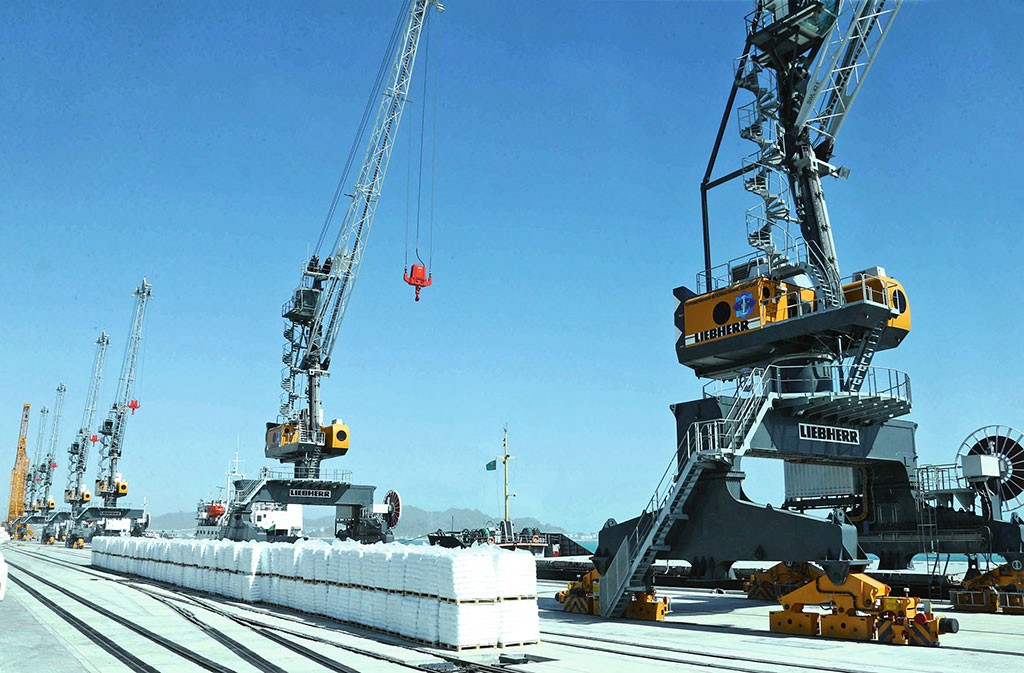
ASHGABAT (TCA) — Turkmenistan on May 2 opened a large new port on the Caspian Sea that the country hopes will improve its export prospects and establish it as a regional hub connecting Europe and Asia, RFE/RL reported.

The opening of the $1.5 billion cargo and passenger port comes as the Central Asian country tries to diversify its economy, which overwhelmingly depends on natural gas exports for revenues.

Gas exports are also Turkmenistan’s main source of hard currency. They took a hit when Russia, once its main customer, stopped all purchases in 2016 after a pricing dispute.

The elaborate new port in the city of Turkmenbashi will more than triple Turkmenistan’s cargo handling capacity to 25-26 million tons a year, the government said.

Although it has no outlets to the world’s oceans, the 1,000-kilometer long Caspian Sea is an important thoroughfare for trade and passengers in the region.

Speaking before the official opening ceremony, Turkmen President Gurbanguly Berdymukhammedov said the new port will be an important link in a modern maritime transport system giving users favorable conditions for access to the Black Sea area, Europe, the Middle East, and Asia.

He said Ashgabat is ready to discuss use of the seaport with its landlocked neighbors, in a reference to Uzbekistan and Afghanistan.

Turkmenistan already has a railway link with China through neighboring Kazakhstan and the new port could help Ashgabat win some of cargo flows moving between China, the Middle East, and Europe.

The port has container handling facilities and a polypropylene terminal which will handle products from a nearby plant that is set to be launched later this year.

Speaking at International Forum “The Great Silk Road: Towards New Frontiers of Development” on May 2, President Berdymukhammedov encouraged activation of the discussion of various aspects of the construction of transport corridor Afghanistan – Turkmenistan – Azerbaijan – Georgia – Turkey, the State News Agency of Turkmenistan reported.

The formation of the western transport corridor from Central Asia is very important in the context of realization of ambitious targets of the revival of the Silk Road and joining of two world economic poles of Eurasia, the Turkmen leader said.

Construction of Turkmenbashi International Seaport is a considerable input of Turkmenistan to this process, the president highlighted.

Berdymukhammedov expressed the confidence that the new port will become an important link of the Silk Road, a wide open gate for equal, efficient and beneficial international cooperation for decades to come.

Central Asia after Astana: from integration to cooperation

BISHKEK (TCA) — As the geopolitical significance of Central Asia is declining, the region’s states now have to take their fate into their own hands — with less attention to Russia and China. We are republishing this article on the issue by Slavomír Horák*, originally published by the CACI Analyst:

After the March 15 meeting of Central Asian leaders in Astana, analyses, news and reports increasingly use words such as “integration” or “new beginning” to describe political developments in Central Asia. Some Russian media have speculated in the beginning of the next phase of separation from Moscow. However, the “consultative meeting” in Astana should be understood in a completely different manner. The word “integration” reminds us of previous, less successful attempts at regional cooperation in Central Eurasia and so far, no comprehensive integrational concept has materialized. Yet, the Astana meeting was the first of its kind in many years and President Nazarbaev, summing up the results, underlined its informal character and even compared the format to the Visegrad group in Central Europe.

BACKGROUND: Central Asian cooperation and, eventually, integration was a topic for discussion even before the final dissolution of the USSR. Cooperation seemed logical as all five republics had much in common, and struggled to solve similar socioeconomic as well as political problems. However, soon after the USSR ended, the state- and nation-building ambitions of the Central Asian states and their generally competitive relations prevailed over the cooperation strategy. Several attempts to establish a purely Central Asian integrational organization failed due to high expectations of their outcomes and the unwillingness of local leaders to follow the formally agreed rules. The personal rivalries of local leaders made deeper all-regional cooperation impossible, while the interference of other powers (especially Russia and China) and the implementation of their own integration projects (CSTO, EEC, SCO, etc.) absorbed the remnants of Central Asia’s integration potential.

Recent shifts in Central Asian geopolitics as well as the region’s internal affairs have opened a new opportunity for regional talks. From a geopolitical perspective, Central Asia has turned from being the object of a mythical “New Great Game” between Russia, China and the U.S. for global and regional dominance, to a geopolitically peripheral region (except for China). The U.S. has shifted its priorities to internal issues or other regions, with the partial exception of Afghanistan, despite Nazarbaev’s recent successful visit to Washington. Russia’s position in the region has decreased due to its economic weakness and inability to meet the Central Asian elites’ expectations of partnership rather than patronage. Russian foreign policy has also shifted its regional focus, and Central Asia is today much less prominent on Moscow’s agenda than previously. China’s Central Asian policy is primarily determined by its global ambitions; where Central Asia plays the role of a region for transit and raw material supply. At the same time, China’s financial power has raised much concern among Central Asian elites. Despite the region’s secondary role for China, its geographical proximity makes China one of the most important geopolitical players in the region. No other power can balance the increase in Chinese influence. As a result, Central Asian capitals will have to deal with this issue on their own.

IMPLICATIONS: As the region’s geopolitical significance is declining, the states have taken their fate into their hands. In this geopolitical situation, the new enthusiasm for Central Asian cooperation seems to be a logical step forward. The death of Uzbekistan’s President Islam Karimov and the election of Shavkat Mirziyoev became another crucial event in the development of personal contacts among Central Asian elites. Therefore, although Uzbekistan did not host the meeting, the gathering of Central Asian presidents became possible due to the changes in Uzbekistan and the transformation of Uzbekistan’s foreign policy from isolation and hostility towards a more open approach to its neighbors. The current constructive relations between the two main regional powers (Uzbekistan and Kazakhstan) have left little space for outside interference in intraregional matters.

The meeting demonstrates that the most influential countries (Uzbekistan and Kazakhstan) and their smaller counterparts have largely overcome their principal animosities for now. Thus, the breakthrough of the Uzbek president’s visit to Tajikistan on the eve of the Astana summit as well as the markedly improved relations with Kyrgyzstan paved the way for cooperation in the future. This new approach obviously does not exclude tensions over a whole range of problematic issues – unresolved border issues, water management, environmental affairs, migration, and many others. However, there is a clear tendency to solve problems through mutual contacts between leaders rather than threatening statements and the involvement of external powers for mediation.

Turkmenistan’s President Gurbanguly Berdimuhammedov was the only head of state not to attend the Astana meeting due to his simultaneous Gulf States tour. Instead, the Speaker of the Turkmen Parliament Akja Nurberdiýeva, the country’s second person in rank, led the Turkmen delegation. However, the most interesting meeting, between Nazarbaev and Serdar Berdimuhammedov, went mostly unnoticed. The son of the Turkmen President was reelected as a member of Turkmenistan’s parliament in March 2018, although he did not become the head of parliament as was generally expected. The meeting in Astana and the position of Serdar as the de facto head of the Turkmen delegation indicates the introduction of Berdimuhammedov’s eventual successor on the international stage, although very preliminary and unofficial. However, this says little about the interest of the Turkmen president and his elite in future deeper cooperation with Central Asian states.

It is premature to assert that the Astana meeting laid the foundation for a new tradition of informal meetings and talks about cooperation between Central Asian presidents. However, the meeting suggests that such a format is more suitable for Central Asian leaders than seeking an integration scheme with the establishment of supranational structures. Regular informal meetings could prevent a relapse into previous animosities and, most importantly, the leaders showed a willingness to meet and speak.

In this sense, the Visegrad Group mentioned by president Nazarbaev would be exactly the format that Central Asia needs. It has positioned itself as non-institutionalized group of four states organizing regular gatherings of presidents and governmental as well as non-governmental representatives. Other groups, such as the Baltic Assembly, the Nordic Council or even ASEAN, have much more formalized structures and therefore represent instances of supranational integration that may be a step too far for the Central Asian states.

When comparing these regional groupings, geographical, political, demographic, economic and cultural differences must be taken into consideration. The mostly presidential systems of Central Asia primarily stimulate a top-down approach to cooperation instead of bottom-up initiatives based on cooperation in the civic sphere, as is the case in the Visegrad group. Given that the level of regional cooperation is highly dependent on the personal relations between Central Asian leaders, the cordial atmosphere of the Astana summit and the willingness to cooperate invites an optimistic perspective for Central Asia. Moreover, practical bilateral and multilateral steps have accompanied political statements, including the abolishment of visas, a joint program on tourism and other initiatives. This was not the case during previous attempts at cooperation.

CONCLUSIONS: The style and format of the summit represented real and much needed progress in the region after years of confrontation. The participants did not pompously present the summit as a breaking moment in Central Asian integration as in the past. In addition, the absence of outside powers brings hope that the Central Asian states have found an avenue for making their own decisions on regional affairs. This motivates cautious optimism for a more realistic foundation of regional cooperation.

Despite the above-mentioned distinctions between Central Asia and Central Europe, the Visegrad group’s relatively open character of cooperation without unrealistic integrational ambitions could be a stimulating factor for Central Asian leaders. Hopefully, the friendly atmosphere of the Astana meeting, leaving serious personal animosities aside, represents a fresh start for regional cooperation.

* Slavomir Horak is Assistant Professor at the Department of Russian and East European Studies, Charles University in Prague