• KGS/USD = 0.01144 0%
  • KZT/USD = 0.00215 0%
  • TJS/USD = 0.10680 0%
  • UZS/USD = 0.00008 0%
  • TMT/USD = 0.28530 0%
  • KGS/USD = 0.01144 0%
  • KZT/USD = 0.00215 0%
  • TJS/USD = 0.10680 0%
  • UZS/USD = 0.00008 0%
  • TMT/USD = 0.28530 0%
  • KGS/USD = 0.01144 0%
  • KZT/USD = 0.00215 0%
  • TJS/USD = 0.10680 0%
  • UZS/USD = 0.00008 0%
  • TMT/USD = 0.28530 0%
  • KGS/USD = 0.01144 0%
  • KZT/USD = 0.00215 0%
  • TJS/USD = 0.10680 0%
  • UZS/USD = 0.00008 0%
  • TMT/USD = 0.28530 0%
  • KGS/USD = 0.01144 0%
  • KZT/USD = 0.00215 0%
  • TJS/USD = 0.10680 0%
  • UZS/USD = 0.00008 0%
  • TMT/USD = 0.28530 0%
  • KGS/USD = 0.01144 0%
  • KZT/USD = 0.00215 0%
  • TJS/USD = 0.10680 0%
  • UZS/USD = 0.00008 0%
  • TMT/USD = 0.28530 0%
  • KGS/USD = 0.01144 0%
  • KZT/USD = 0.00215 0%
  • TJS/USD = 0.10680 0%
  • UZS/USD = 0.00008 0%
  • TMT/USD = 0.28530 0%
  • KGS/USD = 0.01144 0%
  • KZT/USD = 0.00215 0%
  • TJS/USD = 0.10680 0%
  • UZS/USD = 0.00008 0%
  • TMT/USD = 0.28530 0%

Tourism in Kyrgyzstan: ambitious goals, poor roads and safety problems

BISHKEK (TCA) — Considering that the World Nomad Games are to be held in 2018, it is expected that there will be a deficit of Kyrgyzstan’s state budget in the second half of the year, the Eurasian Development Bank said in its monthly macroeconomic review.

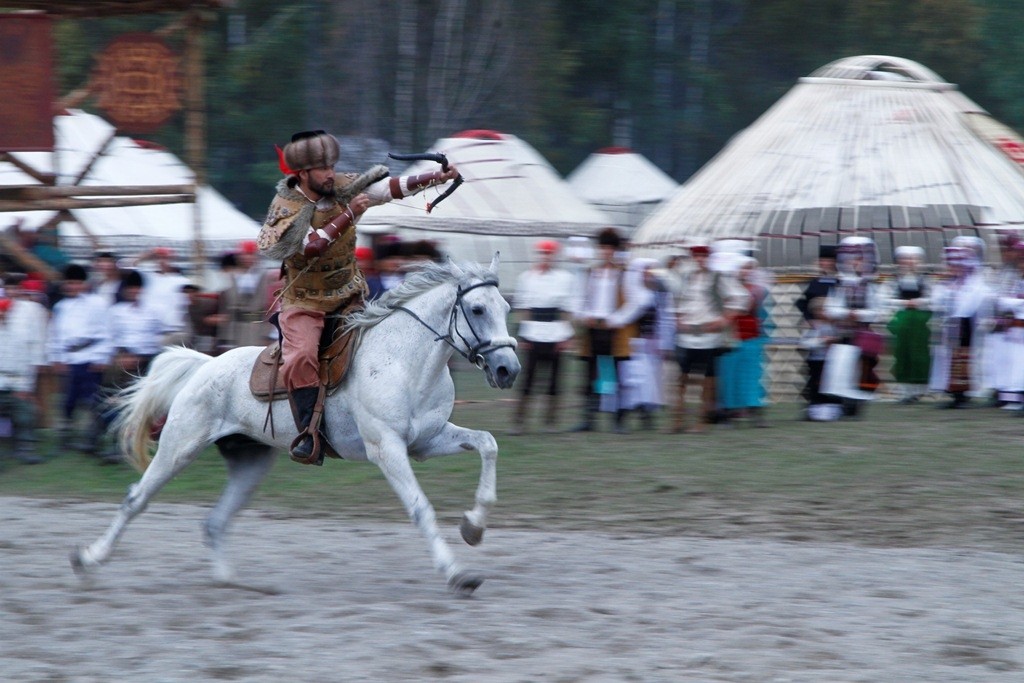
World Nomad Games

According to the Finance Ministry of Kyrgyzstan, it is planned to spend 306.3 million soms for the coming World Nomad Games (WNG) to be held from September 2 to September 8 on the Lake Issyk-Kul coast.

Earlier this month, the WNG organizers asked businesses and state organizations to provide voluntary financial support for the event. The State Ecological Inspectorate is still the only state agency that has allocated money for the Games. The Inspectorate’s employees transferred their one-day salaries to the account of the World Ethnic Sports Confederation in favor of preparations for the WNG 2018.

Meanwhile tickets for the third World Nomad Games are already on sale. Entrance tickets are strictly individual, with QR-codes. Tickets should be bought only for the opening and closing ceremonies (from 400 to 4.9 thousand soms). Entrance to other events will be free.

Deputy Minister of Culture, Tourism and Information Ainura Temirbekova believes that the upcoming competitions will outperform the past ones in 2014 and 2016.

At Kyrchyn jailoo, an ethno-town is being constructed. From 3 to 6 September, a cultural program will be held there including national songs and dances, clothing and food exhibitions, theatrical staging of Kyrgyz traditions and customs, yurt design and assembling, and folk crafts contests.

The WNG organizers will try to surprise and delight the guests. In 2016, the appearance of a thousand of komuzists at the arena of the hippodrome caused the spectators’ admiration. Komuz is an ancient Kyrgyz string instrument.

Foreign guests were more interested in customs and traditions of nomads than sports competitions. Therefore, this year the organizers decided to improve the cultural part of the program focused on both the external attributes of the nomadic life and the inner world and spirit of nomads.

However, the lofty intentions to hold a high-level international event are not fully implemented.

Scandalous road

Scandals are continuing around the construction of a ring road around Issyk-Kul Lake, on the shore of which the WNG will be held. Recently, the Prosecutor General’s Office initiated a criminal case related to the construction of the Balykchi-Korumdu road. According to the investigation, the Transport Ministry illegally used budget funds in attracting consulting services.

Construction of this road, estimated at 6.8 billion soms, is the only major project financed from the state budget. The construction project which began in 2015 and was due to be completed in December of 2017, was accompanied by corruption scandals.

In April of 2016, the scandal over this road led to the resignation of then Prime Minister Temir Sariev and Transport Minister Argynbek Malabaev.

The total length of the Balykchi-Korumdu road is 104 kilometers, and only a section from the 33rd to 104th kilometer has been completed.

Travel safety

The incident that took place on July 9 during rescuing tourists at the Southern Inylchek base camp of mountaineers revealed major shortcomings in the tourist sector in Kyrgyzstan. As a result of the helicopter crash, a mountaineer — a foreign citizen — suffered.

The Mi-8 helicopter, which belonged to the air defense forces of Kyrgyzstan, carried out a rescue operation. It had to evacuate climbers from the slope of the Khan-Tengri mountain peak. When landing, the helicopter fell on the port side due to a strong side wind.

The Khan-Tengri peak is located in the Issyk-Kul province of Kyrgyzstan, on the border with Kazakhstan and China, and belongs to the mountains of the northern Tien Shan. The South Inylchek base camp of mountaineers, from where the helicopter was supposed to evacuate the mountaineers, is at an altitude of 4,000 meters above sea level.

According the General Staff of Kyrgyzstan’s Armed Forces, a tourist company asked them to deliver help, medicines and food to tourists on the glacier. Helicopters of the Armed Forces should not be used to rescue tourists, this is the responsibility of the Emergency Ministry, but its only helicopter went out of order.

Losing image

Earlier this month, at a press conference in Bishkek, tour operators warned that due to the lack of helicopters, the tourist season could be frustrated, and mountaineering in Kyrgyzstan would lose its popularity. This year, there are no helicopters to ensure the safety of tourists in mountainous areas. Such a situation is developing for the first time for the 26 years of the country’s independence, they said.

Every year, more than 20 rescue operations are implemented during the summer tourist season, but now travel companies cannot provide them. Kazakhstan agreed to deliver tourists with its helicopters to the peaks of Khan-Tengri and Pobeda, but the General Staff of the Armed Forces of Kyrgyzstan did not allow this.

Kyrgyzstan is a mountainous country, so many tourist routes pass through mountain areas. Currently, trekking and mountaineering tourism is gaining popularity but Kyrgyzstan must ensure the safety of tourists. Helicopters are also necessary to deliver tourists to the mountains, and tourists are ready to pay all expenses for helicopter services. In addition, there are tourists who would like to look at the mountains from the air.

About five thousand tourists from 18 countries applied for mountain programs in Kyrgyzstan this year. Tour operators fear that now tourists can include the country in their blacklist because it cannot ensure their safety.

Not only the tourist season may fail but the positive image of the country, worked out over the years, will suffer.

Kazakhstan presents UN Security Council its vision on climate change mitigation

ASTANA (TCA) — “Climate change is a ‘threat multiplier’ as it can result in poverty, food insecurity, illegal migration, social instability and bitter conflicts,” the Deputy Minister of Foreign Affairs of Kazakhstan, Yerzhan Ashikbayev, said last week at the open debate of the United Nations Security Council dedicated to Understanding and Addressing Climate-related Security Risks, the Kazakh Foreign Ministry reported.

Continue reading

Tajikistan: monopoly practices send fuel prices soaring

DUSHANBE (TCA) — Tajikistan’s lucrative motor fuel business, and its revenues, is largely controlled by a relative of Tajik President Emomali Rahmon. We are republishing this article on the issue, originally published by Eurasianet:

One of the most popular means to get around Tajikistan’s capital is the “three-somoni taxi,” named for the set price of the fare.

No more. It will be five-somoni taxis from now – the direct result of a recent dramatic spike in the cost of car fuel and an opaque fuel-import market dominated by a relative of the president.

The taxi business has been a lifeline for a huge number of Tajikistan’s unemployed, like Nozim Subhonov, 30. For the past year, Subhonov has been picking up a maximum of four people at a time in his Opel Vectra, charging 3 somoni ($0.32) to be carried along route number eight, a fixed path through Dushanbe.

“Because of the financial crisis I was fired from my last job, where I worked delivering groceries,” Subhonov, who provides for two children and his parents, told Eurasianet.

To save money, he converted his car to run on liquified gas, which costs less per unit traveled than petrol. Around 60 percent of drivers in Tajikistan use liquified gas to run their cars, according to the State Antimonopoly Service.

But the price of liquified gas has risen dramatically in recent weeks. After the middle of June, prices for gas in Dushanbe leapt by more than one-third, from 3.40 somoni per liter to around 4.90 somoni in mid-July. Petrol has followed suit, jumping from around 6.40 somoni to 8 somoni per liter.

Subhonov said this has forced drivers like him to hike their own prices.

“What is the point of me working if there is no profit for me in it?” he asked.

The impact has also been felt on travel between towns. Where a ride from Dushanbe to the country’s second city, Khujand, once cost around 80 somoni, now it is around 120 somoni. The rate of increase applies across the board.

According to official figures, around 85 percent of the 340 tons of liquified gas imported for motorists annually comes from Kazakhstan. The rest is from Russia.

Following the trail of fuel supplies is intensely complicated, however, as the business is opaque and malfeasance is said to abound.

In writing about the regional rise in prices for liquified gas, Argus, a publication that specializes in analyzing the global energy market, wrote in an emailed Russian-language bulletin dated June 20 that it had been caused by a slowdown of operations at the Kazakh-Chinese-run Zhanazhol gas processing plant near Aktobe in western Kazakhstan.

The price of gas at the Uzbek-Tajik border in June was recorded as rising by $140 per ton week-on-week, to $540, Argus reported in its bulletin without stating its source.

Those figures, which industry insiders have said may be set to grow further, are startling for a number of reasons.

The price at which bulk retailers of liquified gas in Kazakhstan, where Tajik traders source much of their fuel, are allowed to sell their product on the internal market is set in law at regular intervals. The current level is 38,700 tenge ($113) per ton. When it comes to selling to international buyers, negotiation is the name of the game.

Lawmakers in Kazakhstan have worried that this dynamic has created a strong incentive to export to nearby countries. But under changes to the rules set to go in place in Kazakhstan in January 2019, the bulk sale price of liquified gas will be allowed to float in line with market forces, reducing the incentive for export.

That could result in deficits and prices rising even further for consumers down the pike, in Tajikistan.

Even in the short term, the picture does not look reassuring.

A representative for a Tajikistan-based company dealing in the import and sale of hydrocarbon products told Eurasianet on condition of anonymity that the Zhanazhol plant’s suspension of deliveries to Tajikistan began on June 1 and is expected to end on July 15.

“Considering this situation, other Kazakh companies have sharply increased the cost of their exported gas. That is why the price has risen so sharply,” the source said.

Russia should be a competitive alternative given that the two countries have a standing agreement on the tariff-free trade of energy products, but in practice this appears to have little effect.

“Only a couple of Tajik companies and [Russia’s state-controlled] Gazpromneft can take advantage of this agreement,” the sale trading company source said.

More upward pressure was put on retail liquified gas prices by the rising cost of transportation. In April, Tajikistan’s national railway company increased the cost of carrying liquified gas and petrol into the northern Sughd region by around one-third. This revenue-raising move in effect penalizes those using the most direct route for importing fuel from places like Kazakhstan and Russia.

“The rise in cost of transportation, the tax burden and customs duties all have a negative effect on the price-formation of oil goods, and it is the consumer who suffers primarily,” the trading company representative said.

Market insiders expect the current volatility to diminish by the end of summer, but that it is unlikely that prices at the pump will return to former levels.

Tajikistan’s narrow and uncompetitive market is the elephant in the room. The fuel business is controlled for the large part by a company called Faroz, which belongs to Shamsullo Sohibov, a son-in-law of President Emomali Rahmon. The activities of this company have been subject of reporting by Eurasianet correspondents and, later, the Organized Crime and Corruption Reporting Project, or OCCRP.

But Faroz has denied it enjoys a near de facto monopoly. In a statement posted on Facebook on June 27, Faroz pointed out that there are 35 companies in Tajikistan that import and trade in fuel products.

And yet, as OCCRP has noted, Faroz in 2013 established a would-be lobbying entity called the Association of Oil and Liquefied Gas Importers. According to industry insiders cited by OCCRP, the lobby group actually acted as an intermediary with the authorities, so that only companies that somehow got into its good graces were granted the right to operate.

The cost of the now five-somoni taxis are just the tip of the iceberg.

Once the new fuel-prices play their way through the system, it will eventually lead to rises in the cost of basic staple goods, Alisher Safarov, an economist, told Eurasianet.

“Prices for groceries will go up, because you need transport to carry them around, and the cost of that has gone up. Any changes in the end will hit the consumer,” he said.