ASHGABAT (TCA) — Although official statistics reports economic growth, the economy of Turkmenistan is experiencing a severe crisis, with the population suffering from periodic shortages of some staple food products. We are republishing this article on the issue, written by John C. K. Daly, originally published by The Jamestown Foundation’s Eurasia Daily Monitor:
It is notoriously challenging to acquire accurate socio-economic data on a country as insulated as Turkmenistan. And the difficulty is further heightened by the fact that the autocratic government in Ashgabat consistently paints society in roseate terms, even as the Turkmenistani opposition scattered abroad relates much darker imagery. The gulf between these disparate portrayals is particularly noticeable in coverage of the country’s economy. Since January 2016, Turkmenistan’s beleaguered currency, the manat, has endured a perfect storm, depreciating by more than 542 percent; and since the beginning of the year, the unofficial exchange rate skyrocketed from about 10 manats to the dollar up to 29 as of June 3. That drop in value has caused significant increases in the prices of staple products, including gasoline, medicines and wheat (Fergananews.com, June 9). And while the government projects a GDP increase of 6.2 percent this year, the opposition reports that food rationing has begun in the country (Turkmenistan Segodnya, June 8).
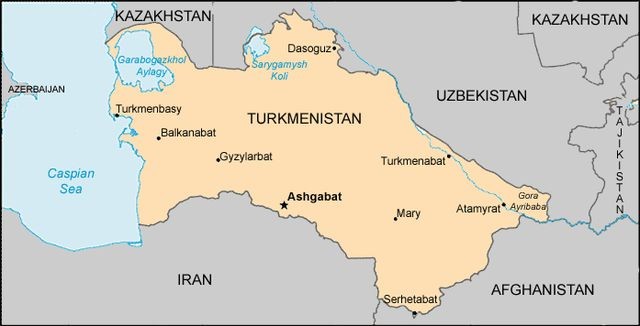
Since achieving independence in 1991, Turkmenistan under its first president, Saparmurat Niyazov (a.k.a. Turkmenbashi), and his successor, Gurbanguly Berdimuhamedov, has not only remained under authoritarian centralized government control, but has squandered much of the revenue generated from natural gas exports by pursuing a number of vanity projects. Alongside a new $2.3 billion airport in the capital Ashgabat, the city now houses the most marble buildings in the world—543 new structures clad in 4.5 million square meters of the white stone—earning the municipality a place in The Guinness Book of Records (MIR 24 TV, October 14, 2017).
Beneath the glittering façades, however, life is apparently deteriorating for the country’s citizens. Last October, the government ended the supply of free natural gas, electricity and water, which residents of this former Soviet republic had enjoyed for a quarter century. Now, Turkmenistan has introduced rationing for basic foodstuffs. On June 15, Radio Liberty’s Azatlyk Turkmen service reported that identification cards are now required to buy subsidized bread; in the morning, when the queues are long, police officers are posted in front of each store (Habartm.org, June 13, as cited in Radio Azatlyk, June 15).
Turkmenistan is currently experiencing its worst economic crisis since 1991, setting the government on a desperate search for new export routes for its natural gas. When China’s first 1,242-mile gas pipeline from Turkmenistan became operational in late 2009, Turkmenistan was already also massively exporting to both Russia and Iran; while potential Chinese investment and future gas demand were regionally regarded as virtually limitless. But since then, Russia and Iran effectively ended their imports of Turkmenistani gas, while declines in global energy prices and China’s lower economic growth rates have heavily reduced the region’s overly optimistic expectations. While Turkmenistan has long expressed a strong desire to expand its export markets by selling gas to Europe as well as energy-deficient Pakistan and India, both options face major routing, funding and security concerns (see EDM, April 8, 2016; February 6, 2018; March 28, 2018).
The tightly controlled state media, combined with President Berdimuhamedov’s burgeoning cult of personality, have made actively assessing internal developments in Turkmenistan unusually difficult. The Turkmenistan State News Agency, Turkmenistan Segodnya, remains relentlessly upbeat in its reporting; on June 8, it announced that the Cabinet of Ministers was briefed on the state of the national economy for January–May 2018, with retail trade turnover apparently increasing by 19.4 percent, year on year. Moreover, production rates of all ministries and departments reportedly rose 4.3 percent, while GDP grew by 6.2 percent (Turkmenistan Segodnya, June 8).
In the absence of other statistically reliable data, international financial institutions must rely on the figures provided by the Turkmenistani government. The International Monetary Fund (IMF) has utilized Ashgabat’s optimistic GDP projections for 2018 of 6.2 percent. And yet, the IMF’s April assessment of Turkmenistan’s economy, which the international organization summarized and transmitted to the Central Asian government, evidently proved sufficiently sensitive that the Turkmenistani “authorities have not consented to publication of the staff report and the related press release” (Imf.org, April 25).
On June 3, the IMF’s Middle East and Central Asia deputy head Juha Kahkonen observed that the only interim political options for the country were now to either devalue the manat or reduce government spending (Paruskg.info, June 6). If the domestic economic situation deteriorates further, some experts do not rule out that rioting could break out in the streets (Nezavisimaya Gazeta, June 28).
Berdimuhamedov, known in Turkmenistan by his self-styled moniker “Arkadag” (The Protector), does not yet seem ready to fully confront his country’s profligate spending against the background of economic decline. To give but one example, on May 3, the president conducted a “sudden check” of the army’s combat readiness, with the national TV channel Altyn Asyr (Golden Age) “showing him sitting in the cockpit of a recently purchased Leonardo-Finmeccanica Italian Alenia M-346 jet trainer, as well as inspecting an Alenia C-27J Spartan military transport plane (Centrasia.ru, May 11).
No immediate solutions are at hand to address Turkmenistan’s economic morass caused by declining global energy prices and extravagant government expenditures. The IMF’s proposals to devalue the manat or reduce the state budget are unlikely to be implemented, as the first would further reduce the citizenry’s standard of living, and the latter would call into question the government’s priorities. Accordingly, in the short term it seems that the situation is likely further to drift and worsen, the only question being how quickly.




 TCA
TCA