TASHKENT (TCA) — Official Tashkent is changing its attitude to the large army of Uzbek labor migrants working in Russia. Although this change is for the better, much is yet to be done to protect the rights of Uzbek laborers in Russia — and perhaps the most decisive step in this direction would be Uzbekistan’s possible entry into the Moscow-led Eurasian Economic Union. We are republishing this article on the issue, originally published by EurasiaNet.org:
The recent murder of an Uzbek migrant in the Moscow region was stunning for its pettiness and brazenness. The reaction both in Russia and Uzbekistan was out of the ordinary.
In broad daylight on October 13 in a drab village southwest of Moscow, a man in his mid-20s allegedly stabbed hairdresser Dostan Adehanov repeatedly in the chest with a skewer. The suspect had been teased mercilessly by his friends over the haircut given to him by Adehanov, a 24-year old native of Uzbekistan, so he decided to take revenge in an act caught on a surveillance camera.
It’s not particularly unusual for Central Asian citizens in Russia to fall victim to fatal workplace accidents or racially motivated crimes. But this particular episode gained more attention than usual because one of Adehanov’s customers happened to be the friend of a prominent politician.
“Danya worked in a cheap Moscow region hairdresser. That’s why his prices were low. Despite his golden hands, Danya couldn’t get a job in a more expensive establishment. And that is because Danya was a migrant laborer,” Anton Belyakov, a member of the Federation Council, Russia’s upper house of parliament, wrote on his Facebook page.
The sense of indignation was felt in Uzbekistan, too.
Back in the days of President Islam Karimov, who died just over a year ago, the woes of the country’s army of migrant laborers — the vast majority of whom work in Russia — rarely got much attention inside Uzbekistan itself. On the contrary, they received only disdain from the president.
“Those people who go to Moscow to clean the streets are just lazybones. You just feel disgust when Uzbeks go there just to earn a crust of bread. Nobody is dying of hunger in Uzbekistan,” Karimov said in June 2013.
This was remarkably harsh language considering the contributions made to the economy by expatriate laborers. In 2016 alone, they sent home $2.7 billion from Russia. Remittances from laborers abroad keep many of their struggling friends and relatives back home above the poverty line.
And so it is being taken as evidence of yet more change happening inside Uzbekistan that Adehanov’s murder sparked a surge of public reaction. Local media devoted ample coverage to the killing, while social media users collected funds needed to cover the cost of returning the young man’s body to his impoverished family in the Ferghana region. Only in the event of mass casualties — as in major vehicle collisions — does the Uzbek government typically organize the repatriation of victims’ remains.
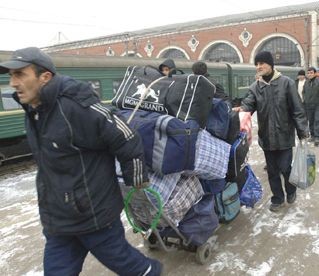
The 1.5 million person-strong Uzbek diaspora in Russia can use all the help it can get.
Bureaucratic hurdles have become increasingly complicated since 2015, when Russia began requiring labor migrants to obtain a work permit. That same year, Kyrgyzstan joined the Moscow-led Eurasian Economic Union, freeing their citizens of the requirement to obtain the permit. The removal of that requirement made Kyrgyz migrants a far more attractive proposition for employers in Russia, thus additionally shrinking options for would-be Uzbek migrants.
Many Uzbeks have long sought to avoid the hassle of paperwork — and the $58 fee levied monthly for the work permit. Thus, they tend to opt for to reside in Russia illegally, making them prey for police. According to figures from Uzbekistan’s Agency for External Labor Migration, around 400,000 Uzbeks overall have at some point been deported from Russia and been included on a travel blacklist.
The government has now turned its attention to cutting through this muddle of problems.
“Uzbekistan is changing its attitude to the issue of labor migration at its very roots and recognizing the contribution made by these migrants to the economy of Uzbekistan and to development in the country where they are working. We intend from the very outset to protect their rights and interests,” Karim Bahriyev, spokesman for the Agency for Foreign Labor Migration Affairs, told Eurasianet.org.
During his state visit to Russia in April, Uzbek President Shavkat Mirziyoyev dwelled at length on the issue of labor migration. The trip produced two bilateral documents of note that strive to better regulate migration.
One sets the terms of data to be passed between the Russian and Uzbek governments. Moscow will provide advance information to Uzbekistan about available jobs and the specializations it needs to have filled. Uzbek authorities will in turn assist in selecting qualified personnel, help candidates obtain medical insurance and test applicants for knowledge of Russian.
The other document requires Uzbekistan to open additional consulates across Russia and establish branches of the Agency for Foreign Labor Migration Affairs in many major cities — including Moscow, St. Petersburg, Novosibirsk and Yekaterinburg. Meanwhile, a Center for Pre-Vocational Training supported by both nations’ governments opened in Samarkand in early November. Another is expected to begin operating in Tashkent by the end of the year.
The prospect of enhanced legal and job security will be eagerly welcomed by those for whom work in Russia is an indispensable lifeline.
Farkhod Djalilov, 38, the oldest of three brothers and a native of the Kashkadarya region, has for 15 years been working alternately in Moscow and Grozny, the capital of Chechnya.
“My [monthly] earnings are around $500. I don’t spend money on accommodation and food, because those costs are covered by my employer. I work in a factory producing plastic windows and doors. I send most of my income home, where I have a wife and three children. I could only dream of money like that back home,” Djalilov told Eurasianet.org.
But there is also cause for tempering expectations. As Sergei Abashin, a St. Petersburg-based historian who has written extensively on migration issues, told EurasiaNet.org, the government in Uzbekistan will only be able to process a fraction of those wishing to work in Russia. And the demand may not be there on the legal job market.
“Russia has not set itself the unequivocal goal of attracting migrants from Central Asia. It is believed rather that their numbers should be contained and their presence limited in time. It might be easier for Uzbek migrants if the country decided to enter the Eurasian Union,” Abashin said. “But I don’t think accession to this organization is on the agenda for the Uzbek authorities.”



 TCA
TCA