• KGS/USD = 0.01144 0%
  • KZT/USD = 0.00211 0%
  • TJS/USD = 0.10460 0%
  • UZS/USD = 0.00008 0%
  • TMT/USD = 0.28571 0.28%
  • KGS/USD = 0.01144 0%
  • KZT/USD = 0.00211 0%
  • TJS/USD = 0.10460 0%
  • UZS/USD = 0.00008 0%
  • TMT/USD = 0.28571 0.28%
  • KGS/USD = 0.01144 0%
  • KZT/USD = 0.00211 0%
  • TJS/USD = 0.10460 0%
  • UZS/USD = 0.00008 0%
  • TMT/USD = 0.28571 0.28%
  • KGS/USD = 0.01144 0%
  • KZT/USD = 0.00211 0%
  • TJS/USD = 0.10460 0%
  • UZS/USD = 0.00008 0%
  • TMT/USD = 0.28571 0.28%
  • KGS/USD = 0.01144 0%
  • KZT/USD = 0.00211 0%
  • TJS/USD = 0.10460 0%
  • UZS/USD = 0.00008 0%
  • TMT/USD = 0.28571 0.28%
  • KGS/USD = 0.01144 0%
  • KZT/USD = 0.00211 0%
  • TJS/USD = 0.10460 0%
  • UZS/USD = 0.00008 0%
  • TMT/USD = 0.28571 0.28%
  • KGS/USD = 0.01144 0%
  • KZT/USD = 0.00211 0%
  • TJS/USD = 0.10460 0%
  • UZS/USD = 0.00008 0%
  • TMT/USD = 0.28571 0.28%
  • KGS/USD = 0.01144 0%
  • KZT/USD = 0.00211 0%
  • TJS/USD = 0.10460 0%
  • UZS/USD = 0.00008 0%
  • TMT/USD = 0.28571 0.28%

Number of traffic accidents on the rise in Kyrgyzstan

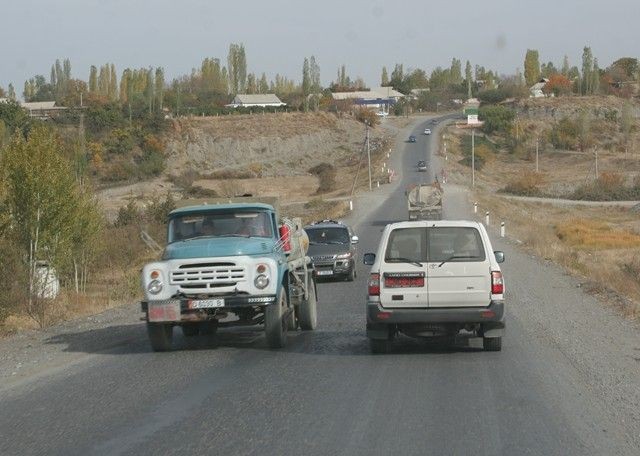
BISHKEK (TCA) — The number of traffic accidents has increased dramatically in Kyrgyzstan over the last 10 years, with 11,553 people killed, including 958 children.

For the first 10 months of 2017, 695 people died in road accidents in Kyrgyzstan, 24.kg news agency reported citing the Kyrgyz Ministry of Internal Affairs.

Last month, during the presidential election campaign, Kyrgyzstan’s Vice Prime Minister Temir Jumakadyrov with his driver and assistant were killed in a road accident, when a Kamaz truck hit their car near the capital, Bishkek. The Kamaz driver had crossed into the oncoming traffic lane which resulted in a deadly head-on crash.

The peak of auto-accidents in Kyrgyzstan is summer, says a local safety expert, Artur Medetbekov.

According to him, there are many reasons contributing to this sad number of traffic accidents on Kyrgyz roads. These are the increasing number of cars, irresponsible behaviour of drivers who do not follow the traffic rules (especially young drivers), drunk drivers, the lack of patrolling police officers and corruption among them, and the natural conditions of Kyrgyzstan.

“Most of Kyrgyzstan is mountains. People die from landslides and snowslides in Too-Ashuu, Ala-Bel, Otmok mountain passes every year,” says Artur Medetbekov. Every winter and spring, landslides and avalanches are a usual phenomenon at mountain passes.

The expert also mentioned that another reason for high numbers of injuries and deaths from road accidents is right-handed cars. The Kyrgyz roads have been designed for left-handed cars. But a local activist, Aibek Baratov, believes that the right-handed cars are not to be blamed for the increase in road accidents. “If a person drives badly in a right-handed car, he still will be doing the same thing in a left-handed car,” he said, adding that the number of road accidents has decreased in the last couple of years thanks to social media users who have recorded the bad behaviour of drivers on roads and shamed them online.

Dastan Bekeshov is a parliamentarian who has been raising this issue in the Kyrgyz parliament. The MP suggested tougher punishment of bad drivers by introducing penalties up to a million som (nearly US $15,000). Also, such drivers might lose their driver’s license for up to 3 years if Bekeshov’s proposal finds support. But it is at the stage of discussion only and haven’t gone any further yet.

How do Kyrgyz drivers obtain their driver’s licenses?

In Kyrgyzstan, there are no probationary plates. In order to obtain a driver’s license, you need to attend a 3.5-month long drivers’ school. After that, you need to take a traffic rules and a driving test. But many fail in those tests. Unfortunately, many drivers prefer buying a license, as corruption is widespread in the driver’s schools and road police department.

According to Aibek Baratov, raising penalties will help solve the problem partly but not completely. “We need to solve this issue comprehensively,” the activist says.
Central Asian countries sign cooperation program at EU-Central Asia meeting

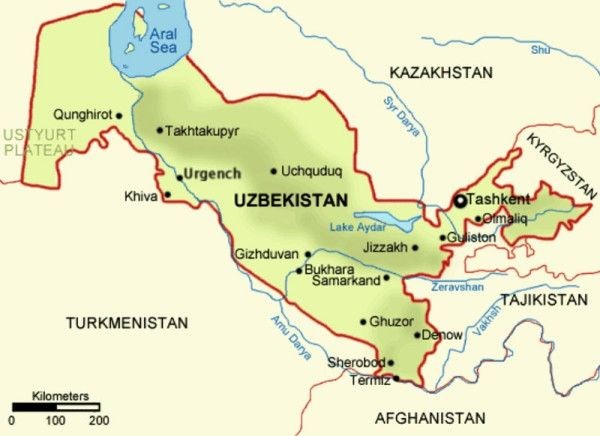
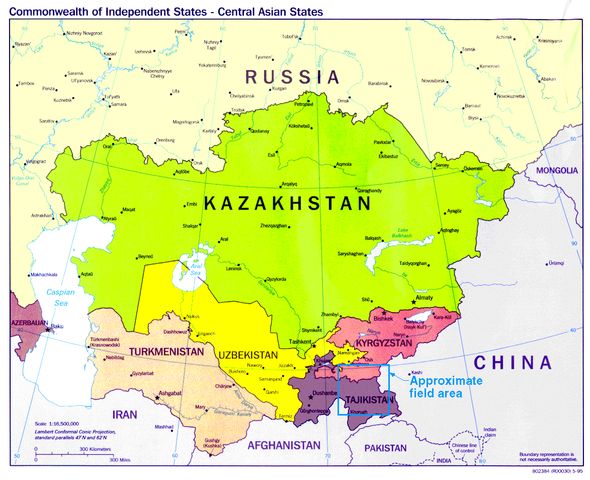
BISHKEK (TCA) — The Foreign Ministers of Kazakhstan, Kyrgyzstan, Tajikistan, Turkmenistan, and Uzbekistan, the European Union’s (EU) High Representative for Foreign Affairs and Security Policy and Vice-President of the European Commission, and the European Commissioner for International Cooperation and Development met on 10 November in Samarkand, Uzbekistan, for the 13th EU-Central Asia Ministerial Meeting.

During the meeting, the foreign ministers of the five Central Asian nations signed a Program on Mutual Cooperation for 2018-2019, which outlines joint efforts to boost security, trade and economic cooperation, investment, transportation, energy, tourism, and culture across the region, the Kazakh Foreign Ministry said.

The Participants of the EU-Central Asia Ministerial Meeting addressed regional and international issues of mutual interest, the security situation in and around Central Asia including Afghanistan, and the security challenges facing the European Union. In this regard they welcomed the support provided to Afghanistan by the countries of the region and the EU and called for continuing relevant common efforts, the European External Action Service said.

The Participants also focused on the potential for enhanced economic relations between the EU and the Central Asian countries. Strengthening the nexus between security, migration, climate change and economic sustainable development could contribute to stronger economies. Transparent rules and regulations, as well as increased use of e-governance solutions, are important for a favourable investment climate and private sector development in the countries of Central Asia, which will promote the region’s further sustainable economic development, the EEAS said.

It added that particular attention should be paid to enhancing Central Asia’s economic, transit and transport potential, which will require the implementation of programmes aimed at improving the investment climate, ensuring sustainable economic growth, effective border management, developing human capital through education and supporting small- and medium-sized businesses and employment.

The Foreign Ministers welcomed the European Union’s commitment to a relationship with Central Asia based on the principles of responsibility and cooperation and aimed at assisting the stable, secure and sustainable development of this region. They welcomed the European Union’s continued financial support amounting to €1 billion for programmes to be implemented in Central Asia until 2020. They also welcomed the involvement of EU Member States in regional and bilateral development programmes.

The five Foreign Ministers also welcomed the call by the EU Foreign Affairs Council for a new EU Central Asia Strategy by the end of 2019, which should be based on mutual interests, common approaches and values of the EU and countries of the region.

Investment opportunities of Kazakhstan and AIFC presented in London

ASTANA (TCA) — Investment opportunities of Kazakhstan and Astana International Financial Center (AIFC) were presented on November 9 to government and private business officials of Great Britain during the Kazakh-British Investment Forum in London City, the official website of the Prime Minister of Kazakhstan reported.

The event was organized by London City Corporation, AIFC and National Company Kazakh Invest, and supported by Kazakhstan’s Embassy in the UK.

During the Forum, welcome speeches were delivered by Ambassador of Kazakhstan to the UK Yerlan Idrissov, Ambassador of Great Britain to Kazakhstan Caroline Brown, AIFC Governor Kairat Kelimbetov, and Deputy Chairman of the Board of Kazakh Invest Birzhan Kaneshev, as well as London City Lord Mayor Andrew Parmly and Trade Envoy of the UK Prime Minister to Kazakhstan, Baroness Emma Nicholson.

Yerlan Idrissov noted in his speech that for 25-year history of cooperation, the status of relationships between Kazakhstan and Great Britain reached the level of strategic partnership.

“Based on strong and trusting relations, our countries actively cooperate in the implementation of such priority projects as creation and development of AIFC, the program of privatization of Kazakhstan’s national companies, interaction within the framework of the Chinese initiative One Belt, One Road,” the Kazakh ambassador to Great Britain said.

Ambassador of Great Britain to Kazakhstan Caroline Brown said that “International confidence is a key to success of Astana International Financial Center. The more investors from Great Britain and other countries and a variety of economic sectors consider the investment opportunities in Kazakhstan, the more will be the role of AIFC in providing financial and juridical services that investors will need.”

Kairat Kelimbetov, the Governor of AIFC, mentioned during his speech that the platform being built provides for numerous privileges for investors and those advantages should be supportive in creating comfortable conditions of investment inflow to Kazakhstan.

“AIFC is well placed to become a Eurasian gate providing trade and financial flows between East and West countries,” Kelimbetov said.

Deputy Chairman of Kazakh Invest Birzhan Kaneshev said that “The total direct investments volume from the UK to Kazakh economy exceeds $12 billion. According to the National Investment Strategy of Kazakhstan, Great Britain is one of the high-priority countries in the context of investment attraction, which makes collaboration between our countries even stronger.”

EU ready to start talks on new bilateral agreement with Kyrgyzstan

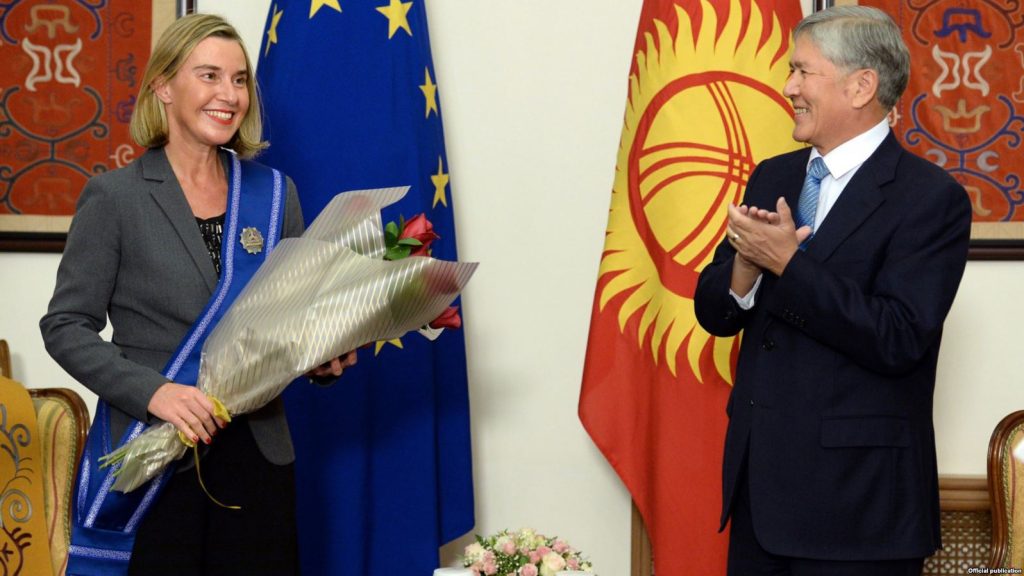
BISHKEK (TCA) — On November 9, the High Representative of the European Union for Foreign Affairs and Security Policy/Vice-President of the European Commission, Federica Mogherini, paid a visit to Kyrgyzstan and held talks with outgoing President Almazbek Atambayev, President-elect Sooronbai Jeenbekov and Prime Minister Sapar Isakov. She was also awarded the Order of Friendship of the Kyrgyz Republic by President Atambayev for her contribution to the development of EU-Kyrgyzstan cooperation.

Continue reading

EBRD underlines commitment to Uzbekistan

TASHKENT (TCA) — The European Bank for Reconstruction and Development (EBRD) is ready to increase its engagement in Uzbekistan. In a speech in the capital Tashkent the Bank’s First Vice President Phil Bennett praised reforms in the Central Asian country in recent months and emphasised the importance of economic integration: “Integration allows countries to opt into institutional arrangements of a high standard, and more generally, acts as a discipline on governance, legal, regulatory and other institutions,” the EBRD press office reported on November 9.

For the Uzbek economy to make further progress in mobilising investment is key, Mr Bennett stressed. A crucial role in this falls to attracting foreign direct investment: “FDI provides, through acquisition of business or assets or starting an enterprise, the closest link to the host country, and thus the greatest impact,” the EBRD First Vice President said.

To attract long-term and committed investment three factors stand out: market potential, business opportunities and an enabling environment. “The first two factors are clearly present in Uzbekistan. It would be a miss to overlook the third!” Mr Bennett stressed. With the recent liberalisation of currency conversion “a key step has been taken,” he said, but also warned: “There is more to be done.”

Following the recent developments in Uzbekistan the EBRD has welcomed the opportunity to reengage in the country and followed this up with rapidly developing new projects. The Bank opened a new office in Tashkent on November 8. In addition, First Vice President Bennett signed three projects for a total value of US$ 120 million with local companies during his stay in Uzbekistan this week.

More investments are in preparation: “We have a strong pipeline of projects across many sectors which we will be implementing in the coming year,” Mr Bennett said.
About Uzbekistan’s prospects he added: “I cannot but think of the exceptional legacy of the Silk Road, which for centuries brought people together in peace across continents, regardless of religion and race, to trade with each other. The spirit of the Silk Road is alive today, 500 years later.”

The speech at Westminster International University in Tashkent was one of the highlights of Mr Bennett’s visit to Uzbekistan this week, his first stay in the country where he met Prime Minister Abdulla Aripov and other senior officials.

The new EBRD office in Uzbekistan is headed by Associate Director Alkis Vryenios Drakinos and supports the expansion of the Bank’s operations in the country. The EBRD’s near-term objectives in Uzbekistan are to support domestic small and medium-sized enterprises and promote trade finance and cross-border cooperation, as well as to facilitate FDI and support the government’s reform efforts, including those aimed at improving the investment climate.

Mr Bennett will conclude his visit to Uzbekistan with a speech at the International Conference on Security and Sustainable Development in Central Asia in Samarkand on November 11.