

• KZT/USD = 0.00226
  • TJS/USD = 0.10820
  • UZS/USD = 0.00009
  • TMT/USD = 0.29760
  • KZT/USD = 0.00226
  • TJS/USD = 0.10820
  • UZS/USD = 0.00009
  • TMT/USD = 0.29760
  • KZT/USD = 0.00226
  • TJS/USD = 0.10820
  • UZS/USD = 0.00009
  • TMT/USD = 0.29760
  • KZT/USD = 0.00226
  • TJS/USD = 0.10820
  • UZS/USD = 0.00009
  • TMT/USD = 0.29760
  • KZT/USD = 0.00226
  • TJS/USD = 0.10820
  • UZS/USD = 0.00009
  • TMT/USD = 0.29760
  • KZT/USD = 0.00226
  • TJS/USD = 0.10820
  • UZS/USD = 0.00009
  • TMT/USD = 0.29760
  • KZT/USD = 0.00226
  • TJS/USD = 0.10820
  • UZS/USD = 0.00009
  • TMT/USD = 0.29760
  • KZT/USD = 0.00226
  • TJS/USD = 0.10820
  • UZS/USD = 0.00009
  • TMT/USD = 0.29760
28 September 2026

Viewing results 1 - 6 of 3

Astana’s WIPO City of Innovation Bid Reaches Final 15

Astana  is the only Central Asian city among 15 finalists for the inaugural World Intellectual Property Organization (WIPO) City of Innovation Award. WIPO, a specialized agency of the United Nations (UN), announced the finalists on September 22. Shanghai, Moscow, and Liverpool are among the other cities competing for the award. The award focuses on what cities pledge to do over the following 12 months rather than what they have already achieved. Judges consider the ambition of those plans, how well they fit each city’s circumstances, and whether they can realistically be carried out. Astana’s submission is heavily focused on technology. The city proposes an artificial intelligence- and data-enabled Smart City platform and a single digital gateway for personalized public services, alongside projects intended to improve accessibility and sustainability. Those plans build on several years of investment in the capital’s digital infrastructure. Astana has been selected three times for the Intelligent Community Forum’s Smart21 Communities of the Year, in 2015, 2017, and 2023. The program recognizes cities and regions using connectivity, technology, and knowledge-based development to improve their economies and communities. A much larger smart-city project began in February 2025 when the city signed a six-year, $190 million agreement with Presight to introduce artificial intelligence across urban infrastructure, traffic management, and public services. The project includes a digital twin of the capital, bringing together information from city systems and sensors to support planning and day-to-day management. The project is being developed alongside a wider technology ecosystem. As The Times of Central Asia has reported, Astana Hub has more than 2,200 companies in its ecosystem, while the Alem.ai International Artificial Intelligence Center brings together startups, researchers, technology companies, and government projects. Presight opened its first Central Asian research and development laboratory at Alem.ai in October 2025, with smart-city applications among its areas of work. The WIPO nomination comes as Astana rolls out a model of city management built around artificial intelligence, connected infrastructure, and data. An independent international jury will choose up to three winners. They will be announced on October 12 at WIPO headquarters in Geneva, on the margins of the sixth UN Forum of Mayors.

Kazakhstan Turns from Pipelines to Processors

Kazakhstan’s strategic plan for advanced computing represents a diversification of its traditional oil, gas, and transit profile and of the wider national economy. A $2 billion Nvidia-linked initiative now turns on three main elements. First is a national supercomputer using Nvidia H200 chips, with headline AI performance around 2 exaflops. Second is a planned 100 MW data-center campus, designed to expand capacity for commercial users over several years. Third is a “sovereign AI hub” concept that promises long-term chip access for sensitive public-sector workloads. Prior to this package, Kazakhstan had already moved unusually quickly to build high-end AI and computing infrastructure, treating digital capacity as central to its development policy. The national supercomputer is now the most powerful system in Central Asia and is housed in a Tier III state data center intended for use by universities, startups, and corporate tenants. The hardware push accompanies a wider digital policy agenda, including new training programs with Nvidia to expand the country’s AI talent base. Parallel initiatives with the United States seek to anchor Kazakhstan more firmly within Western regulatory and connectivity frameworks, as part of a broader attempt to move beyond hydrocarbons and build domestic capability in computation-heavy activities. Kazakhstan’s New AI Statecraft Astana is presenting the Nvidia package as an economic instrument, not just a hardware upgrade. Senior officials now describe advanced computing as a new pillar of national development, on a par with hydrocarbons and transit. Recent policy statements frame AI and digital infrastructure as central, not a side theme of “innovation” policy. In parallel, the long-running “Digital Kazakhstan” agenda has moved from e-government and broadband roll-out into a second phase where data centers, national platforms, and specialized training come to the foreground. Within that shift, “sovereign AI” is becoming a core organizing idea. Officials and local specialists talk about national language models that can handle Kazakh, Russian, and other regional languages, and about keeping sensitive public-sector data on infrastructure under national jurisdiction. The new supercomputer and the sovereign AI hub are presented as the place where that work will happen at scale: training and serving models for government services, regulatory tasks, and domestic firms, rather than relying entirely on foreign platforms. The Nvidia partnership is therefore framed as a way to secure long-term access to leading chips for these “sovereign” workloads, even as global export rules tighten. The same initiative also underwrites a shift in Kazakhstan’s self-presentation from a “pipeline corridor” to Kazakhstan as a corridor for data and high-end digital services. The government has begun to link the sovereign AI hub and supercomputer to a set of fiber-optic projects across the Caspian that aim to tie Central Asia more tightly into Eurasian data routes. The same geography that once made Kazakhstan a crucial link for oil, gas, and rail freight can now make it a regional conduit for digital traffic and AI-enabled services. Kazakhstan is also using the package to deepen a specific diplomatic track with the United States. Joint announcements and working groups on digital transformation,...

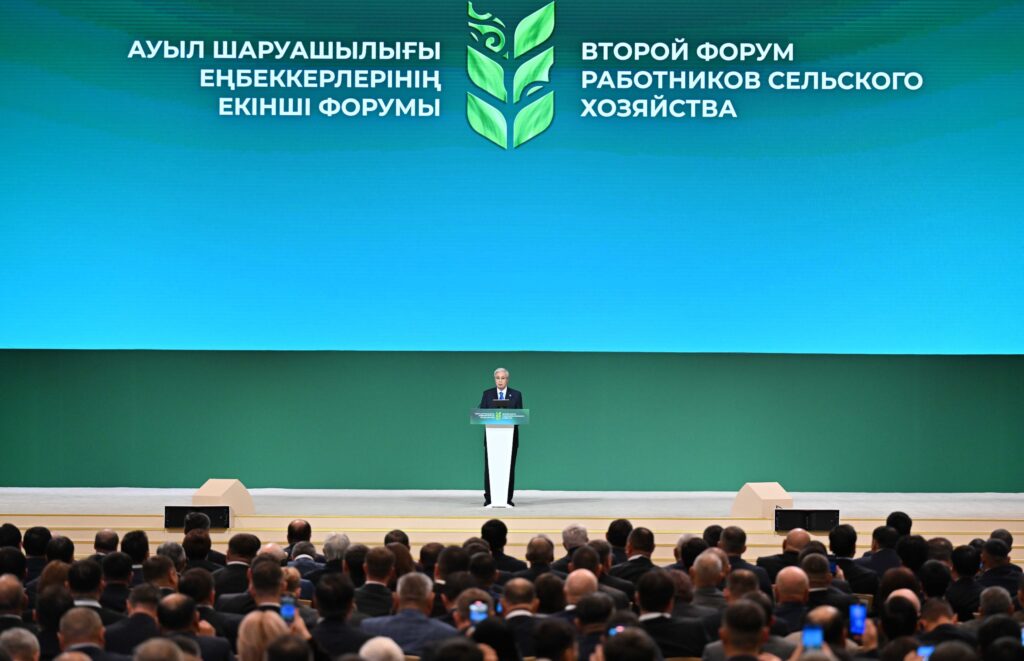
Tokayev Proposes Linking Farm Subsidies to Advanced Technologies

Kazakhstan’s President Kassym-Jomart Tokayev has proposed that state support for farmers be tied to their adoption of advanced technologies, including artificial intelligence (AI). The proposal was made during his speech at the country’s second Agricultural Workers Forum. Tokayev noted that while many farms are already using innovations such as smart farming systems, agricultural drones, satellite monitoring, and AI, technological development at the national level remains uneven. “We must move from isolated ‘smart’ solutions to full-scale digital agricultural production,” Tokayev stated. “Every farm should be incentivized to adopt digital technologies. State support should be directed toward those enterprises implementing innovations, including artificial intelligence.” Tokayev also reported that preferential lending to the agricultural sector has exceeded $1.9 billion in 2025, ten times more than five years ago. He stressed that the adoption of innovative technologies must extend beyond producers to include the regulatory authorities overseeing the agro-industrial sector. “It is necessary to develop an effective system for tracking and controlling state grain reserves using digital technologies and AI tools,” he said. “This requires modernizing existing grain elevators and constructing new, modern facilities. In state-backed financing programs for private elevators, having electronic systems for grain intake and dispatch should be a mandatory requirement.” Tokayev also highlighted persistent issues in agricultural data systems, which he described as fragmented and lacking integration. This, he said, results in policy decisions based on unreliable statistics. He called for comprehensive, objective data to be provided by the upcoming National Agricultural Census, which should serve as the foundation for updating digital infrastructure across the agro-industrial complex. Previously, The Times of Central Asia reported that Kazakhstan achieved a record harvest this year of grains, oilseeds, and legumes.
