
• KGS/USD = 0.01144 0%
  • KZT/USD = 0.00202 0%
  • TJS/USD = 0.10448 -0.19%
  • UZS/USD = 0.00008 0%
  • TMT/USD = 0.28490 0%
  • KGS/USD = 0.01144 0%
  • KZT/USD = 0.00202 0%
  • TJS/USD = 0.10448 -0.19%
  • UZS/USD = 0.00008 0%
  • TMT/USD = 0.28490 0%
  • KGS/USD = 0.01144 0%
  • KZT/USD = 0.00202 0%
  • TJS/USD = 0.10448 -0.19%
  • UZS/USD = 0.00008 0%
  • TMT/USD = 0.28490 0%
  • KGS/USD = 0.01144 0%
  • KZT/USD = 0.00202 0%
  • TJS/USD = 0.10448 -0.19%
  • UZS/USD = 0.00008 0%
  • TMT/USD = 0.28490 0%
  • KGS/USD = 0.01144 0%
  • KZT/USD = 0.00202 0%
  • TJS/USD = 0.10448 -0.19%
  • UZS/USD = 0.00008 0%
  • TMT/USD = 0.28490 0%
  • KGS/USD = 0.01144 0%
  • KZT/USD = 0.00202 0%
  • TJS/USD = 0.10448 -0.19%
  • UZS/USD = 0.00008 0%
  • TMT/USD = 0.28490 0%
  • KGS/USD = 0.01144 0%
  • KZT/USD = 0.00202 0%
  • TJS/USD = 0.10448 -0.19%
  • UZS/USD = 0.00008 0%
  • TMT/USD = 0.28490 0%
  • KGS/USD = 0.01144 0%
  • KZT/USD = 0.00202 0%
  • TJS/USD = 0.10448 -0.19%
  • UZS/USD = 0.00008 0%
  • TMT/USD = 0.28490 0%

Viewing results 1 - 6 of 4

Kazakh and Chinese Universities Sign Over 20 New Cooperation Agreements

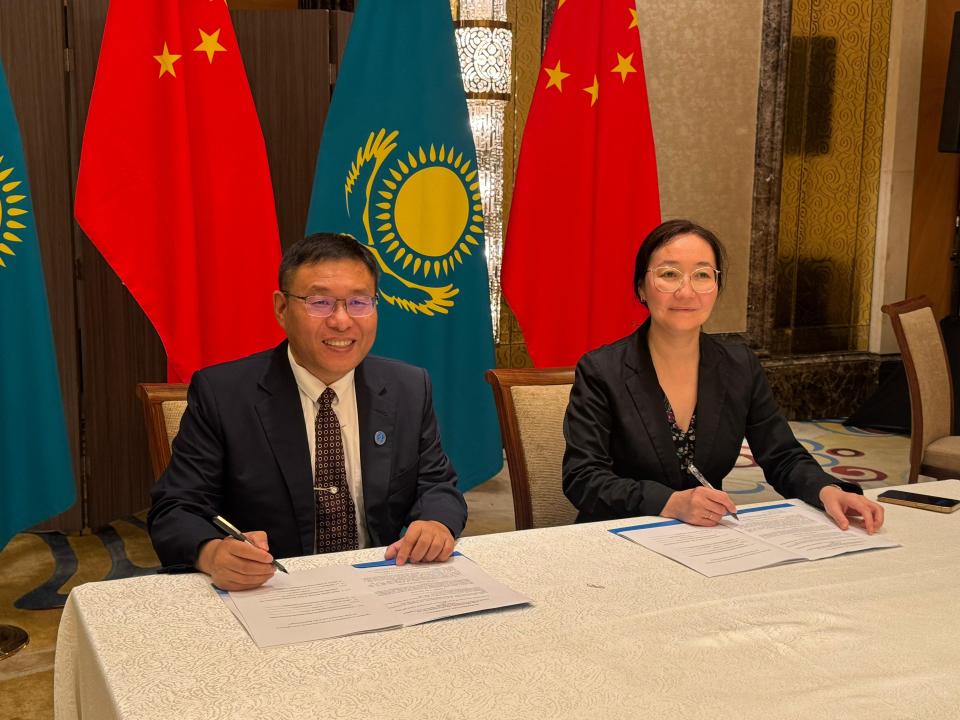
At the Kazakhstan-China Business Council meeting held in Beijing on September 2, leading universities from both countries signed more than 20 new agreements aimed at deepening cooperation in education, science, and innovation, according to the Kazakh Ministry of Science and Higher Education. The wide-ranging agreements span areas such as artificial intelligence, robotics, water resource management, and dual degree programs, highlighting the growing strategic role of academic and research collaboration in the Kazakhstan-China partnership. Among the most significant developments was the establishment of the Kazakh-Chinese Scientific and Technological Alliance on Spatio-Temporal Artificial Intelligence. The alliance includes the National Academy of Sciences of Kazakhstan, the Kazakh National Agrarian Research University, Zhejiang University of Technology, and Zhejiang Zhonghe Technology Co., Ltd. A joint laboratory will also be launched as part of the Belt and Road Initiative. Al-Farabi Kazakh National University (KazNU) signed an agreement with Chinese investment and development firm Yuan Zhen to jointly design and produce unmanned aerial vehicles. KazNU also partnered with Jiangsu Huibo Robotics Technology Co., Ltd. to inaugurate the International Institute of Digital Technologies and Robotics, along with a Robotics Center dedicated to training the next generation of engineers. In Almaty, the Technological University signed an agreement with Beijing Technology and Business University to create the Kazakhstan-China Center for Technology and Innovation Development. Meanwhile, the Kazakh National University of Water Resources and Irrigation and the North China University of Water Resources and Electric Power (NCWU) agreed to collaborate on sustainable water management. In the digital sphere, Astana IT University signed a memorandum of cooperation with Tus-Holdings, a science park affiliated with Tsinghua University, focusing on information technology, artificial intelligence, and startup incubation. Multiple institutions expanded joint academic offerings. Gumilyov Eurasian National University, Abylkas Saginov Karaganda Technical University, ALT University, and Uzbekali Zhanibekov South Kazakhstan Pedagogical University all signed agreements with top Chinese universities to launch dual bachelor’s and master’s degree programs. In the energy sector, the Atyrau University of Oil and Gas and Liaoning Petrochemical University will establish the Kazakhstan-China International Engineering School and a joint international laboratory. Additionally, Astana International University and Beijing Language and Culture University agreed to open a branch campus of the Chinese university in Kazakhstan. These agreements underscore the strategic role of higher education and scientific cooperation in advancing Kazakhstan-China relations, particularly within the framework of the Belt and Road Initiative.
Uzbekistan and Afghanistan Sign $243 Million Power Transmission Deal

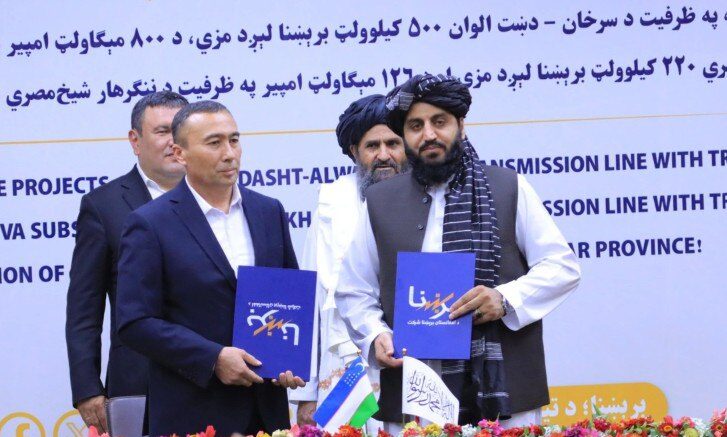
Afghanistan and Uzbekistan have signed four contracts worth $243 million aimed at expanding power transmission infrastructure and building new substations, according to Da Afghanistan Breshna Sherkat (DABS), Afghanistan’s state-owned utility company. The agreements were concluded between DABS and Uzbekistan’s Ministry of Energy, represented by Nego Energy and Uz Energy. Key components of the project include the extension of the 500-kilovolt Surkhan-Dasht Alwan transmission line, designed to carry up to 1,000 megawatts, the expansion of the Arghandeh substation to 800 megavolt-amperes (MVA), the construction of a new Sheikh Mesri substation in Nangarhar Province, and the extension of the 220-kilovolt Kabul-Nangarhar (Sheikh Mesri) line. The signing ceremony took place in Kabul and was attended by high-ranking officials, including Deputy Prime Minister for Economic Affairs Mullah Abdul Ghani Baradar Akhund, Head of the General Directorate of State-Owned Corporations Mawlawi Ahmad Jan Bilal, and members of the press. Describing the projects as “vital for ensuring reliable electricity services,” DABS CEO Dr. Abdul Bari Omar said the upgrades would support Afghanistan’s commercial, industrial, and agricultural development. Uzbekistan’s Minister of Energy, Jurabek Mirzamakhmudov, stressed that the initiative demonstrates “strong joint cooperation and continuous efforts by the leaders of the two friendly nations,” and pledged close collaboration on the implementation phase. In addition to the infrastructure deals, DABS also signed a separate long-term agreement with Uzbek companies to purchase electricity over a ten-year period, helping to stabilize Afghanistan’s power grid. As previously reported by The Times of Central Asia, DABS has entered into or prepared agreements for domestic energy generation projects totaling 1,070 megawatts over the past 11 months. Foreign partners are financing 70% of the estimated $1.01 billion investment. Afghanistan currently generates approximately 250 MW of electricity domestically and imports 800 MW from neighboring countries, Turkmenistan, Iran, Uzbekistan, and Tajikistan, at an annual cost of $250-280 million. Officials estimate national electricity demand at 6,000 to 7,000 MW, with the potential to reach 10,000 MW as industrial output grows.

Kazakhstan Signals Early Review of Oil Production Sharing Agreements

The question of revisiting Kazakhstan’s production-sharing agreements (PSAs) with foreign oil companies is once again gaining prominence both within the country and internationally. While the Ministry of Energy is formally responsible for managing these contracts, growing pressure is coming not only from civil society but also directly from President Kassym-Jomart Tokayev, who has publicly questioned the long-standing terms of these deals since 2022. Confidential Terms, Public Scrutiny Recent revelations have further fueled this debate. The International Consortium of Investigative Journalists (ICIJ) recently detailed the ongoing arbitration dispute between Kazakhstan and the North Caspian Operating Company (NCOC), which manages the Kashagan field. The stakes are high: $160 billion is under contention. Yet what shocked the Kazakh public most was not the litigation itself, but that the state receives just 2% of the field’s profits, with a staggering 98% flowing to foreign stakeholders. Such findings offer context for why the Ministry of Energy is reluctant to release details of these 1990s-era agreements, originally negotiated with significant involvement from Kazakhstan’s first president, Nursultan Nazarbayev. In a recent court case, the ministry successfully blocked a lawsuit by Vadim Ni, founder of the Save the Caspian Sea movement, who demanded public disclosure of PSA terms affecting environmental interests in the Caspian. The ministry argued that Kazakhstan’s adherence to international confidentiality clauses is essential to avoid multibillion-dollar lawsuits and maintain its reputation as a stable investment destination. However, the ministry also emphasized that confidentiality does not shield violators from environmental penalties. Calls for transparency and revision have come from various quarters. Members of the Ak Zhol party and the Parasat Business Alliance have joined the chorus, urging the government to review the PSAs. In this context, President Tokayev’s consistent remarks suggest a coordinated state policy shift. A Change in Presidential Tone Tokayev first broached the subject in a 2022 interview with Russia 24, reflecting on the constraints Kazakhstan faced during the early years of independence. At the time, the country had no legal framework for foreign investment and had to rely on companies like Chevron to develop its energy sector. The president acknowledged the success of some ventures but also suggested the need for a “correction” to reflect current realities. Fast forward to 2023, and the government launched a $5 billion lawsuit against NCOC over alleged environmental violations. Although Kazakhstan has been temporarily barred from collecting the fines pending arbitration, the case marks a significant escalation. In April 2024, the Parasat Business Alliance held a public briefing demanding more local participation in procurement contracts tied to oil fields such as Karachaganak, Kashagan, and Tengiz. Kazakh companies reportedly receive less than 5% of $12 billion in annual procurements, a figure viewed as unacceptable by domestic businesses. By January 2025, Tokayev’s rhetoric had hardened. Speaking at an expanded government meeting, he instructed his cabinet to actively renegotiate PSA terms before their expiration. "The implementation of these agreements has helped Kazakhstan become a reliable global energy supplier,” he said, “but large investments require updated terms that benefit our nation.”...

Uzbekistan and Kuwait Strengthen Ties with Landmark Agreements During President Mirziyoyev’s Visit

Uzbekistan’s President Shavkat Mirziyoyev visited Kuwait on February 17 at the invitation of Emir Sheikh Meshal Al-Sabah. The two leaders met at Bayan Palace in Kuwait City to discuss ways to strengthen bilateral ties. During the meeting, Mirziyoyev expressed gratitude for the Emir’s warm welcome and extended congratulations to the people of Kuwait on their upcoming national holidays. He also praised Kuwait’s progress under its Vision 2035 program, noting that its objectives align with Uzbekistan’s long-term development plans. Following their discussions, the leaders adopted a joint statement on enhancing Uzbek-Kuwaiti cooperation. Several agreements were signed, including: Agreement on cooperation in industry Protocol to the Agreement on Air Services Agreement on labor cooperation Agreement on the development of “smart” cities Agreement on cooperation in arts and culture Agreement on healthcare collaboration Tourism cooperation program for 2025-2027 Cooperation agreement with the Kuwait Fund for Arab Economic Development These agreements mark a new phase in Uzbekistan-Kuwait relations, fostering closer collaboration in key economic and social sectors.
