• KGS/USD = 0.01144 0%
  • KZT/USD = 0.00205 0%
  • TJS/USD = 0.10785 0.09%
  • UZS/USD = 0.00008 0%
  • TMT/USD = 0.28571 0.28%
  • KGS/USD = 0.01144 0%
  • KZT/USD = 0.00205 0%
  • TJS/USD = 0.10785 0.09%
  • UZS/USD = 0.00008 0%
  • TMT/USD = 0.28571 0.28%
  • KGS/USD = 0.01144 0%
  • KZT/USD = 0.00205 0%
  • TJS/USD = 0.10785 0.09%
  • UZS/USD = 0.00008 0%
  • TMT/USD = 0.28571 0.28%
  • KGS/USD = 0.01144 0%
  • KZT/USD = 0.00205 0%
  • TJS/USD = 0.10785 0.09%
  • UZS/USD = 0.00008 0%
  • TMT/USD = 0.28571 0.28%
  • KGS/USD = 0.01144 0%
  • KZT/USD = 0.00205 0%
  • TJS/USD = 0.10785 0.09%
  • UZS/USD = 0.00008 0%
  • TMT/USD = 0.28571 0.28%
  • KGS/USD = 0.01144 0%
  • KZT/USD = 0.00205 0%
  • TJS/USD = 0.10785 0.09%
  • UZS/USD = 0.00008 0%
  • TMT/USD = 0.28571 0.28%
  • KGS/USD = 0.01144 0%
  • KZT/USD = 0.00205 0%
  • TJS/USD = 0.10785 0.09%
  • UZS/USD = 0.00008 0%
  • TMT/USD = 0.28571 0.28%
  • KGS/USD = 0.01144 0%
  • KZT/USD = 0.00205 0%
  • TJS/USD = 0.10785 0.09%
  • UZS/USD = 0.00008 0%
  • TMT/USD = 0.28571 0.28%

Viewing results 1 - 6 of 770

Uzbekistan Sends Over 20 Crop Varieties to Global Seed Vault in Norway

Uzbekistan has deposited more than 20 types of agricultural crop seeds, including varieties of watermelon, melon, and eggplant, into the Svalbard Global Seed Vault, the world’s most secure seed storage facility, located in the Norwegian archipelago of Svalbard, the Ministry of Agriculture has announced. According to the ministry, the seed samples represent ancient and local Uzbek crop varieties and were delivered through a joint effort involving Uzbekistan’s Ministry of Agriculture, the Scientific Research Institute of Plant Genetic Resources, the UN Food and Agriculture Organization (FAO), and the Nordic Genetic Resource Center (NordGen). Officials say the initiative marks a significant step in Uzbekistan’s efforts to preserve genetic diversity, strengthen its national gene pool, and contribute to global food security. The seeds deposited include traditional varieties of melon, watermelon, tomato, pepper, eggplant, carrot, onion, and wheat. Among these, the native “Qayroqtosh” wheat variety is of particular cultural and agricultural importance. Representatives from the Institute of Plant Genetic Resources emphasized that the initiative reflects Uzbekistan’s ongoing commitment to protecting plant biodiversity, supporting global food resilience, and safeguarding genetic material for future generations. The Svalbard Global Seed Vault, located deep within the Arctic permafrost and maintained at a constant temperature of -18°C, currently stores more than 1.1 million seed samples from around the world. Operated by the Norwegian government in partnership with the Crop Trust and NordGen, the vault provides a secure backup for global seed collections, offering protection against threats such as climate change, natural disasters, or geopolitical crises.

Glacier-Dependent Central Asian States to Benefit from ADB Climate Program

On October 29, the Green Climate Fund approved $250 million for Glaciers to Farms, a major adaptation initiative led by the Asian Development Bank (ADB) to build climate-resilient water and agricultural systems in glacier-dependent regions of Central Asia, the South Caucasus, and Pakistan. The funding, provided mostly as grants, will complement a broader $3.25 billion investment by ADB over the next decade. The program spans nine countries: Armenia, Azerbaijan, Georgia, Kazakhstan, Kyrgyzstan, Pakistan, Tajikistan, Turkmenistan, and Uzbekistan. These states rely heavily on glacier- and snow-fed rivers for agriculture, drinking water, and electricity. Accelerated glacial melt poses a direct threat to ecosystems and rural livelihoods, particularly in areas where one in four jobs depends on agriculture. By improving irrigation efficiency, expanding water storage, and investing in watershed management, the program seeks to reduce the growing frequency of droughts and floods linked to glacial melt. Glaciers to Farms will focus on four major glacier-fed river basins: the Naryn and Pyanj in Central Asia, the Kura in the South Caucasus, and the Swat in Pakistan. These basins cover about 27 million hectares and are home to an estimated 13 million people. The program will support glacier and climate assessments, upgrade monitoring networks, and introduce early warning systems to help communities prepare for glacial lake outburst floods and prolonged droughts. Beyond infrastructure, Glaciers to Farms will strengthen the capacity of local banks to finance agricultural enterprises, particularly those led by women, as part of its inclusive development approach. Climate-induced glacial retreat is a pressing concern for Central Asia, where glaciers supply up to 70 percent of river flows. The region contains more than 4,500 glacial lakes, many formed as a result of retreating ice. These lakes increase the risk of natural disasters such as lake outburst floods, avalanches, and landslides, threatening vulnerable mountain communities. Recognizing the urgency, the United Nations General Assembly has declared 2025 the International Year of Glacier Preservation. Tajikistan hosted the International Conference on Glaciers’ Preservation in Dushanbe in May, highlighting the region’s central role in global climate adaptation efforts.

Central Asia Loses 14 Million Tons of Crops Annually Due to Poor Storage Infrastructure

Each year, approximately 14 million tons of agricultural products are lost across Central Asia due to inadequate storage infrastructure, according to a recent analytical report from the Eurasian Development Bank (EDB). In Kyrgyzstan, Tajikistan, and Uzbekistan, so-called “dry warehouses” remain the norm. A significant share of produce is stored in facilities lacking the conditions necessary for long-term preservation. As a result, large volumes of crops spoil annually, especially during seasonal peaks. The EDB notes that Eurasian countries are entering a new logistics phase. The rapid growth of e-commerce and retail expansion is generating unprecedented demand for modern warehouse infrastructure. According to the bank’s projections, total demand for warehouse space in the region will double by 2040, surpassing 120 million square meters. Between 2020 and 2024, the region’s total warehouse space increased from 48 to 58 million square meters. Russia remains the dominant player, with around 53 million square meters of commercial and logistics space. Central Asian countries, however, continue to lag far behind. Crop losses peak during the autumn harvest and spring sales of residual stock. During these times, buffer storage and efficient transport logistics are critical. Without these, “farmers are forced to sell surpluses at the lowest price or throw them away,” EDB analysts warn. Experts identify the warehouse sector as a key driver of trade growth in Eurasia. Realizing this potential, however, will require coordinated action among governments, businesses, and international institutions. The report emphasizes the need for a unified institutional environment to enhance investment appeal and market transparency. “The region, which has long remained on the periphery of global logistics flows, is now shaping a new map of Eurasian logistics. In the coming years, the market will remain highly dynamic: more than 20 million square meters of new warehouse space is planned for commissioning, including 1.6 million square meters in Central Asian countries,” the report states. Kyrgyzstan serves as a case in point. In 2020, amid the COVID-19 pandemic, agriculture was the country’s only growing sector. Yet farmers struggled with oversupply, cabbage, in particular, had to be fed to livestock or discarded due to a lack of buyers and storage facilities. A similar situation unfolded with potatoes.

Kazakhstan to Maintain Grain Exports in 2025 to 2026 Season

Kazakhstan plans to maintain grain exports above 12 million tons in the 2025–2026 marketing season, Deputy Minister of Agriculture Azat Sultanov said at a recent briefing. Grain exports for the current 2024–2025 season reached a record 13.4 million tons, according to Sultanov. “Taking into account this year’s harvest, we forecast that next year’s exports will not fall below last year’s level, that is, more than 12 million tons,” he said. To date, 15.6 million hectares, 88.6% of the total planted area, have been harvested, yielding an average of 16.9 centners per hectare and producing 26.6 million tons of grain. This output will fully meet domestic needs for food, fodder, and seeds, while reinforcing Kazakhstan’s position in its traditional export markets. Wheat has been harvested from 12 million hectares, 99% of the cultivated area, at a yield of 16.5 centners per hectare, resulting in approximately 20 million tons. Barley and oats produced 2.4 million tons, and corn yielded 852,000 tons. Sultanov also noted that Kazakhstan has re-entered several previously lost markets, including Kyrgyzstan, Azerbaijan, and Armenia, where demand for Kazakh wheat is on the rise. As previously reported by The Times of Central Asia, Kyrgyzstan has increased its imports of Kazakh wheat eightfold. Licensed grain receiving enterprises have already received 6.7 million tons from the new harvest, twice the volume recorded at the same time last year. As part of efforts to diversify crop production, special attention has been given to legumes and oilseeds. This year’s legume harvest reached 1 million tons, and the country expects a record oilseed yield of about 4 million tons, of which 3.3 million tons have already been collected. Potatoes have been harvested from 99 percent of the planted area, totaling 130,000 hectares and producing 2.9 million tons. Sultanov said this volume should prevent the shortages and price surges experienced earlier this year. The vegetable harvest totaled 3.9 million tons, while melon crops reached 2.6 million tons.

Kazakhstan Expands Apple Orchards, Prioritizing Legendary Aport Variety

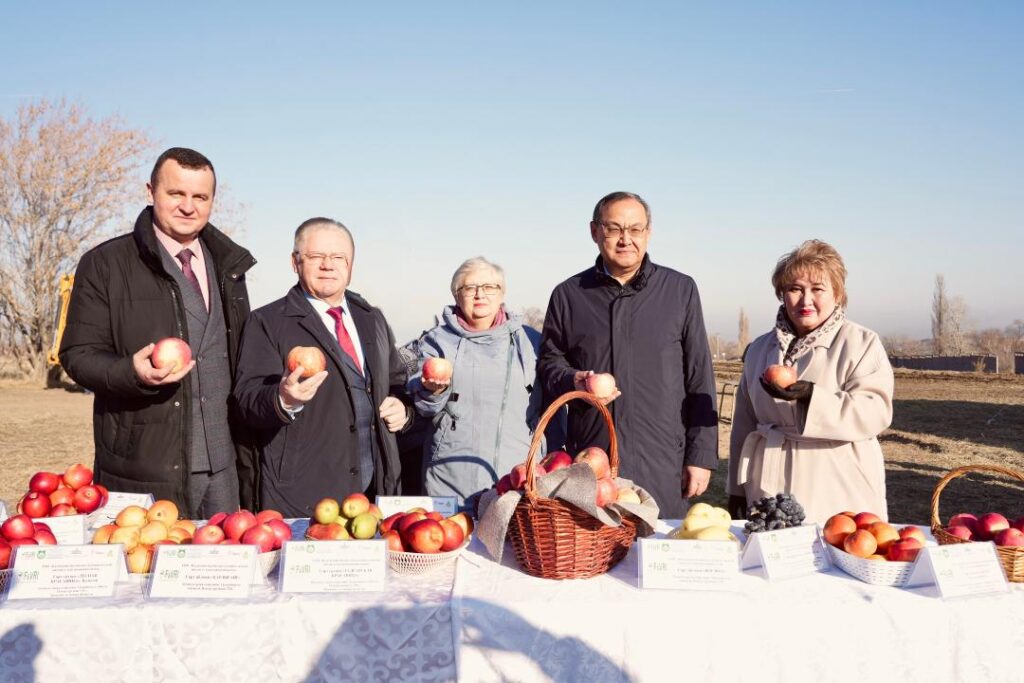
Kazakhstan’s apple orchards now span nearly 29,000 hectares, primarily in the southern regions of Almaty, Turkestan, Zhambyl, and Zhetisu. In the Almaty and Zhetisu regions alone, orchards cover more than 2,400 hectares, hosting over 416,000 apple trees. Deputy Minister of Agriculture Yerbol Taszhurekov shared these figures during the Apple Festival held in Astana on October 4. The event also marked the 80th anniversary of the Food and Agriculture Organization (FAO) and World Food Day 2025. “Horticulture is becoming a key sector in the agro-industrial complex. Since 2014, government support measures, including investment subsidies for orchard planting and intensive cultivation technologies, have led to a 43% increase in gross apple harvests and a 27% rise in yield,” Taszhurekov said. The festival placed special emphasis on Kazakhstan’s iconic apple variety, the aport. Widely recognized as the birthplace of the apple, Kazakhstan and specifically the Almaty region, is home to the legendary aport variety. Aport apples are known for their large size, fragrance, and juiciness, but they require very specific growing conditions. High-quality fruit can be cultivated only at altitudes between 850 and 1,250 meters above sea level, primarily in the Almaty foothills. Unlike other varieties that bear fruit within four to six years, aport trees take eight to nine years to produce their first harvest. Despite the longer wait, the fruit’s quality and heritage value make it highly prized. To revive aport cultivation, the Ministry of Agriculture, in partnership with the National Agrarian Scientific and Educational Center, has launched a program for 2024-2028 involving private investors and specialized nurseries. The initiative aims to produce certified saplings for full-scale commercial cultivation. In 2024, seeds from the Sievers apple tree, considered the ancestor of all domestic apples, were collected, and national standards for aport cultivation were established. In 2025, seedlings were planted on ten hectares to serve as a mother garden for nurseries. Over the next two years, the program plans to grow enough saplings to plant 100 hectares of orchards, eventually making aport saplings available to private gardeners for commercial use. Historically, Kazakhstan had 3.8 million aport trees in 1970. By 1984, that number had declined to just 1.4 million. Taszhurekov underscored that aport is not just a fruit, but a symbol of national identity. “We are taking specific measures to revive it as a national brand. Plans include expanding orchards, improving agricultural practices, and promoting this variety internationally. By 2027, we aim to establish 110 hectares of aport orchards,” he said.  

Kyrgyz Authorities Push for Expanded Winter Wheat Cultivation

The Ministry of Agriculture of Kyrgyzstan is urging the country’s agribusiness sector to expand the cultivation of winter wheat, citing its higher yields and potential to strengthen national food security. According to a recent ministry study, winter wheat yields are 20-30 percent higher than those of spring wheat. Officials noted that greater productivity could ensure more stable incomes for farmers, while year-round demand for high-quality grain provides additional incentives for cultivation. “The vegetation period of winter crops begins earlier, allowing farmers to harvest ahead of spring crops and, if necessary, secure a second harvest. This boosts agribusiness revenue. Autumn sowing also benefits from higher soil moisture, which ensures better germination and deeper plant rooting,” the ministry stated. President Sadyr Japarov has previously criticized Kyrgyzstan’s reliance on wheat imports, noting that the country currently produces only 40 percent of its domestic wheat needs. The remaining 60 percent is met through imports. During the Soviet era, Kyrgyzstan produced up to 1.5 million tons of wheat annually, exceeding its domestic demand of 1 million tons. The ministry emphasized that winter wheat cultivation has steadily declined since the early 2000s, when farmers began relying more on imported grain from Kazakhstan and later Russia. As previously reported by The Times of Central Asia, this year, Kyrgyzstan increased wheat imports from Kazakhstan eightfold due to rising prices for Russian grain. Currently, Kyrgyz farmers cultivate wheat on 250,000 hectares, producing around 650,000 tons annually. Most of this is spring wheat, which yields approximately 35 percent less than winter varieties. The ministry plans to expand the total sowing area by 100,000 hectares, prioritizing winter wheat to reduce import dependence and enhance food security.