


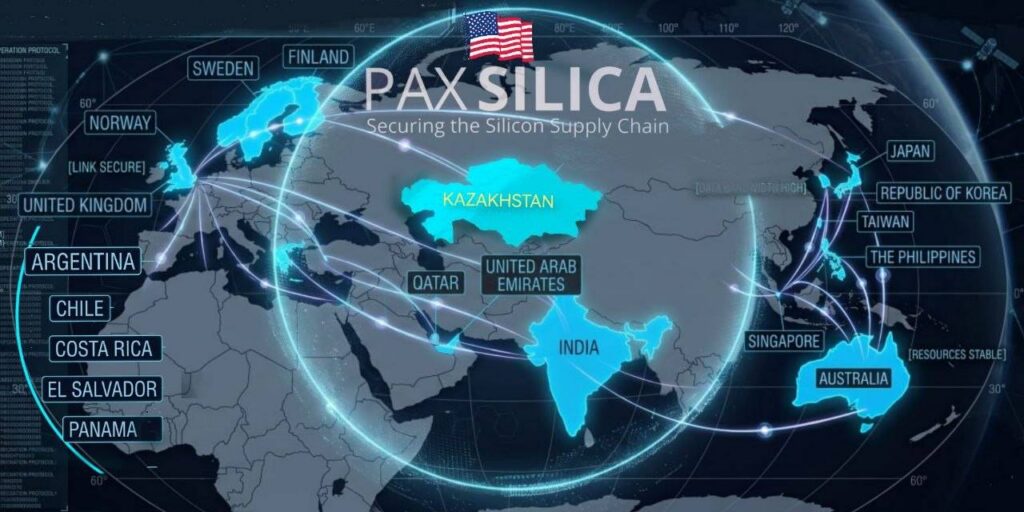
Kazakhstan’s Pax Silica Accession Bodes Well for Foreign Investment
Kazakhstan’s accession to Pax Silica is more than a diplomatic ribbon-cutting. It is an investment signal. By joining an initiative supported by the United States and built around trusted supply chains for the new artificial intelligence economy, Kazakhstan has placed itself inside one of the most important emerging conversations in global industry about who will supply the minerals, energy, computing infrastructure, data centers, talent and manufacturing capacity behind the AI boom. Kazakhstan’s official readout was explicit about that ambition. Pax Silica, it said, brings partner countries together around artificial intelligence, critical minerals, semiconductors, data centers, energy infrastructure, high-tech manufacturing, research and talent development. Kazakhstan became the first country from its region to join, with Deputy Prime Minister and Minister of Artificial Intelligence and Digital Development Zhaslan Madiyev signing the accession declaration and the AI Opportunity Partnership statement in Washington on June 25. “Behind every AI solution are energy, critical minerals, computing capacity, data centers, semiconductors, engineering talent, and secure supply chains,” Madiyev said. Pax Silica is a supply-chain coalition whereby each participant brings a piece of the AI industrial base such as chips, energy, minerals, capital, cloud infrastructure, advanced manufacturing, regulatory alignment or technical talent. Reuters has described the initiative as a U.S.-led effort to secure the supply chains behind artificial intelligence, from energy and critical minerals to high-end manufacturing and AI models. Kazakhstan’s inclusion demonstrates that the country is being viewed as a potentially significant node in the physical infrastructure of the AI economy. Why Kazakhstan Fits the Pax Silica Map Kazakhstan has existing relevance in the AI supply chain as well as the capability to expand that role. That helps explain why Kazakhstan, rather than another regional state, became the first Central Asian node to plug into Pax Silica’s trusted supply-chain architecture. The U.S. International Trade Administration says Kazakhstan has substantial reserves of rare earth elements, copper, lithium, tungsten, tantalum and other materials essential for modern technologies and the energy transition. It also notes that the country’s policy focus is shifting from raw-material exports toward value-added processing and downstream production. With regard to the energy feedstock needed to power AI data centers, Kazakhstan has been the world’s leading uranium producer since 2009 and produced about 40% of global output in 2025. Nuclear energy is returning to the strategic conversation as governments and companies look for firm, low-carbon electricity. Kazakhstan also has a proven record as a resource partner for the U.S. and the West. U.S. energy majors helped build Kazakhstan’s modern oil sector, with Chevron beginning production from a $48 billion expansion of the Tengiz oilfield in 2025. In aerospace, Kazakhstan’s Ust-Kamenogorsk Titanium and Magnesium Plant supplies major global manufacturers, including Boeing and Airbus, and officials say titanium from Kazakhstan accounts for roughly one-fifth of the global aerospace titanium market. A New Layer in U.S.-Kazakhstan Alignment Pax Silica also follows a warming trend in U.S.-Kazakhstan relations under the Trump administration. Tokayev has already framed Kazakhstan as an active participant in several U.S.-backed initiatives, including the Abraham Accords, the...
