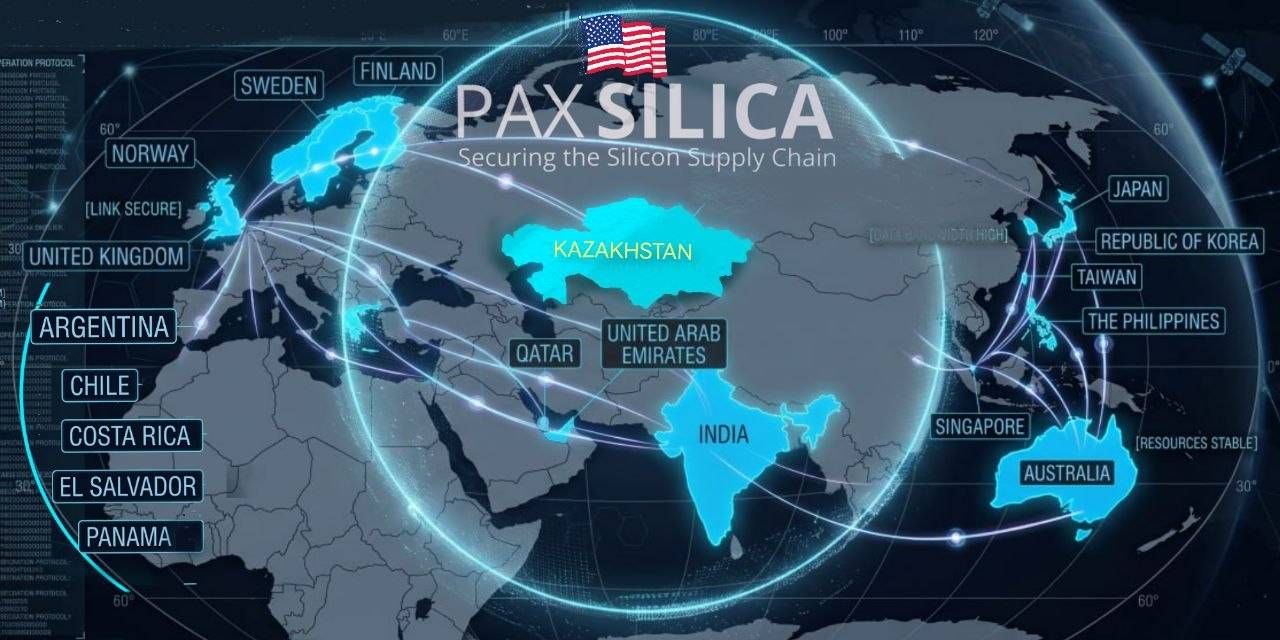
Kazakhstan’s accession to Pax Silica is more than a diplomatic ribbon-cutting. It is an investment signal. By joining an initiative supported by the United States and built around trusted supply chains for the new artificial intelligence economy, Kazakhstan has placed itself inside one of the most important emerging conversations in global industry about who will supply the minerals, energy, computing infrastructure, data centers, talent and manufacturing capacity behind the AI boom.
Kazakhstan’s official readout was explicit about that ambition. Pax Silica, it said, brings partner countries together around artificial intelligence, critical minerals, semiconductors, data centers, energy infrastructure, high-tech manufacturing, research and talent development. Kazakhstan became the first country from its region to join, with Deputy Prime Minister and Minister of Artificial Intelligence and Digital Development Zhaslan Madiyev signing the accession declaration and the AI Opportunity Partnership statement in Washington on June 25. “Behind every AI solution are energy, critical minerals, computing capacity, data centers, semiconductors, engineering talent, and secure supply chains,” Madiyev said.
Pax Silica is a supply-chain coalition whereby each participant brings a piece of the AI industrial base such as chips, energy, minerals, capital, cloud infrastructure, advanced manufacturing, regulatory alignment or technical talent. Reuters has described the initiative as a U.S.-led effort to secure the supply chains behind artificial intelligence, from energy and critical minerals to high-end manufacturing and AI models. Kazakhstan’s inclusion demonstrates that the country is being viewed as a potentially significant node in the physical infrastructure of the AI economy.
Why Kazakhstan Fits the Pax Silica Map
Kazakhstan has existing relevance in the AI supply chain as well as the capability to expand that role. That helps explain why Kazakhstan, rather than another regional state, became the first Central Asian node to plug into Pax Silica’s trusted supply-chain architecture. The U.S. International Trade Administration says Kazakhstan has substantial reserves of rare earth elements, copper, lithium, tungsten, tantalum and other materials essential for modern technologies and the energy transition. It also notes that the country’s policy focus is shifting from raw-material exports toward value-added processing and downstream production.
With regard to the energy feedstock needed to power AI data centers, Kazakhstan has been the world’s leading uranium producer since 2009 and produced about 40% of global output in 2025. Nuclear energy is returning to the strategic conversation as governments and companies look for firm, low-carbon electricity.
Kazakhstan also has a proven record as a resource partner for the U.S. and the West. U.S. energy majors helped build Kazakhstan’s modern oil sector, with Chevron beginning production from a $48 billion expansion of the Tengiz oilfield in 2025. In aerospace, Kazakhstan’s Ust-Kamenogorsk Titanium and Magnesium Plant supplies major global manufacturers, including Boeing and Airbus, and officials say titanium from Kazakhstan accounts for roughly one-fifth of the global aerospace titanium market.
A New Layer in U.S.-Kazakhstan Alignment
Pax Silica also follows a warming trend in U.S.-Kazakhstan relations under the Trump administration. Tokayev has already framed Kazakhstan as an active participant in several U.S.-backed initiatives, including the Abraham Accords, the Board of Peace and the TRIPP initiative, while describing the enhanced strategic partnership as stronger than ever. For investors, supply-chain confidence rests on more than geology and ambition. It relies on political alignment, financing channels, legal predictability and the perception that projects can survive geopolitical pressure.
The possible opening of a permanent U.S. International Development Finance Corporation (DFC) presence in Kazakhstan would add another layer. Tokayev and DFC CEO Ben Black recently discussed cooperation in critical minerals, transport connectivity, agriculture, digitalization and artificial intelligence, as well as the possibility of a permanent DFC office in Kazakhstan. Separately, DFC said its proposed Kazakhstan telecom investment would support secure digital connectivity and that it sees substantial opportunity in infrastructure, energy, critical minerals and the Trans-Caspian Corridor.
Tokayev’s Digital Agenda Meets the AI Supply Chain
Pax Silica fits a policy line Tokayev has been building for years. In his first State of the Nation address in 2019, he linked Kazakhstan’s move beyond a raw-material mindset to the knowledge economy, innovation and artificial intelligence. By 2023-2024, that ambition had become a formal AI agenda, including cooperation with global companies and universities, new institutions, AI education, and digital and AI deployment across the real economy.
The tangible infrastructure push gives the policy and regulatory agenda weight. Tokayev has backed supercomputing capacity, data centers and east-west fiber links, including Trans-Caspian connectivity, to position Kazakhstan as a digital corridor between Europe and Asia. The planned Data Center Valley in Ekibastuz is the clearest expression of that strategy. The complex includes a power-backed AI computing campus aimed at hyperscalers, cloud companies, and infrastructure investors. Recent NVIDIA and Firebird agreements, worth up to $10 billion, give the project concrete weight.
Pax Silica therefore does not introduce a new ambition for Kazakhstan. It gives an external supply-chain framework to an agenda already in motion: AI talent, compute infrastructure, connectivity and industrial deployment.
Derisking for Foreign Investors
Pax Silica gives investors a policy architecture around which deals can be financed, insured, procured and justified before corporate risk committees, boards, and public-sector finance agencies. A Kazakhstan-based project in, for example, mineral processing, grid-backed data centers, secure fiber, telecom infrastructure, advanced manufacturing or mining technology can now be framed as part of a U.S.-aligned AI supply-chain buildout, rather than as a standalone bet in a complex emerging market.
That changes the investment justification because boards can use a national-security rationale, DFC and export-credit agencies can use a mandate-compatible sector map, offtakers can make a stronger trusted-supply argument, and technology companies can gain greater comfort that projects are moving inside a recognized U.S.-led supply-chain lane.
Since Pax Silica is explicitly aimed at securing AI supply chains from energy and critical minerals to high-end manufacturing and AI models, Kazakhstan’s membership can move projects into a more financeable industrial-security category. Such projects still face execution and geopolitical risk, but they are easier to justify and syndicate after due diligence.
That financing logic also depends on Kazakhstan’s sovereign room to maneuver. In Central Asia, investors underwrite more than geology and power access. They also underwrite contracts and whether a project can remain commercially viable in a pressured neighborhood. Kazakhstan’s advantage is that it has the scale, resource base, Western investment record and diplomatic range to support U.S.-aligned supply-chain projects without being captive to any single external power. From a supply chain security perspective, Kazakhstan can offer minerals, energy, and infrastructure inside a host-state environment sturdy enough for long-term investment and independent enough to keep Western-facing projects viable.
The Test Is Execution
Pax Silica reinforces a case already being made in mining and energy circles that Kazakhstan has the raw materials and industrial base to move up the global value chain, helped by its geopolitical positioning. S&P Global Energy/Platts’ Wesley Monteiro recently told The Times of Central Asia that Kazakhstan has a credible path from mining’s second tier toward the global top tier. Pax Silica adds a new layer to that argument by placing Kazakhstan inside a curated supply-chain architecture for the next industrial economy.
Washington has already opened part of the lane. Pax Silica gives Kazakhstan a formal policy rationale for supply-chain projects. DFC engagement adds a potential financing and insurance channel, and the U.S.-Kazakhstan agenda gives firms a clearer reason to examine projects in minerals, connectivity, data infrastructure, and advanced manufacturing. Accession does not make any project bankable by itself, but it supports an investment case that already exists by placing Kazakhstan’s resources, energy base and digital ambitions inside a U.S.-aligned supply-chain framework.
That bodes well for the next phase of foreign direct investment. Kazakhstan already has a proven investment record. Pax Silica sharpens the case by tying its minerals, energy, geography, and digital infrastructure to the AI supply-chain economy. In a region drawing more attention from Washington, Beijing, Europe, and the Gulf, this gives Kazakhstan a more coherent claim to the next wave of industrial investment.