Etihad Flights to Uzbekistan Begin Daily as Almaty Service Moves to 2027
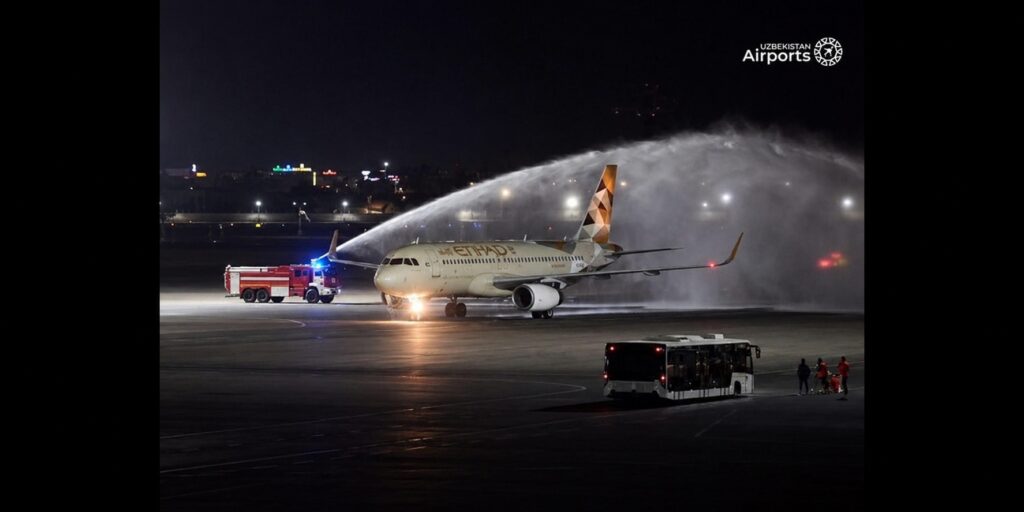
Etihad Airways has launched daily service between Abu Dhabi and Tashkent, adding Uzbekistan to its operated network. A direct service to Almaty that had been scheduled for March 2026 is now expected in 2027. Etihad's inaugural outbound flight departed Abu Dhabi on August 9 and arrived in Tashkent early on August 10. The return flight left later that morning, and the route is operated with an Airbus A320. Etihad senior vice president Jurriaan Pieter Stelder told The Times of Central Asia that the airline had studied Uzbekistan's aviation market for several years before entering it. He said the growth of local airlines and established business demand led Etihad to begin with a higher frequency than it might use in other new markets. Etihad expects the route to perform in line with its network, which recorded an average passenger load factor of 89.7% in the first two months of 2026. Stelder said the carrier expects to fill at least 140 of roughly 160 seats on each leg. The route is supported by a codeshare agreement with Uzbekistan Airways that took effect in May. Etihad customers can buy a single ticket through Tashkent to eight domestic destinations, while Uzbekistan Airways passengers can connect to Abu Dhabi on the Etihad service. The partnership allows Etihad to test demand for Samarkand through Uzbekistan Airways. “We know there is particularly strong demand for Samarkand,” Stelder said. He added that Etihad could eventually operate another route in Uzbekistan if the market grows. Commercial ties between Uzbekistan and the United Arab Emirates (UAE) have grown rapidly, including through civil aviation cooperation. In January 2025, the two governments set targets to increase bilateral trade by a factor of ten by 2030 and raise the bilateral investment portfolio to $50 billion. Etihad Chief Digital Officer Frank Meyer said the relationship already supports business travel, while tourism demand needs further development. He added that Etihad would hire local staff for airport operations and sales, while local contractors would handle ground services. Etihad already reaches Kazakhstan through a codeshare with Air Astana. The agreement allows customers to book Air Astana-operated connections through Almaty and Astana. Etihad announced plans for its own Almaty route in July 2025, with eight weekly flights scheduled from March 16, 2026. The launch did not take place, but Stelder said the carrier had not abandoned the destination. “We expect to start flying to Kazakhstan, specifically Almaty, sometime in 2027,” he said. “For now, we decided it was better to start with Tashkent.”