• KZT/USD = 0.00220
  • TJS/USD = 0.10820
  • UZS/USD = 0.00009
  • TMT/USD = 0.29850
  • KZT/USD = 0.00220
  • TJS/USD = 0.10820
  • UZS/USD = 0.00009
  • TMT/USD = 0.29850
  • KZT/USD = 0.00220
  • TJS/USD = 0.10820
  • UZS/USD = 0.00009
  • TMT/USD = 0.29850
  • KZT/USD = 0.00220
  • TJS/USD = 0.10820
  • UZS/USD = 0.00009
  • TMT/USD = 0.29850
  • KZT/USD = 0.00220
  • TJS/USD = 0.10820
  • UZS/USD = 0.00009
  • TMT/USD = 0.29850
  • KZT/USD = 0.00220
  • TJS/USD = 0.10820
  • UZS/USD = 0.00009
  • TMT/USD = 0.29850
  • KZT/USD = 0.00220
  • TJS/USD = 0.10820
  • UZS/USD = 0.00009
  • TMT/USD = 0.29850
  • KZT/USD = 0.00220
  • TJS/USD = 0.10820
  • UZS/USD = 0.00009
  • TMT/USD = 0.29850
08 September 2026

Viewing results 1 - 6 of 41

Japan to Build Central Asia’s Largest Airport in Uzbekistan by 2028

Japan’s Sojitz Corporation is set to launch one of Central Asia’s most ambitious infrastructure projects: the construction of a new international airport in Tashkent. According to Express Asia, construction will begin in 2025 and is expected to be completed by 2028, with a total project cost estimated at $1 billion. The airport will be developed through a public-private partnership (PPP) with Saudi Arabia’s Vision Invest. Japan’s investment is projected to reach several hundred million dollars. Once completed, the airport will have a capacity of up to 20 million passengers annually and support more than 40 take-offs and landings per hour, making it the largest aviation hub in Central Asia. Sojitz brings experience in airport development from projects in Japan’s Kumamoto and Okinawa prefectures, as well as on the Pacific island of Palau. In Uzbekistan, its activities extend beyond aviation: in partnership with Turkey’s Rönesans International, the company is planning an 800-bed hospital in Samarkand, a 1 GW wind power plant, and a 1.6 GW thermal power plant. Driven by consistent GDP growth of around 6% per year, Uzbekistan continues to attract Japanese investment, bolstered by favorable tax policies and a 15% corporate tax rate. The number of Japanese companies operating in the country has doubled over the past five years to 54. Among them, Toyota Tsusho, through Eurus Energy Holdings, is developing a 500 MW wind power project, while Marubeni is collaborating with UAE firms on a wastewater treatment facility. In 2024, President Shavkat Mirziyoyev met with a Japanese delegation led by Tadashi Maeda, Chairman of the Japan Bank for International Cooperation (JBIC), and representatives of Sojitz. The parties agreed on a three-year cooperation program with JBIC and a strategic roadmap with Sojitz for future projects in high-tech sectors. JBIC currently supports over $3.7 billion in joint ventures across Uzbekistan’s petrochemical, textile, energy, and infrastructure sectors. Sojitz also reaffirmed its commitment to expanding its footprint in the country, including its role in the Syrdarya II IPP project, one of Uzbekistan’s largest planned power generation facilities.

Kyrgyzstan’s Kazarman Airport Reopens After 20-Year Hiatus

Kazarman Airport in Kyrgyzstan’s southern Jalal-Abad region has reopened after more than 20 years, following a major reconstruction project by JSC Airports of Kyrgyzstan. Located near the village of Kazarman, the airport is now ready to receive flights once again. The renovation included repairs to the 1,840 meter runway, taxiways, aircraft parking areas, and the passenger terminal. The facility can accommodate aircraft weighing up to 22 tons and currently operates during daylight hours. Built in 1985, Kazarman Airport previously served flights to Bishkek, Osh, and Jalal-Abad. On August 12, state-owned Asman Airlines made its first flight to the renovated airport, and regular flights to Bishkek are scheduled to begin in early September. “The return of Kazarman Airport to operation is an important step for the development of the country’s transport network. Now residents and visitors of the Jalal-Abad region will be able to get to Bishkek faster and more conveniently,” said Manasbek Samidinov, Chairman of the Board of JSC Airports of Kyrgyzstan. The reopening comes as Kyrgyzstan continues to expand its aviation infrastructure. In May 2025, construction began on a new international airport in Jalal-Abad, the country’s third-largest city, designed to handle passenger and cargo aircraft including Boeing 737s and Airbus A320/A321s. At the groundbreaking, President Sadyr Japarov highlighted rising demand for both domestic and international flights. Since 2021, passenger traffic has grown by 46% and the number of flights by 31%, he said. Asman Airlines has restored all domestic routes linking Bishkek with Talas, Karakol, and Kerben, and in 2024 added two Bombardier Dash 8 Q400 short-haul aircraft to its fleet. The Kazarman and Jalal-Abad projects are part of a broader strategy to modernize Kyrgyzstan’s airports. Work began in February 2025 on a new complex at Osh International Airport, and Karakol International Airport and Talas Airport have already opened. Renovations are also underway at Issyk-Kul International Airport and Naryn Airport.

German Firm to Build New Cargo and Passenger Airport in Kazakhstan

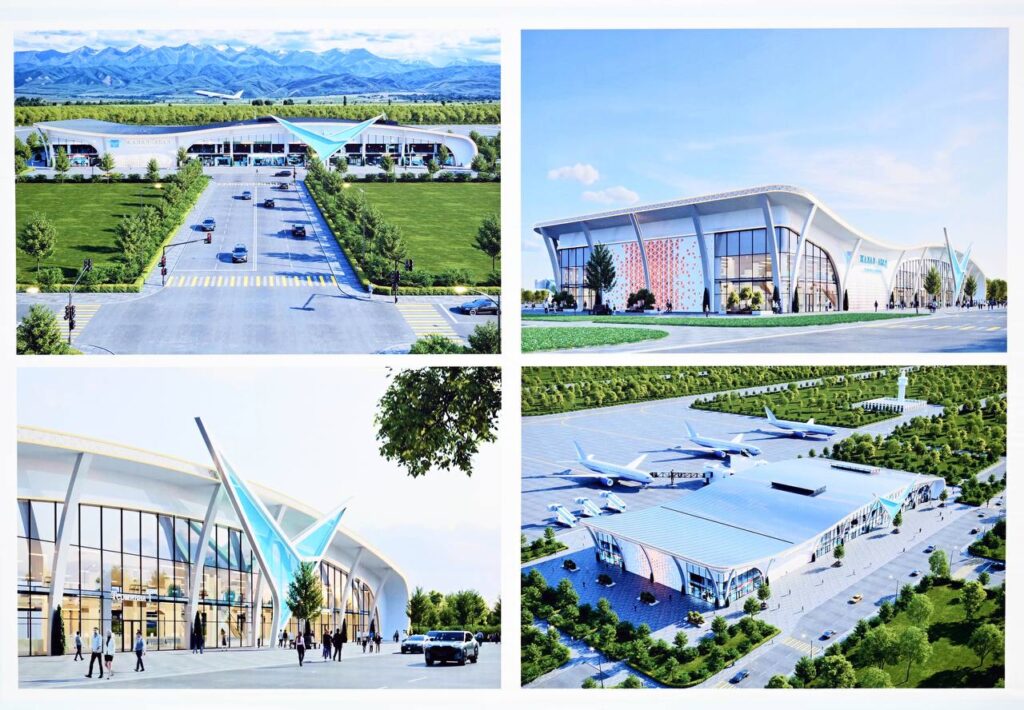
Kazakhstan’s Prime Minister, Olzhas Bektenov, has met with Dr. Christine Grötzbach, board member and co-founder of the German aviation company Skyhansa, to finalize the construction timeline for a new cargo and passenger airport in the Zhetysu region. The first phase of the project is expected to be completed by 2027. The facility will be built within the Khorgos - Eastern Gate special economic zone (SEZ), located on Kazakhstan’s border with China. The project envisions the creation of a multifunctional aviation hub designed to meet ICAO international standards and will be developed in phases, according to a government announcement. The initiative is being carried out under a framework agreement between Kazakhstan’s Ministry of Transport and the Kazakh-German consortium Skyhansa. On the German side, the project is led by the Hansa Consortium, an aviation infrastructure specialist, while the Kazakh side is represented by Skymax Technologies, a regional logistics and infrastructure operator active in Central Asia and the Caucasus. The total investment in the airport project is projected at $500 million. Dr. Grötzbach emphasized that the vision extends far beyond a standard airport facility. “We are creating not just an airport, but a comprehensive infrastructure: cargo and passenger terminals, a fuel and refueling complex, an aviation technical center, a business center, and hotels,” she stated. “Its strategic location near China, combined with access to rail and road transport, positions it as a key logistics node on the New Silk Road.” Bektenov echoed this sentiment, stating that the project will significantly enhance Kazakhstan’s transport and logistics capabilities. “The implementation of this project will give a powerful impetus to the development of transport infrastructure and reinforce Kazakhstan’s role as a bridge between China, Central Asia, and Europe,” he said. This announcement follows a similar initiative by Kazakhstan’s Ministry of Transport, which recently signed an investment agreement with Terminals Astana Airport Limited, a subsidiary of a UAE-based holding company. That project involves a $1.1 billion investment in the development of the Astana Aerotropolis, as reported by The Times of Central Asia.

Kyrgyzstan Begins Construction of New Jalal-Abad International Airport

On May 13, President Sadyr Japarov laid the foundation stone for a new international airport in Jalal-Abad, Kyrgyzstan’s third-largest city. The new airport will span over 380 hectares and include a two-story passenger terminal covering 10,000 square meters, with the capacity to handle 350 passengers per hour. Its airfield infrastructure will meet international standards, featuring a 3,800-meter runway and six aircraft parking bays. The facility will accommodate both passenger and cargo aircraft, including Boeing 737, Airbus A320, and A321 models. Unlike a renovation of the existing facility, the project entails entirely new construction. The current Jalal-Abad airport dates back to 1938, originally serving as an airfield, with a terminal building and asphalt runway added in 1972. Boosting Air Infrastructure At the groundbreaking ceremony, Japarov emphasized the rising demand for both domestic and international flights, underscoring the need to expand the country's airport infrastructure. “Since 2021, Kyrgyzstan has increased passenger traffic by 46% and the number of flights by 31%. New aircraft have been acquired, and previously idle regional airports have resumed operations,” he said. He also noted that the newly established Asman Airlines has restored all domestic routes, linking the capital, Bishkek, with Talas, Karakol, and Kerben. In 2024, the airline added two Canadian-made Bombardier Dash 8 Q400 short-haul aircraft to its fleet for domestic service. Regional Impact Japarov stated that the new Jalal-Abad International Airport would enhance logistics, trade, tourism, and investment across the Fergana Valley, a region shared by Kyrgyzstan, Tajikistan, and Uzbekistan. This project is part of Kyrgyzstan’s broader strategy to modernize its aviation infrastructure. In February 2025, construction began on a new airport complex at Osh International Airport, located in the country’s second-largest city. Kyrgyzstan has also recently inaugurated Karakol International Airport and Talas Airport. Reconstruction efforts are currently underway at Issyk-Kul International Airport and Naryn Airport.

UAE Investor to Inject $1.1 Billion into Astana Aerotropolis Project

The Ministry of Transport of Kazakhstan has signed a long-term investment agreement with Terminals Astana Airport Limited, a subsidiary of UAE-based Terminals Holding, to transform Astana International Airport into a world-class Aerotropolis. The deal, valued at $1.1 billion, was formalized on May 12 during the official visit of Crown Prince Sheikh Khalid bin Mohammed bin Zayed Al Nahyan of Abu Dhabi to Kazakhstan. Strategic Infrastructure Development The agreement outlines a comprehensive development plan, including the construction of a second runway, a third passenger terminal, and a dedicated cargo terminal at Astana International Airport. According to the Ministry of Transport, the investor also aims to build a multifunctional Aerotropolis complex, encompassing an industrial and logistics zone, a business cluster, hotels, retail space, and logistics terminals. An Aerotropolis is a modern urban model that integrates aviation, logistics, and commercial infrastructure to create a self-sustaining hub catering to both passengers and businesses. The concept is designed to provide short-term accommodation and consumer services in proximity to the airport, effectively transforming it into a small city. Operational Modernization In addition to physical infrastructure, the project includes plans to modernize the airport's operational systems. Terminals Astana Airport Limited will upgrade the fleet of specialized airport equipment, introduce digital solutions and automation, and implement phased training and retraining programs for airport staff. Following the restoration of municipal control over the airport in January, Astana’s local authorities extended the trust management agreement, with Terminals Astana Airport Management continuing in its role as the airport operator. Both Terminals Astana Airport Limited and the current operator are subsidiaries of Terminals Holding. In 2024, Astana International Airport served 8.315 million passengers, an 11% increase from the previous year. Broader Investment Context As previously reported by The Times of Central Asia, Kazakhstan continues to attract foreign investment in its aviation infrastructure. Earlier this year, Vietnam’s Sovico Group, which owns Kazakh airline Qazaq Air, was offered the opportunity to manage an airport in the Kyzylorda region.

Vietnam’s Sovico Group Tapped to Manage Airport in Kazakhstan’s Kyzylorda Region

Vietnam's Sovico Group, owner of Kazakh airline Qazaq Air, soon to be rebranded as VietJet Kazakhstan, has been offered the opportunity to manage one of the airports in Kazakhstan’s Kyzylorda region. This week, Kazakhstan’s Deputy Prime Minister and Minister of National Economy, Serik Zhumangarin, confirmed Sovico’s interest in acquiring or taking over the management of an airport in the country, though he did not specify which facility was under consideration. On Thursday, during a session of the Senate (the upper house of Kazakhstan’s parliament), Deputy Foreign Minister Alibek Bakaev clarified that the proposal concerned an airport in the Kyzylorda region. “The point is that the Vietnamese side would manage the airport temporarily to improve its operations. This is not about a buyout, we do not sell strategic assets. We are attracting advanced technologies and companies to enhance the functioning and services of our airports from both technological and administrative perspectives,” Bakaev told reporters. The Kyzylorda region, located in southern Kazakhstan, hosts five airports: in the regional capital Kyzylorda, the district center of Aralsk, the village of Zhosaly, and two airports serving the Baikonur Cosmodrome, Krayniy and Yubileiny. The largest among them is Korkyt Ata International Airport, located in Kyzylorda city. Its 2,700-meter-long, 45-meter-wide asphalt runway, which can accommodate all categories of helicopters and first-class aircraft with a maximum take-off weight of 75 tons or more, includes the Tu-204, Boeing 757 and 747, and Airbus A320, as well as lighter aircraft. In November 2023, a new passenger terminal was inaugurated at Korkyt Ata, boosting the airport’s annual capacity from 300,000 to 2 million passengers. Korkyt Ata International Airport is currently managed by Airport Management Group and owned by the regional akimat (governor’s office). As previously reported by The Times of Central Asia, last autumn, Sovico Group announced plans to modernize and develop airport infrastructure in both the Kyzylorda and Turkestan regions of Kazakhstan.