


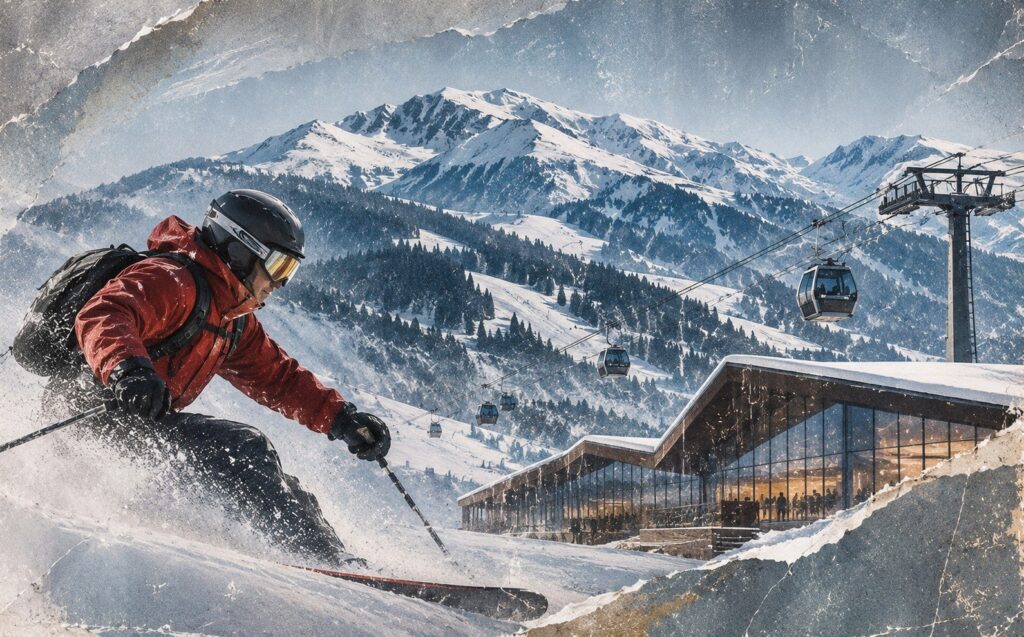
Almaty SuperSki Construction Begins Amid Environmental Concerns
Construction has begun on the Almaty SuperSki mountain resort, even though authorities have yet to decide the fate of 472 protected trees standing in the path of a planned access road. The development revives plans that President Kassym-Jomart Tokayev halted in 2019 following public protests. Almaty SuperSki is being developed by the state-owned company Kazakh Tourism Development. On November 18, its head, Yerzhan Yerkinbayev, told a meeting chaired by Prime Minister Olzhas Bektenov that France's POMA had already begun pouring foundations for cable lifts, of which it is contracted to build 11. Switzerland's Blumer-Lehmann will supply wooden structures for the stations, and Denmark's Bjarke Ingels Group is designing the mountain village. Canada's Ecosign is also participating in the project. The resort will feature 60 kilometers of ski slopes and 17 lifts and is planned to cover 1,022 hectares within Ile-Alatau National Park, representing approximately 0.5% of its territory. The developer maintains that the land will retain its status as a specially protected natural area. Protected Trees and an $81 Million Road According to Yerkinbayev, between 6,000 and 7,000 trees grow within the resort area. Among them are 15 specimens listed in Kazakhstan's Red Book of protected species. Thirteen stand near construction sites, while another two are located farther away. The developer says all the trees have been mapped with precise coordinates, none fall within the construction footprint, and all will be preserved. The situation is more complicated with the access road. At public hearings in May, officials said construction of the six-kilometer road, estimated to cost approximately 36 billion tenge ($81 million), would require the removal of 3,070 trees. In September, the national park put the number at 3,105. According to the national park, 472 of them belong to protected species: 108 common apricot trees, and 364 Sievers apple trees – considered an ancestor of many modern cultivated apple varieties. The Ministry of Ecology, however, has questioned the conservation value of some trees along the proposed road. At the May hearings, a ministry representative argued that hybridization had compromised their genetic purity and that 70% were affected by pests and diseases. Deputy Minister of Ecology Nurken Sharbiyev later clarified that the 70% figure came from a survey of an area covering approximately one hectare. According to him, the proposed removal would affect less than 0.1% of the area occupied by Sievers apple and apricot trees in the national park. In June, Sharbiyev said no permit had been issued to remove protected trees. The ministry proposed considering their transplantation instead. In September, it confirmed that authorization was still pending. At the May hearings, damage to wildlife from road construction was valued at just 41,095 tenge (approximately $90). The calculation was based on the projected loss of 12.3 kilograms of fish. Svetlana Kharitonova, a representative of the environmental organization Green Salvation, questioned why the project's impact on nature had effectively been reduced to kilograms of fish. The authorities propose compensating for tree removal by planting ten saplings for every tree cut down....
