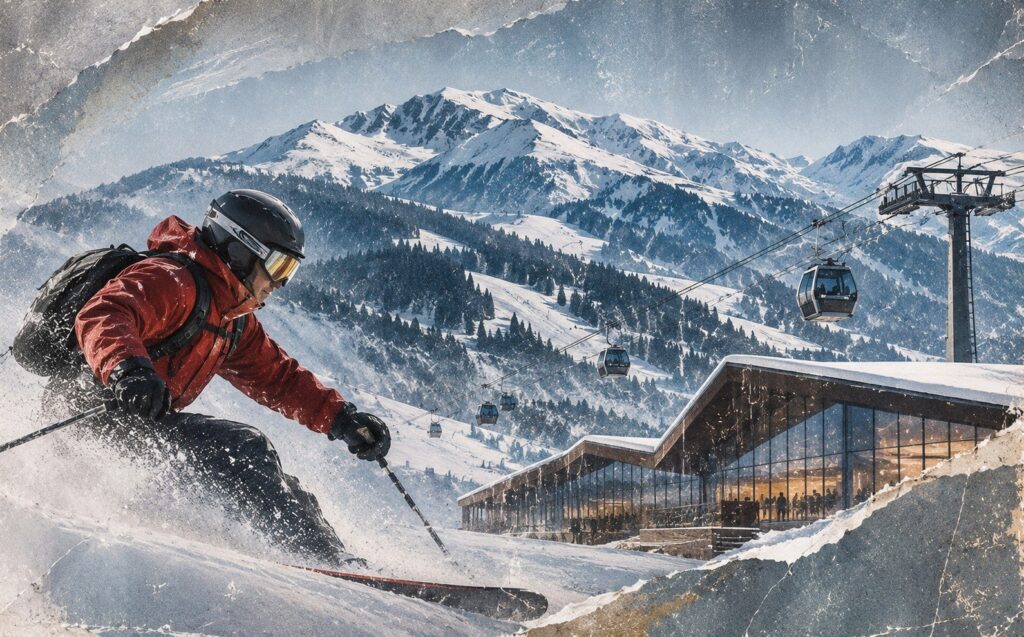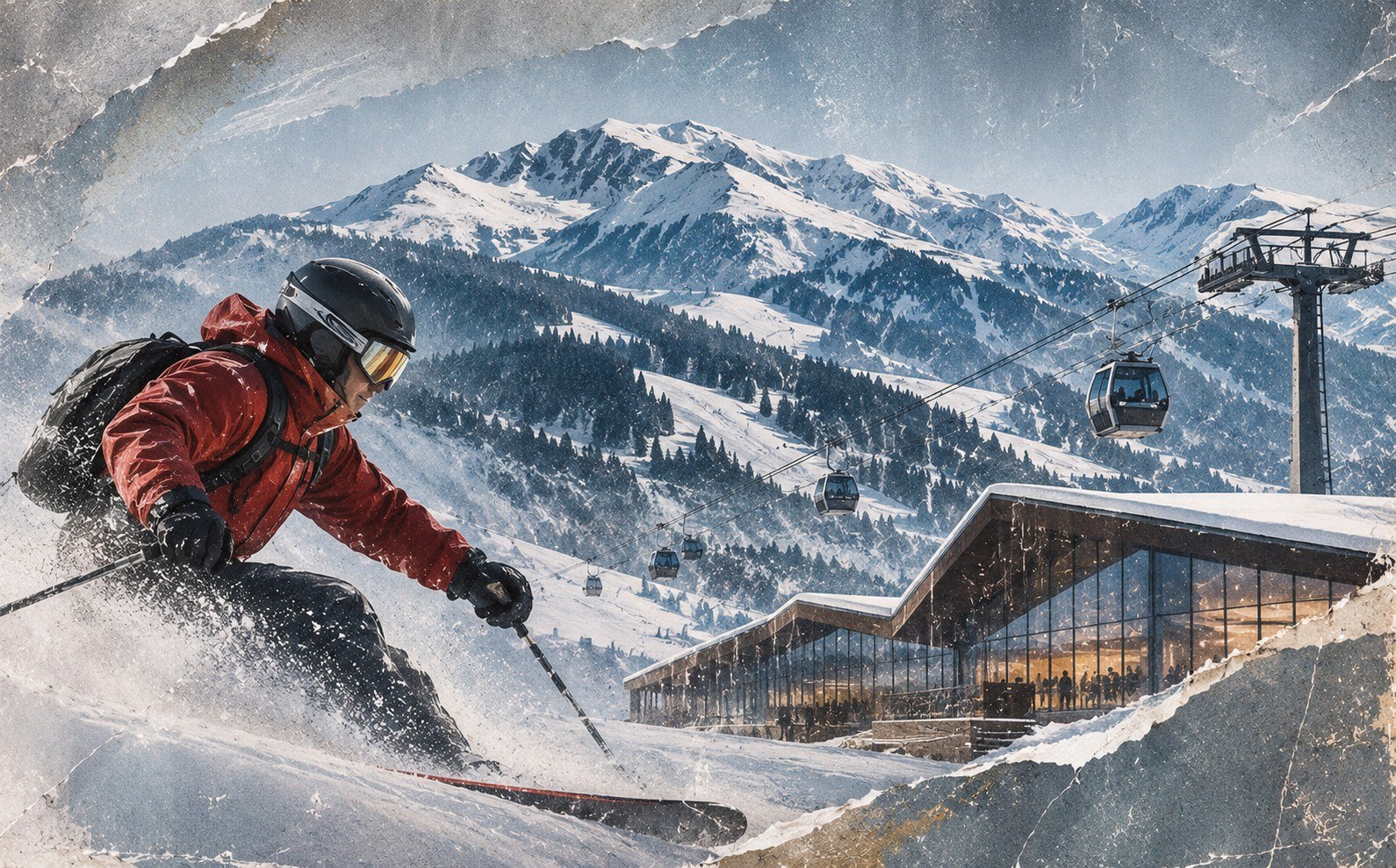
Construction has begun on the Almaty SuperSki mountain resort, even though authorities have yet to decide the fate of 472 protected trees standing in the path of a planned access road. The development revives plans that President Kassym-Jomart Tokayev halted in 2019 following public protests.
Almaty SuperSki is being developed by the state-owned company Kazakh Tourism Development. On November 18, its head, Yerzhan Yerkinbayev, told a meeting chaired by Prime Minister Olzhas Bektenov that France’s POMA had already begun pouring foundations for cable lifts, of which it is contracted to build 11. Switzerland’s Blumer-Lehmann will supply wooden structures for the stations, and Denmark’s Bjarke Ingels Group is designing the mountain village. Canada’s Ecosign is also participating in the project.
The resort will feature 60 kilometers of ski slopes and 17 lifts and is planned to cover 1,022 hectares within Ile-Alatau National Park, representing approximately 0.5% of its territory. The developer maintains that the land will retain its status as a specially protected natural area.
Protected Trees and an $81 Million Road
According to Yerkinbayev, between 6,000 and 7,000 trees grow within the resort area. Among them are 15 specimens listed in Kazakhstan’s Red Book of protected species. Thirteen stand near construction sites, while another two are located farther away. The developer says all the trees have been mapped with precise coordinates, none fall within the construction footprint, and all will be preserved.
The situation is more complicated with the access road. At public hearings in May, officials said construction of the six-kilometer road, estimated to cost approximately 36 billion tenge ($81 million), would require the removal of 3,070 trees. In September, the national park put the number at 3,105. According to the national park, 472 of them belong to protected species: 108 common apricot trees, and 364 Sievers apple trees – considered an ancestor of many modern cultivated apple varieties.
The Ministry of Ecology, however, has questioned the conservation value of some trees along the proposed road. At the May hearings, a ministry representative argued that hybridization had compromised their genetic purity and that 70% were affected by pests and diseases.
Deputy Minister of Ecology Nurken Sharbiyev later clarified that the 70% figure came from a survey of an area covering approximately one hectare. According to him, the proposed removal would affect less than 0.1% of the area occupied by Sievers apple and apricot trees in the national park.
In June, Sharbiyev said no permit had been issued to remove protected trees. The ministry proposed considering their transplantation instead. In September, it confirmed that authorization was still pending.
At the May hearings, damage to wildlife from road construction was valued at just 41,095 tenge (approximately $90). The calculation was based on the projected loss of 12.3 kilograms of fish. Svetlana Kharitonova, a representative of the environmental organization Green Salvation, questioned why the project’s impact on nature had effectively been reduced to kilograms of fish.
The authorities propose compensating for tree removal by planting ten saplings for every tree cut down. On October 3, approximately 2,000 young Schrenk’s spruce trees were planted at Kok-Zhailau. The developer intends to continue planting in spring and fall over the next six years.
Snow Leopards, Glaciers, and Ancient Monuments
Those backing the project have also been keen to head off other environmental objections. Studies presented in November found that the habitats of four snow leopards and the locations of six protected plant species, including the Sievers apple tree, lie outside the main construction zone. Archaeologists also identified 21 heritage sites containing 123 monuments, with protective zones planned around them.
Hydrogeologists estimated that the resort would require no more than 14% of the surface runoff from the Terisbutak River. The developer says Almaty’s water supply will not be affected and has pledged not to use glaciers to extend the ski season.
Smaller Footprint, More Skiers
Smaller Footprint, More Skiers
The project’s backers have also sought to reassure critics about its environmental impact, following earlier revisions that suggested greater emissions and water consumption than initially projected.
Environmental screening documents presented in April put the resort’s planned area at approximately 2,800 hectares, with 16 lifts, 65 kilometers of ski slopes, and capacity for 5,000 skiers a day. The documents also revealed that estimated annual emissions during resort operations had risen from 19.3 to 104.9 metric tons, while projected water consumption during construction had increased from 12,400 to 67,000 cubic meters per year.
By November, however, the developer was citing a much smaller project area of 1,022 hectares, although its planned capacity had doubled to 10,000 skiers a day.
The figures come from different versions of the project, making direct comparisons difficult. A smaller footprint also does not necessarily mean a reduced environmental impact, particularly with more visitors expected.
The Tourism Ministry said in June that the resort had obtained the necessary approvals, including environmental clearance. However, separate government authorization is required to remove protected trees along the access road.
How a Project Rejected in 2019 Returned
On October 29, 2019, President Kassym-Jomart Tokayev publicly prohibited work on a ski resort project in the area, declaring, “We don’t need it.”
In July 2025, the Ministry of Ecology stated that construction could proceed without removing the land from the national park. Environmental organizations opposed the proposal, insisting that the natural area should be preserved. Sergey Kuratov, head of Green Salvation, described the project as unjustified and illogical.
According to Yerkinbayev, approximately 1.5 million people visited the existing Shymbulak resort in 2025. Representatives of the mountaineering community and the Atameken National Chamber of Entrepreneurs supported the new resort at public hearings. They argue that it would ease pressure on Shymbulak, attract more tourists, and create year-round jobs.
On November 18, Prime Minister Olzhas Bektenov ordered construction of Almaty SuperSki to be accelerated so that the resort could open in December 2028. By that point, the fate of the 472 protected trees threatened by the access road remained unresolved.
The Times of Central Asia previously reported on Kazakhstan’s plans to develop Central Asia’s largest year-round mountain tourism complex near Almaty, including the renewed push to develop Kok-Zhailau.