• KGS/USD = 0.01144 0%
  • KZT/USD = 0.00212 0%
  • TJS/USD = 0.10761 -0.09%
  • UZS/USD = 0.00008 0%
  • TMT/USD = 0.28571 0%
  • KGS/USD = 0.01144 0%
  • KZT/USD = 0.00212 0%
  • TJS/USD = 0.10761 -0.09%
  • UZS/USD = 0.00008 0%
  • TMT/USD = 0.28571 0%
  • KGS/USD = 0.01144 0%
  • KZT/USD = 0.00212 0%
  • TJS/USD = 0.10761 -0.09%
  • UZS/USD = 0.00008 0%
  • TMT/USD = 0.28571 0%
  • KGS/USD = 0.01144 0%
  • KZT/USD = 0.00212 0%
  • TJS/USD = 0.10761 -0.09%
  • UZS/USD = 0.00008 0%
  • TMT/USD = 0.28571 0%
  • KGS/USD = 0.01144 0%
  • KZT/USD = 0.00212 0%
  • TJS/USD = 0.10761 -0.09%
  • UZS/USD = 0.00008 0%
  • TMT/USD = 0.28571 0%
  • KGS/USD = 0.01144 0%
  • KZT/USD = 0.00212 0%
  • TJS/USD = 0.10761 -0.09%
  • UZS/USD = 0.00008 0%
  • TMT/USD = 0.28571 0%
  • KGS/USD = 0.01144 0%
  • KZT/USD = 0.00212 0%
  • TJS/USD = 0.10761 -0.09%
  • UZS/USD = 0.00008 0%
  • TMT/USD = 0.28571 0%
  • KGS/USD = 0.01144 0%
  • KZT/USD = 0.00212 0%
  • TJS/USD = 0.10761 -0.09%
  • UZS/USD = 0.00008 0%
  • TMT/USD = 0.28571 0%

Viewing results 1 - 6 of 41

Kyrgyz Anti-Corruption Crackdown: Officials Arrested During Live Meeting in Osh

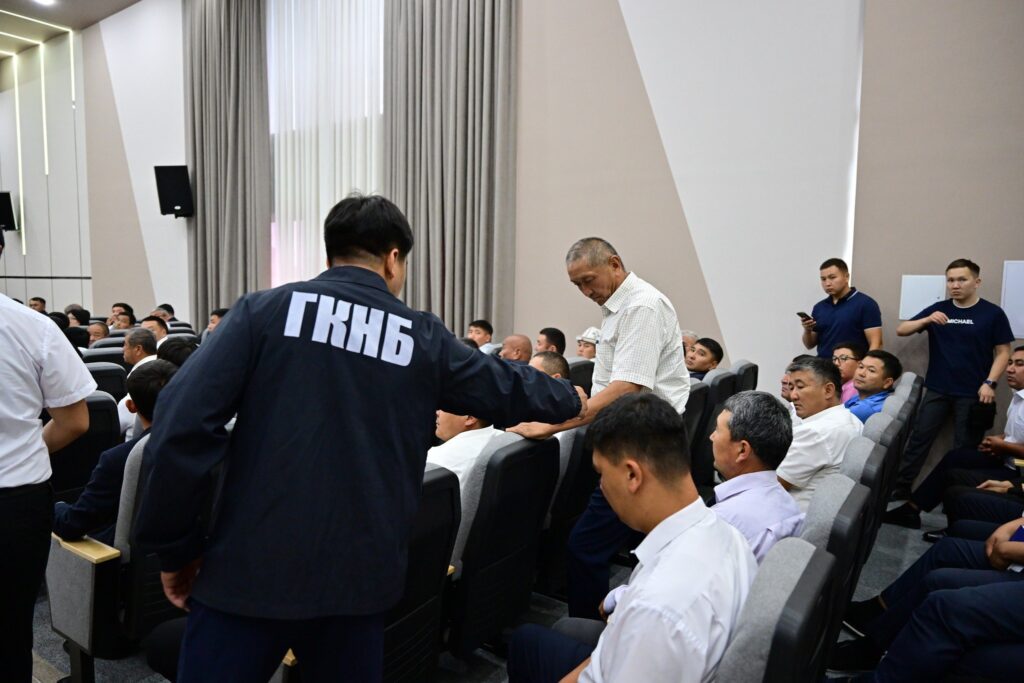
Several officials were arrested during a high-level government meeting in the southern Kyrgyz city of Osh, as part of an ongoing anti-corruption campaign led by the State Committee for National Security (GKNB). Kamchybek Tashiev, chairman of the GKNB, ordered the arrests during a gathering with the heads of state agencies. Six civil servants were detained on the spot after Tashiev accused them of embezzling state funds and providing false information. Among those taken into custody were the head of the Tax Service in the Uzgen district and the deputy head of the Tax Service in the Kara-Suu district. “Take him out, he’s lying!” Tashiev said, pointing to the deputy head of the Kara-Suu Tax Inspectorate. He also stated that the head of the service had already been transferred to the GKNB’s central office in Bishkek for interrogation. The detentions extended beyond the tax authorities. According to local media reports, two employees from the Cadastral Service in the Nookat district, a representative of the judiciary, and a passport office staff member in Uzgen were also arrested. All face allegations of corruption and misappropriation of public funds. These events in Osh follow a series of high-profile detentions in northern Kyrgyzstan. Over the past month, at least three mayors and several senior officials have been arrested in the Chui and Issyk-Kul regions. They are accused of abuse of office, illicit enrichment, and orchestrating corruption networks. During the meeting, Tashiev reiterated the GKNB’s commitment to combating corruption at all levels of government. He referenced the arrest of former State Tax Service head Altynbek Abduvapov in late 2024 as a prominent example. Investigators claim Abduvapov accumulated approximately $55 million in assets through illegal means. “He never had a business of his own. Employees say they gave him bribes ranging from $50,000 to $100,000 every month. We are confiscating everything. Altynbek Abduvapov will now be a poor man,” Tashiev declared. Political analysts suggest the crackdown indicates both an intensification of anti-corruption efforts and a recalibration of power dynamics between Kyrgyzstan’s northern and southern regions. While critics have accused the authorities of selective justice, GKNB officials maintain that the arrests are supported by solid evidence and reveal systemic governance failures.

What Does the Arrest of a Former Top Anti-Corruption Official Signal for Kazakhstan?

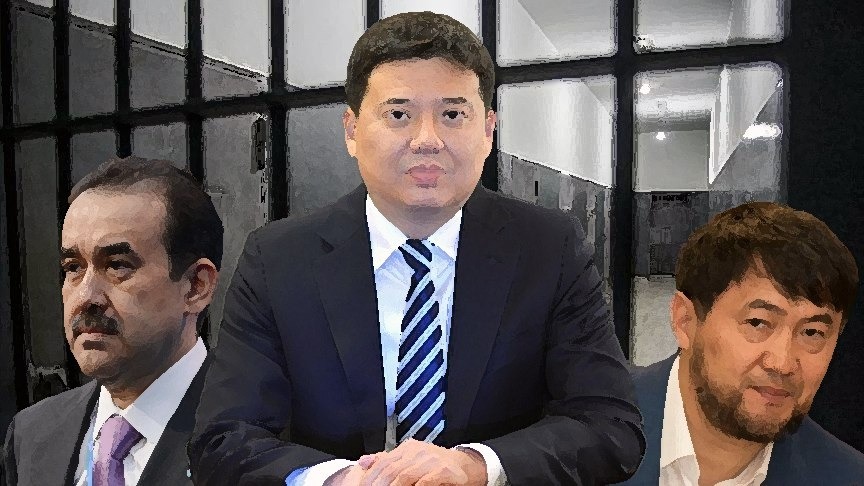
On Friday, July 4, Kazakhstani media erupted with news of the arrest of Talgat Tatubayev, former head of the National Anti-Corruption Bureau, predecessor to the current Anti-Corruption Agency. Yet the significance of Tatubayev’s arrest may extend far beyond his own record. Many believe the case is the opening move in a broader probe that could ensnare Kairat Kozhamzharov, a former senator and top security official under Kazakhstan’s first president. Tatubayev’s arrest was amplified by a post from Aset Mataev, head of the KazTAG news agency and the son of Seytkazy Mataev, the current chairman of the Union of Journalists of Kazakhstan. Both father and son were previously prosecuted during Kozhamzharov’s tenure, a period marked by high-profile anti-corruption investigations, including the conviction of former economy minister Kuandyk Bishimbayev. While Kozhamzharov’s leadership was once praised for exposing major corruption cases, many in Kazakhstan’s media remained skeptical. The elder Mataev's case in particular shook the journalistic community, which saw his prosecution as politically motivated. It is widely believed that the Mataevs were targeted after refusing to sell KazTAG to allies of then-Mazhilis Speaker Nurlan Nigmatulin. “In 2016, I had two encounters with Deputy Head of the Financial Police, Talgat Tatubayev,” Aset Mataev wrote on his Telegram channel. “He offered us a deal under Article 65 of the Criminal Code, exemption from liability in exchange for a guilty plea. Others close to Nigmatulin, Yeseyev, Baybek, Zhumagaliyev, and Mailybayev took that route. We refused”. At the time, the Union of Journalists was gaining influence in the blogosphere amid growing distrust in traditional media. According to Aset Mataev, this created an opportunity for authorities to undermine the Mataevs’ reputation and isolate them professionally. Tatubayev’s damaging interview, published on Ratel.kz, appeared to many as a tool in this campaign. “He tried to intimidate us, saying, ‘We have orders, and we’ll crush you anyway,’” Mataev wrote. After Seytkazy’s arrest, Tatubayev allegedly contacted Aset from his father’s phone, urging him to stop speaking to the press. “He promised the case would be dropped. Of course, he lied. We were tortured until the verdict was handed down, while he gave interviews claiming my father admitted guilt.” Unlike Ratel.kz, which was seen as aligned with certain state actors, other outlets mentioned by Mataev allegedly served figures like Bulat Utemuratov, long considered the financial backer of former President Nursultan Nazarbayev, and Karim Massimov, who moved from prime minister to head of the National Security Committee in 2016. The Mataev prosecution sparked widespread condemnation among journalists, who viewed it as a watershed moment in Kazakhstan’s clampdown on press freedom. To this day, the Mataev case is widely believed to have been orchestrated by Nigmatulin and his political allies. Now, with Tatubayev under arrest once more, this time for alleged torture in the notorious Khorgos customs embezzlement case, some observers see the return of unfinished business from the “Old Kazakhstan.” Khorgos, a major border post linking Kazakhstan and China, was the center of large-scale corruption investigations under Kozhamzharov’s leadership. The General Prosecutor’s Office confirmed...

Bishkek Mayor Urges Investors to Avoid Corruption and Uphold Kyrgyz Law

Bishkek Mayor Aibek Junushaliyev has called on foreign investors to strictly comply with Kyrgyz legislation and avoid involvement in corrupt practices. His statement, published on the official city hall website, stresses the importance of lawful and transparent cooperation between government agencies and the business sector. “We are confident that only transparent and lawful interaction between government agencies and the business community can become the basis for the sustainable development of the capital and attract investment,” Junushaliyev stated. He affirmed that the mayor’s office remains open to dialogue, ready to support responsible investors, and committed to ensuring full transparency in transactions. However, he warned that any attempts to bypass the law through corrupt means would be met with firm opposition. Background: Deputy Mayor Arrested The mayor’s remarks follow the recent arrest of Bishkek Deputy Mayor Taalaibek Baigaziev by the State Committee for National Security. Baigaziev stands accused of soliciting a $35,000 bribe from a foreign company in exchange for lobbying efforts related to the capital’s thermal power plant reconstruction project. After partially failing to deliver on his promises, he was reportedly caught red-handed while returning a portion of the money. A criminal case has been opened against him. Ongoing Projects and Investment Environment In his statement, Junushaliyev highlighted major investment projects currently underway in Bishkek with foreign participation. These include the construction of a multifunctional residential and business complex on the site of the former hippodrome, a waste-to-energy incineration plant, and the modernization of the city’s sewage treatment facilities. He stressed that all these initiatives are being carried out strictly within the bounds of the law and should serve as a model for future investment. “The city administration will continue to adhere to a policy of openness, legality, and a firm stance against corruption,” he said. “If, during the implementation of a project, you encounter any unlawful actions by officials, such as extortion, coercion, or other forms of corruption, please report them immediately to the city hall’s anti-corruption department or law enforcement authorities.” According to the National Statistical Committee of Kyrgyzstan, foreign investment in Bishkek reached $525 million in 2024, a 50% increase compared to the previous year.

Former Justice Minister From ‘Old Kazakhstan’ Sentenced to Nine Years in Prison

Former Minister of Justice Marat Beketayev has been sentenced to nine years in prison with confiscation of property for crimes linked to large-scale corruption. Beketayev is widely regarded as a representative of the "Old Kazakhstan" of the first president, Nursultan Nazarbayev, a term widely used to describe officials removed from power in the wake of the January 2022 unrest and associated with systemic corruption. Verdict Handed Down The Anti-Corruption Service of Kazakhstan announced on June 30 that Beketayev was convicted of fraud, embezzlement on an especially large scale, and illegal participation in entrepreneurial activities. Details of the case remain classified. The charges were formally submitted to the court in March 2025. Beketayev served as Minister of Justice from 2016 until early 2022. Following the January unrest, he was appointed as an advisor to the Prime Minister but was quietly dismissed in December 2022, a fact that only became public knowledge in February 2023. He was detained in October 2023 while allegedly attempting to flee the country. According to investigators, he abused his office by lobbying for the interests of an affiliated company and awarding it annual contracts for unnecessary services, actions that reportedly inflicted significant financial damage on the state. Fallout from the January Events Beketayev’s dismissal came immediately after the events known in Kazakhstan as "Bloody January" (Qantar), when protests initially triggered by rising liquefied gas prices escalated into nationwide unrest. From January 3-7, 2022, major cities were engulfed in chaos. Government buildings, law enforcement agencies, and military units were attacked; 238 people were reportedly killed, including children and police officers. The worst violence occurred in Almaty, where protesters stormed the city administration, the president’s residence, and the airport. Order was restored on January 8 with the intervention of the Collective Security Treaty Organization (CSTO), at the request of President Kassym-Jomart Tokayev. Open-source information and official investigations suggest the unrest was orchestrated by supporters of former president Nursultan Nazarbayev, who had stepped down in 2019 after nearly 30 years in power. In the aftermath, many high-ranking officials were removed or prosecuted. Among them was former Prime Minister and National Security Committee (KNB) Chairman Karim Massimov, who was sentenced to 18 years in prison for orchestrating what authorities describe as a coup attempt. Nazarbayev’s nephews, Samat Abish and Kairat Satybaldy, also faced charges. Abish received an eight-year suspended sentence due to his "sincere repentance," while Satybaldy, accused of economic crimes, paid approximately 700 billion tenge ($1.5 billion) in restitution and was released. The post-Qantar purge extended to numerous grassroots organizers and ordinary citizens involved in the unrest. In political discourse, the divide between Tokayev's supporters and the remnants of Nazarbayev’s influence is often described as a split between "New Kazakhstan" and "Old Kazakhstan." Beketayev’s Legacy and Links to Major Scandals Beketayev is considered an ally of Massimov and thus part of the old power structure. He was also involved in one of Kazakhstan’s most controversial international legal disputes, the case involving Moldovan businessmen Anatol and Gabriel Stati. In 2017, $22...

Kazakhstan Transfers Anti-Corruption Authority to National Security Committee

Kazakh President Kassym-Jomart Tokayev has signed a decree dissolving the country’s standalone Anti-Corruption Agency and transferring its functions to the National Security Committee (NSC), in what officials describe as a move to modernize and streamline public administration. According to the decree, the Anti-Corruption Agency, previously a direct presidential subordinate tasked with both strategic and operational anti-corruption efforts, will now be integrated into the NSC as its sixth division. It joins the ranks of other specialized units including the Border Service, Foreign Intelligence Service, Government Communications Service, Special Division “A” (special forces), and the Aviation Service. Some responsibilities, particularly those involving the development and implementation of anti-corruption policy, interagency coordination, and public outreach, will be transferred to the Agency for Civil Service Affairs. That agency will also absorb part of the former Anti-Corruption Agency’s staff and resources. “In order to modernize and improve the efficiency of the public administration system, I hereby decree: to reorganize the Anti-Corruption Agency by merging it with the National Security Committee...” the decree states. The Anti-Corruption Agency was created in 2014 as the successor to the Agency for Combating Economic and Corruption Crimes, also known as the financial police, which had operated since 1994. Throughout its existence, the agency reported directly to the president and was central to the country’s efforts to combat corruption, from policy design to investigations. Under the decree, the NSC must draft new regulations for the anti-corruption division and submit personnel redistribution proposals, particularly concerning the Agency for Civil Service Affairs, within one month. Additionally, the government has until September 1, 2025, to prepare and submit a bill to parliament reflecting the institutional changes. As previously reported by The Times of Central Asia, President Tokayev recently launched a broad reform initiative targeting the entire law enforcement system. The incorporation of anti-corruption functions into the NSC may thus represent only the first phase of a wider restructuring.

Kazakhstan Improves Standing in Global Anti-Money Laundering Ranking

Kazakhstan has made significant progress in the Basel AML Index, moving up to 111th place out of 164 countries in the 2025 global ranking for quantifying money laundering. The index, published by the Basel Institute on Governance, ranks countries from highest to lowest risk, meaning Kazakhstan's lower position reflects improved performance and reduced vulnerability. According to a recent analysis by Finprom.kz, Kazakhstan now ranks among the top three performers in the Commonwealth of Independent States (CIS), surpassed only by Armenia (129th) and Moldova (112th). The country’s index score improved from 4.71 in 2024 to 4.65 in 2025, signaling enhanced resilience in anti-money laundering (AML) measures. At the other end of the CIS spectrum, Turkmenistan (23rd), Tajikistan (30th), and Kyrgyzstan (45th) were listed among the top 50 countries facing the highest money laundering risks. Belarus (53rd), Azerbaijan (74th), Uzbekistan (81st), and Ukraine (82nd) fared slightly better but remained behind Kazakhstan in terms of overall AML performance. Globally, Myanmar, Haiti, and the Democratic Republic of the Congo recorded the highest risk levels. In contrast, San Marino, Iceland, and Finland topped the rankings as the countries least susceptible to money laundering activities. Analysts caution that the Basel Index does not measure actual volumes of money laundering, but rather evaluates countries based on the potential risk and their institutional capacity to prevent and combat financial crime. Stronger Law Enforcement Activity in 2025 Domestically, Kazakhstan has also seen a surge in law enforcement activity. In the first four months of 2025, authorities registered 77 criminal offences under the legalisation of criminal proceeds article, 2.8 times more than during the same period in 2024, when 28 cases were reported. The capital, Astana, led with nine cases, up from two in January-April 2024. Shymkent followed with eight cases (up from three), and Almaty recorded seven (up from four). Significant increases were also reported in the Almaty region (from one to six cases) and the Karaganda region (from one to five). These figures point to intensified law enforcement efforts and a greater capacity to detect and prosecute money laundering-related crimes.