• KGS/USD = 0.01143 0%
  • KZT/USD = 0.00205 0%
  • TJS/USD = 0.10724 0.09%
  • UZS/USD = 0.00008 0%
  • TMT/USD = 0.28571 0%
  • KGS/USD = 0.01143 0%
  • KZT/USD = 0.00205 0%
  • TJS/USD = 0.10724 0.09%
  • UZS/USD = 0.00008 0%
  • TMT/USD = 0.28571 0%
  • KGS/USD = 0.01143 0%
  • KZT/USD = 0.00205 0%
  • TJS/USD = 0.10724 0.09%
  • UZS/USD = 0.00008 0%
  • TMT/USD = 0.28571 0%
  • KGS/USD = 0.01143 0%
  • KZT/USD = 0.00205 0%
  • TJS/USD = 0.10724 0.09%
  • UZS/USD = 0.00008 0%
  • TMT/USD = 0.28571 0%
  • KGS/USD = 0.01143 0%
  • KZT/USD = 0.00205 0%
  • TJS/USD = 0.10724 0.09%
  • UZS/USD = 0.00008 0%
  • TMT/USD = 0.28571 0%
  • KGS/USD = 0.01143 0%
  • KZT/USD = 0.00205 0%
  • TJS/USD = 0.10724 0.09%
  • UZS/USD = 0.00008 0%
  • TMT/USD = 0.28571 0%
  • KGS/USD = 0.01143 0%
  • KZT/USD = 0.00205 0%
  • TJS/USD = 0.10724 0.09%
  • UZS/USD = 0.00008 0%
  • TMT/USD = 0.28571 0%
  • KGS/USD = 0.01143 0%
  • KZT/USD = 0.00205 0%
  • TJS/USD = 0.10724 0.09%
  • UZS/USD = 0.00008 0%
  • TMT/USD = 0.28571 0%

Viewing results 1 - 6 of 7

Opinion: Middle Powers and the “Voice of the Region” – Is Central Asia Becoming a Coordinated Actor?

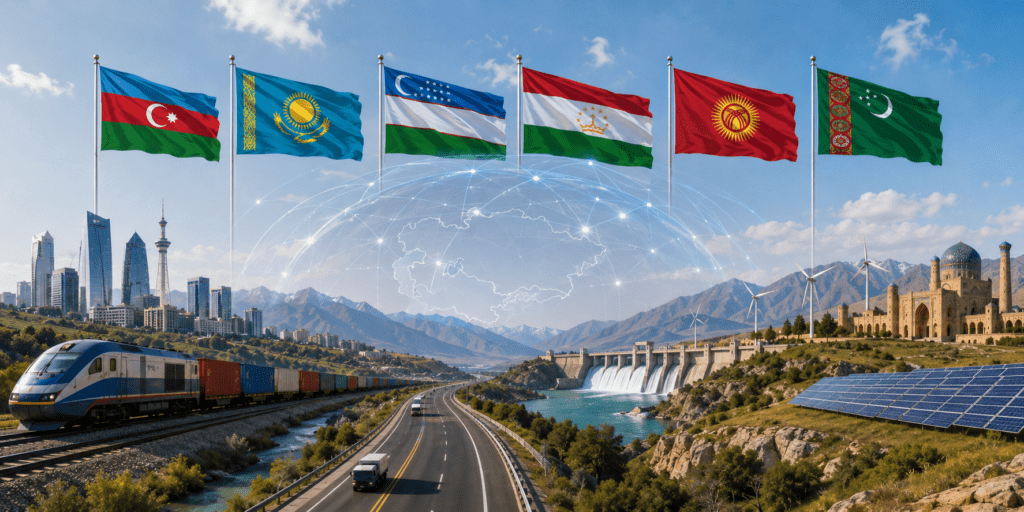
Against the backdrop of growing global fragmentation and the weakening of universal international institutions, the role of so-called middle powers is increasing. These are states able to influence regional agendas without possessing great-power status. In this changing system, Central Asia is gradually moving beyond its long-standing image as a geopolitical periphery and is beginning to act more like a region with shared interests. For decades, the region was viewed mainly as a space where the interests of external powers, including Russia, China, the U.S., and others, intersected. Today, that paradigm is beginning to shift. Central Asia is showing greater signs of agency through what may be described as a cluster effect: individually, the countries have limited influence, but collectively they form an important transit hub between Europe and Asia, a growing market, a significant resource base, and a strategic security zone. This creates the conditions for a more coordinated regional position, even if a single regional voice is still emerging rather than fully formed. C5+Azerbaijan as a Foundation for Regional Architecture The institutional foundation of this process is the Central Asian leaders' consultative format, which is now expanding through Azerbaijan's participation. That is turning what was once a C5 dialogue into a looser C5+Azerbaijan, or C6, framework focused on transport, energy, and practical cooperation. Within this framework, the countries of the region are learning to act in a more coordinated manner without supranational pressure. In practice, this process is developing through three main areas. The first is transport and logistics. Azerbaijan's participation has strengthened efforts to make the Middle Corridor more coherent, though the route still faces bottlenecks in capacity, customs coordination, and Caspian crossings. Through tariff coordination, simplified border procedures, and investment in port and rail infrastructure, Central Asia and the Caucasus are increasingly functioning as parts of a single transport artery. That gives the region a faster option for cargo between China and Europe, even if it remains far smaller than traditional maritime routes. Shipping goods via the Suez Canal or the northern route can take between 35 and 45 days, whereas the Middle Corridor can reduce transit times to around 13-21 days under favorable conditions. According to forecasts cited by BCG, shipping volumes along the route could increase three- to fourfold during the current decade. Beyond logistics, the project is creating a new economic framework for the region. Its status as a crossroads is attracting investment in transport hubs and manufacturing facilities along the route, with the potential to turn transit corridors into zones of economic growth. This gives participating countries not only transit revenue but a stronger basis for long-term strategic resilience. The second major area is energy integration, where historical disputes over water and fuel resources are increasingly being supplemented by models of joint development. The Kambarata HPP-1 hydropower project in Kyrgyzstan, being developed with Kazakhstan and Uzbekistan, has created an important precedent for shared management of water and energy interests. The project is expected to support cleaner electricity generation while helping stabilize irrigation flows...

Uzbekistan Gains ASEAN Approval to Join Cooperation Treaty

Uzbekistan’s efforts to strengthen its ties with Southeast Asia advanced significantly this week after all member states of the Association of Southeast Asian Nations (ASEAN) approved Tashkent’s application to join the Treaty of Amity and Cooperation in Southeast Asia (TAC). The decision was made during a meeting of ASEAN foreign ministers chaired by Malaysia in Kuala Lumpur, according to the Dunyo news agency. Signed in Bali in 1976, the TAC outlines core principles for regional cooperation, including peaceful dispute resolution, non-interference, renunciation of force, and respect for sovereignty. ASEAN now comprises 11 countries with a combined population nearing 700 million, forming one of the world’s most dynamic economic regions. Uzbekistan’s accession to the TAC is expected to enhance its political and economic presence in Southeast Asia, facilitate state-to-state cooperation, boost trade and investment, and increase confidence among international companies operating in or considering expansion into Central Asia. Political analyst Jahongir Akramov described the approval as a significant diplomatic achievement for Uzbekistan. Speaking to The Times of Central Asia, he said the move aligns closely with Uzbekistan’s foreign policy principles: “Uzbekistan’s joining this treaty can be seen as a very significant diplomatic success. One of the key reasons is that the core principles of the TAC fully match the principles set out in Article 17 of Uzbekistan’s Constitution, non-use of force, resolving conflicts peacefully, negotiating disputes, and respecting the sovereignty of states.” Akramov noted that since 2016, Uzbekistan’s foreign policy has evolved along three strategic vectors, all of which are reinforced by the TAC: “First, Uzbekistan adopted a multi-vector foreign policy. Second, the country has taken major steps to develop economic diplomacy. Third, we have been deepening regional integration. All three of these trends are fully consistent with joining the TAC.” He emphasized that the timing is especially relevant amid growing geopolitical strains: “Geopolitical tensions have intensified, particularly among the United States, China, and Russia. In this situation, participating in platforms such as ASEAN can help reduce pressure and maintain diplomatic balance.” Akramov also positioned Uzbekistan’s move as part of a broader Global South cooperation trend. “Central Asian and ASEAN countries are both part of the Global South. Building closer relations ensures our interests are better represented in shaping new international norms.” Economically, Akramov pointed to ASEAN’s size and diversity as highly advantageous. “ASEAN includes Indonesia, the world’s most populous Muslim-majority country, Singapore, a global innovation hub, Malaysia, an advanced and diversified economy, and Thailand, a leading tourism destination. Closer ties with these states could expand tourism, improve Uzbekistan’s international image, and boost the competitiveness of Uzbek products.” He added that ASEAN’s extensive experience with regional integration offers a model for Central Asia. “As one of the first Central Asian countries to join the TAC, Uzbekistan could take a leading role in fostering ASEAN-Central Asia cooperation. A regional office or cooperation structure based in Tashkent or Samarkand would be a major diplomatic achievement.” However, Akramov cautioned that the partnership would require careful navigation. “Southeast Asia has its own geopolitical tensions, such...

Middle Powers Converge: Kazakhstan and Singapore Strengthen Bilateral Ties

During his country’s first presidential-level visit to Singapore in two decades, Kazakhstan’s President Kassym-Jomart Tokayev met with Singapore’s Prime Minister Lawrence Wong on May 23. The meeting represents an alignment of interests and resources between the two middle powers and serves to create a more balanced and cooperative global environment.   Identifying middle powers When global powers become embroiled in their domestic issues or engage in rivalries that prevent effective international cooperation, middle powers step in to fill the leadership void. For instance, Canada has historically taken a lead in peacekeeping missions under the United Nations, advocating for human rights and mediating conflicts where larger powers are either unwilling or unable to engage. Middle powers, also referred to as “swing states”, are defined as influential players in international politics who resist taking sides in major conflicts and possess a specific combination of characteristics such as geostrategic location, demography, economic performance, natural resource wealth, military power and/or political influence. In a January 2024 study, the German Institute of Security and International Affairs (SWS) listed Kazakhstan among twelve notable “middle powers” in the world, who were of great importance to Germany and the EU for either shaping policies or minimizing geoeconomic risks by diversifying foreign policy relations. Kazakhstan possesses immense energy resources and critical materials for the green transition. Bordering Russia, China, and the Caspian Sea, it also offers a land bridge linking East-West and North-South corridors. Singapore is also considered a middle power with its notable regional and international influence, particularly in the Indo-Pacific region. A highly developed country with one of the highest per capita GDPs in the world, Singapore is the only nation in Asia with a “AAA” sovereign credit rating from all major rating agencies. Additionally, it has one of the highest per capita defense expenditures globally and is among the largest arms manufacturers.   A partnership between Kazakhstan and Singapore strengthens their middle power status What distinguishes middle powers from smaller powers is their ability to be more independent and active, particularly in the realm of diplomacy. The collaboration between these two leaders, therefore, helps solidify their middle power status. On a diplomatic level, President Tokayev emphasized Singapore's role as Kazakhstan’s strategic partner in Southeast Asia and expressed confidence that his state visit would strengthen bilateral relations. For his part, Prime Minister Wong highlighted that Singapore could serve as a gateway for Kazakhstan to engage with Association of Southeast Nations (ASEAN) while Kazakhstan could help Singapore build ties with Central Asia. Economically speaking, collaboration offers great potential gains for both sides. Currently, over 140 Singaporean entities and joint ventures operate in Kazakhstan, with total investment exceeding $1.7 billion. These numbers are expected to rise through further integration of their economies. During their recent meeting, the leaders focused on key sectors where Kazakhstan brings high strategic value. For instance, Wong expressed the importation of more agri-food products from Kazakhstan. Singapore’s Indorama Corporation is already in discussions about the production of phosphate fertilizers in Kazakhstan. Logistics is another key...