• KGS/USD = 0.01144 0%
  • KZT/USD = 0.00205 0%
  • TJS/USD = 0.10784 0%
  • UZS/USD = 0.00008 0%
  • TMT/USD = 0.28490 0%
  • KGS/USD = 0.01144 0%
  • KZT/USD = 0.00205 0%
  • TJS/USD = 0.10784 0%
  • UZS/USD = 0.00008 0%
  • TMT/USD = 0.28490 0%
  • KGS/USD = 0.01144 0%
  • KZT/USD = 0.00205 0%
  • TJS/USD = 0.10784 0%
  • UZS/USD = 0.00008 0%
  • TMT/USD = 0.28490 0%
  • KGS/USD = 0.01144 0%
  • KZT/USD = 0.00205 0%
  • TJS/USD = 0.10784 0%
  • UZS/USD = 0.00008 0%
  • TMT/USD = 0.28490 0%
  • KGS/USD = 0.01144 0%
  • KZT/USD = 0.00205 0%
  • TJS/USD = 0.10784 0%
  • UZS/USD = 0.00008 0%
  • TMT/USD = 0.28490 0%
  • KGS/USD = 0.01144 0%
  • KZT/USD = 0.00205 0%
  • TJS/USD = 0.10784 0%
  • UZS/USD = 0.00008 0%
  • TMT/USD = 0.28490 0%
  • KGS/USD = 0.01144 0%
  • KZT/USD = 0.00205 0%
  • TJS/USD = 0.10784 0%
  • UZS/USD = 0.00008 0%
  • TMT/USD = 0.28490 0%
  • KGS/USD = 0.01144 0%
  • KZT/USD = 0.00205 0%
  • TJS/USD = 0.10784 0%
  • UZS/USD = 0.00008 0%
  • TMT/USD = 0.28490 0%

Viewing results 1 - 6 of 3

Kyrgyz Airlines See EU Flight Ban Lifted After Two Decades

The European Commission has removed all air carriers certified in Kyrgyzstan from the EU Air Safety List, ending restrictions first imposed in 2006. The decision opens a route back into European Union (EU) airspace for airlines certified in Kyrgyzstan. Regular flights cannot start on the delisting alone. Each airline will still need aircraft suited to European routes and approval to operate under EU rules. The change came through the EU’s 48th update to the Air Safety List. After the update, 154 airlines remain banned from EU skies. The list also identifies 16 countries where the EU says national aviation authorities lack adequate safety oversight. Airlines certified in Kyrgyzstan were added to the list in October 2006 under Commission Regulation (EC) No 1543/2006. That decision followed a European expert mission to Kyrgyzstan from September 10 to 15, 2006. The EU found that the country’s civil aviation authority lacked enough capacity to apply and enforce safety standards under the Chicago Convention. It also found that most of the carriers inspected held Kyrgyzstan-issued air operator certificates but did not have their principal place of business in the country. The 2006 decision placed all air carriers certified by Kyrgyzstan’s aviation authorities under a blanket ban. Last September, The Times of Central Asia reported that 16 carriers from Kyrgyzstan were still on the list, out of 169 banned airlines worldwide. Kyrgyzstan moved through the final stage of the EU review process over the past year. Last October, the State Civil Aviation Agency under the Cabinet of Ministers of the Kyrgyz Republic held a technical meeting with the Commission. In February, the agency submitted evidence on the revised Kyrgyz Air Code, along with new rules for airline certification and recertification. An EU assessment team visited Kyrgyzstan from March 23 to 27. It examined how the new legal framework worked in practice and reviewed the recertification of airlines. The team also checked the SCAA’s oversight of operators and visited AeroStan Air Company LLC and Avia Traffic Company. The Commission Implementing Regulation credited the agency with significant progress in applying the revised Air Code and related aviation legislation. The new legal framework gave it an acceptable basis for certification and oversight. The EU still identified weaknesses. Recurrent training and document control were not yet consistent enough, while oversight procedures needed clearer standardization. Some aircraft safety checks still require attention, including non-destructive testing at approved maintenance organizations. Kyrgyzstan reduced the number of active operators before the EU decision. Between December 2025 and February 2026, all certified air carriers went through a full reassessment. Active air operator certificates fell from 21 to eight. The SCAA said only carriers able to meet the new safety and regulatory requirements kept their certificates. The decision followed the EU Air Safety Committee meeting in Brussels from May 19 to 21. By then, Kyrgyzstan had closed 19 of 23 observations from the March assessment and seven of 12 recommendations. The remaining items were described as being at an advanced stage. The removal has renewed attention...

Kyrgyzstan Signs Deal to Acquire Two Airbus A321 Aircraft

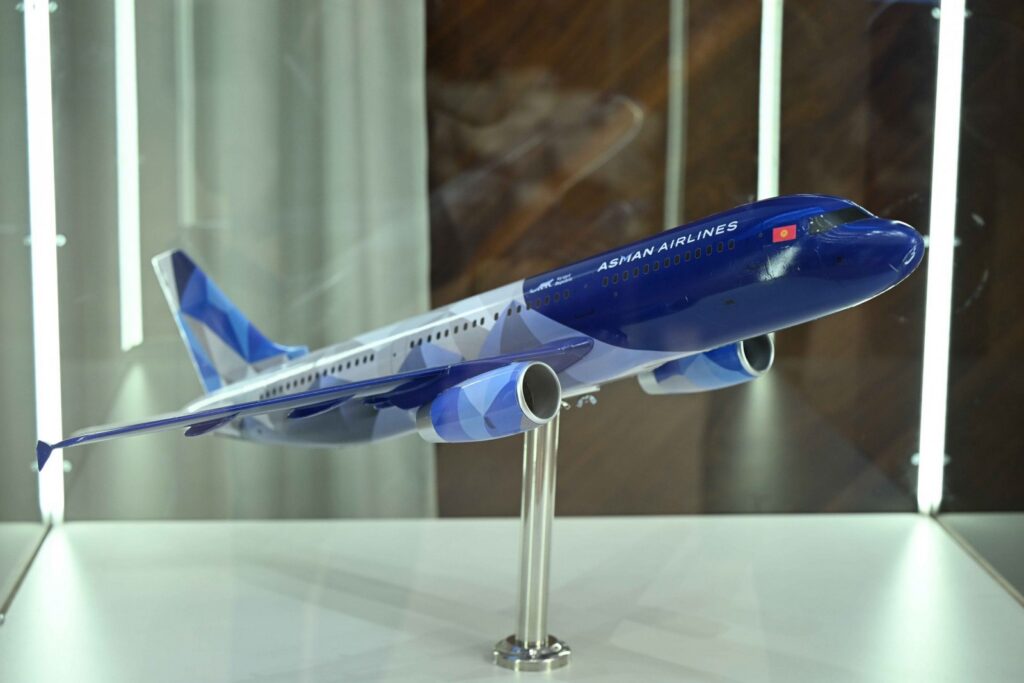
Kyrgyzstan has signed an agreement to acquire two Airbus A321ceo aircraft as part of efforts to expand the country’s civil aviation sector and launch new international routes. The signing ceremony took place on March 5 in Bishkek, where the agreement was signed by Manasbek Samidinov, chairman of the board of Airports of Kyrgyzstan OJSC, and Maurice Prendergast, senior vice president of BBAM Aircraft Leasing & Management. The event was attended by Johan Pelissier, president of Airbus Europe, and Kyrgyz Prime Minister Adylbek Kasymaliev. According to the agreement, the aircraft will be delivered to Kyrgyzstan by the end of 2026. They are intended for the state-owned carrier Asman Airlines, a subsidiary of Airports of Kyrgyzstan. The new aircraft are expected to support the launch of international flights and improve operational capacity. Asman Airlines currently operates three Dash 8 Q400 aircraft, Canadian-made short-haul turboprop planes capable of carrying up to 80 passengers over distances of up to 2,000 kilometers. These aircraft serve domestic routes across Kyrgyzstan after the airline recently restored air connections between Bishkek and several remote regional centers. Speaking at the ceremony, Kasymaliev said that the acquisition of modern and efficient aircraft would help raise Kyrgyzstan’s civil aviation sector to a new level of development. He added that between 2021 and 2025 the number of passengers served at Kyrgyzstan’s airports on domestic and international routes increased by 52%, while the number of flights rose by 53%. Kasymaliev also noted that audits conducted by the International Civil Aviation Organization (ICAO) in 2023-2024 confirmed that Kyrgyzstan’s aviation system complies with international standards. According to the latest audit, the aviation security compliance rate reached 85.76%, a significant improvement compared with previous results. “These achievements create the necessary conditions for Kyrgyzstan to be removed from the European Union’s aviation safety blacklist,” the prime minister said, adding that the final audit by the European Commission is expected in the coming days. Later the same day, President Sadyr Japarov met with Johan Pelissier and Maurice Prendergast to discuss the development of Kyrgyzstan’s aviation sector. During the meeting, Japarov highlighted the rapid modernization of airport infrastructure and the expansion of domestic air routes. While previously only four airports in the country were fully operational, all 11 airports in Kyrgyzstan are now functioning. Construction of a new international airport in Jalal-Abad is also underway. The president also confirmed that Kyrgyzstan is in the final stage of the process to be removed from the European Union’s aviation safety blacklist, with the final inspection expected later this month.

Third Canadian-Manufactured Aircraft for Asman Airlines Arrives in Kyrgyzstan

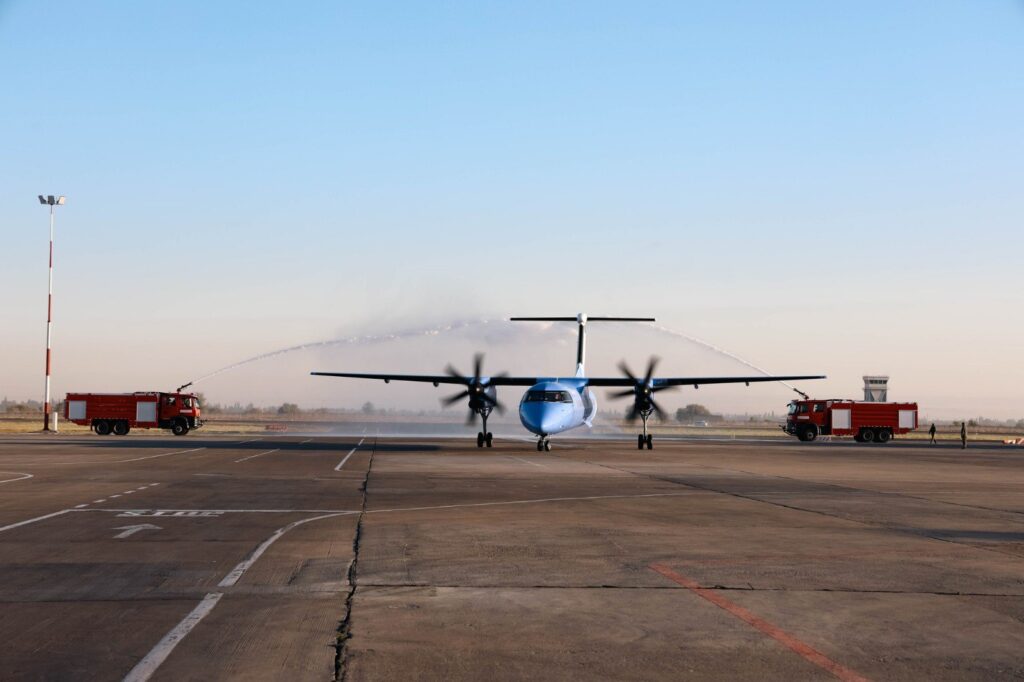
On September 2, the third Dash 8 Q400 aircraft for Kyrgyzstan’s state-owned Asman Airlines arrived at Manas International Airport in Bishkek, according to JSC Airports of Kyrgyzstan. The Dash 8 Q400, manufactured in Canada, is a short-haul turboprop aircraft designed to carry up to 80 passengers over distances of up to 2,000 kilometers. Its specifications make it well-suited for domestic flights in Kyrgyzstan, where mountainous terrain and underdeveloped road infrastructure pose challenges to ground transportation. Asman Airlines has recently restored domestic air connections between Bishkek and remote regional centers, including Talas, Karakol, Kerben, and Kazarman. The arrival of the third short-haul aircraft will allow the airline to expand its route network and improve accessibility and affordability of air travel for residents across the country. The first Dash 8 Q400 entered service in September 2024, followed by a second aircraft in November of the same year. The addition of the third aircraft further enhances Asman Airlines’ ability to meet growing demand for domestic travel. Looking ahead, the airline is considering the acquisition of larger aircraft such as the Airbus A320/A321 and Boeing 737, which would enable the launch of international flights. Kyrgyzstan is currently experiencing growth in both domestic and international passenger traffic. Speaking at the reopening ceremony of Kazarman Airport in the southern Jalal-Abad Region in August, President Sadyr Japarov noted that since 2021, passenger traffic has increased by 46%, while the number of flights has risen by 31%. The expansion of Kyrgyzstan’s air fleet is part of a broader national strategy to modernize the country’s aviation infrastructure. Construction of a new terminal complex at Osh International Airport began in February 2025, while Karakol International Airport and Talas Airport have already reopened. Renovation projects are also underway at Issyk-Kul International Airport and Naryn Airport.