• KGS/USD = 0.01144 0%
  • KZT/USD = 0.00212 0%
  • TJS/USD = 0.10803 0%
  • UZS/USD = 0.00008 0%
  • TMT/USD = 0.28571 0%
  • KGS/USD = 0.01144 0%
  • KZT/USD = 0.00212 0%
  • TJS/USD = 0.10803 0%
  • UZS/USD = 0.00008 0%
  • TMT/USD = 0.28571 0%
  • KGS/USD = 0.01144 0%
  • KZT/USD = 0.00212 0%
  • TJS/USD = 0.10803 0%
  • UZS/USD = 0.00008 0%
  • TMT/USD = 0.28571 0%
  • KGS/USD = 0.01144 0%
  • KZT/USD = 0.00212 0%
  • TJS/USD = 0.10803 0%
  • UZS/USD = 0.00008 0%
  • TMT/USD = 0.28571 0%
  • KGS/USD = 0.01144 0%
  • KZT/USD = 0.00212 0%
  • TJS/USD = 0.10803 0%
  • UZS/USD = 0.00008 0%
  • TMT/USD = 0.28571 0%
  • KGS/USD = 0.01144 0%
  • KZT/USD = 0.00212 0%
  • TJS/USD = 0.10803 0%
  • UZS/USD = 0.00008 0%
  • TMT/USD = 0.28571 0%
  • KGS/USD = 0.01144 0%
  • KZT/USD = 0.00212 0%
  • TJS/USD = 0.10803 0%
  • UZS/USD = 0.00008 0%
  • TMT/USD = 0.28571 0%
  • KGS/USD = 0.01144 0%
  • KZT/USD = 0.00212 0%
  • TJS/USD = 0.10803 0%
  • UZS/USD = 0.00008 0%
  • TMT/USD = 0.28571 0%

Viewing results 1 - 6 of 133

Uzbekistan Becomes Top International Destination for Russian Airlines

Uzbekistan has become the leading international destination for Russian airlines in the summer 2026 schedule, with flights planned on 67 routes between the two countries, according to data reported by ATO.ru, citing Russia’s aviation authority, Rosaviatsiya. The figures show Uzbekistan surpassing other popular destinations for Russian carriers, including China and Turkey, by a significant margin. Flights to Uzbekistan will operate on 10 more routes than to China and 12 more than to Turkey. Other traditional leisure destinations, such as Thailand and Egypt, will see considerably fewer routes, with 35 and 33 respectively. According to the report, this marks a major shift compared to pre-pandemic travel patterns. In 2019, Uzbekistan ranked ninth among international destinations for Russian airlines, with passenger traffic totaling around 1.24 million people, well behind Turkey and China. The growing number of routes reflects strong demand for travel between the two countries. Analysts attribute this to labor migration, as well as expanding business and tourism ties. Uzbekistan has also gained importance as a transit hub, particularly as Western airspace restrictions now limit routing options for Russian carriers. Tashkent, in particular, has emerged as a key connection point for long-haul travel, including flights to the United States. Uzbekistan Airways remains the only Central Asian carrier operating transatlantic flights to New York. The trend is mirrored on the Uzbek side. According to earlier estimates by Lufthansa Consulting cited in the report, Russia accounted for 49% of Uzbek airlines’ passenger traffic in 2019, rising to 52% by 2022. In the current summer schedule, Uzbekistan Airways operates flights to 19 Russian cities, while private carriers such as Centrum Air and Qanot Sharq serve multiple destinations, including Moscow and St. Petersburg. A new airline, FlyOne Asia, is also expected to launch services on five routes from Tashkent to Russian cities. Previously, The Times of Central Asia reported that Uzbekistan Airways continues to maintain regular operations on Russian routes, including a January incident in which a Boeing 767 flying from Tashkent to Vladivostok made a safe emergency landing in Krasnoyarsk.

Kazakhstan Expands Aviation Hub with Focus on U.S. and Long-Haul Flights

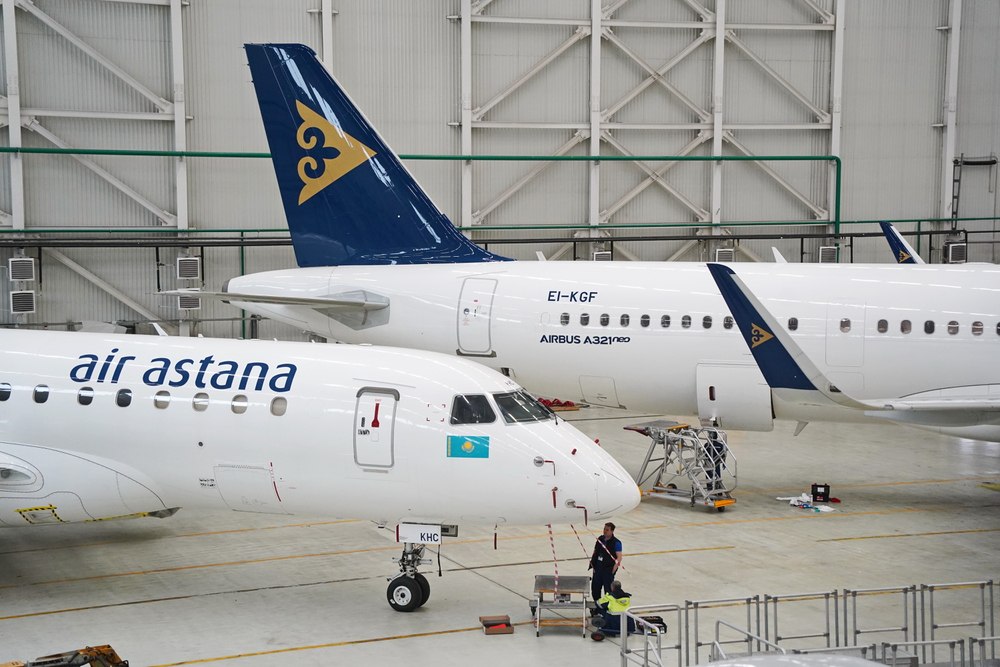
Kazakhstan is preparing for an audit by the U.S. Federal Aviation Administration (FAA) that would allow the country to launch direct flights to the United States. To achieve this, the government must demonstrate the reliability of its aviation regulatory system, the presence of an independent and effective oversight body, and transparent airline certification procedures. The country is also planning to acquire modern long-haul aircraft and has begun construction of its first maintenance center to service them. The Times of Central Asia spoke with representatives of Kazakhstan’s aviation industry about the progress of these efforts, when direct flights to North America may begin, and what challenges remain. As part of efforts to expand international routes and strengthen Kazakhstan’s position as an aviation hub between Europe and Asia, Bauyrzhan Umiraliyev, head of the Aviation Safety Department at the Civil Aviation Committee, said the national carrier Air Astana plans to purchase 15 Boeing 787 Dreamliner aircraft, with deliveries scheduled between 2026 and 2035. “This is a strategically important decision that can significantly boost civil aviation, the economy, and the country’s international standing,” an aviation authority representative told The Times of Central Asia. “Long-haul aircraft will allow airlines to launch direct flights to destinations in North America, Europe, Asia, and Australia that were previously inaccessible or required layovers.” The aircraft will also enhance Kazakhstan’s attractiveness as a transit hub and tourist destination, while enabling airlines to compete internationally through improved efficiency, pricing, and service quality. The purchase of these aircraft, previously delayed twice since 2025 due to production backlogs at Boeing, is expected to open new opportunities for Kazakhstan’s aviation sector, particularly following the anticipated attainment of Category 1 (CAT-1) safety status, confirming compliance with international aviation standards. CAT-1: The Path to the U.S. In 2024, Kazakhstan’s aviation authorities and the FAA signed an agreement to conduct a technical assessment under the International Aviation Safety Assessment (IASA) program. According to Aslan Satzhanov, Acting Executive Director of the Aviation Administration of Kazakhstan, the assessment identified areas requiring improvement in flight safety oversight. “We are currently working on amendments to regulatory acts to implement modern safety procedures and standardize processes, with technical support from FAA experts,” Satzhanov said. In parallel, experts from the U.S. Transportation Security Administration have conducted preliminary assessments of airport security under the Export Control and Border Security Program. The first visit, in October 2021, resulted in a generally positive evaluation of Kazakhstan’s aviation security framework. A follow-up visit in August 2022 focused on screening procedures for passengers, baggage, and cargo at Astana Airport. “The capital’s airport received a positive assessment, and the coordinated work of aviation security personnel was noted,” Satzhanov said. According to preliminary information, the full IASA audit may take place after long-haul aircraft enter service and relevant infrastructure is fully prepared; though, it should be noted that Kazakhstan does not control the timing of the IASA audit. Industry Awaits New Aircraft Preparations for launching new international routes, including previously announced flights to New York and Tokyo, are already underway....

European Investment Fund Commits Over $200 Million to Tajik Airline

The European investment fund CFC s.r.o. plans to invest more than $200 million in the development of Tajikistan’s private carrier Shohin Airlines. The five-year agreement follows several months of negotiations between the parties. According to Shohin Airlines, the final round of talks took place on March 10, 2026, in Dushanbe. The meeting was attended by the airline’s chief executive officer, Zafar Ahmadzoda, and the founder of CFC s.r.o., Guntars Selikovs. One factor influencing the investor’s decision was the recent improvement in Tajikistan’s sovereign credit ratings by the international agencies Moody’s and S&P Global Ratings. This development has increased foreign partners’ confidence in the country’s economic stability. The parties agreed that the investment will be directed toward expanding the airline’s fleet, developing operational capacity, and modernizing infrastructure. “The signing of the investment agreement is an important milestone in Shohin Airlines’ development,” Ahmadzoda said, noting that the deal is expected to accelerate the company’s growth and expand its route network. Selikovs stated that negotiations lasted more than six months and included meetings in Dubai and several European countries. “This allowed us to thoroughly assess the company’s business model and market potential,” he said. Shohin Airlines is a private carrier focused on developing regional aviation in Tajikistan and neighboring markets. At present, the company operates specialized helicopter flights. The next stage of development will involve fleet expansion. In the near future, the airline plans to acquire an L-410 NG, a Czech-made turboprop aircraft designed for regional transport. CFC s.r.o., a fund registered in the Czech Republic, operates across markets in Europe, the Persian Gulf, and Central Asia. Its investment strategy focuses on fast-growing industries. The agreement with Shohin Airlines could become one of the largest private investments in Tajikistan’s aviation sector in recent years and may signal growing interest among international investors in the country.

Jet Fuel Shortages Threaten Kazakhstan’s Aviation Growth Despite Expansion Plans

Kazakhstan’s aviation industry is demonstrating steady growth. By the end of 2025, the country’s airports had served 31.8 million passengers, up from 29.7 million in 2024, and handled 173,300 tons of cargo compared with 170,900 tons a year earlier. Total airline passenger traffic reached 20.7 million, and more than 35 new international routes were launched. The government plans to expand regional transport links and attract investment into the aviation sector. It also aims to increase the number of international routes. The industry is working to develop airport hubs and accommodate growing passenger demand, while positioning Kazakhstan as a transit country. These plans will depend in part on the availability of aviation fuel. Shortages of aviation kerosene in Kazakhstan have moved beyond an industry concern and are becoming an issue of energy and transport policy, as well as a potential source of economic risk. Despite being one of the world’s major oil producers, Kazakhstan continues to rely on imports of petroleum products. Of roughly 100 million tons of oil produced annually, only about 18 million tons are refined domestically. Although refining volumes and petroleum product output increased in 2025, the country still imports diesel and jet fuel at higher prices. According to Argus data, the cost of imported jet fuel at the Russian-Kazakh border averaged $765 per ton at the beginning of 2025. By early summer, the price had fallen to $610 per ton, before rising by nearly 60% in November to $975 per ton, excluding VAT. In 2026, the domestic supply situation may become more complicated. In addition to volatility in global markets, including tensions in the Middle East, scheduled maintenance shutdowns at oil refineries are expected to affect output. This year, all three major refineries, Atyrau Oil Refinery, Pavlodar Petrochemical Plant, and PetroKazakhstan Oil Products, are scheduled for maintenance, which will temporarily reduce fuel production. According to data provided by the national oil and gas company KazMunayGas, Kazakhstan’s refineries produced 726,000 tons of jet fuel last year. Under the Ministry of Economy’s indicative plan, output is expected to reach 750,000 tons in 2026. Demand for jet fuel is rising due to the active development of the air transport market and an increase in flight frequency. KazMunayGas is implementing measures to expand production and introduce new technologies. By 2030, refinery modernization is expected to increase jet fuel output. Deputy Minister of Energy Kaiyrkhan Tutkyshbaev told The Times of Central Asia that plans are being considered to increase jet fuel production from the current 0.7 million tons to 1.7 million tons per year through phased refinery capacity expansion from 17 million to 27.7 million tons by 2030. This includes expanding the Shymkent refinery from 6 million to 12 million tons of crude per year, the Pavlodar refinery from 5.5 million to 9 million tons in two phases and increasing secondary refining capacity at the Atyrau refinery by 0.7-1.2 million tons. Additionally, domestic jet fuel production is expected to grow by 50,000 tons annually between 2026 and 2028. With consumption projected at 1.18...

Uzbekistan Discusses Local Production of Hungarian Magnus Aircraft

Uzbekistan is continuing efforts to expand its aviation sector, as Deputy Minister of Transport Jasurbek Choriyev held talks with Laszlo Borosh, Chief Executive Officer of the Hungarian company Magnus Aircraft Zrt., on the potential production of the Magnus Fusion 212 aircraft in the country. According to the Ministry of Transport, the meeting focused on prospects for assembling and manufacturing the lightweight composite aircraft in Uzbekistan. The Magnus Fusion 212 is produced by the Hungary-based firm, which specializes in the design, production, and sale of innovative aircraft made from composite materials. Magnus Aircraft is headquartered in Pogány, Hungary, near Pécs-Pogány International Airport, where it operates a facility covering approximately 8,000 square meters. The company is active in several international markets, including the United States, China, Kenya, Nigeria, Serbia, and countries in the Middle East. Earlier this month, Brazilian aerospace manufacturer Embraer Defense & Security announced at the Singapore Airshow that Uzbekistan is the previously undisclosed buyer of its C-390 Millennium military transport aircraft. In a statement released on February 3, the company identified Uzbekistan as the first Central Asian country to acquire and operate the aircraft. Embraer stated that the Uzbek Air Force will use the C-390 primarily for transport and humanitarian missions, strengthening national airlift and emergency response capabilities. “We officially welcome the Republic of Uzbekistan to the group of C-390 operators,” said Bosco da Costa Junior, President and CEO of Embraer Defense & Security.

Uzbekistan Airways Boeing 767 Makes Emergency Landing in Krasnoyarsk

An Uzbekistan Airways Boeing 767 made an emergency landing at Russia’s Krasnoyarsk airport on January 21 while en route from Tashkent to Vladivostok, according to a statement published by Krasnoyarsk airport on its Telegram channel. The aircraft, a Boeing 767-300, was carrying 101 passengers, five flight crew members, and 16 cabin crew at the time of the incident. Airport authorities confirmed the plane landed safely. Passengers subsequently underwent border and customs procedures and were relocated to the airport’s general terminal area. The aircraft was temporarily taken out of service pending a technical inspection. Uzbekistan Airways was expected to dispatch a reserve aircraft to complete the journey to Vladivostok. Later that day, airport officials reported that the stranded passengers were transferred to local hotels and provided with meals. As of 17:45 local time, the reserve aircraft was expected to arrive early on January 22, with a scheduled departure shortly thereafter. A follow-up update confirmed that the replacement aircraft departed Krasnoyarsk at 7:11 a.m. on January 22. Uzbekistan Airways has not yet disclosed the technical issue that led to the emergency landing. This incident follows another serious aviation event earlier this month involving aircraft from Russia’s Pobeda Airlines and Uzbekistan Airways. On January 10, in the Shymkent regional airspace over southern Kazakhstan, Pobeda flight PBD997 from Moscow to Samarkand and Uzbekistan Airways flight UZB9609 from Termez to Moscow came into potential conflict. The incident was classified as serious under Kazakhstan’s aviation safety regulations and prompted a formal investigation, Kazinform reported.