• KGS/USD = 0.01144 0%
  • KZT/USD = 0.00208 0%
  • TJS/USD = 0.10440 -0.19%
  • UZS/USD = 0.00008 0%
  • TMT/USD = 0.28490 0%
  • KGS/USD = 0.01144 0%
  • KZT/USD = 0.00208 0%
  • TJS/USD = 0.10440 -0.19%
  • UZS/USD = 0.00008 0%
  • TMT/USD = 0.28490 0%
  • KGS/USD = 0.01144 0%
  • KZT/USD = 0.00208 0%
  • TJS/USD = 0.10440 -0.19%
  • UZS/USD = 0.00008 0%
  • TMT/USD = 0.28490 0%
  • KGS/USD = 0.01144 0%
  • KZT/USD = 0.00208 0%
  • TJS/USD = 0.10440 -0.19%
  • UZS/USD = 0.00008 0%
  • TMT/USD = 0.28490 0%
  • KGS/USD = 0.01144 0%
  • KZT/USD = 0.00208 0%
  • TJS/USD = 0.10440 -0.19%
  • UZS/USD = 0.00008 0%
  • TMT/USD = 0.28490 0%
  • KGS/USD = 0.01144 0%
  • KZT/USD = 0.00208 0%
  • TJS/USD = 0.10440 -0.19%
  • UZS/USD = 0.00008 0%
  • TMT/USD = 0.28490 0%
  • KGS/USD = 0.01144 0%
  • KZT/USD = 0.00208 0%
  • TJS/USD = 0.10440 -0.19%
  • UZS/USD = 0.00008 0%
  • TMT/USD = 0.28490 0%
  • KGS/USD = 0.01144 0%
  • KZT/USD = 0.00208 0%
  • TJS/USD = 0.10440 -0.19%
  • UZS/USD = 0.00008 0%
  • TMT/USD = 0.28490 0%

Viewing results 1 - 6 of 90

Central Asia Advances Agenda at Record-Breaking SCO Summit in Tianjin

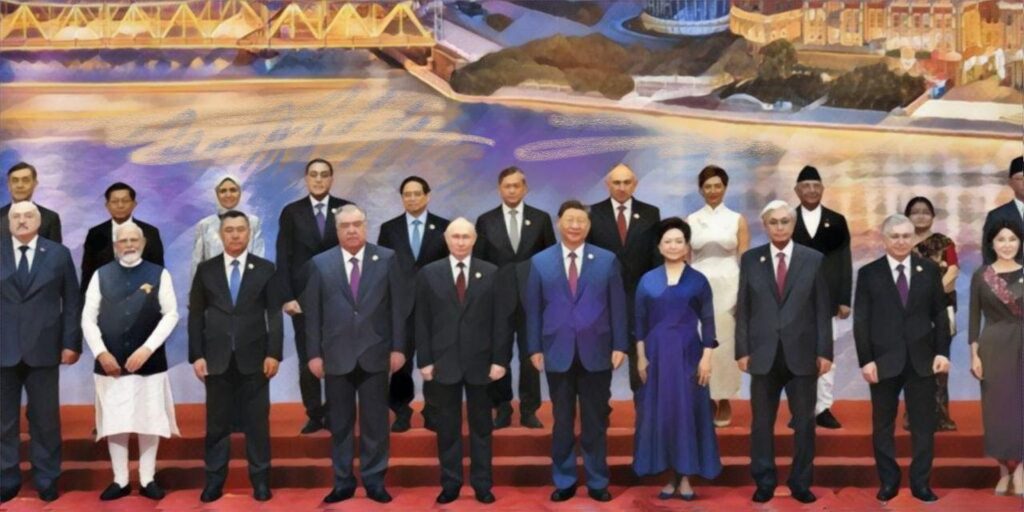
At the opening ceremony of the SCO Summit in Tianjin on August 31, Chinese President Xi Jinping, Russian President Vladimir Putin, and India’s Prime Minister Narendra Modi joined Central Asian leaders in a group photo. The Tianjin summit - China’s second time hosting the SCO and its “largest-ever” summit - was attended by all five Central Asian presidents alongside a host of key countries. In his welcome speech, Xi highlighted that the SCO now bears “greater responsibility” for safeguarding regional peace and stability, and said the summit was expected to produce a new 10-year development strategy. Xi proposed fast-tracking an SCO development bank, pledging 2 billion yuan ($280 million) in aid plus 10 billion yuan in loans to seed the fund. Xi also urged members to oppose a “Cold War mentality” and support an inclusive, multilateral trading system in a pointed rebuke to recent U.S. tariffs. Central Asian Leaders and Their Messages Kazakh President Kassym-Jomart Tokayev opened the summit for his delegation, thanking Xi and praising China’s “consistent policy aimed at strengthening security, stability, economic cooperation, and cultural ties within the SCO framework.” In his address, Tokayev marked the symbolic 80th anniversaries of the end of World War II, noting the value of unity and solidarity which he said the SCO embodies. Tokayev reaffirmed Kazakhstan’s support for a multipolar world order, respect for sovereignty, and mutually beneficial trade and investment, and pledged to keep combating the “three evils” of terrorism, separatism, and extremism. Beyond the opening remarks, Central Asian leaders used the summit to lay out their strategic priorities. Speaking at the heads-of-state meeting, President Shavkat Mirziyoyev of Uzbekistan called for further reform of SCO institutions and expansion of its dialogue partners. Mirziyoyev advocated for new cooperation mechanisms - a regional center for critical materials, a “Unified SCO Transport Space” linked to China’s Belt and Road Initiative, digital platforms, and green energy corridors - and proposed measures to boost intra-regional trade. Notably, Mirziyoyev urged the signing of an Agreement on Trade Facilitation, saying it “will give a boost to the growth of intra-regional trade within the SCO area.” In his closing remarks, he congratulated Kyrgyzstan’s Sadyr Japarov on assuming the SCO chairmanship for 2026, setting up the next summit. Tajik President Emomali Rahmon did not address the leaders’ meeting, but in a pre-summit interview, he highlighted China’s role in the SCO, crediting China with significant investment in Tajik infrastructure and energy, and welcoming Beijing’s proposal to locate an SCO Anti-Drug Center in Dushanbe. "We are confident that the center will make tangible contributions to strengthening regional cooperation and combating illicit drug trafficking," he stated. As a founding member, Rahmon stressed that the SCO’s top priority has long been Central Asian security and said that Tajikistan fully backs China’s Tianjin agenda, citing Beijing’s support for roads, tunnels, and power lines in Tajikistan. The incoming 2026 chair, Sadyr Japarov of Kyrgyzstan, met with Xi on August 31, reviewing plans to deepen all-around cooperation. Xi stated that China will fully support Kyrgyzstan in...


Kyrgyz PM Highlights Belt and Road as Strategic Priority

Kyrgyzstan regards China’s Belt and Road Initiative (BRI) as a strategic pillar of bilateral cooperation aimed at modernizing infrastructure and attracting investment, Prime Minister Adylbek Kasymaliyev said during a panel session on BRI prospects at the 2025 Summer Davos in Tianjin on June 24. “In today’s geopolitical climate, marked by tension, uncertainty, and international fragmentation, the Belt and Road Initiative remains a vital platform for global cooperation,” Kasymaliyev stated. He emphasized that Kyrgyzstan was one of the first countries to support and actively participate in the initiative, which was launched 12 years ago and has since expanded to include numerous countries worldwide. Many of these nations, he noted, are already experiencing the tangible benefits of BRI-related cooperation. Five Pillars of Engagement Kasymaliyev outlined five strategic areas in which Kyrgyzstan is cooperating with China under the BRI framework: Transport Connectivity “Kyrgyzstan is ready to leverage its geographic location and transit potential to become a key logistics hub linking Asia and Europe,” he said. The construction of new transport corridors under the BRI is central to this vision, particularly in enhancing Eurasian connectivity. Trade and Economic Cooperation Kasymaliyev called for deeper trade and investment ties. He positioned Kyrgyzstan as a potential gateway for Chinese and other foreign investors to access markets in both the Eurasian Economic Union (EAEU) and the European Union. Financial Sector Development Highlighting ongoing reforms, he noted that Kyrgyzstan’s financial sector, including its capital market, is undergoing active development. Digitalization and Innovation Kyrgyzstan supports the development of the Digital Silk Road and is home to a high technology park offering favorable conditions for resident companies engaged in digital and tech innovation. Energy Cooperation Kasymaliyev pointed to ongoing and planned energy initiatives, including renewable energy projects, as a key area for future collaboration. “Kyrgyzstan remains committed to the principles of the Belt and Road Initiative, which is gaining even greater relevance in today’s complex global environment,” he concluded. High-Level Bilateral Dialogue Also on June 24, Kasymaliyev held talks with Chinese Premier Li Qiang. The Chinese premier reaffirmed Beijing’s commitment to aligning its development strategy with Kyrgyzstan’s and urged continued progress on interconnection projects, most notably the long-discussed China-Kyrgyzstan-Uzbekistan railway.

Iran–Israel War Highlights Central Asia as Zone of Strategic Stability

The explosive conflict between Iran and Israel, including coordinated U.S. strikes on Iranian nuclear infrastructure, has drawn global attention to the Persian Gulf and Levant. The escalatory spectacle, however, has blinded most observers to a quieter structural shift. This is the rising indispensability of Central Asia, including its linkages with the South Caucasus. Unaligned in rhetoric and untouched by spillover, Central Asia's very stability quietly threw into relief its increasing centrality to Eurasian energy and logistics calculations. As maritime chokepoints came into question and ideological rhetoric became more inflamed, Central Asia offers a reminder that the most valuable nodes in a network are the ones that continue operating silently and without disruption. Neither Israel nor Iran has real operational depth in Central Asia, and this has made a difference. Unlike Lebanon, Iraq, or Yemen — where proxy networks or ideological leverage allowed Tehran to externalize confrontation — no such mechanisms exist east of the Caspian Sea. Iran’s efforts in Tajikistan, grounded in shared linguistic heritage and periodic religious diplomacy, today remain cultural and informational rather than sectarian and clientelist. The influence of Iran's Islamic Revolutionary Guard Corps (IRGC) in Central Asia is minimal; Israeli presence, while diplomatically steady in places like Kazakhstan and Uzbekistan, is neither controversial nor militarized. There are no significant arms flows or dual-use infrastructure for either side to use. As a result, Central Asia has remained untouched by the conflict. Although the Iran–Israel conflict is relatively geographically localized, it has shed light on global systems far beyond the immediate zone of combat. Although not so far from the missile trajectories and nuclear facilities, Central Asia and the South Caucasus are remarkably insulated from their effects. Rather than becoming another theater of contestation, they have demonstrated their value as stabilizing elements at a time of heightened geostrategic volatility. It is no longer optional to take into account the Central Asian space, which geoeconomically includes Azerbaijan, now a permanent fixture at the region's summits. As the war now produces a phase of reactive adaptation in international geoeconomics and diplomacy, the region has become a control parameter of the international system rather than a fluctuating variable dependent upon it. The Iran–Israel conflict has drawn new attention to the vulnerability of maritime energy corridors, especially the Strait of Hormuz, through which a fifth of the world’s oil passes. While contingency planning has focused on naval logistics and airpower deterrents in the Gulf, the Eurasian interior has remained materially unaffected, reflecting its structural indispensability. Central Asia and the South Caucasus, particularly Kazakhstan and Azerbaijan, offer existing and potential overland alternatives that bypass maritime chokepoints entirely. Kazakhstan’s oil continues to flow via the Caspian Pipeline Consortium (CPC) pipeline to the Black Sea, while Azerbaijan’s infrastructure, anchored by the Baku–Tbilisi–Ceyhan (BTC) corridor, links Caspian energy to Mediterranean terminals. These routes are not replacements for Persian Gulf volumes, but, as redundancies, they acquire significance as stabilizing arteries as well as increased relevance in moments of system stress. The war has thus sharpened a fact...

Opinion: Xi Jinping Heads to Astana – What’s at Stake in the Central Asia-China Summit?

On June 16-17, President Xi Jinping of the People’s Republic of China will visit Kazakhstan. The second Central Asia-China summit is scheduled for June 17 in Astana. Leading up to the event, a series of forums, meetings, and conferences have been unfolding across Central Asia and China, drawing experts, journalists, diplomats, and energy-sector representatives. These activities suggest that the upcoming summit is poised to overshadow its predecessor. While U.S. analysts continue debating the viability of their own C5+1 framework for engaging with Central Asia, and the European Union advanced its outreach with the inaugural EU-Central Asia summit, China has relied on a well-worn path. The thousand-year legacy of the Middle Kingdom is filled with moments when it had to engage with the complex mosaic of Central Asia, once a turbulent region of khanates, emirates, and nomadic tribes. Despite the chaos, China succeeded in carving out a secure overland corridor, the Great Silk Road, which threaded through what are now the independent Central Asian republics, linking them like beads in a continental necklace. Then, as now, China is seeking stability in the region, not just for political influence but to safeguard its global supply chains. Beijing’s modern initiatives, including the Belt and Road Initiative and its broader “community of shared future” concept, aim to establish global “islands of comfort” conducive to Chinese interests.  At the heart of this strategy lies a deeply embedded worldview: that China represents civilization itself. The Chinese learned long ago to deal with their neighbors not with violence, but through economic incentives, a method which is proving just as effective today. This layer of understanding is notably absent in many Western and post-Soviet analyses of China’s actions in Central Asia, the Middle East, Africa, and beyond. The reasons for this are twofold. First, Chinese officials are careful never to state views about cultural hierarchies explicitly; doing so would risk alienating partners. This reticence is a feature of traditional Eastern diplomacy. Second, Beijing has cultivated its own expert ecosystem within the post-Soviet sphere. In response to a wave of Sinophobia that swept through Central Asia a decade ago, China now primarily engages with favorable media outlets and Sinologists, many of whom are nurtured through carefully managed media tours. One such tour, organized by People’s Daily, is currently underway ahead of the Astana summit. As a result, the discourse surrounding the summit is shaped less by hard policy proposals than by diplomatic pageantry, with everything presented in the best possible light. At the recent 5th Forum of Think Tanks, “Central Asia-China: New Horizons for Regional Partnership,” Kazakhstan's State Councilor Yerlan Karin likened China and Central Asia to “the two lungs of Asia,” emphasizing the symbolic depth of their growing relationship. The 6th Central Asia-China Foreign Ministers’ Meeting, chaired by Chinese Foreign Minister Wang Yi and held in Almaty in April, likewise offered little in terms of concrete summit outcomes. According to a general statement from Kazakhstan’s Foreign Ministry, topics included political dialogue, trade, connectivity, sustainable development, and security cooperation,...

Amid Sanctions, China’s Xinjiang Strengthens Ties with Central Asia

China’s Xinjiang region is deepening its engagement with Pakistan and Central Asia as part of efforts to counter Western sanctions and bolster its role in the Belt and Road Initiative (BRI). On November 26, officials from Xinjiang met with their counterparts from Kazakhstan’s Zhetysu region for the first meeting under a new cross-border coordination mechanism. The discussions focused on cross-border tourism, infrastructure, market regulation, quarantine measures, and joint crime prevention. The meeting culminated in the signing of a memorandum on cross-border tourism. The discussions took place near the port of Khorgos, a critical hub for the China Railway Express, which connects China with Europe. Khorgos is home to China’s first cross-border cooperation center, where residents of neighboring countries can engage in business and shop visa-free. The center allows duty-free purchases of up to 8,000 yuan ($1,104) per day. Xinjiang Governor Erkin Tunyoz stressed the importance of strengthening ties with Zhetysu in areas such as trade, tourism, security, and agriculture. This cooperation is becoming increasingly crucial for Beijing as Xinjiang grapples with sanctions from the United States and other Western countries over alleged human rights abuses—a claim that China denies. Sanctions include the U.S. Uyghur Forced Labor Prevention Act, which prohibits imports from Xinjiang suspected of being produced using forced labor. Similar measures have been implemented by Canada, the United Kingdom, and the European Union. In addition to its collaboration with Kazakhstan, China has established a dialogue mechanism with the five Central Asian countries—Kazakhstan, Kyrgyzstan, Tajikistan, Turkmenistan, and Uzbekistan. Since 2020, foreign ministers from these nations have met annually to discuss logistics, trade, investment, agriculture, mining, and security. Li Lifan, a Central Asia scholar at the Shanghai Academy of Social Sciences, described Xinjiang as a “bridgehead” for the BRI. He highlighted the region’s rich natural resources and its role as a base for major industries, including automobile manufacturing. In 2023, trade between Xinjiang and Central Asian countries surged by 50%, reaching 283 billion yuan ($39 billion). Despite these successes, Li cautioned about future challenges. He noted uncertainties surrounding potential Western secondary sanctions, geopolitical tensions, and Russia's ongoing war in Ukraine. Additionally, U.S.-China relations remain fraught, with further unpredictability anticipated under the leadership of Donald Trump. “Full economic development may only be achievable once global tensions ease,” he said.

Kazakhstan and China to Double Trade, Increase Cargo Transportation

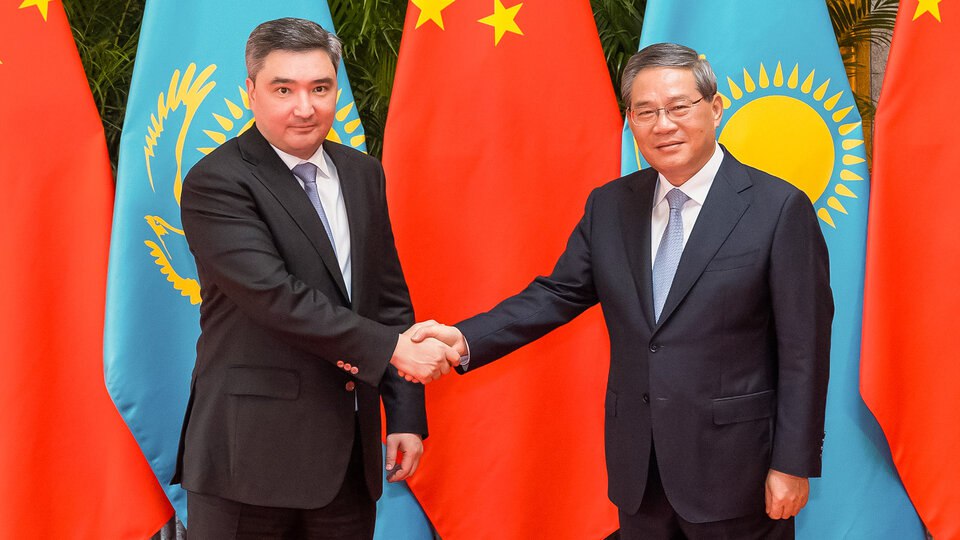
On November 4, Kazakhstan’s Prime Minister Olzhas Bektenov arrived in Shanghai and held talks with his Chinese counterpart China Li Qiang. They discussed strengthening trade, investment, transport and logistics cooperation, agriculture, energy, and tourism. Kazakhstan and China aim to double bilateral trade turnover from last year’s historic high of $41 billion. In January-September 2024, Kazakh-Chinese trade totaled $33 billion. Bektenov stressed that Kazakhstan is ready to increase exports to China of 180 high-value-added commodity items worth $1.6 billion. Bilateral agricultural trade increased by 5.8% from January to September 2024, reflecting China’s growing demand for Kazakhstani organic and environmentally-friendly agricultural products. The sides discussed expanding the export of Kazakh grain, crops, and livestock products. Regarding the transport and logistics sector, the Kazakh and Chinese prime ministers noted that over 80% of land cargo transportation from China to Europe today passes through Kazakhstan. Therefore, Kazakhstan is interested in deepening cooperation within China’s Belt and Road Initiative framework. Bektenov noted that this globally important project, together with the Trans-Caspian International Transport Route (the Middle Corridor), running through the territory of Kazakhstan, can unlock the potential of the North-South and East-West corridors. In January-September 2024, the traffic volume along the Middle Corridor exceeded the previous year's figures by 23% and amounted to 3.4 million tons. This figure is expected to increase to 10 million tons annually by 2030. Bektenov also attended the Kazakh-Chinese investment roundtable in Shanghai, which resulted in the signing of commercial agreements with Chinese companies totaling $2.5 billion, including on energy projects and localized automotive production. Addressing the forum, Bektenov said: "Kazakhstan and China have huge potential for implementing joint investment projects. Together, we can open new horizons for interaction and increase the effectiveness of cooperation. To this end, we should actively work to expand transit opportunities, strengthen industrial cooperation, and build ties between our business communities."