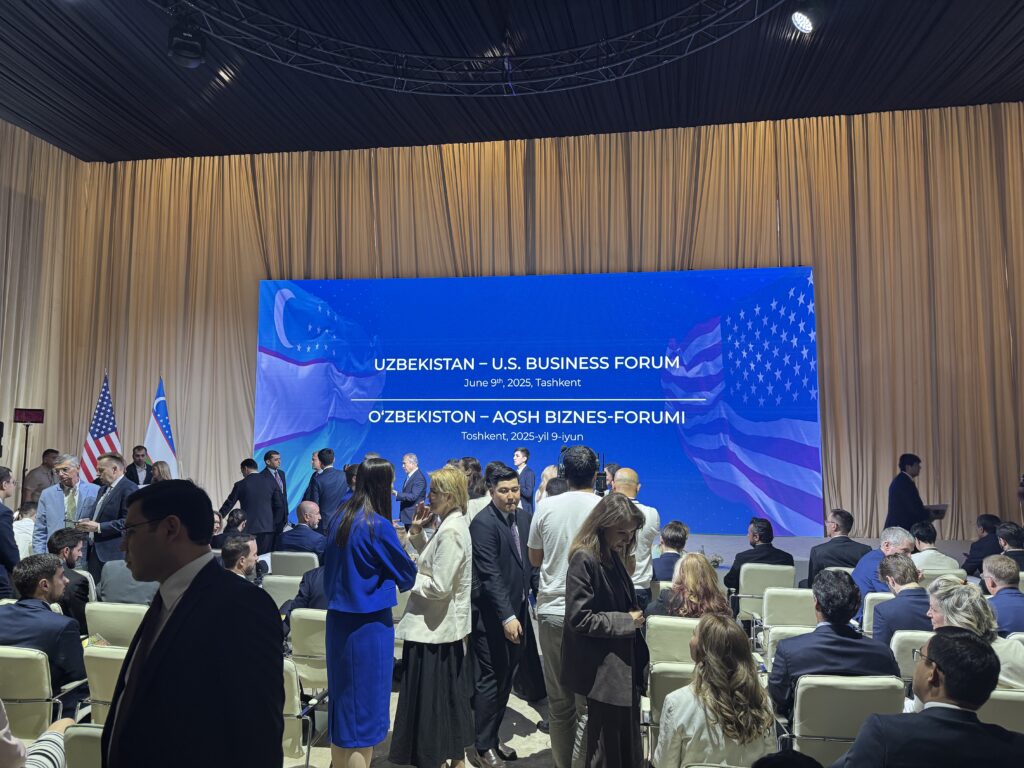
On June 9, ahead of the Tashkent International Investment Forum, President Shavkat Mirziyoyev welcomed a senior delegation of U.S. business leaders and government officials, underscoring deepening economic ties between Uzbekistan and the United States. Among the participants were U.S. Assistant Secretary of State Eric Meyer, U.S. International Development Finance Corporation (DFC) Vice President Bethany Brez, American-Uzbek Chamber of Commerce Chair Carolyn Lamm, and executives from Boeing, Visa, NASDAQ, Coca-Cola, Morgan Stanley, Franklin Templeton, FLS, Air Products, and others. Mirziyoyev noted that the meeting reflected growing U.S. interest in Uzbekistan’s reform-driven and investment-oriented economy. In 2024, bilateral trade between Uzbekistan and the U.S. reached $882 million, a 15.2% increase from 2023. Of this, Uzbek exports to the U.S. totaled $314.7 million, while imports stood at $564.3 million. Despite this growth, exports to the U.S. still account for only 1.2% of Uzbekistan’s total export volume, according to economist Mirkomil Kholboyev. During the Uzbekistan-U.S. Business Forum in Tashkent, DFC Vice President Brez led discussions on joint projects in critical minerals. The DFC, with a $60 billion mandate, supports global investment in sectors such as energy, infrastructure, and advanced manufacturing. [caption id="attachment_32862" align="aligncenter" width="2560"] Image: Uzbekistan–U.S. Business Forum[/caption] Digital innovation emerged as a key area of cooperation. According to a recent UNDP study, Uzbekistan plans to implement 100 priority artificial intelligence models by 2030 and establish supercomputing labs at major universities. USAID has previously supported this digital agenda by enabling Uzbek startups to engage with Silicon Valley investors and participate in TechCrunch Disrupt in October 2024, strengthening linkages with the U.S. tech ecosystem. Transport and energy infrastructure modernization also featured prominently in the talks. In January 2025, Uzbekistan Airways signed a memorandum with Boeing to acquire fourteen 787-8 Dreamliners, a multibillion-dollar deal with deliveries expected by 2032. Meanwhile, USAID partnered with Uzbekistan on energy sector reform, including support for drafting the “Law on the Electric Power Industry,” which introduces transparent tariff policies and facilitates private-sector entry. Tourism and small business development were additional focus areas. USAID’s five-year, $17.7 million Business Support Project has targeted key sectors such as ICT, tourism, textiles, and the green economy. Under this initiative, the Association of Private Tourism Agencies of Uzbekistan launched new training modules and classification standards for family-run guesthouses in Bukhara, Samarkand, and Tashkent, promoting sustainable, community-based tourism. Throughout the meeting, U.S. business leaders expressed support for Uzbekistan’s reform agenda and presented specific proposals, ranging from expanding fintech infrastructure to piloting AI-driven logistics platforms. The exchanges reflected a mutual commitment to strengthening the U.S.-Uzbek partnership across a wide range of strategic sectors.